Colombia intelligence kills Petro's fraud
Petro's own intelligence contradicts his fraud claim
Model Diplomat8 min readSouth America
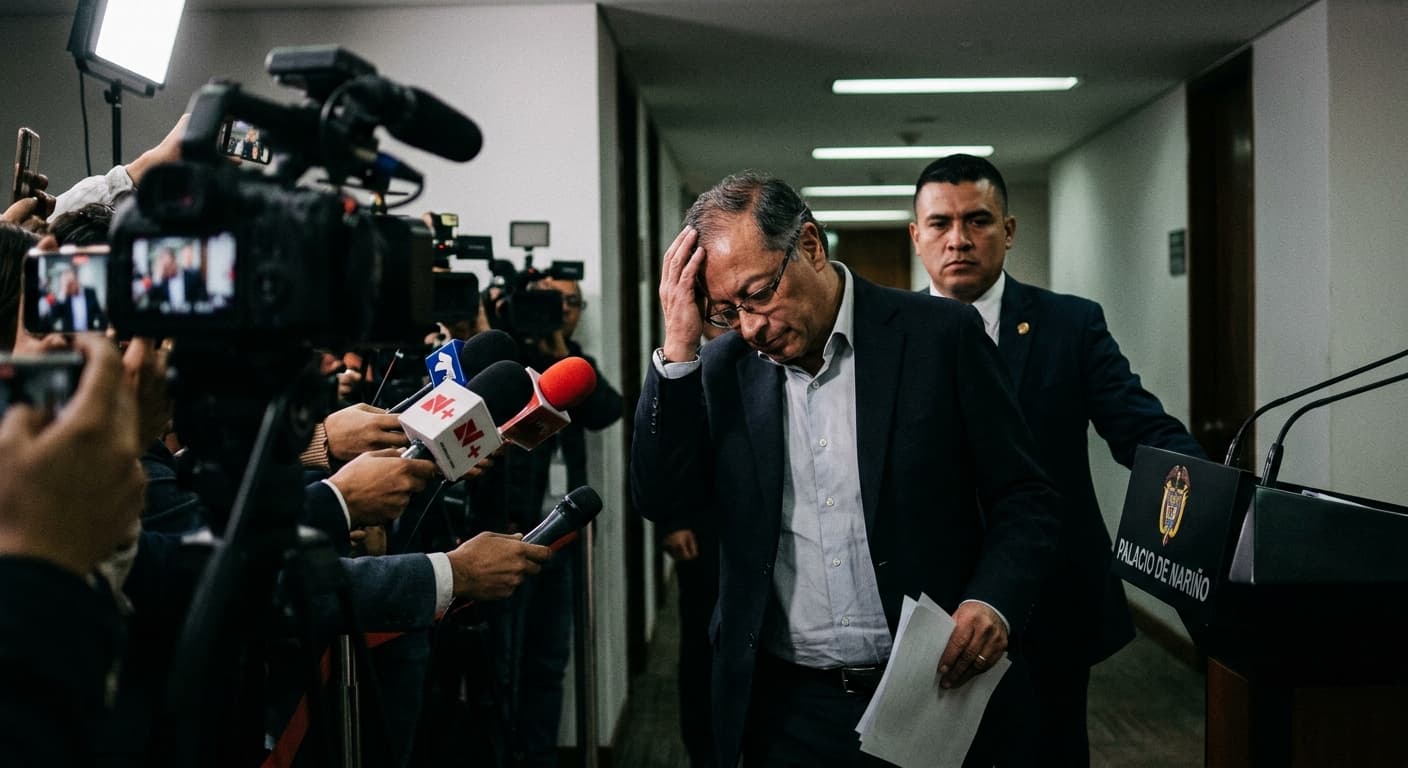
Colombia's own intelligence kills Petro's fraud claim — and the transition with it
A four-page technical report dated June 30, 2026 concluded the hacker Gustavo Petro personally cited as his star fraud witness produced no evidence — stripping the outgoing president of his last institutional foothold three weeks before Abelardo de la Espriella takes office on August 7.
On June 30, 2026, a four-page technical intelligence report landed on Petro's desk. Its verdict, obtained exclusively by EL PAÍS América Colombia: the hacker the president had publicly invoked as his key fraud witness "no entregó nada" — delivered nothing. The document concludes that, on the strength of that source at least, there is no evidence of electoral irregularity. Petro is now the last man in the Colombian state still asserting the June 21 runoff was stolen — after the electoral authority, two international observation missions, the Carter Center, his own candidate, and now his own intelligence services have all contradicted him. The report does not merely undercut a legal strategy; it exposes the president's fraud narrative as an argument his own government can no longer sustain.
A witness who never delivered
The report, prepared by an IT technician attached to an intelligence agency tasked with verifying the president's fraud accusations, reconstructs a single, underwhelming encounter. The source — a hacker Petro had publicly invoked — came to intelligence claiming he had seen results pre-loaded into the Registraduría's software before election day. He then alleged his communications had been intercepted with Pegasus spyware and asked for protection. "Nos decía que llevaba cuatro días trabajando en consolidar las pruebas, pero que su familia corría peligro y al final no entregó nada," the document records. The agency's conclusion: at least on that source, no evidence of electoral irregularity exists.
This is the second technical body inside Petro's own government to refuse to validate his claims. According to EL PAÍS, the president knocked on the doors of at least three state entities with IT units. Only one other intelligence agency says it found evidence that user credentials for the vote-loading software were circulated before the election — but explicitly not of any alteration to the count. Petro then sought a second opinion at the Ministry of Information Technologies and Communications (MinTIC) and got the same non-answer. In a cabinet meeting he turned on his minister, Carina Murcia: "A mí me gustaría saber cómo funcionó la ciberseguridad de MinTIC, porque no veo que hayan detectado nada." He then ordered her to personally file the criminal complaints he says he will lodge on July 16.
The pattern is now clear. Petro's fraud narrative has lost every technical referee he has consulted inside his own state — and he has responded by escalating against the referees rather than revising the claim. Petro's own presidential press office documented his long-running campaign against the electoral software, including his insistence that the firm Thomas Greg & Sons operated unauditable algorithms and his demand that the state take ownership of the source code, in an official presidency statement dating to August 2025. Another
presidential release from March 10, 2026 shows Petro publicly alleging discrepancies between pre-count and ballot-box results, promising to show evidence of jurado fraud in Valle del Cauca. The evidence never arrived.
The verdict nobody in Nariño wanted to hear
The intelligence finding lands atop a stack of institutional rejections that now spans the entire electoral-verification architecture. The Registraduría Nacional, which organizes Colombia's elections, formally rejected Petro's core claim on June 3, 2026 — that the census was modified five days before the first round to add 885,409 cédulas. In a comunicado reported by EFE, the authority stated the definitive census of 41,421,973 voters was "cerrado y socializado con los partidos políticos el pasado 30 de abril," and that no software modification occurred on May 26 — the timestamps Petro cited corresponded to routine technical briefings for party auditors.
The Consejo Nacional Electoral (CNE), the body constitutionally empowered to declare the result, finished its four-stage escrutinio and proclaimed Abelardo de la Espriella president-elect on June 24, 2026, with 12,960,166 votes (49.66%) against 12,708,312 (48.70%) for Iván Cepeda — a margin of roughly 251,000 votes, according to EFE. CNE president Cristian Quiroz called the scrutiny "la verificación más rigurosa de lo expresado en la voluntad popular." ColombiaOne reported the final count accuracy at
99.997%. The proclamation came after the Pacto Histórico itself withdrew its remaining claims. Turnout was 63.6% — the highest for a Colombian runoff, per
Prensa Latina — with 26,345,364 voters casting ballots out of 41.4 million eligible.
International observers were blunter still. The EU Election Observation Mission, deployed since January 26 with roughly 150 observers across 592 polling stations in 30 departments, delivered its preliminary statement on June 23. Chief observer Esteban González Pons — a Spanish MEP and vice-president of the European Parliament — said the EU MOE observed "ninguna irregularidad" and that "el sistema de gestión de resultados demostró una vez más ser fiable y eficaz," as reported by EFE. He noted, with visible surprise, that the president was denouncing irregularities the candidates themselves had not raised: "parece ocioso recordarlo, pero él no es un candidato," per
Clarín.
The Carter Center issued its own statement the same day, calling the elections "bien organizadas" and the results management system "confiable, transparente y plenamente trazable," per Clarín. On July 1, 2026, the OAS Electoral Observation Mission published its third report, congratulating Colombians on a "cívica y pacífica" second round and recognizing the elected ticket of De la Espriella and vice-president-elect José Manuel Restrepo, according to
EFE.
The AP confirmed that Cepeda himself conceded on June 24, 2026, taking the Senate seat reserved for the runner-up and pledging a "democratic, vigilant opposition," per AP News. Even Cepeda's campaign had told
EFE on June 2 that its own verifications had found no irregularities of sufficient weight to question the process. The intelligence report makes that convergence total: every actor with access to the evidence — including Petro's own government — has now declined to confirm the fraud.
The Black Cube conspiracy and the foreign-interference frame
Stripped of domestic technical support, Petro has increasingly externalized the fraud narrative. Since June 21, he has insisted the real winner was Cepeda and that De la Espriella's victory was "fraguó con algoritmos operados desde California por la empresa de inteligencia privada israelí Black Cube," per EL PAÍS. He claims roughly 880,000 irregular votes, alleges the fraud was committed in the United States — specifically citing the Los Angeles consulate's failure to deliver escrutinio de claveros — and says "usaron la nube de Google desde Estados Unidos, donde se cometió el delito."
Anadolu and Middle East Monitor reported Petro's accusation that Black Cube deployed 500,000 bots to distort the electorate, per
Anadolu Agency. ColombiaOne reported on July 10 that Petro identified Black Cube as the central actor in an international operation to alter the outcome, though the firm has denied involvement and no public evidence has been released, per
ColombiaOne. The claim sits atop a broader geopolitical frame: Petro has pointed to the backing De la Espriella received from U.S. President Donald Trump and Argentine President Javier Milei as evidence of foreign interference, per
EFE.
The foreign-interference frame carries genuine political utility. It externalizes the loss — if Colombia was robbed by algorithms run from California, the defeat is not a verdict on Petro's presidency. But it also raises the stakes of the transition. Colombia Reports noted Petro announced on July 7 he would seek a court order to annul the election, alleging "nonexistent votes" and foreign-sourced manipulation, while De la Espriella rebutted by calling Petro a tyrant seeking a coup and urged the armed forces to defend the Constitution.
Who wins, who loses
The decisive winner is De la Espriella, who takes office August 7 with a certified mandate and the backing of two international observation missions, the Carter Center, and now the tacit acquiescence of Petro's own intelligence apparatus. His position hardens with each day Petro fails to produce evidence: the president-elect suspended the transition empalme on July 7, accusing Petro of "destruir a Colombia," per EFE. The Petro government reciprocated, with Finance Minister Germán Ávila suspending joint transition tables for lack of "condiciones mínimas de respeto institucional." The transition is now the first in Colombian history proceeding without a sitting meeting between the outgoing and incoming presidents, per
EFE.
The decisive loser is Petro's political legacy. His candidate lost. His party withdrew its claims. His intelligence services contradicted him. His own ministers found nothing. A source close to Casa de Nariño told EL PAÍS that Petro's inner circle backs the fraud narrative "más por un acto de fe que porque conozcan alguna evidencia" — more as an article of faith than from knowledge of evidence. One aide insisted "tiene una prueba reina" but offered no details. The proof, if it exists, has survived no test it has faced.
The institutional losers are quieter but more durable. The Registraduría and CNE have been forced to spend weeks defending their credibility against a sitting president's claims — a cost the Carter Center flagged when it warned the CNE faces challenges generating "confianza pública" because its members are appointed by Congress on partisan lines, per Clarín. The intelligence services, forced to adjudicate a political claim they could not validate, now carry the institutional awkwardness of having contradicted their commander in writing.
The regional parallel
Petro's stance mirrors a regional pattern where outgoing leaders contest results and mobilize supporters rather than concede. The OAS itself has expressed concern over "threats and acts of harassment directed at electoral authorities, journalists, and other stakeholders" in Peru's 2026 cycle, per Andina. The difference in Colombia is that the incumbent is the one destabilizing the process — and he is doing so after the institutions he leads have already certified the result against him. Petro has called supporters to the streets on July 20, when the new Congress installs, and August 6, his last full day in office. The date is chosen for maximum leverage: it is the eve of the handover.
Diplomat View
The intelligence report does not end Colombia's political crisis — it narrows it. With every institutional validator having rejected the fraud claim, Petro's remaining options are street mobilization and symbolic criminal complaints with no technical backing. The forecast hinges on three variables. First, whether Petro physically hands over power on August 7 — if he does, the crisis is contained as a turbulent transition; if he does not, Colombia enters constitutional uncharted territory. Second, whether the July 20 and August 6 mobilizations draw significant crowds — large turnout would give Petro leverage to negotiate amnesty or protect his reforms; small turnout would confirm the base has moved on. Third, whether any court — domestic or foreign — accepts his filings. None of the technical evidence so far supports a case.
The revision condition is simple: if Petro produces verifiable technical evidence of vote alteration — not credential circulation, not timestamp anomalies, not bot networks, but actual count manipulation — the forecast changes. Until then, the most defensible read is that Colombia's institutions held, the intelligence report is the final nail, and the question is no longer whether the fraud claim is true but what damage its afterlife will do.
What to watch
- July 16, 2026: Petro's announced date for filing criminal nullity complaints — the first test of whether any evidence accompanies the legal filing.
- July 20, 2026: Installation of the new Congress; Petro's first called mobilization. Crowd size is the proxy for his remaining street leverage.
- August 6, 2026: Petro's last full day in office; second called mobilization. The eve-of-handover test.
- August 7, 2026: Scheduled inauguration of De la Espriella before Congress. The binary variable: does Petro attend, and does power transfer?
Discover more

US Politics
US Launches $166B Tariff Refund Portal
The US is launching a $166 billion tariff refund portal to aid importers hit by Trump-era tariffs, with major implications for trade and supply costs.
International Relations
Venezuela Protests Demand Economic Reforms
Protests across Venezuela spotlighted deepening economic hardship under Maduro as workers demanded higher wages and pensions amid growing public discontent.

US Politics
House Ethics Committee Pushes Sexual Miscond.
The House Ethics Committee has shifted responsibility for sexual harassment settlement records to the Office of Congressional Workplace Rights, complicating disclosure efforts.

Economics
Fed's Amex AML order puts correspondent banking on notice
Federal Reserve's Amex AML order requires board-level controls and a 90-day plan; OCC fined the bank $350 million over enterprise-wide deficiencies.