China's WAICO: AI Governance Power Play
Xi Jinping launches 29-nation AI body to rival UN track
Model Diplomat8 min read
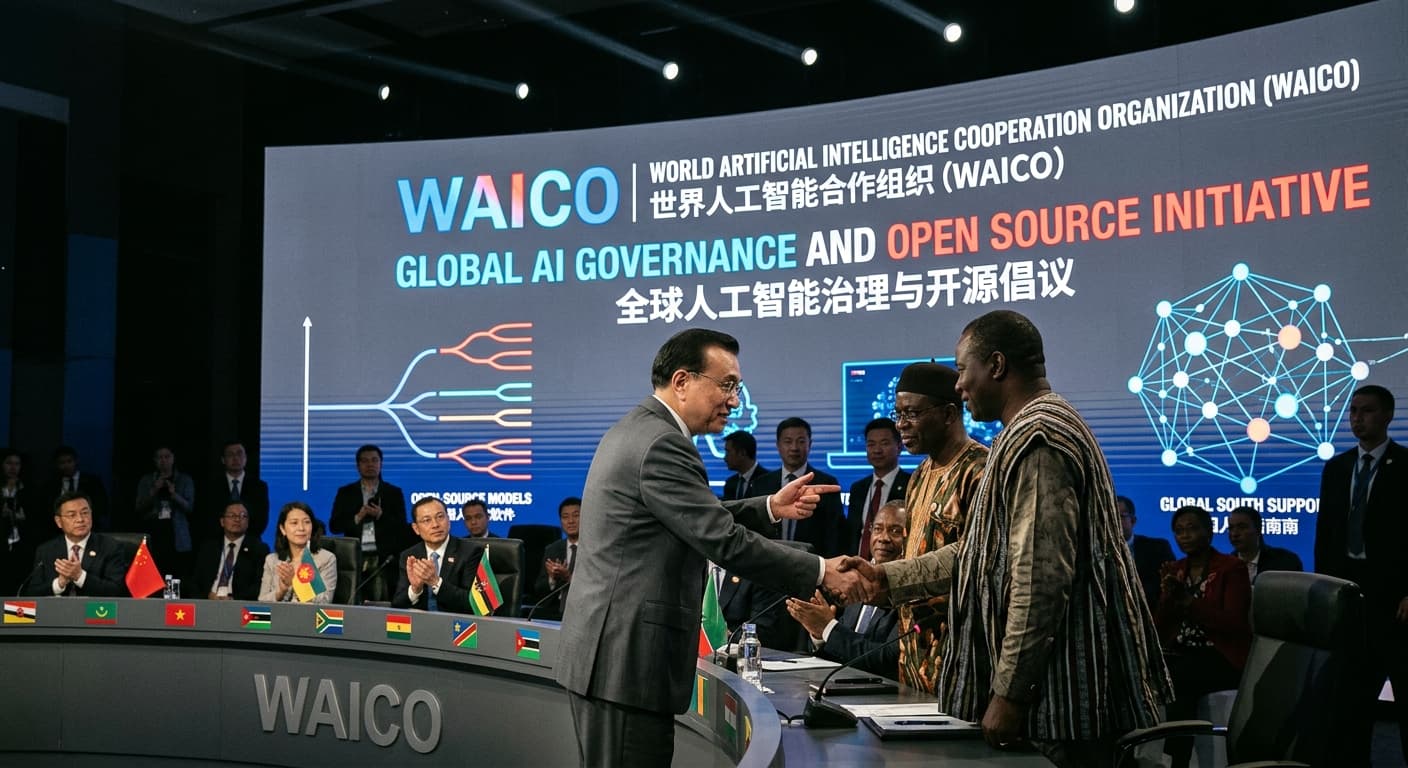
China's WAICO: The Institutional Power Play Behind Xi's "AI Symphony"
Xi Jinping launched a 29-nation AI governance body in Shanghai on July 16, 2026, with the UN chief in attendance — and the real target is not US chips, it's the UN's rule-writing seat.
On July 16, 2026, 29 nations signed an agreement in Shanghai to establish the World Artificial Intelligence Cooperation Organisation (WAICO), the first standing intergovernmental body dedicated to AI governance, headquartered in China's commercial capital and personally unveiled a day later by President Xi Jinping at the World Artificial Intelligence Conference (Al Jazeera). The thesis: WAICO is not a technology club — it is an institutional capture operation aimed at the UN's AI governance track, timed to lock in Global South buy-in before the Western-led Global Dialogue on AI Governance matures, with open-source Chinese models as the inducement and Secretary-General António Guterres's attendance as the legitimacy stamp.
What WAICO Actually Is
WAICO was formally constituted on July 16, with Chinese Foreign Minister Wang Yi signing on behalf of Beijing and UN Secretary-General Guterres attending the ceremony as a representative of the UN system (Xinhua). Its 29 founding members lean heavily Global South: Indonesia, Brazil, Malaysia, South Africa, Senegal, Russia, Pakistan, Kazakhstan, Laos, Belarus, Serbia, Cuba, and Venezuela among them (
Al Jazeera;
The Telegraph). Notably absent: India, which reportedly aligned with a separate US-anchored initiative.
Xi's keynote the following day was doctrinally pointed. "AI development should not be a solo performance by a single country, but a symphony of international cooperation," he told the conference, adding: "We should jointly oppose overstretching the national security concept in the field of AI or placing one country's security over that of others" (Al Jazeera). That phrase — "overstretching the national security concept" — is Beijing's preferred formulation for US chip export controls. The audience understood.
The organization's stated goals are cooperative AI regulation and capacity-building. But the substance is structural: WAICO is a standing intergovernmental institution, not a summit declaration or a multi-stakeholder forum. It has a headquarters, a secretariat in Shanghai, and a founding treaty signed by sovereign states. That distinguishes it from every existing Western-led initiative.
The Institutional Gap China Is Exploiting
To understand why a 29-nation club matters, look at the fragmented AI governance landscape Beijing is moving into.
The Western-led architecture is real but fragmented and, crucially, non-binding. The G7 Hiroshima AI Process produced a code of conduct endorsed by 49 countries through a "Friends Group" hosted at the OECD — but it is voluntary (CSIS). The Bletchley Declaration from the November 2023 UK summit drew 29 signatories including China, but remains a declaration, not an institution. The Global Partnership on AI (GPAI), founded in 2020 with 15 members and grown to 29, sits at the OECD and emphasizes rights-based, multi-stakeholder governance (
Brookings).
The most consequential track is the UN's. In August 2025, the General Assembly adopted Resolution A/RES/79/325, establishing the Independent International Scientific Panel on AI and the Global Dialogue on AI Governance — the first universal, treaty-anchored AI governance process (United Nations). The first Dialogue convened in Geneva on July 6–7, 2026, just 10 days before WAICO's launch, with Guterres presiding and 193 nations at the table (
United Nations). The Dialogue is explicitly non-negotiating — designed to build shared understanding, not rules (
United Nations FAQ).
That is the gap. The UN process is slow, deliberative, and non-binding. The Western clubs are voluntary and Western-leaning. WAICO is a standing, state-led, treaty-based institution with a Shanghai secretariat — the one thing nobody else has built. As one analysis noted, WAICO is "distinct from existing Western-led and UN-centric frameworks" because its design emphasizes sovereignty and development over rights and safety (arXiv preprint). By acting ahead of the predictable maturation of the UN process, Beijing is not competing with Washington's chips — it is competing with Geneva's agenda.
| Forum | Lead | Members | Binding? | HQ/Host |
|---|---|---|---|---|
| WAICO (2026) | China | 29 founding | Intergovernmental org | Shanghai |
| GPAI | OECD/Canada-France | 29 | Non-binding | OECD, Paris |
| G7 Hiroshima AI Process | Japan/G7 | 49 Friends | Voluntary code | OECD |
| Bletchley Declaration | UK | 29 signatories | Declaration | None |
| UN Global Dialogue on AI | UN General Assembly | 193 states | Non-negotiating dialogue | Geneva/NY |
Sources: CSIS, Brookings, UN A/RES/79/325, Al Jazeera
The Open-Source Wedge
The inducement China is offering is not diplomatic — it is material. Xi called on countries to "seize the historic opportunity" of open-source AI, framing Chinese models as a public good for developing nations and warning against "new historical injustices" in AI access (Al Jazeera). The timing is not accidental.
At the same Shanghai conference, Chinese startup Moonshot AI unveiled Kimi K3, a 2.8-trillion-parameter model that it says rivals OpenAI's GPT and Anthropic's Claude in independent benchmarks — and which will be released as open-source on July 27, 2026, making it the world's first freely downloadable model in the three-trillion-parameter class (BBC). This follows DeepSeek's open-source releases that already disrupted the global AI market in early 2025.
The strategic logic is straightforward. US export controls restrict access to advanced chips and, under the now-rescinded AI Diffusion Rule, would have restricted access to the model weights of the most advanced US closed-weight AI systems (Congress.gov). China's response is to flood the zone with open-source alternatives that are free, downloadable, and unrestricted — and to wrap that technology transfer in a multilateral institution that legitimizes it.
As Singapore-based analyst Vivian Toh told BBC Chinese, China's open-source path is about "opening a new lane of low cost, high cooperation" rather than breaking Western ecosystems — but the effect is the same: developing countries get capable AI models without US licensing fees, export restrictions, or geopolitical strings (BBC Chinese).
The UN Track: Where WAICO Bites
The second-order effect is on the UN process. WAICO does not need to replace the Global Dialogue; it needs to shape it. With 29 member states already signed onto a China-led institution with concrete commitments — Xi announced 5,000 AI training places over five years and AI application centers with ASEAN, the Arab League, the African Union, and BRICS (The Telegraph) — those governments now arrive at UN Dialogues with pre-aligned positions. The Dialogue's co-chairs, Ambassador Egriselda López of El Salvador and Ambassador Rein Tammsaar of Estonia, are tasked with identifying "common understandings on priority areas for international AI governance" as input to the 2027 high-level review of the Global Digital Compact (
United Nations). If a bloc of 29 states — including Security Council permanent members Russia and China — arrives with coordinated positions on open-source mandates, data sovereignty, and opposition to "overstretching" national security exceptions, the co-chairs' summary will reflect that consensus. The UN process becomes a venue where Chinese-preferred norms are input, not debated.
This is the institutional play. The Bletchley Declaration had 29 signatories and no secretariat. WAICO has 29 signatories and a permanent home. The asymmetry is deliberate.
Export Controls: The Counterpressure
Meanwhile, Washington's policy apparatus is oscillating. The Trump administration rescinded the Biden-era AI Diffusion Rule in May 2025 — which had created a three-tier global licensing system for advanced chips and model weights, placing China in a presumption-of-denial category — and replaced it with a strategy promoting export of "America's full AI technology stack" to allied nations (Congress.gov;
GAO). In December 2025, Trump personally announced that Nvidia would be permitted to sell its H200 chip to China in exchange for a 25% tariff on the proceeds, with the chips undergoing a US security review first (
Congress.gov Legal Sidebar).
This whipsaw — tightening controls, then loosening them for revenue — creates exactly the credibility gap WAICO is designed to exploit. When US policy fluctuates between restriction and deal-making, China's pitch for a stable, sovereign-led, open-source cooperative framework gains traction among countries that fear being caught in the middle of a sanctions spiral.
Congress is pushing back. The AI OVERWATCH Act (S.4456) would require licenses for exports of covered integrated circuits to entities headquartered in or parented by "countries of concern," closing the subsidiary loophole (Congress.gov). The Semiconductor Controls Effectiveness Act (H.R.8287) mandates a comprehensive State Department report on whether export controls have actually constrained Chinese AI capabilities or simply redirected revenue to non-US firms (
Congress.gov). A November 2025 House hearing on BIS's FY2026 budget featured testimony that Chinese AI chip production capacity was approaching 200,000 Ascend units annually, with most destined for domestic AI deployment (
Congress.gov). The controls are not stopping Chinese AI development; they are reshaping its supply chains.
Winners and Losers
The winners are specific. China gains a permanent institutional foothold in global AI governance — a seat it did not have in GPAI, the G7 process, or the Bletchley track beyond a signature. Founding members like Indonesia, Brazil, South Africa, and Pakistan gain access to AI training, infrastructure, and a governance forum where they are architects, not invitees. Russia gains another multilateral platform outside Western institutions. Chinese AI firms — Moonshot, DeepSeek, Alibaba's Qwen, Tencent's Hunyuan — gain a multilateral endorsement for their open-source models and a pipeline of government adopters across the Global South.
The losers are equally specific. The US loses first-mover advantage in building a standing intergovernmental AI institution. The OECD, which hosts GPAI, risks irrelevance if the world's largest AI governance forum is in Shanghai, not Paris. India, which chose a US-aligned track over WAICO membership, risks isolation from a bloc that includes most of its non-Western partners. And Western AI firms pushing closed-weight models — OpenAI, Anthropic, Google DeepMind — face a multilateral institution whose founding doctrine explicitly champions open-source as a developmental right, not just a technical choice.
Historical Parallel: The Asian Infrastructure Investment Bank
This is not Beijing's first institutional capture operation. In 2015, China launched the Asian Infrastructure Investment Bank (AIIB) with 57 founding members, headquartered in Beijing, despite US opposition and active lobbying against it by the Obama administration. Key European allies — the UK, Germany, France — broke ranks and joined. The AIIB did not replace the World Bank or ADB; it created a parallel institution where China set the terms. WAICO is the AI governance equivalent: a parallel institution that does not need to defeat the existing order — it needs to make the existing order share the table.
What to Watch Next
- September 2026 UNGA high-level week: WAICO members' statements at the General Assembly will reveal whether the 29-state bloc coordinates positions on the Global Digital Compact review process.
- May 2027 Global Dialogue, New York: The second session of the UN Global Dialogue on AI Governance, where co-chairs' "common understandings" will be drafted — the first real test of whether WAICO bloc coordination shapes the UN output.
- July 27, 2026 Kimi K3 open-source release: Moonshot AI's model goes live as the world's first freely downloadable three-trillion-parameter system — the concrete technology deliverable behind Xi's "historic opportunity" rhetoric.
- US congressional action on S.4456 and H.R.8287: If either bill passes, it would tighten the export control regime and sharpen the contrast Washington is trying to draw between restricted US technology and unrestricted Chinese alternatives.
The Bottom Line
China's WAICO is not a rival to US chip policy — it is a rival to the UN's AI governance agenda. By building the first standing intergovernmental AI institution and staffing it with 29 Global South states before the UN's own Dialogue process has produced a single binding output, Beijing is attempting to pre-commit the developing world to Chinese-preferred norms on open-source access, data sovereignty, and limits on national security exceptions. If the May 2027 Global Dialogue in New York adopts language that echoes WAICO's founding principles rather than the G7's voluntary code, the institutional capture will have succeeded — and the West will be negotiating on terrain China already controls.
Discover more
Global Politics
Trump's Conflicting Messages on Iran War
Trump's mixed messages on Iran reflect a strategy of audience management, benefiting Tehran amid a complex geopolitical landscape.

India
Delhi CM Rekha Gupta Blasts Opposition's Delm
Delhi CM Rekha Gupta's remarks on women's quota defeat reveal BJP's strategy for the 2029 Lok Sabha elections, focusing on delimitation.
India
Rajnath Singh's Durga Squad for 2026 Polls
Rajnath Singh's Durga Squad promised women's safety in Bengal but has since disappeared from the agenda, revealing BJP's true priorities.

Economics
Fed's Amex AML order puts correspondent banking on notice
Federal Reserve's Amex AML order requires board-level controls and a 90-day plan; OCC fined the bank $350 million over enterprise-wide deficiencies.