China's Tariff Wall Became a Factory Door
Tariffs backfired as Chinese EV factories move inside the walls
Model Diplomat10 min readAsia
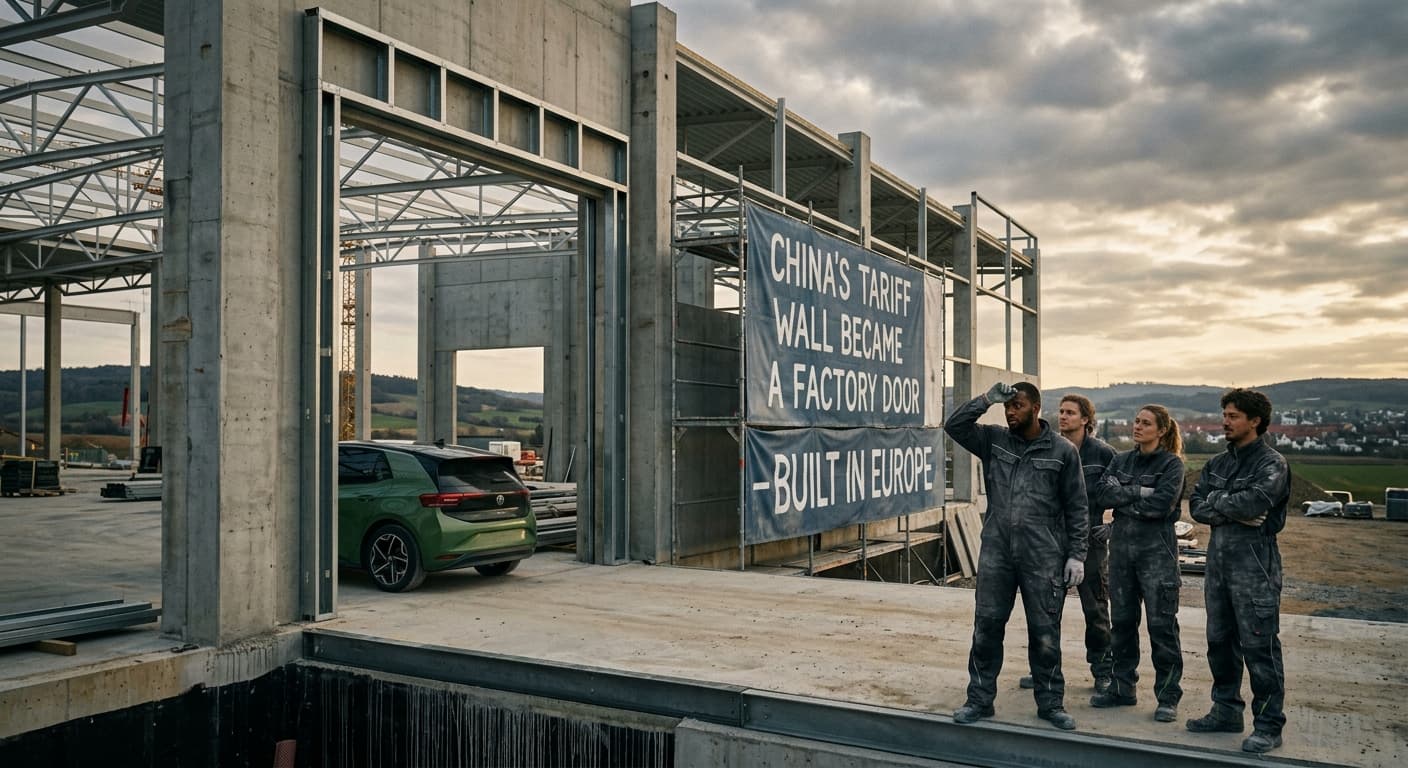
China's Tariff Wall Became a Factory Door — and the West Built It
Chinese EV exports surged 40% in April 2026 even under combined US and EU tariffs exceeding 100% and 45%; the barriers have not blocked Chinese vehicles so much as relocated Chinese factories inside the walls meant to keep them out — while a Middle East oil shock pushes the Global South toward Chinese EVs faster than any green subsidy ever could.
The trade barriers the West erected to keep Chinese electric vehicles out have not stopped them — they have rerouted them. Wood Mackenzie's mid-year outlook, released this week, declares 2026 "the year that Chinese EVs go global," with global battery demand on track for 15% growth and Chinese-built vehicles projected to account for over 75% of EV sales across the Middle East, Latin America, Africa, and Oceania, according to Mining.com.au. The International Energy Agency estimates global EV sales will hit 23 million in 2026 — nearly 30% of all auto sales worldwide — with China manufacturing roughly three-quarters of them. The West's policy toolkit is not merely failing to slow China's advance; it is embedding Chinese industrial capacity inside the very markets that built the walls.
The tariff paradox
The numbers confound the logic that produced them. China exported a record 2.5 million EVs in 2025, double the previous year, per the IEA. By April 2026, monthly exports hit 278,081 units — up 40% year-on-year — taking year-to-date overseas sales to 893,852, according to customs data compiled by Bloomberg and reported by Al Jazeera. Asia absorbed 110,613 of April's exports, Europe 83,813, and Latin America 52,897. Brazil alone saw Chinese EV imports surge 221% to 38,144 vehicles. South Korea, Germany, and Australia each posted triple-digit import growth. This surge comes despite a 100% US tariff and EU duties of up to 35.3% layered on top of the bloc's standard 10% import levy, as
BBC News reported in October 2024.
The tariff wall created an economic logic that Chinese firms are now executing: build inside it. BYD, the world's largest EV maker after overtaking Tesla with 2.25 million battery car sales in 2025 against Tesla's 1.64 million, is constructing a passenger-car factory in Szeged, Hungary — its first in Europe — with production expected by end of 2026, according to BBC News. It signed a $1 billion plant deal in Manisa, Turkey, which sits inside the EU Customs Union and allows tariff-free exports to the bloc, as
BBC News reported. Chery is producing vehicles at a former Nissan plant in Barcelona through a joint venture with EV Motors and has flagged the UK as a candidate for a second European base, per
BBC News. SAIC, hit with the EU's highest individual tariff at 37.6%, is scouting for its first European manufacturing site. CATL, the world's largest battery maker with roughly 40% of the global market, operates a factory in Germany and is building another in Debrecen, Hungary, as a
CSIS analysis documented.
The arithmetic is simple and brutal. A 35% tariff on a shipped car can be avoided entirely by building it in Szeged or Debrecen — which is why Hungary now hosts 36 battery factories built, under construction, or planned, giving it 4% of global battery manufacturing capacity and third place globally behind China and the United States, as BBC News reported. The Hungarian government promised CATL €800 million in tax incentives and infrastructure support — more than 10% of the €7.3 billion investment — to clinch the deal. Budapest's foreign minister was blunt: "We do not intend to become the world leader, because the world leader is China." The EU's tariff wall created the economic logic for Chinese firms to move production inside it. The barrier became a doorway.
The damage to European incumbents is now visible and accelerating. Volkswagen is preparing to cut as many as 100,000 jobs — about 15% of its workforce — in what German media described as the biggest restructuring in the history of the global automotive industry, according to Al Jazeera. BMW announced 5% workforce cuts by end of 2026; Mercedes-Benz paused employee bonuses and offered thousands voluntary redundancy. China's trade surplus with the EU hit €360.6 billion in 2025 — €1 billion a day, up 15% year-on-year. In May 2026, Chinese models surpassed 10% of total auto sales in the bloc for the first time, per Dataforce.
The oil shock accelerant
The Middle East conflict that erupted on February 28, 2026 — when Israeli-US strikes on Iran triggered counterstrikes across Gulf states and effectively closed the Strait of Hormuz — has become an unintended accelerant for Chinese EV exports. Oil prices surged more than 60% in a matter of days, gas prices more than doubled, according to a UNCTAD report on the conflict's economic fallout. The UN trade body warned that vulnerable economies face import cost increases that could exceed 5% of GDP in some cases.
Wood Mackenzie's outlook notes that rising fuel prices from the conflict have "further pushed consumers to consider switching to electric, and Chinese EVs entering global markets provide more options," as Mining.com.au reported. The IEA's Global EV Outlook 2026, cited by the European Commission, noted that "electric car drivers enjoy fuel cost savings that are 35% higher compared to just a year ago" at oil prices of $100 per barrel, according to
EU Climate Action. For consumers in oil-importing developing economies, the math is decisive: a Chinese EV at $20,000 with electricity at a fraction of $100-barrel petrol pays for itself faster than any policy mandate could engineer.
The Global South is not waiting for permission. In the Middle East, Latin America, Africa, and Oceania combined, over 75% of EV sales in 2026 will originate from China, per Wood Mackenzie. Outside Europe and the US, Chinese models already accounted for 55% of all EV sales in 2025, according to the IEA. The World Bank projects that by 2030, electric passenger cars will reach cost parity with internal combustion vehicles across all 40 countries it studied — but the vehicles filling that demand will overwhelmingly bear Chinese brand marks. Vietnam's BEV market share jumped from 24% to 37% in a single year; Indonesia's doubled from 7% to 15%; Türkiye's rose from 10% to 14%, per the EU Climate Action data.
This is the structural shift that matters most: China is not merely exporting cars, it is building consumer dependency across markets that have no domestic alternative. The UNCRD warned that Asia-Pacific low- and middle-income countries import 95% of their EVs and batteries, creating "complete dependence on external suppliers with inadequate local recycling infrastructure." The dependency runs deeper than vehicles: a
JRC report for the European Commission found that in 2024, more than 85% of batteries imported to the EU originated in China — above the threshold to activate the resilience contribution mechanism under the Net-Zero Industry Act.
The battery chokepoint
The decisive lever is not the car — it is the cell. China accounted for over 80% of global battery cell production in 2025 and is set to remain the largest producer through 2035, according to Wood Mackenzie. CATL alone held nearly 40% of the global EV battery market in 2024, more than double second-place BYD, as BBC Future reported. From January to April 2026, CATL and BYD combined held 54.3% of the global EV battery market, while South Korea's LG Energy Solution and SK On collectively held just 12.6% — down 1.2% from the prior year, according to the
Atlantic Council.
China's dominance extends across the midstream. It processes over half of global raw material for lithium, cobalt, and graphite, and in 2022 produced 78% of cathodes and 91% of anodes, as a UK Parliament report documented. The
WTO found that Chinese manufacturers' total battery production capacity reached 1,600 GWh in 2023 — 3.9 times that of second-ranked South Korea. China's domestic battery production rose 46% from 2023 to 2024, and its lithium-ion manufacturing capacity runs 60% higher than total battery demand — overcapacity that is being absorbed through exports, with roughly 30% of finished battery production shipped abroad in 2024, per the Atlantic Council.
The Carnegie Endowment assessed that most forecasts expect the supply chain to remain largely unchanged over the next five years, with only marginal progress in diversification. The cells being built today will define the primary battery ecosystems for decades. China has also imposed a transfer ban on its latest LFP (lithium iron phosphate) technologies, meaning the chemistry that dominates global battery production — and which eliminates cobalt and nickel dependence — is a Chinese monopoly that will not be shared.
America's self-isolation
The United States has chosen a different path — and it is the one that produces the least leverage. The 100% tariff on Chinese EVs effectively locks them out of the US market, but the CSIS documented that 40% of operating and planned US battery manufacturing capacity was tied to partnerships with Chinese firms in 2025. The US accounts for less than 1% of global lithium processing, less than 3% of nickel, and less than 1% of global reserves of nickel, cobalt, and natural graphite. US lithium-ion battery imports grew nearly sevenfold between 2018 and 2023; by 2024, China supplied nearly 70% of finished battery imports and about 33% of parts.
The domestic policy environment is moving in the wrong direction. The expiry of the $7,500 EV tax credit in September 2025 triggered a 43% drop in consumer EV spending in Q4 2025, according to Bruegel. Eleven billion dollars of US battery investment was cancelled in 2025 — more than ten times the 2024 level. A further $1 billion in planning-stage projects is vulnerable. The
European Parliament commissioned study on Chinese overcapacity concluded that in the EV and battery sector, "restructuring and localisation of production networks reduce overcapacity risks for EV producers in the EU, but increase technological dependence on Chinese battery suppliers."
Meanwhile, America's own neighbours are slipping through the net. Canada under Prime Minister Mark Carney reduced tariffs on Chinese EVs to 6.1% and agreed to admit 49,000 Chinese EVs in 2026, rising to 70,000 annually — in exchange for expanded Canadian canola oil access to China, as the Council on Foreign Relations reported. Mexico raised its tariff rate to 50% for companies without domestic plants, effectively inviting Chinese firms to build factories on its soil. The CFR analysis warned that "Carney's deal to admit Chinese EVs into Canada will be seen in retrospect as the camel's nose under the tent," potentially leaving the United States "an isolated, self-reliant island of internal combustion vehicles in an EV world led by China."
The historical parallel
This is Japan in the 1970s, inverted. When OPEC's oil embargo quadrupled petrol prices, Japanese automakers selling fuel-efficient small cars captured the US market within a decade. The difference is scale and depth. Japan exported cars; China exports cars, batteries, cathodes, anodes, processing capacity, and the industrial ecosystems that produce them. The BBC calculated that Beijing spent approximately $231 billion developing its EV industry from 2009 to 2023, per CSIS estimates. The investment yielded a vertically integrated supply chain that no tariff regime can replicate and no ally can match.
The second-order effect is deindustrialisation in the West's automotive heartland. The EU's own dashboard acknowledged that only 6 EV models sold for less than €30,000 — three of them Chinese — and no model was available below €20,000 without incentives, as the European Commission reported. Chinese firms produce a small electric SUV at least 30% cheaper than advanced-economy competitors, per the IEA. Europe's gigafactories can produce twice its domestic EV demand and two-thirds of its battery demand, according to
Bruegel — but cathode and anode capacity is insufficient, creating "risk of serious dependencies at battery component level."
The winners are named and specific: BYD, CATL, Chery, SAIC, Geely. The losers are Volkswagen, BMW, Mercedes-Benz, Ford, GM, and the industrial workforces that depend on them. The Atlantic Council noted that the resilience benefits of LFP chemistry diversification depend on consumer preferences — and US automakers have continued to favour nickel-rich chemistries because larger vehicles and range preferences place a premium on energy density, meaning the United States "has participated less fully in the cobalt-reducing potential of battery chemistry diversification." China maintains a virtual monopoly on LFP.
Diplomat View
The tariff strategy has produced the opposite of its intent. By blocking Chinese car imports while permitting Chinese battery and component investment, the EU and US have created a structure where Chinese firms build factories inside the tariff wall, employ European workers, and deepen technological dependence on Chinese battery IP — while Western incumbents shed jobs and market share. The Middle East oil shock has accelerated the Global South's pivot to Chinese EVs in markets that have no domestic industry to protect and every economic incentive to switch. The United States, by dismantling its own EV incentives and imposing a 100% tariff, is engineering its own isolation from the dominant automotive technology of the next decade.
The forecast: Chinese firms will complete their European factory build-out within 24 months, at which point EU tariffs become irrelevant — the cars will be made in Hungary, Spain, and Turkey. The question is whether Brussels will then extend tariffs to locally-produced Chinese-owned vehicles, which would trigger a WTO challenge and probable retaliation against European car exports to China. If it does not, the European automotive industry faces a managed decline. If the US maintains its current trajectory, it risks becoming what CFR described — "an isolated, self-reliant island of internal combustion vehicles in an EV world led by China."
What would change the forecast: a breakthrough in solid-state or sodium-ion battery chemistry commercialised outside China by 2028, a negotiated minimum-price agreement between Brussels and Beijing that preserves European production capacity, or a Middle East ceasefire that collapses oil prices and removes the economic urgency driving Global South EV adoption. None of these is the base case.
What to watch:
- Late 2026: BYD's Szeged plant begins production — first Chinese-built passenger cars manufactured inside the EU tariff wall.
- October 2026: EU-China trade review — Brussels is negotiating a minimum import price mechanism for Chinese EVs; the outcome determines whether tariffs persist or are replaced.
- 2027: US battery manufacturing capacity assessments — whether the $1 billion in vulnerable planning-stage projects survives or joins the $11 billion already cancelled.
- 2027-2028: Canada's annual Chinese EV import quota expands to 70,000 — the test case for whether North American integration holds or fragments under Chinese automotive pressure.
Discover more

US Politics
US Launches $166B Tariff Refund Portal
The US is launching a $166 billion tariff refund portal to aid importers hit by Trump-era tariffs, with major implications for trade and supply costs.

US Politics
House Ethics Committee Pushes Sexual Miscond.
The House Ethics Committee has shifted responsibility for sexual harassment settlement records to the Office of Congressional Workplace Rights, complicating disclosure efforts.

US Politics
White House Pressures Congress for Crypto Leg
The Trump administration's push for the CLARITY Act aims to reshape crypto regulation, impacting trillions in market value and the Trump family's wealth.

Conflict & Security
Drone Warfare Killing Aid Workers at Unprec
Over 1,000 humanitarian workers killed in three years as cheap armed drones collapse legal protections. Gaza, Sudan, Ukraine, and DRC see deliberate targeting of aid convoys and hospitals with zero prosecutions.