China's Taiwan Blockade Playbook: White Hulls
Senator warns of gray-zone blockade by 2028
Model Diplomat10 min readEast Asia and Pacific
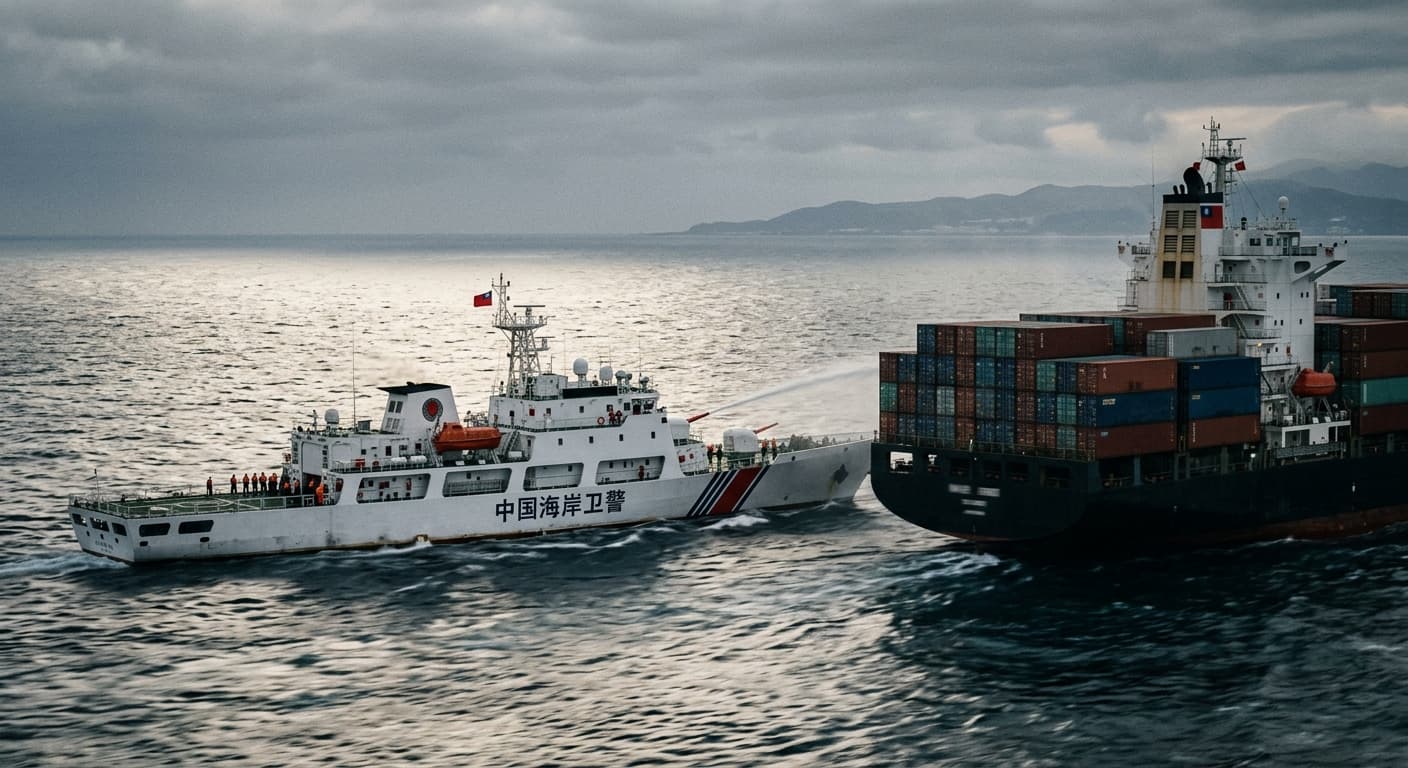
China's Taiwan Blockade Playbook Is Being Written in White Hulls, Not Gray Ones
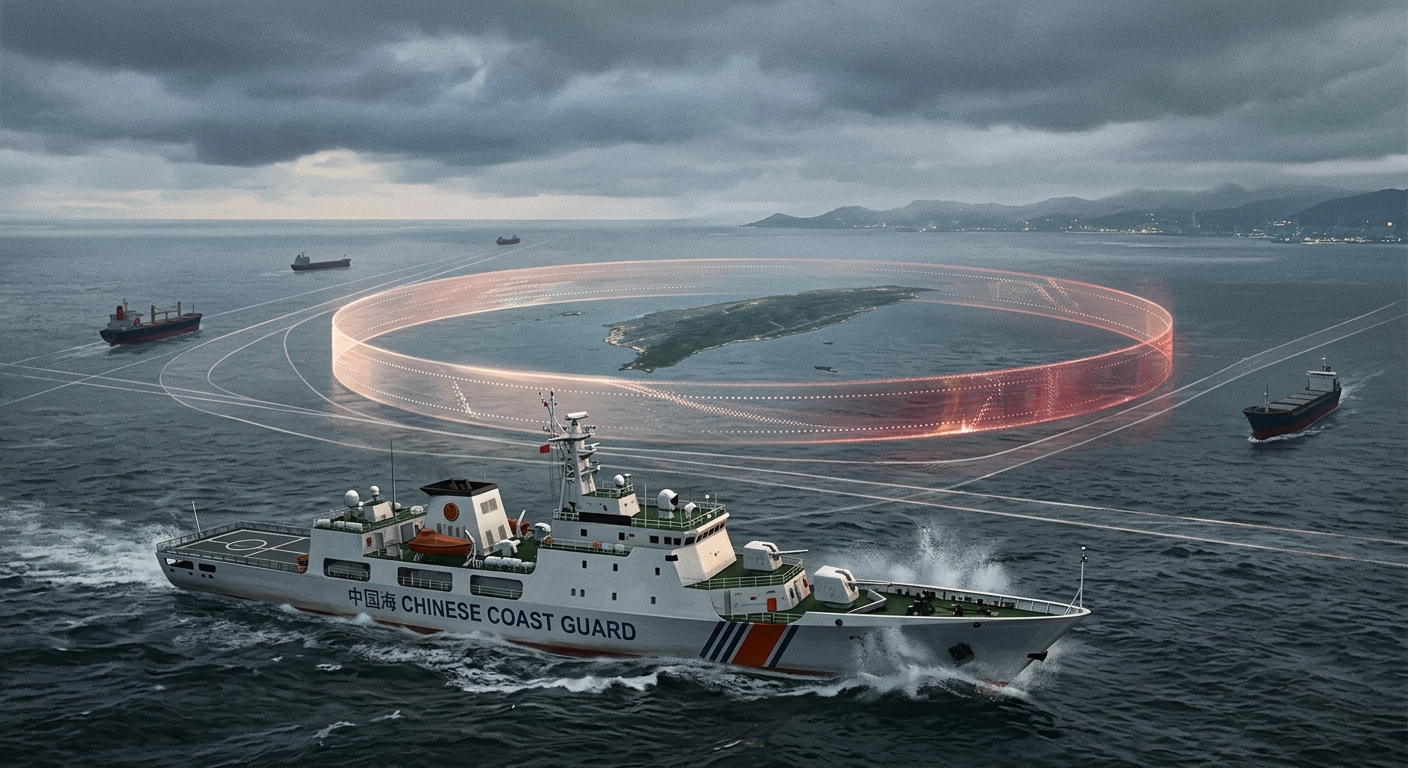
U.S. Senator Tammy Duckworth warned on July 18, 2026, that China is more likely to impose an economic blockade on Taiwan than launch a full-scale military invasion in 2028 — and the mechanism would not be naval warships but coast guard vessels operating under the legal cover of maritime safety enforcement. The warning, delivered at a Center for Strategic and International Studies event in Washington, marks the most specific public forecast yet from a senior U.S. lawmaker with direct access to classified tabletop exercises on cross-strait contingencies. Focus Taiwan
The distinction matters because it signals where Beijing's operational planning has quietly moved over the past four years — away from the high-visibility, high-risk amphibious assault scenarios that dominate public debate and toward a gray-zone strangulation strategy that would test the boundaries of international law, alliance commitments, and the global economy's tolerance for disruption.
The Coast Guard Pivot: From Auxiliary to Front Line
Duckworth's core insight, that a blockade would come 'under the guise of safety and security', aligns with an accumulating body of evidence from military exercises, Japanese defense assessments, and maritime tracking data. The operational concept is straightforward: China would require commercial vessels transiting the Taiwan Strait to check in with the People's Republic of China Coast Guard (CCG) for escort, effectively interdicting traffic to and from the island while framing the action as a law-enforcement measure rather than an act of war. Focus Taiwan
"It is actually blockading the straits and telling shipping companies that if you want to go through the Taiwan Strait, you need to check in with the PRC Coast Guard to help escort you through the strait safely," Duckworth said.
This is not speculation drawn from thin air. Japan's 2025 Defense White Paper, released by the Ministry of Defense on July 15, 2025, explicitly noted that China's military exercises related to Taiwan have diversified, with increasing emphasis on "blockade" scenarios — and that the primary operational force in such simulations is now the CCG, not the People's Liberation Army Navy. Japan Ministry of Defense
The CCG participated for the first time in a Taiwan-related military exercise during Joint Sword 2024A in May 2024. By October 2024's Joint Sword 2024B, Chinese forces were rehearsing the "blockade and control of key ports and areas in Taiwan," with CCG patrol vessels conducting operations in waters surrounding the island. In December 2025, Justice Mission 2025 — the largest and most complex military exercise China has staged around Taiwan since the 2022 Pelosi visit — featured an unprecedented integration of CCG vessels with PLA Navy assets, with at least 13 CCG ships positioned near Taiwan's contiguous zone and outlying islands. Janes
The trajectory has since hardened into continuous presence. In June 2026, China established what analysts describe as a "new normal" — persistent CCG rotation east of Taiwan, with relief cutters arriving on July 4 to maintain a perpetual deployment. CMSI Note 21, published July 6, 2026, characterized this as an inflection point: a deliberate shift from episodic signaling patrols to routine, sustained maritime enforcement. Jamestown Foundation
The Legal Fog
The strategic logic of using white-hull coast guard vessels rather than gray-hull warships is not about firepower — it is about creating legal ambiguity that complicates any potential U.S. or allied intervention.
Under international law, U.S. intervention to defend Taiwan could be justified through collective self-defense in response to an armed attack. But a blockade enforced by the CCG under the guise of maritime law enforcement — particularly with China framing the action as a domestic quarantine rather than a belligerent blockade — may not meet the threshold of an "armed attack" required to invoke self-defense rights. As Japan's Ministry of Defense assessed, this legal ambiguity "is precisely what makes gray-zone warfare centered on the CCG so challenging." Naval News
The Lieber Institute at West Point examined the same question through the lens of the Law of Armed Conflict and Law of Naval Warfare, concluding that China could frame a blockade-like action as a policing operation within territorial seas under Article 25(3) of the Law of the Sea Convention — avoiding the formal declaration of a blockade that would trigger neutrality obligations and belligerent rights for third states. Lieber Institute
This legal engineering is not theoretical. China Maritime Report #48, published in July 2025 by the U.S. Naval War College's China Maritime Studies Institute, argued that PRC maritime law enforcement operations in the Taiwan Strait "function as forms of cognitive and legal warfare aimed at undermining international maritime law and Taiwan's sovereignty." The report documented how China has leveraged its 2021 Coast Guard Law — which permits the use of "all means" against intruding vessels — to construct an enforcement architecture that could be activated for quarantine operations without any new legal authorization. CMSI
The Economic Calculus: $2.45 Trillion and a 5% Contraction
Duckworth grounded her warning in hard economic stakes. During her July 6–8 visit to Taiwan — the first by a U.S. senator since the May 2026 Trump-Xi summit in Beijing — she told President Lai Ching-te that a conflict in the Taiwan Strait could cost the global economy as much as $10 trillion and put more than 7% of U.S. GDP at risk, an impact exceeding either the 2008 global financial crisis or the COVID-19 pandemic. Focus Taiwan
The underlying trade figures explain why. CSIS research estimates that approximately $2.45 trillion worth of goods transited the Taiwan Strait in 2024 — roughly 21% of global maritime trade, placing it on par with the Malacca Strait as one of the world's two busiest maritime chokepoints. Japan, South Korea, and the Philippines collectively shipped $755 billion through the strait. China itself is acutely dependent: nearly $1.3 trillion of Chinese trade transited the Taiwan Strait in 2024, including roughly one-third of China's imports — particularly oil, coal, natural gas, and manufacturing inputs. CSIS
Bloomberg Economics has modeled the consequences. A Chinese air and sea blockade of Taiwan would trigger an estimated 5% decline in global GDP, comparable to the 2008-09 financial crisis and the COVID-19 downturn. In a worst-case scenario of full-scale U.S.-China war, global GDP would contract by approximately 9.6% in the first year, with Taiwan's economy shrinking by roughly 40% due to direct war damage and semiconductor supply-chain collapse. The EU and Southeast Asia would be among those most impacted after Taiwan itself. Chatham House
Taiwan News
Duckworth drew a pointed comparison to the Strait of Hormuz, where conflict-related disruptions have already prompted IMF warnings of a possible global recession. "Let's make sure that what's happening in the Strait of Hormuz does not become the new and acceptable norm for all of the other waterways around the world," she said, adding that any disruption to Taiwan Strait shipping would have far greater global economic consequences than instability in the Persian Gulf. Focus Taiwan
2028: The Convergence Window
Why 2028 specifically? Duckworth's timeline is not arbitrary — it reflects a convergence of political calendars that multiple analysts have identified as a period of maximum vulnerability.
The year 2028 will see presidential elections in both Taiwan (January) and the United States (November). If Lai Ching-te is reelected and his Democratic Progressive Party secures a legislative majority, Beijing will face a Taiwanese leader with a stronger domestic mandate to strengthen defenses, limit cross-strait ties, and assert sovereignty more forcefully. Simultaneously, the U.S. electoral transition — particularly if it brings a more explicitly competitive approach to China — could be read in Beijing as a closing window for action before the strategic environment deteriorates further. Foreign Affairs
In China, Xi Jinping is likely to secure another five-year term at the party congress in late 2027 and appoint new members to the Central Military Commission. A reconstituted military leadership selected primarily for ideological purity and loyalty to Xi may prove less willing — or less able — to fully inform China's leader of the costs and risks of using force. This, combined with Xi's long-standing directive that the PLA be capable of invading Taiwan by 2027, narrows the perceived window. Foreign Affairs
The Trump-Xi summit in May 2026, while producing rhetorical commitments to "constructive strategic stability," did not resolve the fundamental disagreement over Taiwan. Xi told Trump that Taiwan is "the most important issue in China-US relations" and warned that if mishandled, "the two countries will have clashes and even conflicts." The White House readout, notably, did not mention Taiwan at all — and Trump ignored a question from reporters on the subject during his time in Beijing. The $14 billion arms-sales package for Taiwan remains in limbo without a presidential determination. Al Jazeera
Who Benefits and Who Loses
The blockade scenario distributes costs and benefits unevenly — and the pattern reveals why it is an attractive option from Beijing's perspective.
Winners: The CCG and People's Armed Forces Maritime Militia gain operational primacy and institutional resources at the expense of the PLA Navy, which is sidelined from the front line — reducing the likelihood that a U.S. carrier strike group can justify direct engagement. Beijing's political leadership gains a coercive instrument that keeps escalation below the threshold that would unify international opposition or trigger automatic U.S. defense commitments. Chinese shipbuilding and maritime enforcement industries receive sustained investment.
Losers: Taiwan faces economic asphyxiation without a single shot being fired — its energy imports, on which the island is almost entirely dependent, would be the first and most devastating casualty. The CSIS wargame series "Lights Out," which ran 26 scenarios simulating a Chinese blockade of Taiwan, concluded that energy and merchant shipping access are the critical factors for Taiwan's resilience, and that Taiwan "cannot face China alone" — the disparity in economic and military power is too great. CSIS
Japan and South Korea, which collectively shipped $755 billion through the Taiwan Strait in 2024, would see their trade arteries severed overnight. The Philippines, geographically positioned to potentially serve as a supply corridor to Taiwan, would face intense pressure to deny access. Global semiconductor supply chains would seize — Taiwan produces roughly 62% of the world's advanced semiconductors, and TSMC alone accounts for approximately 70% of global foundry revenue. CSIS
Taiwan News
A RAND Corporation study on economic deterrence in a China contingency found that allies are "highly unlikely to join in preemptive economic measures absent strong U.S. pressure and leadership" — meaning the burden of both deterrence and response falls disproportionately on Washington, while the economic pain is globally distributed. RAND
What Duckworth Is Doing About It
Duckworth's CSIS remarks were not simply diagnostic — they previewed the policy response she is advancing from her seats on both the Senate Armed Services Committee and the Senate Foreign Relations Committee. CSIS
She has inserted two provisions into the current National Defense Authorization Act: one to create a State Partnership for Peace-style program that would pair a U.S. National Guard unit with Taiwan's defense forces for habitual training and integration, and another directing the Department of Defense to actively identify and expand training opportunities between the U.S. military and Taiwanese forces. The objective, Duckworth said, is to ensure that "we're going to have a much more persistent and more visible presence of the United States when it comes to Taiwan and the Taiwan Straits." CSIS
On deterrence specifically, she called for continued U.S. naval transits through the Taiwan Strait and for encouraging allied nations to do the same — a direct rebuttal to any normalization of Chinese claims to regulate commercial traffic through the waterway.
Diplomat View
Duckworth's assessment should be read as more than a scenario exercise. She is describing a playbook that has already left the simulation room. The pieces are in motion: a continuous CCG presence east of Taiwan established in June 2026, a legal framework built through the 2021 Coast Guard Law and subsequent regulations permitting detention of foreign vessels, and military exercises — most recently Justice Mission 2025 — that have repeatedly rehearsed the precise choreography of a paramilitary blockade under the cover of law enforcement.
The 2028 convergence of political calendars is the proximate trigger, but the structural conditions are already being laid. China has demonstrated that it can rotate coast guard assets indefinitely, that it can frame exclusion-zone operations as maritime safety enforcement, and that the international community lacks a clear legal or operational playbook for distinguishing a "quarantine" from a blockade — or for responding to either without escalating to full conflict.
The forecast: a blockade scenario in the 2028 window is more probable than an invasion, but not inevitable. Three conditions would change the calculus. First, if the KMT or a joint opposition ticket wins Taiwan's January 2028 presidential election and adopts a more Beijing-accommodating posture, the coercive imperative recedes. Second, if the Trump administration's September 2026 follow-up summit with Xi produces a verifiable Taiwan modus vivendi — unlikely given the failure to mention Taiwan in the May readout, but not impossible. Third, if Taiwan, Japan, and the Philippines together establish a multilateral coast-guard coordination mechanism that raises the operational cost of a CCG-led quarantine, moving the deterrence equation in Taipei's favor.
The bottom line: Senator Duckworth's warning is not about what China might plan. It is about what China has been rehearsing — and the legal and economic architecture it has been building to ensure that when the test comes, Washington and its allies will hesitate, and that hesitation will be decisive.
Discover more

US Politics
White House Pressures Congress for Crypto Leg
The Trump administration's push for the CLARITY Act aims to reshape crypto regulation, impacting trillions in market value and the Trump family's wealth.
US Politics
U.S. House Passes Alert Act for Aviation
The House passed the ALERT Act 396–10, replacing the ROTOR Act after Pentagon intervention, impacting aviation safety regulations.

US Politics
US Launches $166B Tariff Refund Portal
The US is launching a $166 billion tariff refund portal to aid importers hit by Trump-era tariffs, with major implications for trade and supply costs.

Economics
Fed's Amex AML order puts correspondent banking on notice
Federal Reserve's Amex AML order requires board-level controls and a 90-day plan; OCC fined the bank $350 million over enterprise-wide deficiencies.