China's Submarine Missile Test Signals Power
A strategic missile launch amid Pacific diplomacy
Model Diplomat7 min readAsia-Pacific
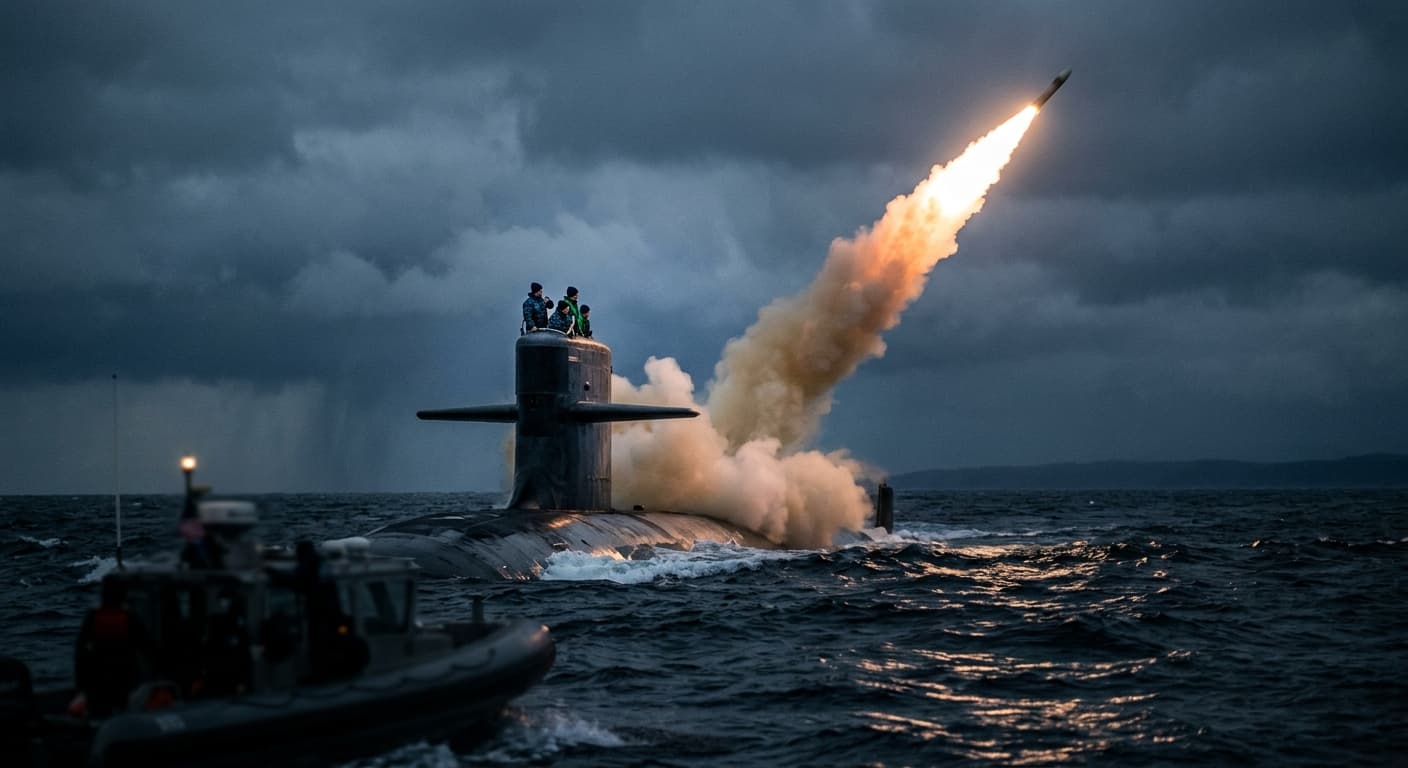
China's submarine missile test into the Pacific: what it signals
China's July 6 SLBM test in the Pacific — hours after Australia and Fiji signed the Ocean of Peace Alliance — was a strategic-signalling shot aimed at Washington, timed for Canberra.
China's People's Liberation Army Navy fired a long-range strategic missile from a nuclear-powered submarine into the Pacific on July 6, 2026 — hours after Australian Prime Minister Anthony Albanese and Fijian counterpart Sitiveni Rabuka signed the "Ocean of Peace" Alliance in Suva. Beijing called it "routine". It was not. This was the first advertised operational test of China's sea-based nuclear deterrent — a signal aimed at Washington but timed to bracket Canberra's Pacific diplomacy on the same news cycle. The Type 094 submarine and the missile it fired sit at the heart of a triad Beijing is racing to make credible; the test, and its choreography with Australia's Fiji treaty, tells the region who now sets the tempo in the second island chain.
What actually flew, and from where
Chinese state media said the missile carried a dummy warhead and fell in "designated waters" of the Pacific, framing the launch as an annual training event conducted "in a safe, stable and professional manner." Foreign Ministry spokeswoman Mao Ning warned "certain countries" against "over-interpreting" it, according to the BBC. Beijing did not identify the submarine or the missile.
Analysts and Western defence documents fill the blanks. The International Institute for Strategic Studies noted in February 2026 that China has launched a seventh and eighth Type 094 (Jin-class) SSBN in 2024 and 2025, and is transitioning the class from the JL-2 to the longer-range JL-3 submarine-launched ballistic missile. The IISS Military Balance assesses that the JL-3 "allows the Type-094s to target the western continental United States from the South China Sea." The Center for Strategic and International Studies, writing after Beijing publicly displayed the JL-3 at its September 2025 Victory Day parade, put the missile's range at
over 5,400 nautical miles.
The Economist, in its July 6 dispatch, called the announcement itself the story: "the Chinese government has never confirmed" that its SSBNs are on deterrent patrol, and Monday's release ends that ambiguity. That is what makes this different from the September 2024 land-based DF-31AG shot from Hainan into the seas off French Polynesia — a test the Manohar Parrikar Institute for Defence Studies and Analyses documented as China's
first full-range ICBM test in 44 years. Two years on, Beijing has moved from surfacing its land leg to surfacing its sea leg.
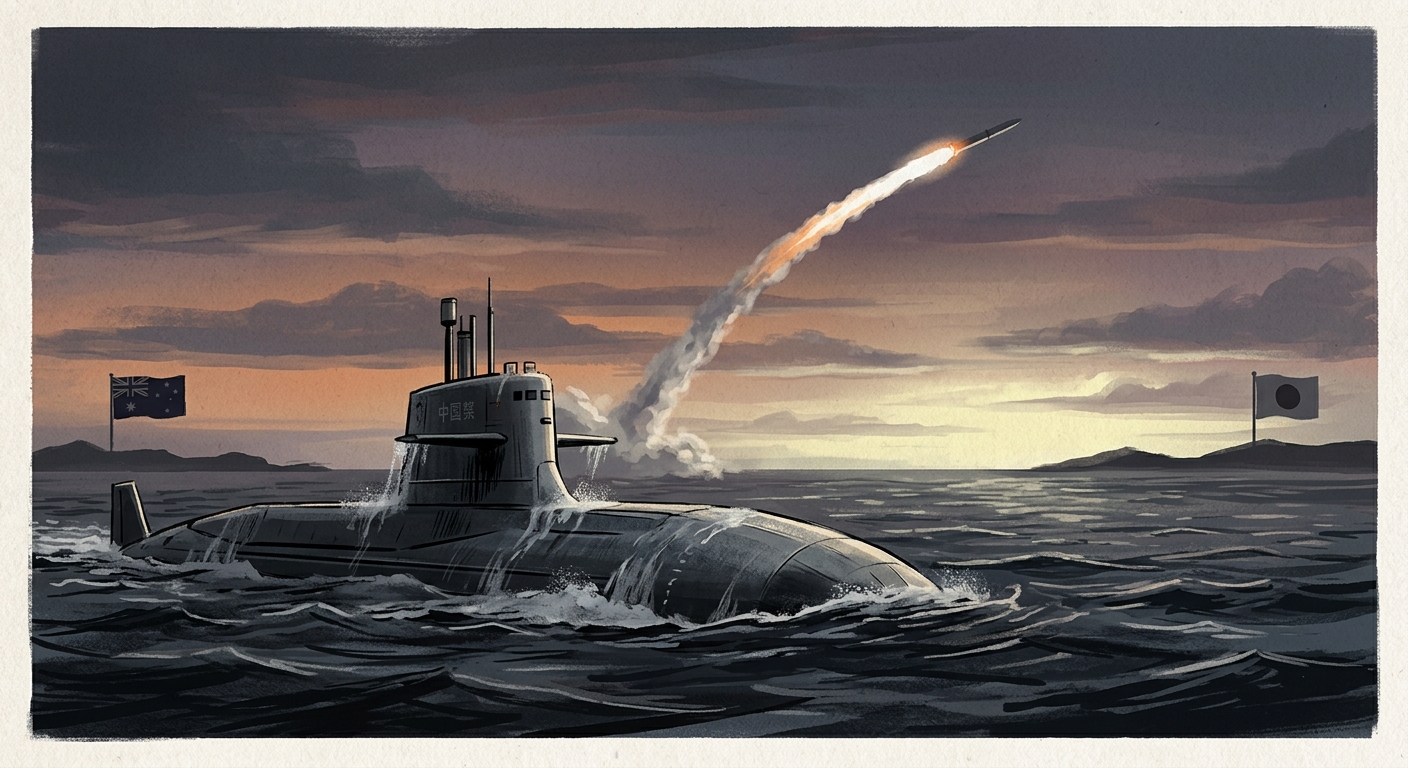
The choreography with Fiji is the story
The 24-hour sequence in Suva is the analytical point. On Monday morning Wong stood with her Fijian counterpart to formalise a treaty her department is calling the Ocean of Peace Alliance — Fiji's first-ever alliance and Australia's fourth, after the United States, New Zealand and Papua New Guinea, according to the BBC. It is the operational sequel to the May 2026 Vuvale Union, which the
Center for Strategic and International Studies described as embedding Australia into Fijian policing, interdiction and critical-infrastructure decisions.
Hours later, Beijing informed Canberra, Tokyo, Wellington and Port Moresby of a maritime drill. Australian Defence Minister Richard Marles said China notified Australia "hours before" the launch; Japan's Ministry of Foreign Affairs said it got 90 minutes' warning. Wong, speaking in Suva, called the test "in the context of a rapid military build-up by China" and warned that it risked "destabilising" the region. Marles was careful to say Canberra does not assess the launch as a response to the Fiji pact. Read that disclaimer literally: it means Canberra concedes it cannot prove intent, but the analytical presumption is otherwise. Beijing's window for this kind of signal — a rare deep-Pacific launch — was open for weeks, and it opened it on the day of the Suva ceremony.
The Lowy Institute notes that Fiji completed a National Security and Defence Review in 2024 and stood up an Office of National Security Assessments in 2025. Canberra has been building, treaty by treaty, what analysts are now calling a Pacific Eyes intelligence architecture: Papua New Guinea (2025), Nauru (2024), Tuvalu (2023), and now Fiji. From Beijing's angle, a Pacific it once approached through a Solomon Islands security pact in 2022 is being fenced off. The July 6 launch is a message to that fence: it does not extend to the second island chain.
Japan is the second audience — and the more consequential one
Tokyo's protest was sharper than Canberra's, and the reasons are structural. In November 2025 Prime Minister Sanae Takaichi told the Diet that a Chinese attack on Taiwan would constitute a "survival-threatening situation" for Japan, unlocking military response under the pacifist constitution. Beijing has since imposed dual-use export controls on Japanese firms — Mitsubishi Heavy Industries' shipbuilding group, Kawasaki Heavy Industries, and the Japan Aerospace Exploration Agency were among the first 20 entities, according to Al Jazeera, with a second tranche in late June including Subaru and ENEOS.
An SSBN test in the Pacific, in that context, functions as a nuclear-shaded reminder over a Taiwan-shaded quarrel. Tokyo "strongly urged" Beijing to reconsider the launch; the phrasing is diplomatic, but the calculation is not. Japan's defence planners have to price in a submarine leg that, per the US Department of Defense 2025 China Military Power Report, is now bolted to a stockpile heading north of 1,000 warheads by 2030. Testimony in April 2026 to the House Armed Services Strategic Forces Subcommittee put China's current
deliverable warhead count above 600, and flagged a shift toward launch-on-warning posture despite Beijing's stated no-first-use pledge.
The primary document Beijing did not publish
The absence at the centre of this story is a Chinese Ministry of National Defense release naming the platform, the missile or the impact zone. In September 2024 Beijing at least told the world it had fired an ICBM; on July 6, 2026, it named nothing. That opacity is deliberate. The Royal United Services Institute argues the Type 094 remains "noisier than both the UK and US equivalents" — a reason China has kept its SSBNs bastioned in the South China Sea. The JL-3, at 10,000+ km, is the workaround: strike the US mainland without leaving the bastion. Monday's test is best read as a live-fire validation of that concept and a claim that the concept works far from home waters.
The primary-source spine sits on the Western side. The US Congressional Research Service report on Chinese naval modernisation puts the JIN fleet at six operational hulls, each with 12 tubes; the
Pentagon's 2025 CMPR has already assessed that the JL-3 is fielded on later Type 094s. The AUKUS Defence Ministerial Joint Statement of May 30, 2026 — a
UK government primary release — announced the establishment of Submarine Rotational Force-West at HMAS Stirling in 2027 and Australian outlays of up to AUD 8 billion. That is the Western counter-move Monday's test was meant to complicate.
The second-order effect nobody in Suva said out loud
The Ocean of Peace Alliance and the July 6 launch together answered a question that has hung over Australian defence policy since 2022: does bilateral treaty-making with Pacific micro-states buy strategic depth against a peer competitor with intercontinental reach? On the evidence of Monday, the honest answer is: less than Canberra hoped. Fiji buys Australia policing, interdiction and critical-infrastructure influence — real, cumulative, useful. It does not buy anti-submarine coverage of the Coral Sea, and it does not deter an SSBN patrol whose whole point is that it cannot be found.
That is why Marles at the June Shangri-La Dialogue put 40% of Australia's defence budget under the 2026 National Defence Strategy into maritime capabilities — Virginia-class submarines, air-warfare destroyers, general-purpose frigates — and why the
Quad's May announcement to develop Suva and Lautoka ports is not really about ports. The winners from Monday's test are the Australian, Japanese, British and American programme officers holding budget requests for undersea surveillance, seabed sensors and long-range strike. The losers are the region's remaining non-aligned Pacific states — Vanuatu, Solomon Islands under new PM Matthew Wale — whose room to hedge has just narrowed.
Diplomat View
The forecast: China will conduct at least one more advertised strategic-forces demonstration in the Pacific before end-2026, and it will land during a Western-led regional summit or treaty signing — not before it. The signal Beijing wants is that the timing is Beijing's. Two years elapsed between the September 2024 DF-31AG shot and Monday's SLBM launch; the cadence is compressing as the JL-3 completes fleet integration and the Type 096 approaches sea trials. Expect Japan under Takaichi to accelerate counterstrike acquisition and to make explicit what her November 2025 Diet remarks left implicit: that Japan-based US assets, and Japanese Self-Defence Force assets, will be positioned to complicate a Taiwan scenario. Expect Australia to bring forward SRF-West by months, not weeks.
What would falsify this call: a Chinese Defence Ministry release naming the platform and missile fired on July 6, or a bilateral Beijing–Canberra transparency mechanism concluded before the November 2026 East Asia Summit. Neither is likely. The default is opacity as strategy.
What to watch next
- September 2026: Pacific Islands Forum leaders' summit — first regional test of whether the Ocean of Peace framework holds up under Chinese pushback.
- November 2026: East Asia Summit and APEC; watch for a Xi–Takaichi meeting request from Tokyo and Beijing's response.
- Late 2026 / early 2027: US Department of Defense annual China Military Power Report — first authoritative Western assessment of the July 6 launch and any inferred Type 096 progress.
The Bottom Line
China's July 6 submarine missile test was not routine and not directed at "no one" — it was a nuclear-shaded signal fired the same day Australia locked in its fourth formal alliance, aimed at Washington and priced for Tokyo. The takeaway for the region is that Beijing now considers its sea-based deterrent mature enough to advertise, and confident enough to time. Every subsequent Pacific treaty Canberra signs will be read against that ability — and against the Type 096 waiting in the Bohai yard.
Discover more

US Politics
US Launches $166B Tariff Refund Portal
The US is launching a $166 billion tariff refund portal to aid importers hit by Trump-era tariffs, with major implications for trade and supply costs.

US Politics
White House Pressures Congress for Crypto Leg
The Trump administration's push for the CLARITY Act aims to reshape crypto regulation, impacting trillions in market value and the Trump family's wealth.
India
700 Activists Accuse PM Modi of MCC Breach
Over 700 activists allege PM Modi breached election code with a televised address attacking opposition parties just before state elections.

Conflict & Security
Drone Warfare Killing Aid Workers at Unprec
Over 1,000 humanitarian workers killed in three years as cheap armed drones collapse legal protections. Gaza, Sudan, Ukraine, and DRC see deliberate targeting of aid convoys and hospitals with zero prosecutions.