China's SLBM Test: A Misguided Message
Beijing's missile launch backfires in the Pacific.
Model Diplomat8 min readPacific
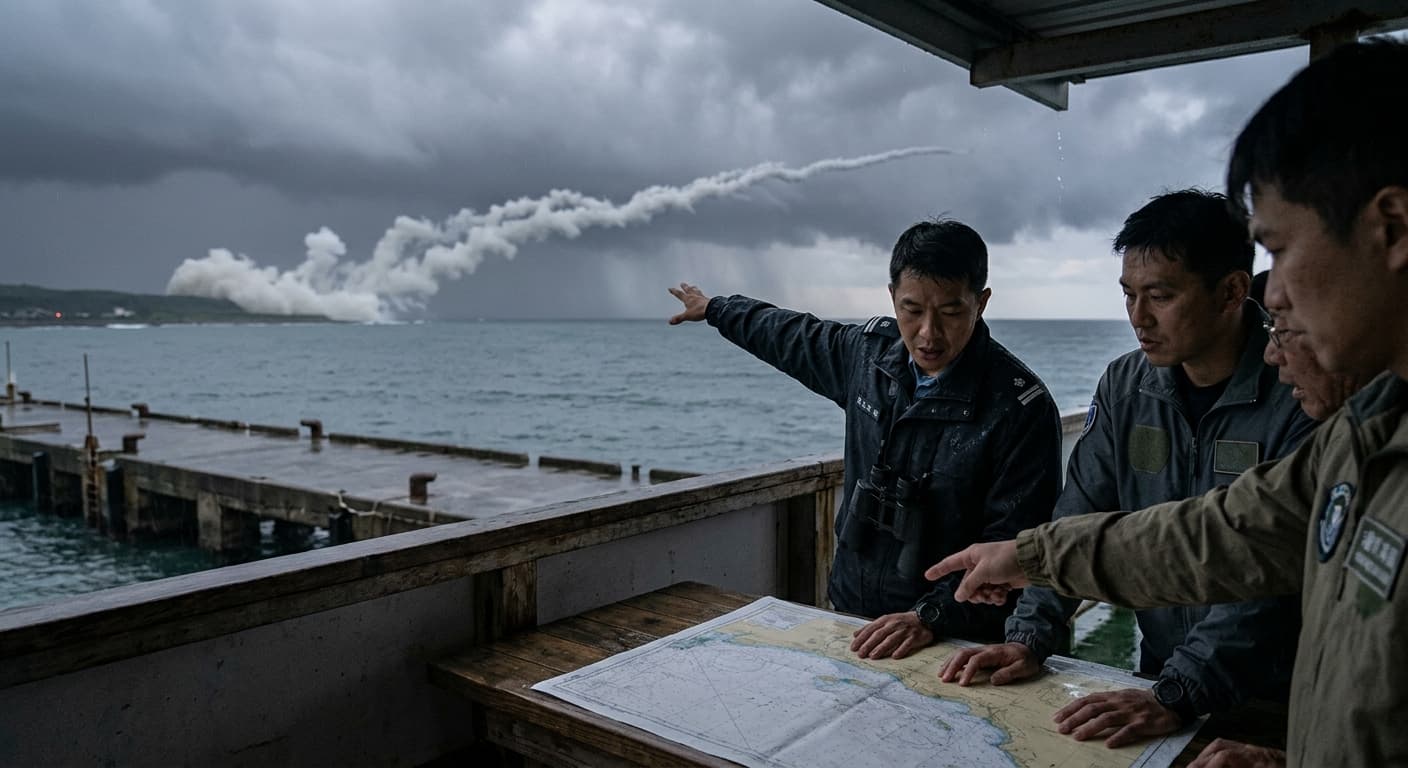
China's Pacific SLBM Test Was a Message — And It Backfired
China fired a JL-class SLBM into the Pacific on July 6, 2026, hours after Australia and Fiji signed the Ocean of Peace Alliance. The signal missed.
Beijing's message was meant for Suva, Honiara and Canberra, not Washington. On July 6, 2026, a People's Liberation Army Navy strategic submarine launched an intercontinental-range ballistic missile with a dummy warhead into a splash zone west of the Solomon Islands — hours after Australian Prime Minister Anthony Albanese and Fijian counterpart Sitiveni Rabuka inked the Ocean of Peace Alliance, Fiji's first treaty-level defence pact. Beijing called it "routine annual training." The timing said otherwise. The deeper point is this: China now possesses a credible sea-based deterrent it feels safe to show publicly, but the coercive dividend the launch was designed to buy in the Pacific is running the wrong way — accelerating exactly the Australia-led security lattice Beijing wanted to disrupt.
What actually flew, and from where
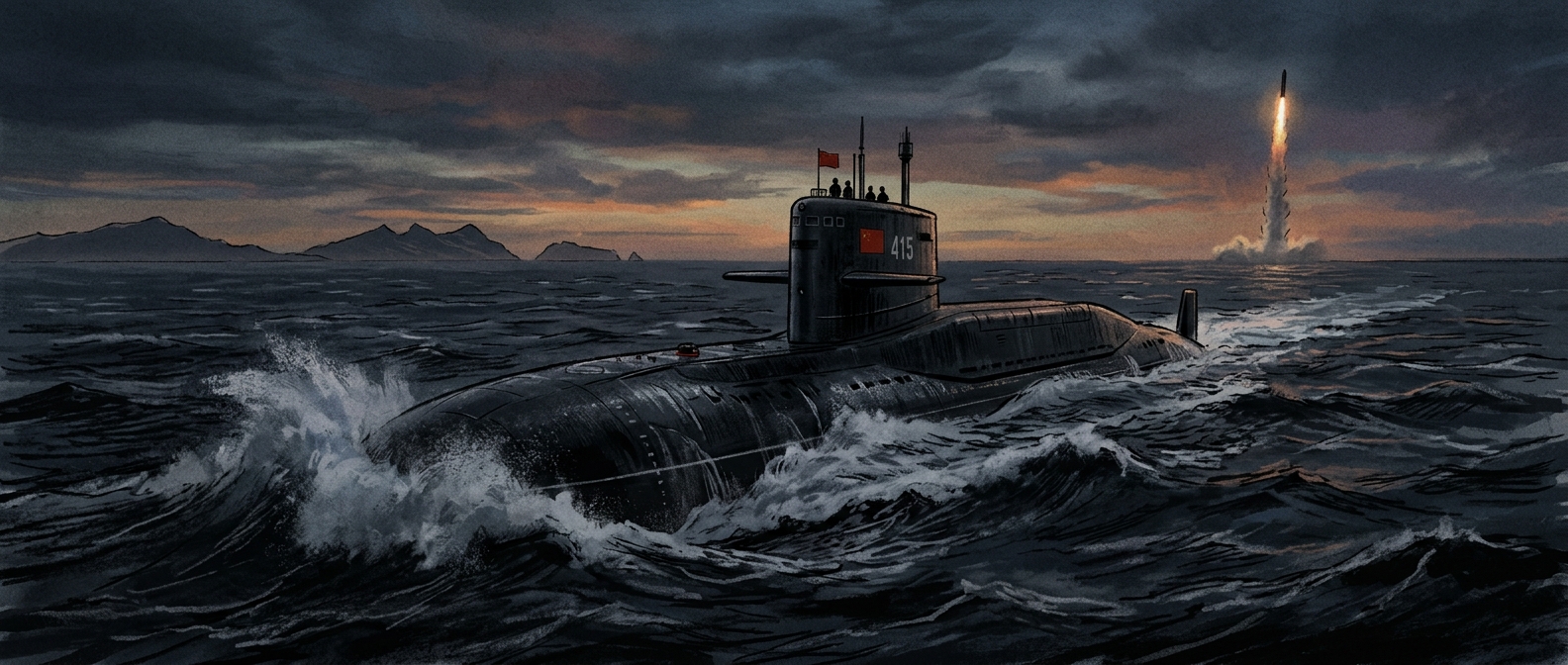
Chinese state media confirmed the launch at 12:01 Beijing time (04:01 GMT), with the missile "accurately landing in the predetermined sea area." The PLAN did not name the platform, the boat, or the missile. Independent trajectory analysis by astronomer Jonathan McDowell and open-source trackers cited by The War Zone placed the flight at roughly 7,300 km on a suborbital arc from the Bohai Sea, with the reentry vehicle coming down near 174°E 6°S — west of the Solomons. Two separate Chinese navigation warnings, one anchored on the Yellow Sea and another on the northern South China Sea, suggested Beijing was prepared to launch from either box.
The missile was either a JL-2 or the newer JL-3. China's official China Military Bugle account paired the announcement with stock imagery of both. If the flight distance approximated maximum range, physics point to the older JL-2; if this was a demonstrated capability short of its ceiling, it was the JL-3 the PLA paraded for the first time at Beijing's September 2025 Victory Day event. The
Center for Strategic and International Studies assessed the JL-3 as an extended-range variant with a possible range above 5,400 nautical miles — enough to hold most of the continental United States at risk from waters close to China's coast.
The platform is not in doubt. China's only in-service ballistic-missile submarines are the Type 094 Jin class. The International Institute for Strategic Studies has documented an unprecedented shipbuilding tempo at Huludao: the IISS Military Balance noted in February 2026 that between 2021 and 2025 Beijing launched more nuclear-powered submarines by tonnage than the United States, including a seventh and eighth Type 094. The next-generation Type 096 — quieter, longer-legged, MIRV-capable — is expected in the water this decade.
The primary document: what Beijing said, what Washington heard
The PLAN's own release framed the test as "not directed against any specific country or target." That language is a legal claim as much as a diplomatic one: China is a state-party to Protocols II and III of the Treaty of Rarotonga, the 1985 South Pacific Nuclear Free Zone agreement, undertaking not to threaten Pacific parties with nuclear devices and not to test them inside the zone. The dummy warhead and the target box's location outside the treaty area let Beijing argue it stayed inside the letter. The spirit, Pacific capitals note, was pulverized.
The US State Department response was pointed. Spokesperson Tommy Pigott said Washington had "monitored China's test launch from a submarine of an unarmed intercontinental-range ballistic missile" and called on Beijing — a permanent UN Security Council member — to accept a standing notification mechanism for ICBM and space launches. The Pentagon's 2024 China Military Power Report is now the operating baseline: DoD estimates the PRC surpassed 600 operational nuclear warheads by mid-2024 and will exceed 1,000 by 2030. Sunday's launch is a physical demonstration of the sea-based half of that curve.
Japan, which received advance notice only 90 minutes before launch after being told a day earlier of "falling space debris" over waters south of Cape Shionomisaki, protested through Chief Cabinet Secretary Kihara Minoru, calling China's opacity "a matter of serious concern." New Zealand Foreign Minister Winston Peters, quoted by Al Jazeera, called it an "unwelcome and concerning development." Australia's Penny Wong labelled the launch "destabilizing." Nothing in that chorus was surprising. The Pacific response was.
The Pacific said no — and that is the story
The most consequential reaction did not come from a capital with a nuclear-weapons portfolio. It came from Honiara. Solomon Islands Prime Minister Matthew Wale, standing beside Albanese on the country's 48th Independence Day, said the missile test was "not something a friend does." That is the same Honiara that stunned Canberra in 2022 by signing a security pact with Beijing. In the space of four years, the political ground has moved.
That movement is the reason the timing of the test looks less like precision signalling and more like an unforced error. As Oliver Nobetau of the Lowy Institute put it, "A missile test makes Pacific countries spectators in their own region, much like they were during the Second World War." Nobetau's argument — echoed by USSC chief executive Michael Green, who told The Australian that Beijing wanted "to intimidate Pacific island nations and Australia, and to demonstrate there will be punishment" for security agreements with Canberra — is that the demonstration effect has inverted. Instead of chilling Pacific leaders on further deals with Australia, the launch handed Albanese the moral case for signing more of them.
The evidence is on the ledger. Days before the launch, Australia had concluded the Nakamal Agreement with Vanuatu, a country where Beijing is the largest external creditor. On the morning of the launch, Australia and Fiji progressed the Vuvale Union alongside the Ocean of Peace Alliance — a treaty the BBC framed as an alliance explicitly designed to counter Beijing's regional footprint. On July 8, the Pukpuk Treaty with Papua New Guinea entered into force, with Tongan Prime Minister Lord Fakafanua and PNG's James Marape in Canberra. That is four Pacific security instruments in nine days. As the
Center for Strategic and International Studies noted in May, each contains a "consultation clause" giving Canberra a formal say when a partner considers letting Beijing into sensitive areas.
Why Beijing did it anyway
Three motives fit the evidence. The first is capability signalling to Washington. Coming two days after the United States' 250th Independence Day, the launch — if it was the JL-3 — was a reminder that Beijing's second-strike capability is no longer theoretical. That message tracks with the pattern set by the September 2024 ICBM launch into the Pacific and with the September 2025 parade, at which China publicly displayed the JL-3, the JL-1 air-launched ballistic missile and the DF-5C for the first time.
The second is domestic. Chinese state media framed the launch as validation of the sea-based leg of the nuclear triad. Coming amid ongoing Rocket Force corruption purges disclosed in the DoD's 2024 report, a public demonstration that the Navy's boomer force works served as an internal reassurance as much as an external one.
The third is coercive theatre aimed at the Pacific. The Global Times editorial cited by The Economist called the test "necessary and restrained" and told critics they would "have to accept and get used to" China exercising this reach. That is not the vocabulary of routine training. It is the vocabulary of a regional order Beijing is trying to codify by demonstration.
The problem for Beijing is the audience. Taiwan National Security Council Secretary-General Joseph Wu posted publicly that the missile flew "along the route from the South China Sea past the Philippines" — a claim independent trackers dispute, but a reminder that from Manila's angle every Chinese launch is now filed under Taiwan-crisis rehearsal. The Philippines, under a Marcos administration deepening EDCA access with the United States, needs no further push. And in Taipei, where the SWP Berlin has warned that Trump-era transactionalism is eroding faith in U.S. security guarantees, a visible Chinese sea-based deterrent complicates any American calculus of intervention over the Strait.
Diplomat View
The launch was a strategic signal that arrived at the wrong address. Beijing wanted Suva, Port Vila and Honiara to conclude that Australian security pacts carry a cost; instead, it wanted the Pacific to see Australia as an alternative that arrives without missile plumes. On present evidence — Wale's public rebuke, the Nakamal-Vuvale-Pukpuk sequence, the confirmed Ocean of Peace framework — the coercion is failing on its stated terms. The forecast: expect at least two more Australian bilateral security agreements before the Pacific Islands Forum Leaders' Meeting in September 2026, and expect the Chinese Ministry of National Defense to normalise Pacific-directed strategic launches as a demonstration cadence, not a one-off. What would change this call? A Pacific capital publicly declining an Australian security instrument in the next 90 days, or a Chinese offer of a binding no-first-use assurance to Rarotonga parties. Neither is on the table. What is on the table is a hardening lattice around the Second Island Chain that Beijing's own submarine just helped weld shut.
What to watch next
- September 2026 — PIF Leaders' Meeting: whether Australia secures a Pacific-wide security architecture endorsement built on the Ocean of Peace framework, and whether the U.S. arrives with ambassadors at post after CSIS flagged the vacancy earlier this summer.
- Q3 2026 — Type 096 launch indications: fresh commercial imagery of Huludao is the tell. A first-of-class Type 096 in the water reprices every deterrence estimate in this piece.
- Vanuatu's parliamentary vote on Nakamal ratification: Beijing came close to a competing agreement earlier in 2025; the ratification margin will be the clearest single index of whether the July 6 launch shifted a Pacific vote toward or away from China.
The Bottom Line
China's July 6 SLBM test proved the technology and lost the politics. In the same 24 hours Beijing demonstrated it can hold the U.S. mainland at risk from a submerged platform, Pacific leaders — including a Solomon Islands prime minister who signed with Beijing in 2022 — publicly sided with Canberra's alternative. The lesson for policymakers in Global Politics is unambiguous: a credible undersea deterrent buys Beijing standing in Washington, but it is now actively costing it standing in Suva, Honiara and Port Vila — and that is the trade the next decade of Indo-Pacific alignment will be settled on.
Discover more

US Politics
SNAP Food Assistance Faces Legal Challenges
In 2026, SNAP faces stricter eligibility rules and mounting legal challenges, threatening food assistance for the millions of Americans who rely on the program.

US Politics
US Launches $166B Tariff Refund Portal
The US is launching a $166 billion tariff refund portal to aid importers hit by Trump-era tariffs, with major implications for trade and supply costs.

India
India-South Korea $50B Trade Expansion Plan
India and South Korea target $50 billion in bilateral trade by 2030, focusing on industrial cooperation and strategic alignment amid US pressures.

Conflict & Security
Drone Warfare Killing Aid Workers at Unprec
Over 1,000 humanitarian workers killed in three years as cheap armed drones collapse legal protections. Gaza, Sudan, Ukraine, and DRC see deliberate targeting of aid convoys and hospitals with zero prosecutions.