China's Monkey Cartoon Tests ASEAN Unity
Beijing refuses apology for racist AI video as ASEAN ministers meet.
Model Diplomat8 min readSoutheast Asia
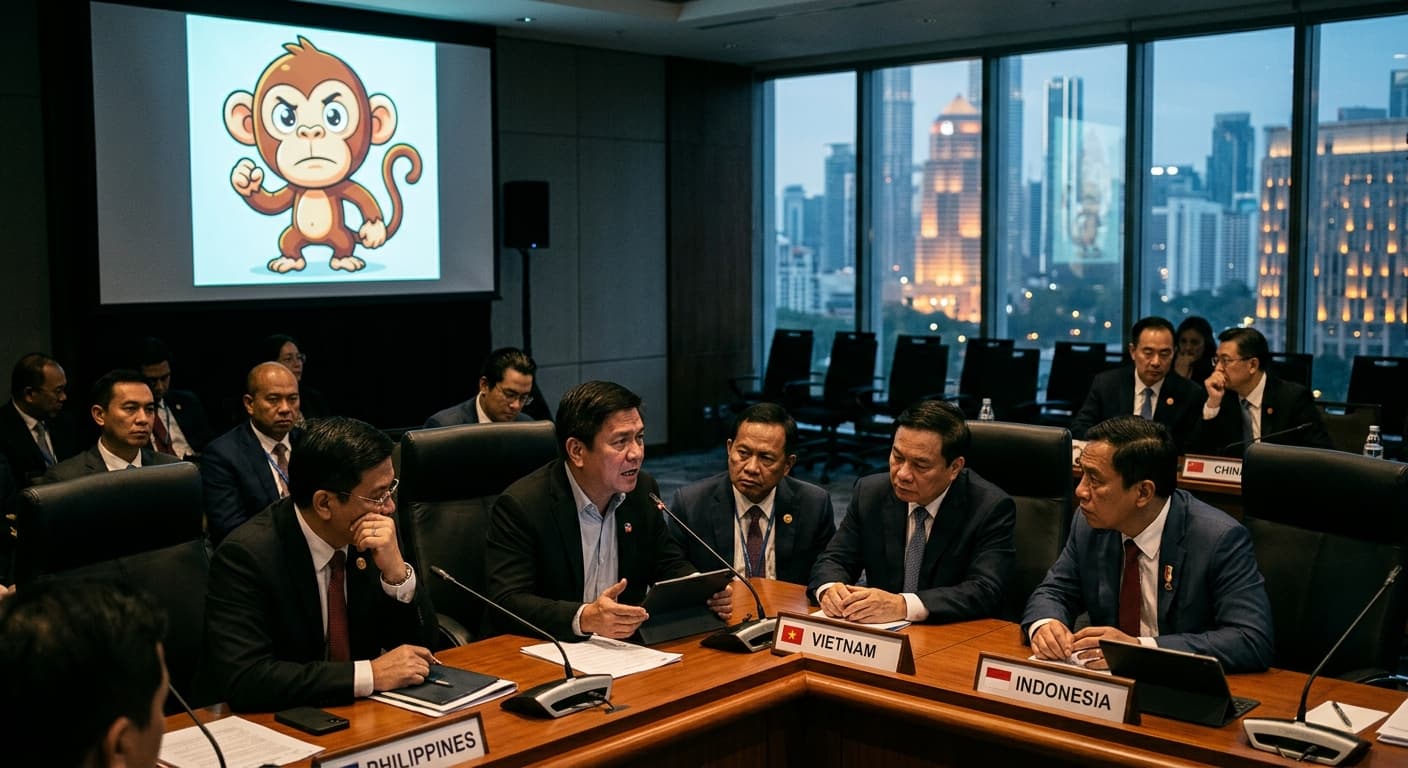
Beijing's Monkey Cartoon Wasn't a Gaffe — It Was a Stress Test for ASEAN Unity, and Manila Knows It
China's refusal to apologize for a state-media video depicting Filipinos as monkeys — timed to the 10th anniversary of the landmark South China Sea ruling — forces ASEAN members to pick sides just as their foreign ministers gather in Manila.
On July 19, 2026, China's foreign ministry spokesman Lin Jian stood at a regular press briefing in Beijing and declined to apologize for a state-media video that used AI to depict Filipinos as a monkey in a Barong Tagalog. Instead, he pivoted to calling the 2016 Permanent Court of Arbitration ruling — which invalidated Beijing's sweeping nine-dash-line claims — "a political farce masquerading as a legal process." The nine-word dismissal did more than stonewall Manila's formal diplomatic protest. It dared the entire Association of Southeast Asian Nations to respond collectively, exactly as Chinese Foreign Minister Wang Yi prepares to board a plane for the 59th ASEAN Foreign Ministers' Meeting in the Philippine capital. The calculation is straightforward: if Beijing can deploy racialized AI propaganda through a state-owned outlet against its most vocal ASEAN critic — and pay no diplomatic cost — then the bloc's leverage on South China Sea issues is a fiction.
The video and the protest
The offending content appeared on July 10, 2026, on the official Facebook page of China Daily, the English-language newspaper owned by the Central Propaganda Department of the Chinese Communist Party. According to BBC News, the AI-generated clip showed a monkey in traditional Filipino attire screaming as arms bearing the U.S. and Japanese flags shoved it onto a karaoke stage aboard a boat. The monkey is then scolded for singing the wrong song, pulls out a document labeled "South China Sea arbitration award," and is flung into the sea and blasted by a water cannon — a direct visual reference to the water cannons Chinese coast guard vessels have deployed against Philippine resupply missions for years.
The video was not an isolated piece of content. It belonged to a series of clips and cartoons China Daily had posted over several weeks mocking the Philippines, including depictions of Manila as a clown and a snake, BBC News reported. The monkey video, however, crossed a qualitatively different line — deploying one of the most visceral racial slurs in the Asia-Pacific colonial lexicon, a trope with its own documented history of aggravating diplomatic disputes.
The Philippine response was rapid and multi-channel. Foreign Affairs Undersecretary Leo Herrera-Lim confronted Chinese Ambassador Jing Quan in a tense face-to-face meeting on the evening of July 16, demanding the video's immediate removal. On July 17, the Department of Foreign Affairs filed a formal diplomatic protest, branding the content "blatantly demeaning, dehumanizing, and racist," according to The Manila Times. The Philippine Embassy in Beijing separately published an open letter to China Daily's editor, flagging a "breach of editorial norms and principles,"
Al Jazeera reported.
Defense Secretary Gilberto Teodoro Jr. — whom Beijing had already sanctioned with an entry ban on June 11 for his criticism of Chinese maritime conduct, Al Jazeera noted — issued the sharpest personal rebuke. He called the video evidence of "the moral and intellectual bankruptcy of China's propaganda machine" and described recent Chinese Communist Party conduct as "schizophrenic behavior."
Beijing's refusal and the legal pivot
Lin Jian's July 19 briefing response contained two moves. First, a denial of responsibility: the video "does not represent the government position," he said, claiming it fell outside his mandate to comment. Second, a deliberate pivot to substance — the 2016 South China Sea arbitral award itself. Lin did not merely repeat Beijing's decade-old position of non-recognition. He escalated the language, calling the tribunal's award "illegal, null and void, and has no binding force" while framing Manila's reliance on the ruling as the real source of regional instability.
The 2016 award, issued on July 12 of that year by a five-member tribunal constituted under Annex VII of the United Nations Convention on the Law of the Sea, ruled that China's sweeping claims in the South China Sea had no legal basis under international law. The tribunal found that disputed features — including Scarborough Shoal and features in the Spratly Islands — were rocks or low-tide elevations incapable of generating exclusive economic zones, according to the award text published in the United Nations Reports of International Arbitral Awards. China has never participated in the proceedings and has rejected the ruling from the moment it was handed down at the Permanent Court of Arbitration in The Hague.
What is new in July 2026 is Beijing's decision to fuse that legal rejection with racialized state-media content targeting Filipinos specifically — at the exact moment the arbitral award's 10th anniversary puts it back on the diplomatic agenda.
A playbook refined since 2017
The method is not new. In 2017, Chinese state media outlet Xinhua published a video titled "7 Sins of India," featuring a Chinese actor in a Sikh turban speaking in an exaggerated Indian accent while a presenter listed Chinese grievances over the Doklam border standoff. That video, BBC News reported at the time, drew immediate accusations of racism from Indian outlets and the UK-based Sikh Press Association, which noted the targeting of a minority that makes up less than 2% of India's population.
The Philippines video represents an evolution of the tactic in three respects. First, the technology changed: AI generation lowers the production cost of inflammatory content to near zero, making it repeatable and scalable in a way that hiring actors in costumes never was. Second, the racial coding is more pointed — the monkey slur carries a specific colonial history in Southeast Asian contexts that the Doklam video's crude Indian caricature did not. Third, and most consequentially, the timing is calibrated to a multilateral diplomatic event — not merely a bilateral border spat.
The ASEAN meeting in Manila
The 59th ASEAN Foreign Ministers' Meeting is scheduled to take place in Manila in late July 2026, Manila Bulletin confirmed on July 16. Wang Yi and U.S. Secretary of State Marco Rubio are both expected to attend. The meeting also marks the 50th anniversary of the Treaty of Amity and Cooperation in Southeast Asia — a milestone the host country had hoped would showcase ASEAN's diplomatic maturity.
Instead, Wang will walk into a room where the host government has just formally accused his country's state media of racism. The agenda includes the South China Sea disputes that have grown sharper throughout 2026. According to the CSIS Asia Maritime Transparency Initiative, China Coast Guard presence at Scarborough Shoal in the first half of 2026 surged to record levels, averaging roughly 19 interaction-days per month with Philippine patrol vessels — up from an already record-setting 2025. AMTI documented 112 total interaction days in the six-month period.
Who wins, who loses
The immediate winner is Beijing's hardline faction. The propaganda apparatus under the Central Propaganda Department has demonstrated impunity — it can publish dehumanizing AI content, trigger a formal diplomatic protest, and face no concession. The video remains on China Daily's Facebook page as of publication, BBC News confirmed, signaling that the take-down demand will not be met. Domestically, the episode feeds a nationalist narrative that casts China as besieged by ungrateful neighbors doing Washington's bidding — and unwilling to abide by even the performative norms of diplomatic discourse.
The intermediate loser is ASEAN cohesion. The bloc operates by consensus, and no consensus will form around joint condemnation of Beijing's propaganda. Member states with their own South China Sea claims — Vietnam, Malaysia, Brunei — are now watching to see whether any collective statement emerges from the Manila meeting, and whether it names China Daily's conduct or is watered down to generic calls for restraint. Cambodia and Laos, the two ASEAN members closest to Beijing on maritime issues, face the opposite pressure. The result, in all likelihood, is a communiqué that satisfies no one — and the quiet degradation of ASEAN's relevance as a forum for managing South China Sea tensions.
The longer-term loser may be Beijing itself. The monkey video inflames precisely the political constituency in the Philippines most committed to the Enhanced Defense Cooperation Agreement with the United States and the deepening of Manila's alliance relationships with Japan, Australia, and France. Defense Secretary Teodoro — already under personal Chinese sanctions — now has fresh ammunition for his argument that engaging Beijing diplomatically is futile. The Philippine Senate, which passed a resolution in February 2026 condemning the Chinese embassy's "improper" intervention in domestic affairs, Al Jazeera reported, will find the video a powerful exhibit in any future debate over downgrading relations.
Diplomat View
The monkey video is best understood not as a propaganda gaffe but as a deliberate escalation in Beijing's information-warfare toolkit — one that serves four strategic functions simultaneously.
First, it tests the floor. If a state-owned outlet can publish AI-generated racist content targeting a sovereign neighbor's population and face no meaningful consequence, the boundary of acceptable state behavior shifts — and Beijing learns it can push further. Second, it disrupts the ASEAN meeting's agenda. Wang Yi's counterparts cannot pretend the video does not exist; the host country's foreign ministry has put it on the formal diplomatic record. Third, it signals to Washington that Beijing will not be shamed into restraint — and that Rubio's presence in Manila does not alter the calculus. Fourth, it binds the Chinese propaganda apparatus more tightly to Communist Party foreign-policy goals, making future rhetorical escalation easier to authorize.
The counterparty that matters most is not the Philippines — it is Vietnam. Hanoi has its own territorial disputes with Beijing, its own arbitration option under UNCLOS, and its own calculation about whether international law provides a meaningful shield. Watching Manila fight a solo battle against state-media racial caricatures while ASEAN produces a non-statement will shape that calculation more than any legal brief ever could.
The key variable to watch over the next two weeks is whether any ASEAN foreign minister — beyond the Philippine delegation — raises the China Daily video in a bilateral meeting with Wang Yi, and whether that exchange is made public. If the answer is no, the lesson for Beijing will be unambiguous.
• What to watch next: Wang Yi's bilateral meeting with Philippine Foreign Affairs Secretary Enrique Manalo on the margins of the ASEAN gathering; any mention of the video in the ASEAN foreign ministers' joint communiqué; whether China Daily removes the content or publishes additional installments in the series before the meeting concludes.
The Bottom Line
Beijing's refusal to apologize for a state-media video depicting Filipinos as monkeys is not about the video. It is about establishing a new floor for what state-backed outlets can do to a rival nation's population without diplomatic consequence — and doing so at the moment the region's foreign ministers are gathering in that nation's capital. The cost will not be paid in Beijing; it will be paid in ASEAN's diminishing credibility as a forum that protects its members from coercion in any form. If Wang Yi leaves Manila without any counterpart beyond Manila having raised the issue, the 2026 ASEAN chairmanship — and the 50th anniversary of the Treaty of Amity — will be remembered for something the host country did not want to commemorate at all.
Discover more

US Politics
US Launches $166B Tariff Refund Portal
The US is launching a $166 billion tariff refund portal to aid importers hit by Trump-era tariffs, with major implications for trade and supply costs.

US Politics
White House Pressures Congress for Crypto Leg
The Trump administration's push for the CLARITY Act aims to reshape crypto regulation, impacting trillions in market value and the Trump family's wealth.
Global Politics
Xi Jinping Calls China-Russia Ties 'Precious'
Xi Jinping's description of China-Russia ties as 'precious' reflects a strategic imbalance, with Beijing dictating terms in the partnership.

Economics
Fed's Amex AML order puts correspondent banking on notice
Federal Reserve's Amex AML order requires board-level controls and a 90-day plan; OCC fined the bank $350 million over enterprise-wide deficiencies.