China's Legal Challenge to Philippine Claims
Beijing critiques Manila's South China Sea stance ahead of arbitration anniversary
Model Diplomat8 min readAsia
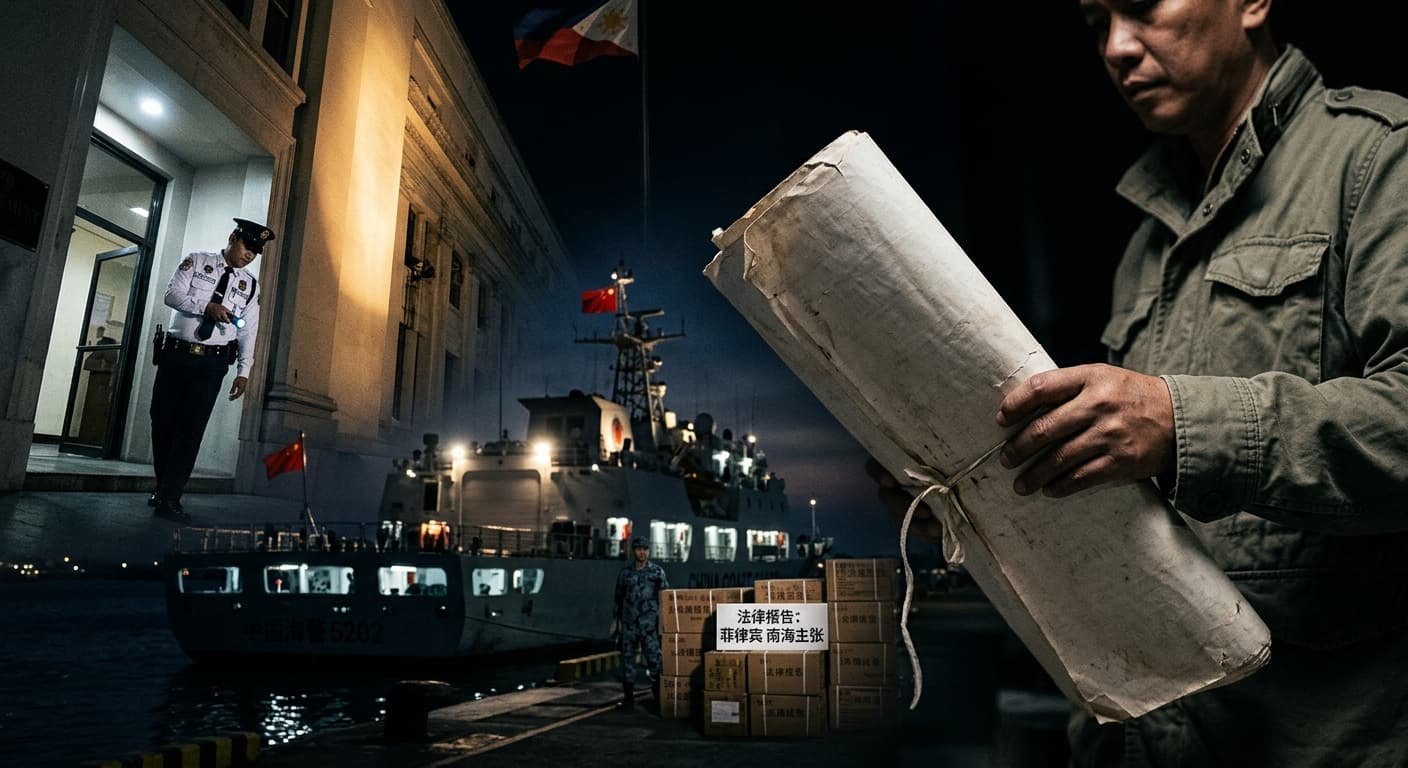
China's Legal Broadside Times Manila's Arbitration Anniversary
China's Ministry of Natural Resources issued a legal critique of Philippine South China Sea claims on July 8, 2026 — four days before the 10th anniversary of the Hague ruling that gutted Beijing's own case.
Beijing's new legal paper is not a jurisprudential exercise. It is a pre-emptive strike. On July 8, 2026 — four days before the tenth anniversary of the arbitral award that invalidated most of China's claims in the South China Sea, and two days before Manila hosts an international UNCLOS conference to mark it — the China Institute for Marine Affairs (CIMA), the research arm of the Ministry of Natural Resources, released a report titled Historical and Legal Critique of the Philippines' Territorial Claims in the South China Sea. According to China Daily, the report argues that Philippine claims to Scarborough Shoal (Huangyan Dao) and features in the Nansha (Spratly) Islands are "devoid of historical and legal foundation" and undermine the post-World War II order. The substance is old; the point is the calendar.
Under Ferdinand Marcos Jr., Manila has more than tripled the number of governments publicly demanding Chinese compliance with the 2016 award — from eight when he took office in July 2022 to 26 plus the European Union, according to CSIS. Beijing's response is to launch a parallel legal narrative aimed at the same third-country audiences and frame the Philippines — not China — as the revisionist. That is the real story on the wire.
The document, and what is new about it
CIMA's report reprises Beijing's long-standing argument that Philippine territory was fixed by three international treaties — the 1898 Treaty of Paris, the 1900 Treaty of Washington, and the 1930 UK–US Convention on the North Borneo boundary — and that Huangyan Dao and Nansha features lie outside those limits. That framing has been Chinese Foreign Ministry boilerplate at least since July 2016, when Beijing rejected the arbitral award as "null and void" in its official statement on the award and reiterated that "Nanhai Zhudao, including Ren'ai Jiao, is completely beyond the limits of Philippine territory,"
per a subsequent MFA remarks paper.
What is new is the packaging. State-linked Bastille Post describes the CIMA text as "the first comprehensive legal assessment" of Philippine claims produced under China's official maritime research apparatus. Beyond the treaty argument, it deploys three sharper legal instruments: an estoppel claim — that Manila's post-1970s assertions contradict its own prior positions — a specific reliance on Philippine domestic maps that placed Scarborough Shoal outside national territory, and the assertion that Manila's 2024 Maritime Zones Act represents unilateral "expansionism." That law, signed by Marcos on November 8, 2024, codified the 2016 award into Philippine domestic law,
according to CSIS analyst Gregory Poling; Beijing responded within 48 hours by publishing territorial baselines around Scarborough Shoal.
The document also lands inside a broader operational campaign. On June 30, 2026, the PLA Southern Theatre Command's navy, air force and coast guard conducted "combat-readiness" patrols around Scarborough Shoal immediately after a five-day US–Philippines joint maritime exercise, per wire reports. In September 2025, China declared a nature reserve at the same feature — a designation the US and the Philippines rejected as unlawful,
according to the Congressional Research Service. The pattern is legal warfare and gray-zone pressure moving in lockstep.
Where the argument is strong — and where it isn't
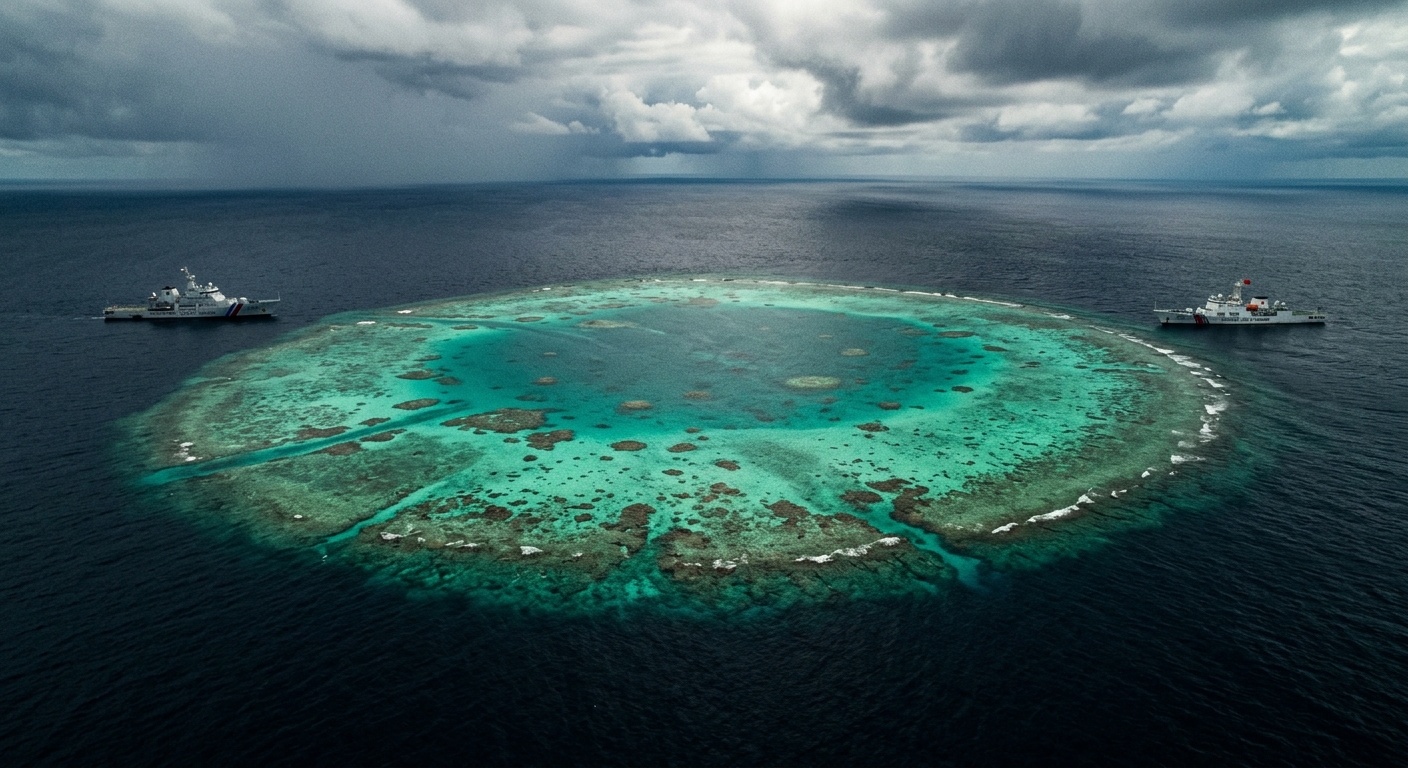
The strongest piece of Beijing's brief is the treaty-limits point on Scarborough Shoal, and Manila knows it. Retired Philippine Supreme Court Justice Antonio Carpio, the country's most influential maritime lawyer, has publicly acknowledged in a lecture archived by the Egmont Institute that "Scarborough Shoal is outside the treaty lines" of the 1898 Treaty of Paris. His counter-rests on the 1900 Treaty of Washington, under which Spain ceded "all title and claim of title… to any and all islands belonging to the Philippine Archipelago, lying outside the lines" of Paris — the exact clause the CIMA report either downplays or ignores. In 1938, a US State Department memo to the Secretary of War concluded that Scarborough "should be regarded as included among the islands ceded to the United States by the American-Spanish Treaty of November 7, 1900," Carpio's lecture notes.
The map argument cuts both ways. Chinese analysts point to 20th-century Philippine survey maps that placed Scarborough outside national territory. Filipino scholars point back to the 1734 Murillo Velarde map and an 1899 US-issued Mapa General, Islas Filipinas that mark the shoal as Bajo de Masinloc within the archipelago, according to a University of the Philippines primer on the West Philippine Sea. Distance is unhelpful to Beijing: the shoal sits about 124–126 nautical miles from Zambales on Luzon and roughly 594 from Hainan,
per Al Jazeera.
The report's weaker flank is UNCLOS. The 2016 award — issued unanimously by a five-judge tribunal at the Permanent Court of Arbitration under Annex VII — ruled that Scarborough Shoal is a "rock" entitled only to a 12-nautical-mile territorial sea, that China's historic-rights claim within the nine-dash line was extinguished by its 1996 ratification of UNCLOS, and that Second Thomas Shoal and Mischief Reef sit on the Philippine continental shelf, per the CSIS ruling analysis. China's rejoinder — that the tribunal "exceeded its mandate" because sovereignty and delimitation were excluded from compulsory arbitration by its 2006 declaration — was offered again by Foreign Minister Wang Yi in Kuala Lumpur on July 11, 2025,
per the Chinese MFA. That jurisdictional argument was heard and rejected by the tribunal in 2015. It has not improved with age.
Beijing's Taiping Dao gambit is the one that alarms UNCLOS lawyers most. Wang insisted the tribunal wrongly classified Taiping — the largest Spratly feature at 500,000 square meters — as a rock; if applied globally, he argued, the standard would strip the United States and Japan of maritime rights around their own remote holdings. That is a rhetorical trap aimed at Washington and Tokyo, not a legal defence: no other claimant has adopted it, and Taiwan, which actually occupies Taiping, has been ambiguous.
Who benefits, who loses
The CIMA report is aimed at three audiences.
The first is the Global South constituency Manila is courting for a possible UN General Assembly resolution or International Court of Justice advisory opinion on Chinese compliance. Philippine officials have been exploring a second Annex VII arbitration since 2024, CSIS reports, and Manila is angling for a non-permanent UN Security Council seat in 2027. If Chinese diplomats can persuade even a dozen African, Gulf or Latin American states that Philippine claims are colonial-era cartography dressed as international law, Manila's future vote count softens. CSIS estimates Manila could count on at least 44 UNGA votes today against just seven publicly for Beijing — the remaining 139 states are the real battlefield.
The second is ASEAN. The Philippines chairs the bloc in 2026, and Foreign Secretary Ma. Theresa Lazaro told CSIS on June 4, 2026 that concluding a Code of Conduct with China by year-end is Manila's flagship deliverable, with monthly drafting sessions now underway on scope, legal-bindingness, the DOC linkage, and the still-undefined term "self-restraint." Chatham House
judged in December 2025 that agreement is unlikely; the CIMA broadside hardens Beijing's rhetorical baseline just as the endgame approaches. The unstated Chinese ask — that any COC supersede UNCLOS — remains the actual obstacle,
Foreign Affairs argues.
The third audience is domestic Chinese and regional scholarly opinion. Positioning the Ministry of Natural Resources and CIMA — not just the Foreign Ministry — as the messenger signals institutionalisation. It says: this is not a diplomatic talking point, this is settled Chinese jurisprudence that state institutions will litigate over years.
The winners in this reframing are two-fold. Beijing wins if enough undecided capitals begin to see the South China Sea as a bilateral treaty dispute with competing merits rather than a settled UNCLOS matter. And Philippine Vice President Sara Duterte — currently feuding with Marcos and drawing on her father's more Beijing-friendly base, per Chatham House — benefits domestically from any narrative that questions the cost-benefit of Marcos's assertive line.
The losers are the Code of Conduct process itself; the ASEAN Maritime Centre that Manila is trying to stand up in Cebu, whose credibility depends on treating the 2016 award as settled law, per MP-IDSA; and the Philippine energy sector. Manila's natural gas reserves at Malampaya are running down, and if Beijing keeps the Reed Bank and adjacent shelf areas legally contested, Philippine offshore exploration remains frozen. Foreign Affairs warned that this could push Marcos toward accepting Chinese joint-development terms he had already floated in March 2026 during a state of emergency triggered by the closure of the Strait of Hormuz.
The historical parallel worth noting: Mauritius won a 2015 UNCLOS Annex VII ruling against the United Kingdom over the Chagos Archipelago and, unlike Manila under Duterte, kept pushing — winning an ICJ advisory opinion in 2019 and eventually forcing London toward a settlement. Beijing understands that legal victories only bind when the winner keeps the argument alive. Its July 8 report is designed to fill the airtime before Manila can.
What to watch next
- July 10, 2026 — Manila's UNCLOS 10th-anniversary conference. Watch which foreign ministers show up. If the count moves above 26+EU on public statements demanding Chinese compliance, the CIMA report has failed at its main task.
- July 12, 2026 — Anniversary of the award. Expect competing statements from the Chinese MFA and the Philippine DFA; watch whether Washington's statement, following the
State Department's endorsement of Manila's 2024 laws, names Scarborough Shoal specifically.
- Q4 2026 — Code of Conduct endgame. Lazaro's stated target is year-end; the real question is whether Manila accepts a non-binding political document or walks away.
- September 2026 — UN General Assembly. Watch for a Philippine-led resolution or hints of an ICJ advisory-opinion request.
Diplomat View
Beijing's July 8 report will not shift the legal reality: the 2016 award is settled international law and, as Philippine Foreign Secretary Lazaro put it to CSIS, "final, binding, and nonnegotiable." But that is not the fight China is picking. The CIMA paper is a diplomatic instrument aimed at the 139 UN member states with no public position, at ASEAN's soft consensus, and at Filipino voters who will decide the 2028 election. The forecast: Manila's Code of Conduct target will slip past December 2026, and the Marcos government will pivot to a UN General Assembly resolution track by mid-2027. Revise this call if Beijing signals flexibility on the "self-restraint" definition before the October ASEAN summit — that would suggest the CIMA report is cover for a real concession, not a substitute for one. Absent that, the tenth anniversary marks not a resolution but the opening of a second decade of legal trench warfare, fought less at sea than in third-country foreign ministries.
Discover more

India
India-South Korea $50B Trade Expansion Plan
India and South Korea target $50 billion in bilateral trade by 2030, focusing on industrial cooperation and strategic alignment amid US pressures.
Global Politics
Trump's Conflicting Messages on Iran War
Trump's mixed messages on Iran reflect a strategy of audience management, benefiting Tehran amid a complex geopolitical landscape.
India
UN Expert Albanese: India Violates Law
UN Rapporteur Francesca Albanese accuses India of breaching international law, spotlighting human rights concerns in Kashmir and prompting diplomatic pushback.

Economics
Fed's Amex AML order puts correspondent banking on notice
Federal Reserve's Amex AML order requires board-level controls and a 90-day plan; OCC fined the bank $350 million over enterprise-wide deficiencies.