China's Kinmen Campaign: The Deceptive Calm
China's 30-month campaign to desensitize Taiwan through incremental incursions
Model Diplomat8 min readEast Asia
When Harassment Becomes Invisible: China's Kinmen Campaign and the Deceptive Calm Masking Escalation
A methodical 30-month operation. Twenty-four incursions this year alone. Four vessels pushing into restricted waters two days after a typhoon. The real warning isn't the incursions — it's how little anyone outside Taiwan's coast guard command still notices them.
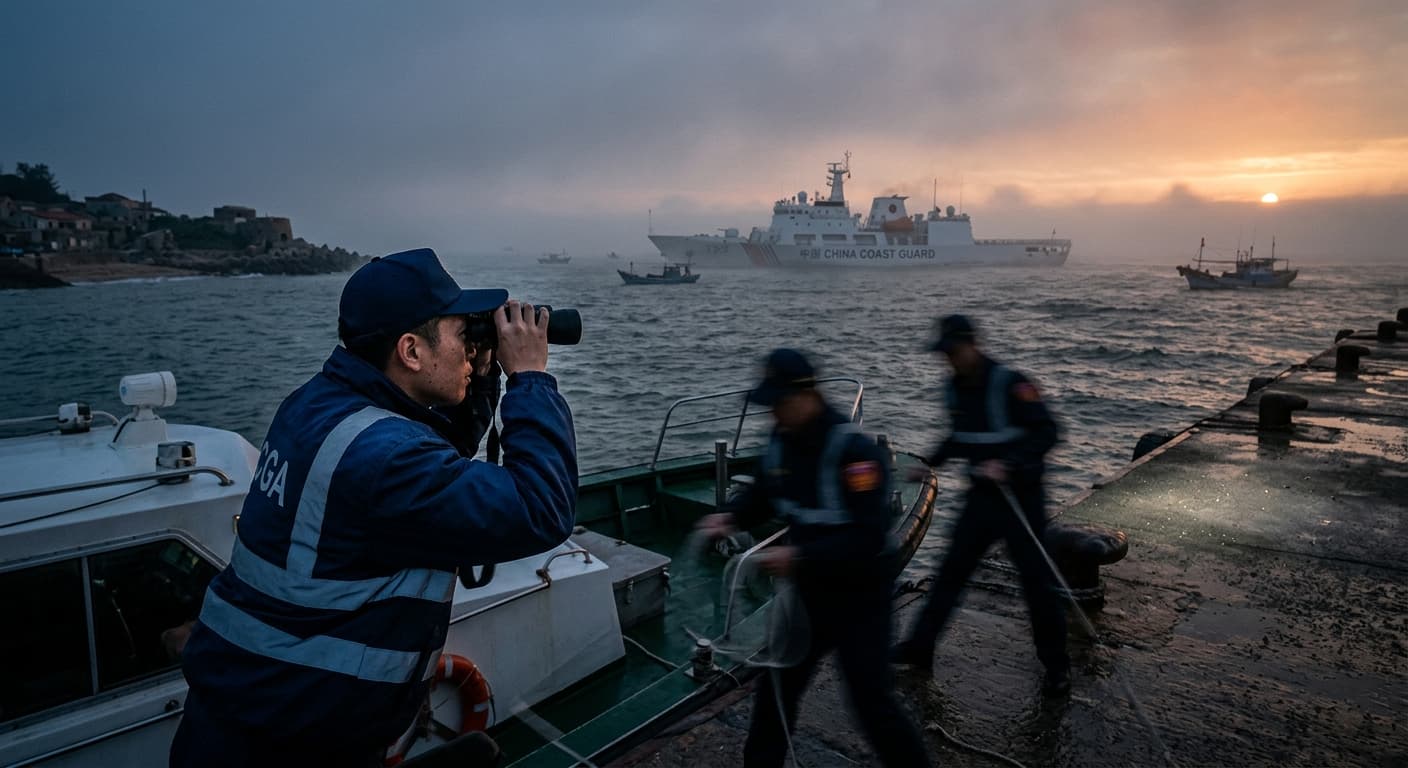
On July 14, 2026, four Chinese coast guard vessels sailed into restricted southern waters around the Kinmen Islands — a Taiwanese-controlled archipelago sitting just 6.2 miles from the Chinese mainland. They remained for several hours, ignoring radio warnings, before departing around 5 p.m. The maneuver, Taiwan's Ocean Affairs Council later stated, was an "irrational, unprofessional, and unsafe harassment operation" launched barely two days after Typhoon Bavi — the largest storm to hit the territory in nearly 30 years — had cleared the area The Epoch Times.
In any other year, the incursion would have made front pages. In 2026, it marked the 24th such intrusion into Kinmen's restricted waters since January — a figure the Ocean Affairs Council released almost matter-of-factly The Epoch Times.
That shift — from crisis to calendar item — is not a sign of stability. It is the product of a deliberate, multi-year campaign to desensitize Taiwan's public and erode its territorial jurisdiction by increments so small that each one, individually, barely registers.
The Numbers Behind the Normalization
Beijing's gray-zone campaign around Kinmen did not begin with President William Lai Ching-te's inauguration in May 2024, but it accelerated sharply after a fatal boat chase on February 14 of that year, when a Chinese motorboat capsized during a Taiwan Coast Guard pursuit and two Chinese nationals drowned. Beijing declared it would increase patrols. It delivered.
According to AIS-based analysis by the CSIS Asia Maritime Transparency Initiative, Taiwan's Coast Guard Administration faced an average of 13 Chinese Coast Guard entrances per week across the Kinmen and Matsu islands in 2024 — more than triple the 2022 weekly average CSIS AMTI. In May 2024, a record 11 Chinese government vessels entered Kinmen's waters simultaneously and conducted a maritime exercise with fishing boats. By October, CCG ships were entering restricted waters around Matsu as part of Joint Sword-2024B, a full-scale blockade simulation
CSIS AMTI.
The trajectory continued through 2025. Between January 2020 and December 2025, the daily average of distinct CCG vessels entering Taiwan's near waters increased by more than 500%, with daily incursions into Taiwan's second maritime security ring more than quadrupling, according to a CSIS Futures Lab analysis CSIS. The Pentagon's 2025 annual report to Congress noted that Joint Sword-2024A was the first named exercise to explicitly include Kinmen, Matsu, Wuqiu, and Dongyin as operational zones, integrating CCG assets directly into PLA command-and-control
Department of Defense.
By December 2025, during the Justice Mission-2025 exercises, PLA live-fire drills entered Taiwan's territorial waters — within 12 nautical miles — for the first time, disrupting 857 international flights and cutting air links between Taiwan's main island and Kinmen entirely Al Jazeera. In January 2026, a PLA military drone crossed into Taiwan's territorial airspace — another first
Brookings.
Each escalation was historic at the time. Each is now background noise.
"Threat Fatigue" as a Designed Outcome
Su Tzu-yun, assistant professor at Tamkang University's Graduate Institute of International Affairs and Strategic Studies, told The Epoch Times that the CCP's strategy is explicitly designed to produce desensitization. Beijing is "exploiting severe weather and rough seas to test how Taiwan's military responds, mobilizes, and coordinates across agencies during a crisis" while simultaneously achieving "a lower political cost and minimal international scrutiny" The Epoch Times.
While these operations may not trigger an immediate crisis, they risk inducing threat fatigue among the public. This could condition ordinary citizens and the media to simply tune out the persistent presence of Chinese military aircraft, naval vessels, and drones.
Su's warning echoes the broader expert consensus that normalcy itself is the weapon. Lin Ting-hui, former deputy secretary-general at the Taiwan Society of International Law, told the same outlet that Beijing is relying on "creeping encroachment to steadily hollow out Taiwan's jurisdiction" — and that "such unawareness of the regime's true intentions risks painting Taiwan's standard naval responses as provocative, which is highly detrimental to Taiwan's overall national cohesion" The Epoch Times.
The dynamic is a studied one. In a March 2025 RAND Corporation analysis, researchers identified gray-zone operations as one of seven core elements of CCP political warfare — alongside information manipulation, lawfare, economic coercion, united front work, espionage, and cyber operations — all intended to "reinforce the others by eroding Taiwan's exercise of territorial sovereignty, wearing down its military and law enforcement resources, and eroding the sense of security held by its citizens" RAND.
Taiwan's own top naval commander described the campaign to The Economist as an "anaconda strategy" — "slowly, but surely" constricting the island CFR.
Why Kinmen Is the Fulcrum
Kinmen is not a random pressure point. It is Beijing's most legally and geographically favorable arena.
Under Taiwan's 1992 Cross-Strait Act, prohibited and restricted waters around Kinmen and Matsu extend only 2.2 to 3.2 nautical miles — a fraction of the 12-to-24-nautical-mile regime that applies to Taiwan's main island Congressional Research Service. Beijing has never officially recognized even these narrow boundaries, and since February 2024 it has acted as though they simply do not exist.
Crucially, the Taiwan Relations Act — the 1979 U.S. law that obligates Washington to provide Taiwan with defensive arms — does not explicitly cover Taiwan's offshore islands Congressional Research Service. Beijing is fully aware of this ambiguity and has calibrated its campaign accordingly, pressing Taipei where a direct U.S. response is least likely.
The residents of Kinmen, for their part, are not panicking. An official with the Kinmen Fishermen's Association told NPR in 2024 that "the anxiety we feel now is not even 1% of what we endured when China was shelling us" NPR. A local counselor described the patrols as political theater — "carefully choreographed" to leave daily life largely unaffected. Many Kinmen residents have family and business ties in Xiamen, the Chinese city visible across the water. Ferries still run.
That calm, perversely, is the point. The old artillery barrages of 1954–1979 were also carefully patterned — Beijing fired only on odd-numbered days, only between 7 and 8 p.m., sparing lives but broadcasting a clear message: if tensions worsened, Kinmen would suffer first NPR. Today's incursions operate on the same logic, updated for a conflict below the threshold of open war.
The Simultaneous Squeeze: Washington's Signal
The threat-fatigue problem does not exist in isolation. It coincides with an unprecedented stress test of U.S. reliability.
In May 2026, Acting Navy Secretary Hung Cao told the Senate Appropriations Subcommittee on Defense that a $14 billion arms sale to Taiwan — the largest in history — was being paused to conserve munitions for the U.S.-Israel war on Iran. Cao used the operational code name "Epic Fury" and said sales would resume "when the administration deems necessary" Al Jazeera. President Trump, fresh from a Beijing summit with Xi Jinping, described the package as "a very good negotiating chip" with China
BBC.
The pause came on top of a pre-existing delay: two arms packages worth up to $14 billion had been stalled since before Trump's March 2026 visit to Beijing, according to NPR, driven by concerns about angering China NPR. The cumulative effect on Taiwanese public opinion has been measurable. Confidence that the United States would send troops to defend Taiwan in the event of a Chinese attack dropped from 60–65% in 2020–21 to under 30% by November 2024, according to polling cited by Brookings
Brookings.
Brookings analysts Stephen Tan and Ryan Hass argued in a March 2026 study that "the United States and Taiwan have thus far deterred an attack against the island, but they have failed to deter Chinese coercion below that threshold." Worse, they wrote, Taiwan's response — scrambling jets, warships, and coast guard vessels to monitor every incursion — has become counterproductive, exhausting assets and diverting resources toward fuel and maintenance Brookings.
Beijing, they concluded, "knows it can operate with near impunity."
Domestic Pressures Complete the Loop
Taiwan's ability to respond is also constrained at home. President Lai's proposed $40 billion special defense budget — intended to fund U.S. weapons purchases, indigenous drone programs, and the "T-Dome" integrated air defense system — has been blocked repeatedly by the opposition-controlled legislature. The Kuomintang (KMT), which favors closer ties with China, and the Taiwan People's Party have rejected the bill at least eight times since December 2025 NPR. In May 2026, parliament passed only two-thirds of the requested funding, cutting the portion earmarked for drones and domestically produced weapons
Al Jazeera.
The asymmetry is stark. China's 2025 defense budget was $247 billion. Taiwan's 2026 budget, after a 16% increase, reaches $31 billion — roughly 3.3% of GDP Foreign Affairs. Even the full $40 billion special budget, spread over eight years, would do little to close the gap. And yet, as of mid-July 2026, the special budget remains stalled — even as Kinmen's restricted waters are entered with impunity at a pace that projects to nearly double the 2024 total.
What to Watch Next
The next decision point is October 2026, when the PLA historically conducts its autumn exercises around Taiwan. If the pattern from 2024 and 2025 holds, the exercises will again include Kinmen and Matsu in their operational zones, and the integration of CCG vessels into PLA command structures will deepen. Separately, the fate of the $14 billion U.S. arms package remains unresolved — any movement by Trump to either approve or permanently shelve it will reshape Beijing's risk calculus.
The View
The Thesis: Beijing's campaign around Kinmen is succeeding because it is being measured in the wrong units. The 24 incursions counted by Taiwan's Ocean Affairs Council in 2026 are not the metric that matters. The metric that matters is the one nobody is counting: the steady contraction of the political, legal, and psychological space within which Taipei can assert sovereignty over its offshore islands.
Beijing is pursuing an attrition strategy on three fronts simultaneously. Militarily, it is exhausting Taiwan's coast guard and air force through repeated, low-cost provocations while gathering operational intelligence that would be invaluable in a blockade scenario. Legally, it is erasing the distinction between Kinmen's restricted waters and open sea — creating a de facto new normal that, if unchallenged, becomes a precedent. Psychologically, it is betting that a desensitized Taiwanese public will not mobilize politically, that a gridlocked legislature will not fund deterrence, and that a distracted Washington will not intervene.
The historical parallel is not the 1995–96 missile crisis, when overt escalation drew global attention and a U.S. carrier group. It is the decades-long artillery campaign of the Cold War — calibrated, patterned, signaling power without triggering war. The difference in 2026 is that the shells are not landing. And that is precisely why the campaign may be working.
The forecast: Absent a shock — a fatal collision between coast guard vessels, an incursion that crosses into Kinmen's ports, a U.S. policy reversal — expect the incursion count to continue rising through year-end, and the public reaction to continue falling. Beijing's most dangerous move would be to do nothing new at all.
The bottom line: China has discovered that the most effective coercion is the kind nobody responds to. Kinmen is the laboratory, and the experiment is working.
Upcoming Catalysts
- October–November 2026: PLA autumn exercises expected around Taiwan, with offshore islands likely integrated into operational zones
- U.S. FY2027 defense authorization process: Whether the paused $14 billion arms package is revived, restructured, or abandoned will signal Washington's trajectory
- Taiwan budget negotiations, late 2026: Whether the blocked portions of Lai's special defense budget — specifically drone and indigenous weapons programs — are funded in the regular 2027 budget cycle
Discover more

US Politics
White House Pressures Congress for Crypto Leg
The Trump administration's push for the CLARITY Act aims to reshape crypto regulation, impacting trillions in market value and the Trump family's wealth.
US Politics
U.S. House Passes Alert Act for Aviation
The House passed the ALERT Act 396–10, replacing the ROTOR Act after Pentagon intervention, impacting aviation safety regulations.
US Politics
Washington's Scrutiny of Iran War Prediction
The Iran war prediction market scandal exposes political ties and regulatory challenges in Washington, as insider trading concerns rise.

Economics
Fed's Amex AML order puts correspondent banking on notice
Federal Reserve's Amex AML order requires board-level controls and a 90-day plan; OCC fined the bank $350 million over enterprise-wide deficiencies.