China's Hotel Clerks Verify Taiwan Military
Beijing uses hotel check-ins to verify Taiwanese military personnel data in real time.
Model Diplomat8 min readEast Asia and Pacific
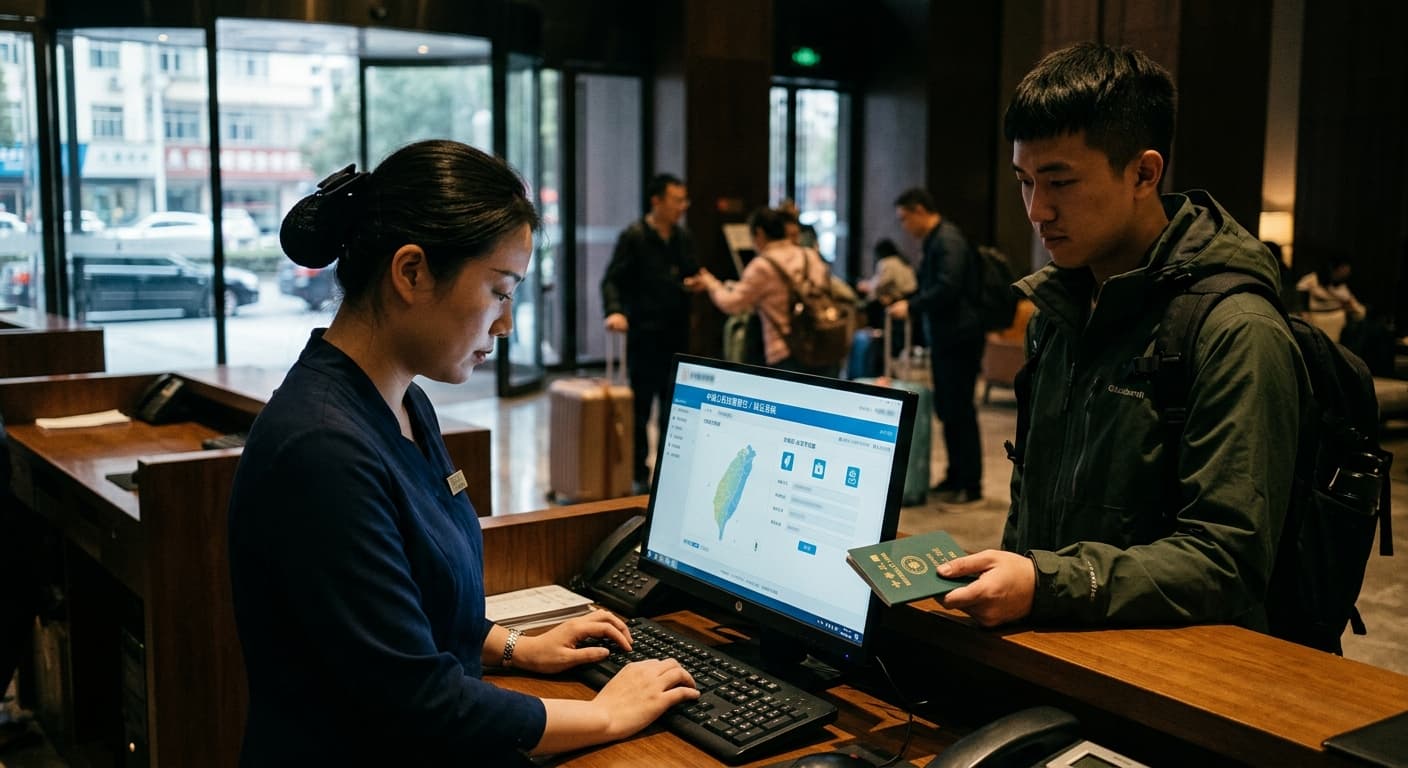

China's Hotel Clerks Are Now Running Real-Time Checks on Taiwan's Military Families
When a Taiwanese service member's parents checked into a mainland hotel, staff instantly flagged a deliberately false ID number. The incident reveals something bigger than espionage — it shows Beijing's intelligence architecture has moved from passive collection to operational verification through civilian infrastructure.
A Taiwanese service member posted on social media this week that her parents, traveling in China with her young son, were asked by hotel staff to verify the national identification numbers of both her and her husband. Both serve in Taiwan's military. Her husband is a senior officer. When he deliberately provided an incorrect ID number over the phone, hotel staff — acting on instructions relayed through the front desk — flagged the number as invalid within moments.
The episode, first reported by the Taipei Times on July 21, 2026, is not an isolated data point in the long-running intelligence war between Beijing and Taipei. It is a milestone. It demonstrates that China's database on Taiwanese military personnel is no longer merely archival — it is live, queryable in real time, and integrated into the civilian infrastructure that processes hotel check-ins, border crossings, and identity verification for millions of travelers daily.
The question the service member asked in her post cuts to the core: "How did the Chinese side know the correct information, and who should this be reported to?"
The answer, according to the evidence assembled over two years of escalating intelligence operations, is that China has built a comprehensive, cross-referenced personnel database on Taiwan's armed forces — and is now using it operationally through the most mundane of civilian touchpoints.
The database beneath the hotel counter
Chinese hotels have been required to deploy facial recognition systems connected to police databases for real-name registration for years. According to the Cambridge Handbook of Facial Recognition in the Modern State, provincial-level regulations in places like Hunan mandate that hotels deploy the Public Security Administration Information System — known as the Lüguanye Zhi'an Guanli Xinxi Xitong — which connects front-desk identity checks directly to police-held data. Local governments justify this under exemptions in China's Personal Information Protection Law for "fulfilling legal responsibility or obligation" regarding security.
What is new is the data layer being queried. When the hotel clerk in this case rejected the false ID number, they were not simply checking whether the number conformed to Taiwan's checksum algorithm. They were verifying it against a database that includes Taiwanese military personnel records — and doing so with sub-second latency through the same terminal used for passport scanning and facial recognition.
Hung Pu-chao, deputy head of Tunghai University's Center for Mainland China and Regional Development Research, told the Taipei Times that if the incident is authentic, it "indicates that China has established a systematic mechanism for verifying Taiwanese citizens' personal information." The keyword is "systematic." This is not intelligence work done through case officers and field recruitment. It is automated through civilian infrastructure.
The architecture of a live-targeting system
To understand how Beijing built the database behind that hotel counter, trace the escalation.
In June 2024, China issued the "22 Guidelines" for punishing what it terms "Taiwan independence separatists," explicitly encouraging citizen reporting and expanding the legal basis for detention. According to Taiwan's Mainland Affairs Council, 330 Taiwanese citizens were reported missing, detained, or had their freedom restricted in China between January 2024 and March 2025 — up 17 in the most recent month alone. That number, buried in a government press release, is the statistical footprint of a database being populated.
In 2024, Taiwan recorded 64 espionage-related prosecutions, with 85 percent involving military or police personnel, according to the Council on Foreign Relations. Taiwan's National Security Bureau reported that 28 serving and 15 retired military personnel were charged in that year alone, a figure that President William Lai cited publicly.
Then, in October 2025, China's escalation moved from covert to overt. Police in Xiamen published photographs, names, and identification numbers of 18 Taiwanese military personnel accused of conducting "psychological warfare," offering cash bounties for information leading to their arrest, as reported by Al Jazeera. The bounties carried little practical legal weight — Beijing has no jurisdiction in Taiwan — but they served a different purpose: signaling that the PRC possessed detailed personal data on individual Taiwanese officers, right down to ID numbers and photographs.
The AEI's China-Taiwan Update reported in April 2026 that Taiwan's National Security Bureau Director-General Tsai Ming-yen had confirmed the PRC was shifting targeting toward noncommissioned officers and enlisted personnel — lower-paid, more financially vulnerable ranks susceptible to debt-based recruitment. The PRC had moved beyond targeting generals and colonels. It was compiling data on the entire force structure.
By May 2026, Taiwan's Ministry of National Defense had disbursed approximately $6.7 million through an emergency loan program for military personnel, explicitly designed to reduce the financial vulnerabilities that PRC intelligence exploited. The program's maximum loan amounts exceeded what Chinese agents had been offering in documented recruitment cases.
The July 2026 hotel incident is the culmination of this sequence. The database is no longer just a recruitment tool. It is a real-time verification engine.
Who benefits, who loses
The People's Liberation Army's intelligence apparatus is the clear winner. The hotel incident provides "ground truth" — verification that their database is accurate enough to catch a false entry at the point of contact. Every time a family member travels and confirms data, the profile on a Taiwanese officer is updated, enriched with relationship links, travel patterns, and behavioral intelligence.
The Manohar Parrikar Institute for Defence Studies and Analyses has documented how China's "united front" operations build layered profiles covering "identity, family background, employment and social networks." Once basic data is verified, the focus shifts to assessing "intelligence value" — access to sensitive information, job responsibilities, social contacts. Those deemed valuable become targets for "contact, recruitment or inducement."
Taiwanese military families are the immediate losers. The incident demonstrates that service members' relatives are not bystanders in the intelligence contest — they are entry points. A grandchild's self-guided trip, a parent's vacation, becomes a vector for data extraction. The chilling effect is intentional: if families fear travel, military morale is undermined. If they travel anyway, data is collected. Either outcome serves Beijing's cognitive warfare objectives.
Taiwan's government has limited options. The Mainland Affairs Council has maintained an "orange" travel warning — avoid nonessential travel — since at least September 2024. But it cannot prevent private citizens from traveling to China, and the 330 cases of missing or detained citizens demonstrate that warnings have limited deterrent effect. The government's online registration system for citizens traveling to China, launched in January 2023, logged 86,387 users by April 2025 — a fraction of actual cross-strait travel volume.
The second-order effect: cognitive warfare through civilian infrastructure
The most consequential implication of the hotel incident is not about espionage — it is about the blurring of civilian and intelligence infrastructure in ways that are difficult for democratic governments to counter without restricting their own citizens' movement.
China's real-name registration system, underpinned by the social credit unified code — an 18-digit identifier identical to the citizen ID number — has already eliminated digital anonymity for Chinese nationals, as documented by the Cambridge Law & Social Inquiry journal. Every hotel check-in, SIM card purchase, and online service login is tied to an identity verified against a central database.
What the hotel incident reveals is that this architecture — built for domestic social control — is now being weaponized for cross-strait intelligence operations. Taiwanese citizens checking into Chinese hotels are not simply complying with local regulations. They are providing biometric and documentary verification that feeds directly into targeting databases for the PLA's political warfare apparatus.
RUSI's analysis of Chinese grey-zone operations notes that in 2025 alone, Taiwan identified more than 45,000 fake online accounts and over two million pieces of disinformation targeted at the island, with content "engineered to sow doubt about the United States as a reliable partner, Taiwan's own military, and its leadership." The database work and the cognitive warfare are two sides of the same operation: one gathers the raw material, the other weaponizes it.
The Chinese consulate in London did not respond to requests for comment. Beijing's Taiwan Affairs Office has consistently denied that Taiwanese citizens face targeting or harassment while traveling in China, according to Tunghai University's Hung Pu-chao. When China's Foreign Ministry spokesperson was asked in 2025 about the detention of an Indian national whose passport listed Arunachal Pradesh as her birthplace, the response was that border authorities had simply "carried out checks in accordance with laws and regulations."
Diplomat View
The hotel incident is not fundamentally about espionage. It is about infrastructure. Beijing has built a live, queryable database on Taiwanese military personnel and their families, and it is running it through the same terminals that process passport scans for business travelers. The strategic logic is clear: embed intelligence collection so deeply in civilian infrastructure that it becomes indistinguishable from routine administration.
The database did not appear overnight. It was populated through years of cross-referencing — travel records, social media scraping, data breaches, hotel registrations, border crossing logs, and intelligence gathered through recruited sources. The 2024 record of 64 espionage prosecutions in Taiwan, with 85 percent involving military or police personnel, is evidence that the recruitment pipeline is wide open. The $6.7 million emergency loan program Taiwan's MND launched in January 2026 — exceeding what PRC agents typically offered in bribes — is a tacit admission that financial vulnerability among lower ranks is a national security liability.
Three conditions would change the forecast. First, if Taiwan reinstates its military trial system for espionage cases — something President Lai has proposed but that requires legislative approval — it would raise the cost calculus for potential recruits. Second, if the U.S. designates the database infrastructure behind China's hotel identity-verification system as part of a sanctions regime, it would signal that Washington views this as more than a bilateral cross-strait matter. Third, if a Taiwanese military family member is detained at a Chinese hotel rather than merely questioned, the incident would escalate from intelligence collection to hostage-taking, triggering a qualitatively different response from Taipei and, likely, Washington.
What to watch:
- Taiwan's Legislative Yuan deliberation on reinstating the military trial system for espionage and national security cases — expected in the autumn 2026 session
- The next Mainland Affairs Council quarterly report on missing/detained citizens in China, due October 2026, which will reveal whether the 330 figure continues to climb
- Any U.S. congressional action linking China's real-name registration infrastructure to sanctions or export controls on surveillance technology components
This story was reported with contributions from Taipei, Beijing, and Washington. The Taipei Times primary report can be accessed here.
Discover more

US Politics
U.S. House Passes Alert Act for Aviation
The House passed the ALERT Act 396–10, replacing the ROTOR Act after Pentagon intervention, impacting aviation safety regulations.

US Politics
US Launches $166B Tariff Refund Portal
The US is launching a $166 billion tariff refund portal to aid importers hit by Trump-era tariffs, with major implications for trade and supply costs.
Global Politics
Xi Jinping Calls China-Russia Ties 'Precious'
Xi Jinping's description of China-Russia ties as 'precious' reflects a strategic imbalance, with Beijing dictating terms in the partnership.

Economics
Fed's Amex AML order puts correspondent banking on notice
Federal Reserve's Amex AML order requires board-level controls and a 90-day plan; OCC fined the bank $350 million over enterprise-wide deficiencies.