China's Grey-Zone Pressure on Taiwan
Beijing's coast guard and navy encircle Taiwan in a campaign short of war.
Model Diplomat6 min readEast Asia
The Lawfare Blueprint
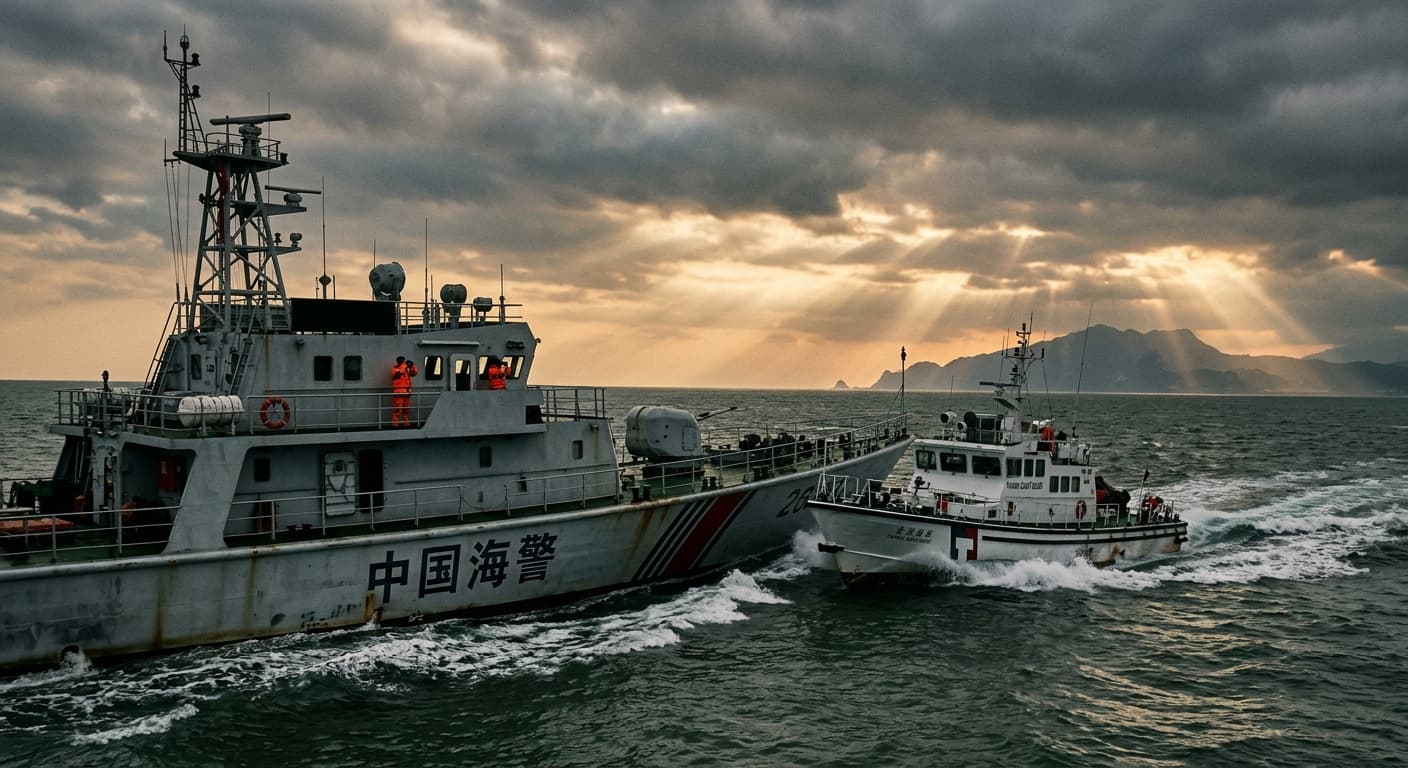
The juridical scaffolding for these operations was laid years in advance. China's 2021 Coast Guard Law permits the CCG to use "all necessary means, including the use of weapons," against foreign organizations or individuals deemed to infringe on Chinese sovereignty, and allows Beijing to establish temporary maritime security zones restricting vessel passage with broad discretion — a provision the European Parliament's research service flagged as "not generally accepted under international law owing to their vagueness and susceptibility to abuse." The law deliberately left "jurisdictional waters" undefined, creating maximal interpretative latitude.
In May 2024, China added Regulation No. 3, authorizing the CCG to detain foreigners for up to 60 days without trial for allegedly crossing into PRC-claimed maritime boundaries. Congressional testimony by U.S. Indo-Pacific Command identified this as the first known CCG policy explicitly authorizing detention over "trespass" in waters China claims.
The legal architecture was matched by operational doctrine. During Joint Sword-2024B in October 2024, the CCG publicly announced it was "conducting law enforcement patrols and circling Taiwan Island for control measures" — describing the encirclement as the "practical enforcement of the 'One China' principle over Taiwan Island," according to CSIS's ChinaPower Project analysis. During that exercise, Taiwan's MND reported 17 law enforcement ships around the island and its outlying islands — an all-time high at the time.
By the Strait Thunder-2025A exercises in April 2025, four CCG patrol vessel formations were operating in four areas surrounding Taiwan simultaneously, while four additional CCG vessels entered waters around the Matsu and Dongyu outlying islands, the ChinaPower Project documented. Then in December 2025, the Justice Mission exercises brought live-fire naval drills closer to Taiwan's shores than ever before, with 27 rockets landing in waters north of Keelung, and exercise zones intruding into Taiwan's claimed territorial waters.
What June 2026 makes unmistakable is that the episodic exercise pattern has been supplemented — and in a practical sense, replaced — by persistent, round-the-clock presence. The drill is no longer a drill.
A Three-Layer Pressure Architecture
The operational pattern that crystallized in June reveals a layered structure that analysts at the Lowy Institute have described as a coordinated, multi-agency maritime pressure system. The PLA Navy maintains the outer layer, providing deterrence. The CCG occupies the middle layer, conducting "law enforcement" and gray-zone missions that create jurisdictional facts below the threshold of war. Maritime safety vessels, rescue ships, and administrative vessels operate in the innermost layer, supplying technical cover that makes the entire operation appear like "normal governance."
The June 6–10 deployment illustrated this perfectly. China's Ministry of Transport dispatched multiple 10,000-ton class vessels, including the Haixun 09 and Haixun 06, for what it termed a "special maritime traffic law-enforcement and hydrographic survey operation." The fleet covered 1,030 nautical miles, inspected 198 passing vessels, and declared three ships "violating." According to the BBC Chinese service, CCG personnel broadcast demands to commercial vessels for port entry and exit information — an attempt to create the appearance of exercising jurisdiction. Taiwan's Coast Guard responded by broadcasting counter-messages instructing ships to maintain normal navigation and ignore the Chinese hails.
This is China's "presence as claim" playbook — the identical strategy it has used around the Senkaku Islands, Scarborough Shoal, and Kinmen: use coast guard hulls to make the exceptional routine, then cite the routine as evidence of jurisdiction.
"It knows it has no jurisdiction now, so it is trying to create something out of nothing," a second senior Taiwan Coast Guard official told reporters, according to the StratNews Global report.
The Supply-Line Calculus
The strategic logic of focusing on Taiwan's eastern waters is straightforward: Taiwan's western ports face the mainland across a narrow strait. The eastern ports of Hualien and Su'ao are the island's maritime back door — the route through which allies would attempt resupply during a blockade or conflict.
The senior Taiwan Coast Guard official framed it bluntly. "If the situation escalates to a blockade — or what would already amount to a quasi-war — we have plans to work with the navy to jointly protect Taiwan's lifeline sea routes," the official said at the briefing. "We have anticipated this scenario not only through tabletop exercises but also through live drills."
Taiwan imports roughly 97% of its energy resources and generates over 100% of its GDP from trade, as CFR documented. In a quarantine scenario, the economic shock would be near-instantaneous. A Chatham House analysis from June 2026 estimated that a Chinese blockade of Taiwan would prompt a 5% fall in global GDP, given that the Taiwan Strait carries approximately one-fifth of global maritime cargo and Taiwan alone accounts for 90% of advanced semiconductor manufacturing,
according to Chatham House.
CSIS ran 26 wargames on a Chinese blockade scenario and published results in July 2025. The central finding: a quarantine led by the CCG rather than the PLA presents a distinctive escalation challenge, because it deliberately occupies the space below clear acts of war. The CSIS wargames found that while China could inflict serious hardship — particularly by targeting Taiwan's energy sector — a blockade creates escalatory pressures that are difficult to contain and could spiral into large-scale conflict. But the gray-zone quarantine, precisely because it is harder to classify, also complicates the international response.
The Asymmetric Capacity Problem
The imbalance is stark. The CCG is the largest coast guard force in the world. According to the CSIS analysis, Taiwan's coast guard — while capable — is "significantly outnumbered and outsized." Taiwan launched a shipbuilding program in 2018 targeting 141 new vessels by 2027, and the Lai administration has continued it. In September 2025, the Executive Yuan allocated $206 million specifically for unmanned maritime vehicles for the Coast Guard Administration,
as CSIS noted. In October 2025, coast guard vessels were integrated into the navy's command structure during the Haiqiang exercise to test wartime transition procedures.
But the CCG can also draw on China's Maritime Safety Administration, which fields at least three dozen oceangoing vessels and hundreds of smaller patrol craft. And behind them sits the maritime militia — hundreds or thousands of fishing vessels that can be organized to support Beijing's claims, the existence of which a CSIS Futures Lab study confirmed by flagging 128 likely gray-zone actors from a dataset of nearly 12,000 vessels traveling near Taiwan.
Taiwan's officials acknowledged the strain. "Chinese coast guard vessels now often operate in pairs just outside Taiwan's economic waters in the Pacific, an expansive area that places a major strain on Taiwan's limited coast guard fleet," the first senior official told the briefing.
The U.S. response toolkit is constrained by geography. The U.S. Coast Guard's 14th District, responsible for much of the western Pacific, has just four ships homeported in Guam — the closest location to Taiwan.
The Pratas Prelude
What happened in June did not come from nowhere. A smaller-scale rehearsal played out weeks earlier.
In early June, Taiwan's coast guard reported what it described as the first coordinated operation by a Chinese coast guard vessel and an oceanographic survey ship to pressure the Taiwan-controlled Pratas Islands, in the northern South China Sea. The Chinese cutter broadcast that "Taiwan's future lies in national reunification" and that it was conducting law-enforcement operations. The standoff lasted 34 hours, according to RUSI.
Pratas has been under increasing pressure for two years. CSIS's Asia Maritime Transparency Initiative documented CCG and Maritime Safety Administration patrols around Pratas rising from zero in 2021 to 60 days of activity in 2025, AMTI found. During Strait Thunder-2025A in April 2025, CCG 3105 was observed within the territorial waters of Pratas. A PLA drone entered Pratas's airspace in January 2026.
The Pratas operation and the eastern Taiwan patrols form part of a single, integrated campaign. The Observer Research Foundation concluded in July 2026 that "Beijing's current actions are not Taiwan-specific, but part of a larger, multi-front campaign to assert jurisdiction across the region" — from Pratas to Scarborough Shoal to the waters east of Taiwan.
Discover more

US Politics
White House Pressures Congress for Crypto Leg
The Trump administration's push for the CLARITY Act aims to reshape crypto regulation, impacting trillions in market value and the Trump family's wealth.

India
Women’s Reservation in India
India's 33% women's reservation law is enacted but won't take effect until after 2029 due to political setbacks and census delays.
US Politics
House Ethics Committee Pushes Sexual Miscond.
The House Ethics Committee has shifted responsibility for sexual harassment settlement records to the Office of Congressional Workplace Rights, complicating disclosure efforts.

Economics
Fed's Amex AML order puts correspondent banking on notice
Federal Reserve's Amex AML order requires board-level controls and a 90-day plan; OCC fined the bank $350 million over enterprise-wide deficiencies.