China's Dongfang Suanxin Bets on 3D Stacking
Shanghai startup aims to bypass US chip export controls
Model Diplomat7 min readAsia
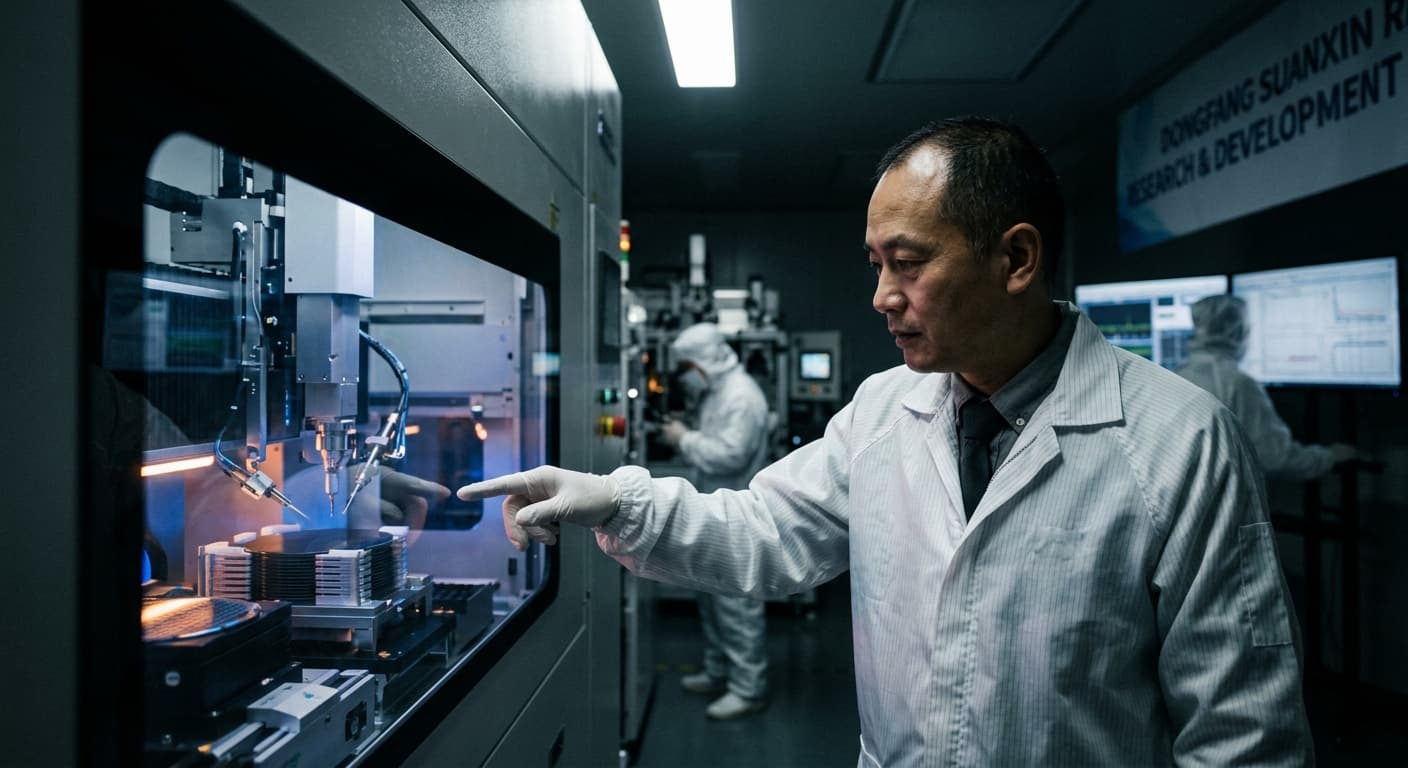
China's Dongfang Suanxin bets on 3D stacking to bypass US chip curbs
Shanghai startup Dongfang Suanxin, led by Tsinghua's Wei Shaojun, is using 3D stacked near-memory chips and a fully domestic supply chain to sidestep US AI export controls.
On July 2, 2026, a Chinese AI-chip company almost no one outside Beijing's semiconductor policy circles had heard of switched on its website and announced itself. Dongfang Suanxin, founded in 2024 and headquartered in Shanghai's Zhangjiang hi-tech zone, is chaired by Wei Shaojun — Tsinghua professor and vice-president of the China Semiconductor Industry Association — and it is engineered from the ground up around one proposition: that 3D stacking on mature Chinese nodes can deliver competitive AI compute without a single controlled US input. According to the South China Morning Post, the company says its flagship DF1000 accelerator uses "software-defined chips" plus "3D stacked near-memory computing" on a supply chain that is entirely domestic. The interesting question is not whether the DF1000 beats an H200. It is whether Beijing has quietly settled on packaging — not lithography — as the axis on which the AI-chip war will actually be fought.
What Dongfang Suanxin is actually building
The company's technical bet is narrow and specific. Rather than chase the sub-7 nanometer node that SMIC cannot yet reliably deliver, Dongfang Suanxin vertically stacks compute and memory dies to compress the distance data has to travel — the "memory wall" that dominates large-model inference economics. Peer-reviewed work out of Chinese Academy of Sciences and Peking University groups has spent the past year publishing exactly this recipe: hybrid-bonded sub-10 μm through-silicon vias yielding, according to an ICT-CAS preprint on arXiv, 46–93% lower energy and 1.4×–7.6× speedups on transformer workloads versus 2D baselines. Peking University's
Tasa architecture reports 2.85× throughput over a GPU baseline on Llama-65B inference by stacking four DRAM dies on a heterogeneous logic die. Dongfang Suanxin is the commercial expression of that literature.
The design also solves a specific regulatory problem. When the US Bureau of Industry and Security tightened controls in December 2024, it did not ban all high-bandwidth memory to China — it drew a bright line at a new metric, "memory bandwidth density," above 3.3 GB per second per square millimeter. Everything above became country-wide prohibited, as the Federal Register interim final rule makes explicit. Government officials confirmed to
CSIS that HBM2 — the 2016-vintage memory that shipped with Nvidia's V100 — is the only tier still legal. Advanced packaging is how Chinese designers extract H100-class effective bandwidth from HBM2-class memory: stack more dies, shorten the wires, and the ceiling on aggregate bandwidth is no longer a US-controlled export.
The wall the DF1000 is designing around
The regulatory environment has moved four times in eighteen months, and each move has narrowed the same corridor. According to the Congressional Research Service's Report R48642, the Biden administration's January 15, 2025
AI Diffusion Rule placed China in a "Tier III" bucket subject to a presumption of denial on advanced chips and, for the first time, on closed-weight AI model weights themselves. The second Trump administration then rescinded the diffusion framework in mid-2025, added 42 PRC entities to the Entity List, and — critically — issued guidance in May 2025 that "any use of Huawei's Ascend AI chips violates U.S. export controls." A further 32 entities were added on September 16, 2025, per the
Federal Register, and on January 15, 2026 BIS again
revised license-review policy for advanced computing commodities to China and Macau.
The consequence is that any Chinese AI-chip company reachable through the foreign-produced direct product rule is now uninvestable for global capital. Dongfang Suanxin's answer is to be unreachable: no US EDA, no TSMC foundry slot, no HBM3e, and — by implication — no dependency the Entity List can sever. Its backer list, reported across Interesting Engineering and Chinese trade press, is a directory of state-adjacent capital: the National AI Industry Investment Fund alongside Yunfeng Capital and the venture arms of Xiaomi and JD.com. That is the funding pattern LSE and NBER researchers describe in
work on China's government-VC ecosystem — public money leading, private money following into firms whose ex-ante signals are weak but whose strategic value is high.
Why packaging, not lithography, is the real front
There is a quiet consensus inside Washington that the export-control regime is working. The Council on Foreign Relations argues that Huawei will not build a chip more powerful than the H200 until Q4 2027, that SMIC cannot advance past 7 nm, and that China's aggregate AI compute will remain around 4% of Nvidia's next-year output. On the merits of that analysis, controls are holding.
The Dongfang Suanxin launch is a bet that the analysis measures the wrong axis. CSIS's Scholl Chair concluded in its advanced-packaging paper that chiplet and 3D-stacking architectures allow "the assembly of packages of less capable chips which, working together, can match or exceed the capabilities of the most advanced semiconductors." Huawei and HiSilicon began exploring exactly this path in 2022. In late May 2026, Huawei formalised it publicly as the "Tau Scaling Law" — an internal engineering principle claiming equivalent transistor-density gains through 3D architectural innovation rather than lithographic scaling. Dongfang Suanxin's public debut, five weeks later, plugs into that same doctrine and gives it a second champion outside the sanctioned Huawei perimeter — one whose backers can raise capital, list on a Chinese exchange, and sell to hyperscalers without inheriting Ren Zhengfei's Entity List problem.
That is the second-order effect Washington's export-control architects appear to have underweighted. The controls are node-, chip-, and entity-based. Advanced packaging is none of those things cleanly. BIS added packaging semiconductor manufacturing equipment to the country-wide restricted list only in December 2024, and enforcement remains uneven; the CSIS Scholl work notes that packaging "used to be the last stop in the fabrication process, a relatively low-value step" and is now the pivot point. The Chinese government reads the same literature. Public procurement rules extended nationally in 2025 now require publicly-owned data centres to source 50% of chips domestically, according to Institut Montaigne — a state-mandated demand floor that lets a Dongfang Suanxin sell a 7 nm 3D-stacked accelerator against a 3 nm Nvidia part on any terms other than pure performance.
The talent problem the design cannot solve
There is one part of the strategy that money and packaging do not fix. China's own Semiconductor Industry Association estimates, cited by Institut Montaigne, that the skilled-chip-worker shortfall would exceed 300,000 in 2025. Wei Shaojun's own advocacy — for stronger chip-talent policies to close the high-end design gap — reads less like a founder pitch than a policy demand. Tsinghua's
Centre for International Security and Strategy concedes that in the highest-value segments — EDA, GPUs, advanced logic — China "still lags far behind." A 3D-stacked accelerator built on domestic EDA and mature-node logic can close a bandwidth gap. It cannot close a design-team gap.
That is why Dongfang Suanxin's institutional shape matters as much as its silicon. Its 500-plus employees, seven-city branch network and Big Fund-adjacent capital are the Chinese state's response to the "paper tiger" critique that RSIS documented in its 2024 assessment — the finding that Tsinghua Unigroup and other early state-led champions failed because they were assembled by acquisition rather than by engineering. The Dongfang Suanxin bet is that a design-first, packaging-forward firm with Wei's authority inside the CSIA and a demand pipeline mandated by procurement rules is a cleaner vehicle than the last generation of national champions. RSIS's follow-up analysis of
China's AI start-ups as "national champions" — noting the recent Enflame, Moore Threads, MetaX and Biren IPO wave — reads Dongfang Suanxin as the next entrant to that pipeline.
Diplomat View
The story here is not whether the DF1000 works. It is that Beijing has now placed two independent bets — Huawei's Tau Scaling Law and Dongfang Suanxin's software-defined 3D stack — on the same thesis: that the axis of the AI-chip race has moved from lithography to advanced packaging, and that US export controls are optimised for the wrong axis. If those bets are correct, the CFR baseline that China's aggregate AI compute stays near 4% of Nvidia's through 2028 will be revised sharply upward within 24 months. What would falsify this call: a sustained MERICS-style finding that Alibaba, ByteDance and Tencent continue routing frontier-model training to imported Nvidia H200s through 2027, and that domestic 3D-stacked parts fail to enter production at Huawei-scale volumes. What would confirm it: a Dongfang Suanxin IPO on Shanghai's STAR Market with the National AI Industry Investment Fund as anchor, and a first design-win at a Tier-1 Chinese hyperscaler. Watch the Shanghai listing calendar.
Forward look — three catalysts to watch:
- Q4 2026: DF1000 sampling and first named customer disclosure — the test of whether Dongfang Suanxin can convert a stealth-mode reveal into a hyperscaler contract inside 18 months of founding.
- October 7, 2026: Fourth anniversary of the original BIS advanced-computing rule; the Trump administration's expected Entity List refresh and any move to add packaging-focused Chinese firms will signal whether Washington reads the 3D-stacking pivot as a loophole.
- March 2027: China's National People's Congress annual session, where the next Five-Year Plan draft is expected to codify advanced packaging as a designated chokepoint priority — the policy signal that would guarantee Dongfang Suanxin a state-underwritten demand floor.
Discover more

US Politics
US Launches $166B Tariff Refund Portal
The US is launching a $166 billion tariff refund portal to aid importers hit by Trump-era tariffs, with major implications for trade and supply costs.

US Politics
SNAP Food Assistance Faces Legal Challenges
In 2026, SNAP faces stricter eligibility rules and mounting legal challenges, threatening food assistance for the millions of Americans who rely on the program.
Global Politics
Xi Jinping Calls China-Russia Ties 'Precious'
Xi Jinping's description of China-Russia ties as 'precious' reflects a strategic imbalance, with Beijing dictating terms in the partnership.

Economics
Fed's Amex AML order puts correspondent banking on notice
Federal Reserve's Amex AML order requires board-level controls and a 90-day plan; OCC fined the bank $350 million over enterprise-wide deficiencies.