China's Coast Guard Expands East of Taiwan
Beijing's coast guard patrols signal a new maritime strategy.
Model Diplomat8 min readAsia-Pacific
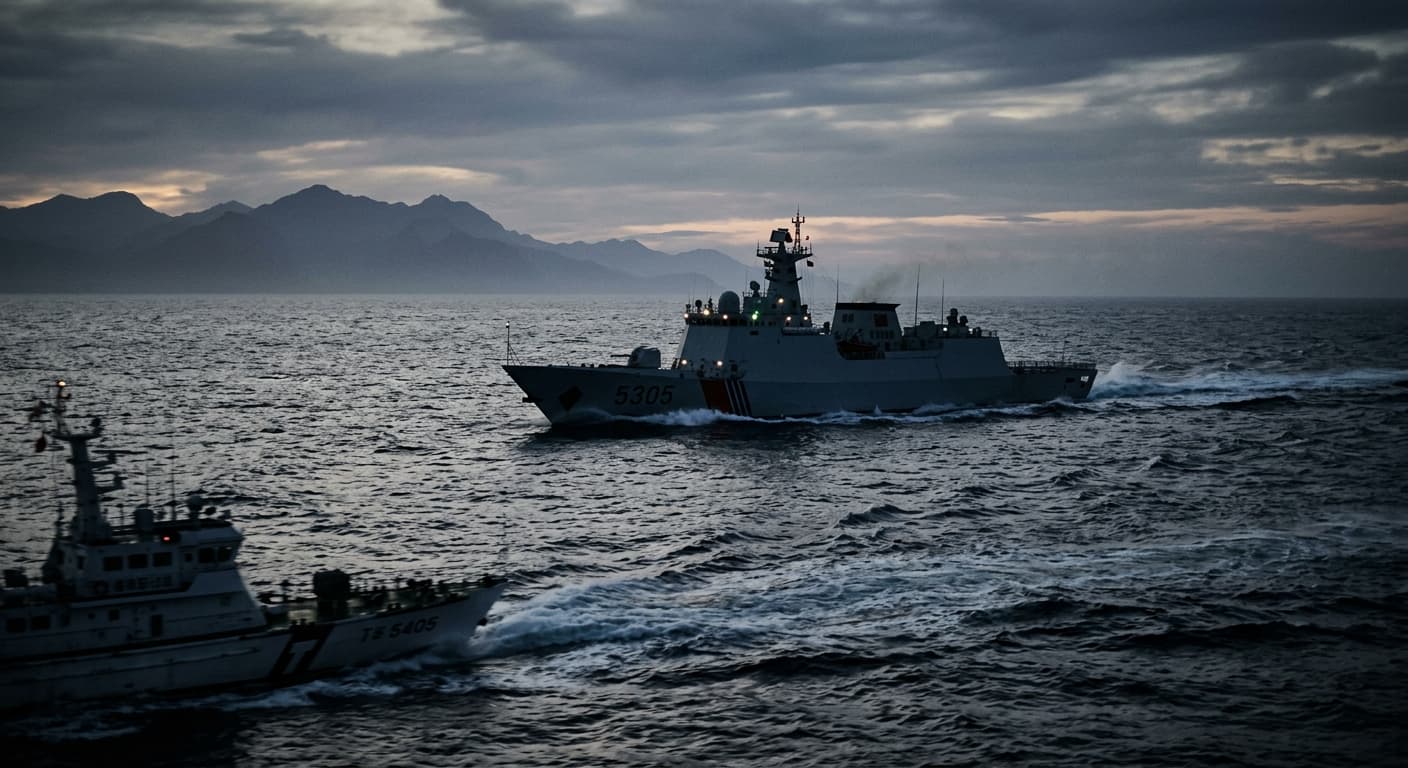
China's Coast Guard Pushes East of Taiwan — For the Second Time
China's second Pacific-side coast guard patrol east of Taiwan in a month exports the Kinmen playbook to the first island chain — and shows what a quarantine dress rehearsal looks like.
On July 4, 2026, China's Coast Guard rotated a task group led by the cutter Xiushan off Taiwan's eastern coast, announcing "law enforcement patrols" in Pacific waters Taipei says lie well outside any lawful Chinese claim. It is the second such operation in about four weeks — and the clearest sign yet that Beijing intends to normalize a coast guard presence on Taiwan's resupply flank, the same corridor US and Japanese reinforcements would use in a crisis. The immediate pretext is a Japan-Philippines exclusive-economic-zone boundary negotiation. The underlying move is a quiet extension of the 2021 Coast Guard Law past the median line, past the Bashi and Miyako straits, and into water that Taiwan's navy has treated as its strategic depth for seventy years.
What actually happened
Chinese state media identified the new formation as the CCG Xiushan group, with spokesperson Jiang Lue confirming that Beijing would "strengthen" law-enforcement patrols in the area, according to Reuters via WHTC. The rotation replaces a task force that arrived in early June and had already prompted démarches from the United States, France, Germany and Britain,
Baird Maritime reported.
The June operation was not a symbolic pass. Between June 6 and June 10, China's Ministry of Transport deployed four large public-service vessels — including the 10,000-tonne Haixun 09 and the 5,000-tonne Haixun 06 — across more than 1,030 nautical miles east of Taiwan, inspecting 198 vessels, sweeping the seabed for cables, and hailing commercial ships to demand information, according to a detailed BBC Chinese reconstruction. The Xiushan then began enforcement patrols roughly 52 nautical miles (96 km) southeast of Lanyu (Orchid Island), the first announced CCG "inspection" activity in Taiwan's Pacific approaches.
Taipei responded with a monitoring-and-radio-off posture: coast guard vessels shadowed the formation, broadcast expulsion warnings in Mandarin and English, and — unusually — the Taiwanese navy joined the chorus over open channels. On July 6, Taiwan's Ministry of National Defence detected five Chinese military aircraft, eight naval vessels and three official ships around the island by 6 a.m. local time, with three sorties entering the southwestern ADIZ, The Indian Economic Observer reported. A senior Taiwan security official told
Reuters via SRN News that Taipei is now tracking an "upward trend" in Chinese naval movement during the peak-exercise season, including joint drills with Russia.
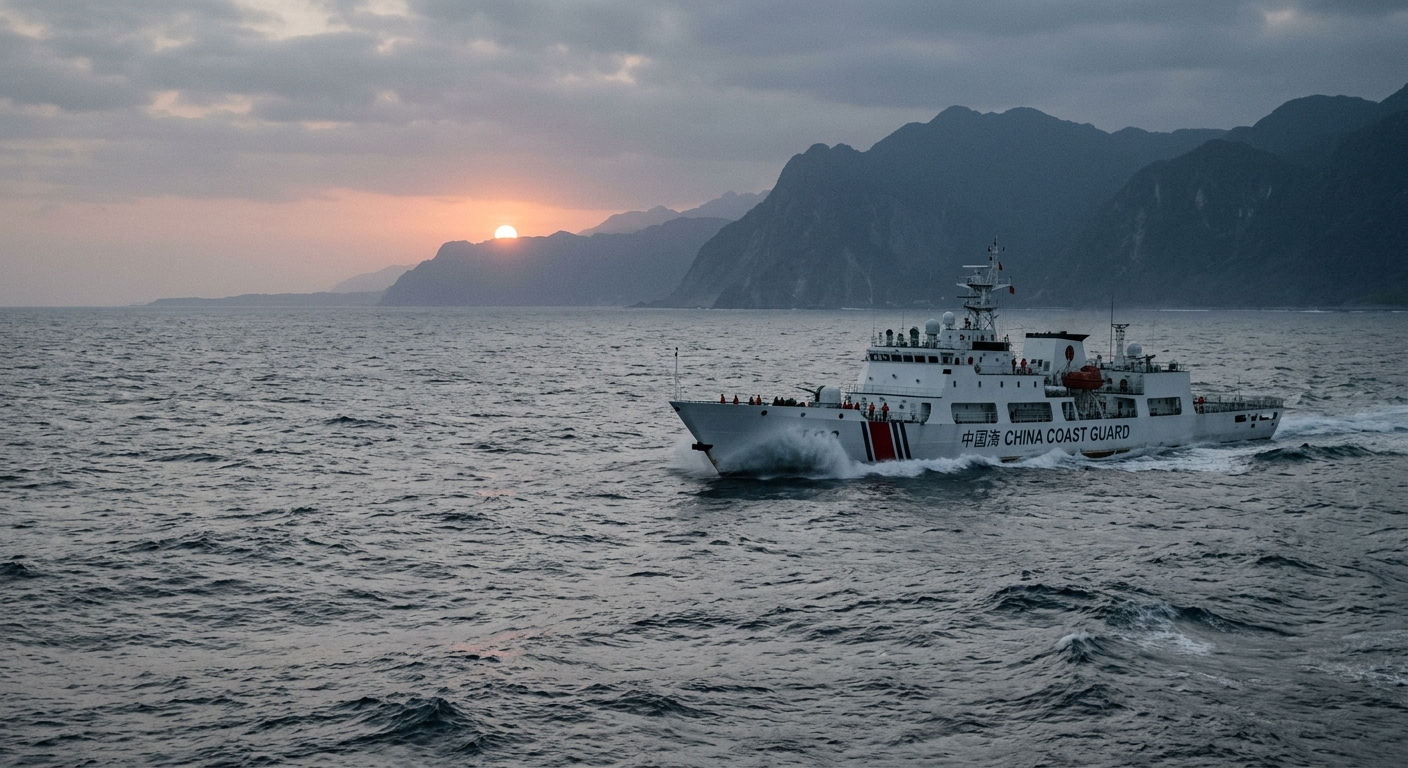
The legal machine behind the ships
The Xiushan is not freelancing. It is executing the 2021 China Coast Guard Law, which authorizes CCG units to conduct enforcement "in the maritime areas under the jurisdiction of the People's Republic of China" — a phrase Beijing has deliberately declined to define. Article 22 allows use of weapons; Article 83 subordinates the coast guard to the Central Military Commission for defense tasks. The Japan Institute of International Affairs flagged in 2021 that the statute was engineered as a domestic foundation for "Chinese control inside the first island chain." That control has now been staged east of that chain.
CSIS scholars Bonny Lin and Brian Hart argued in a May 2026 analysis that Beijing spent the last four years constructing exactly this scaffolding: in 2018 the CCG was folded into the People's Armed Police under the Central Military Commission; in 2021 the law took effect; in 2024 fresh regulations empowered the CCG to detain foreign ships. Their conclusion in the CSIS report is blunt: "The CCG could conduct military operations in peacetime, under the direction of China's military leadership."
The pattern the Xiushan represents is the projection of what Taiwan's 2025 National Ocean Policy White Paper calls a "normalized law enforcement" model — originally rehearsed around Kinmen — into the open Pacific. Taipei's Ocean Affairs Council documented 679 unauthorized CCG transits into Kinmen and Matsu restricted waters in 2024 alone, according to CSIS's review of the white paper. That model has now been exported east.
Why "east" is the whole story
For seven decades, Taiwan's Pacific side has been its strategic sanctuary. The Central Mountain Range shields eastern bases at Hualien and Taitung from PLA rocket fire launched from Fujian. Hualien's Chiashan and Taitung's Chihhang facilities house Taiwan's F-16 fleet in hardened mountain hangars precisely because the eastern coast was assumed to be China-inaccessible. The corridor east of Taiwan is also where the US Seventh Fleet and Japan's Self-Defense Forces would arrive in almost any Taiwan contingency.
That assumption is what Beijing is now dismantling — not with warships, but with white hulls. In a June essay for Foreign Affairs, Brookings' Ryan Hass wrote that with these two "unprecedented actions" — the Pacific-side patrol and a separate CCG incursion into prohibited waters near a Taiwan-held South China Sea island — "Beijing is aiming to assert its jurisdiction over Taiwan's waters and set the foundation for a future quarantine of the island."
The CSIS Futures Lab's May 2026 study, The Geometry of Coercion, quantified the trend: between January 2020 and December 2025, the daily average of distinct CCG vessels entering Taiwan's near waters rose by more than 500 percent, while daily incursions into Taiwan's second maritime security ring more than quadrupled. The Xiushan patrol pushes that pressure into a third ring — the open Pacific — that CSIS's framework did not previously need to measure.
The Japan-Philippines pretext
Beijing's stated trigger is the ongoing EEZ delimitation talks between Tokyo and Manila, whose overlap with waters Taipei claims gave China what BBC Chinese analysts called a "gift": a legal reason to insert itself into a maritime dispute involving Taiwan without needing to name Taiwan. On June 1, hours after Beijing declared the Japan-Philippines negotiations "completely illegal and invalid," it dispatched the Xiushan.
Taiwan's Foreign Ministry, for its part, has publicly demanded that Tokyo and Manila not "exclude or damage" Taiwan's sovereign interests and hold consultations with Taipei, per BBC Chinese. Both Japan and the Philippines have separately hardened their positions on Taiwan: Prime Minister Sanae Takaichi's November 2025 parliamentary remarks that Japan could take military action in a Taiwan contingency triggered a still-unresolved diplomatic crisis,
Al Jazeera reported, and Manila and Tokyo signed new defense supply pacts in January 2026.
Read together, the pattern is clear: as the Tokyo-Manila-Taipei triangle tightens around the first island chain, Beijing is using the CCG to punch through it from inside.
The asymmetry Taipei cannot fix in one budget cycle
Taiwan's coast guard is capable but small. It fields roughly 5,000-tonne flagships against a CCG that operates cutters displacing more than 12,000 tonnes and can surge from China's Maritime Safety Administration, which the CSIS quarantine study notes has "at least three dozen oceangoing vessels." Beijing also fields a maritime militia potentially numbering in the hundreds of vessels. Taiwan has no equivalent.
That imbalance shapes Taipei's posture. Taiwan's Coast Guard Administration operates under a "monitor and drive away" rule of engagement designed to avoid the first shot. On paper, this discipline is admirable; in practice, it hands Beijing the initiative in every encounter. Analysts cited by BBC Chinese, including Chung Chih-tung, warn that if Chinese patrols east of Taiwan become routine, "Taiwan's east will lose its strategic depth."
Taipei is trying to catch up. In May 2026, Taiwan's legislature approved a US$24.8 billion, eight-year special defense budget to purchase US arms, according to the Congressional Research Service. The Executive Yuan's Special Resilience Budget, approved in September 2025, allocated US$894 million to the Ocean Affairs Council, including US$206 million specifically for coast guard uncrewed maritime vehicles,
CSIS documented. In October 2025, coast guard vessels were integrated into the Taiwanese navy's command structure during the Haiqiang exercise — a wartime-transition rehearsal.
What allies are actually doing
The reaction of Taiwan's partners has been notably lower-key than the language coming out of European parliaments. The European Parliament resolution of October 24, 2024 "strongly condemned" Chinese military exercises and specifically flagged that four CCG formations patrolled Taiwan during Joint Sword-2024B, with 17 coast guard ships and 153 aircraft detected on October 14, 2024. Brussels has continued to press UNCLOS-based responses.
Washington's posture is more ambiguous. The US State Department in early January called Chinese drills a source of "unnecessary" tension and urged restraint, per Al Jazeera. But President Trump met Xi Jinping in Beijing in May 2026, subsequently cautioned Taipei against formal independence, and paused a US$14 billion arms sale to Taiwan to conserve munitions for the war on Iran,
Al Jazeera reported. Congress is filling the gap: FY2026 appropriations included US$300 million in Foreign Military Financing for Taiwan and US$1 billion in Taiwan Security Cooperation Initiative funding,
Congress.gov confirms. A separate Senate bill,
S.2222, tasks the US Coast Guard commandant with joint patrols and surveillance in the Taiwan Strait to counter PRC gray-zone tactics — though it has not yet cleared the floor.
For its part, Brookings' Hass has warned that scrambling Taiwan's F-16s and frigates every time China sends white hulls is self-defeating: it exhausts the same crews and platforms Taiwan would need in wartime while giving Beijing free reign to titrate pressure.
Diplomat View
The Xiushan rotation is not another entry in the incursion count. It is a legal-operational template for a maritime quarantine of Taiwan without a shot fired — the version US planners have long feared and Taipei has struggled to counter. The forecast: within twelve months, CCG operations east of Taiwan will become monthly, then continuous. Beijing's optimal outcome is a world in which foreign shipping bound for Kaohsiung or Keelung must acknowledge, even implicitly, a Chinese "law enforcement" presence in the Pacific approaches. That erodes the value of a US-Japan reinforcement corridor without triggering the alliance's tripwires.
What would change this call: a public US-Japan designation of the CCG as an arm of the PLA — as CSIS has urged — combined with joint US, Japanese and Taiwanese coast-guard patrols east of Taiwan under a fisheries-cooperation frame. Absent that, Xiushan wins by showing up. The revision trigger to watch is whether Tokyo, under Takaichi, extends the Japan Coast Guard's mandate to escort in Taiwan-adjacent waters. If it does, Beijing's Pacific play stalls. If not, the first island chain has quietly acquired an eastern leak.
What to watch
- Late July 2026: Whether the Xiushan's third rotation is announced on schedule — the marker that the patrol has moved from "operation" to "permanent presence."
- August 2026: Trilateral Japan-Philippines-US defense consultations under the January 2026 supply pact; Taipei is pressing for coast guard cooperation to be added to the agenda.
- September 2026: Taiwan's Executive Yuan submits the FY2027 defense budget; watch whether the coast guard uncrewed-vessel line item grows past US$206 million.
- October 10, 2026: Taiwan National Day. Every prior Lai Ching-te address has triggered a named PLA exercise within days. This one arrives with the CCG already forward-deployed east of the island.
Read today's full |
Discover more

US Politics
White House Pressures Congress for Crypto Leg
The Trump administration's push for the CLARITY Act aims to reshape crypto regulation, impacting trillions in market value and the Trump family's wealth.
US Politics
Congress Targets AI Chatbot Access for Terror
The House passed the Generative AI Terrorism Risk Assessment Act, focusing on AI's role in terrorism and potential surveillance implications.
Global Politics
Trump's Conflicting Messages on Iran War
Trump's mixed messages on Iran reflect a strategy of audience management, benefiting Tehran amid a complex geopolitical landscape.

Economics
Fed's Amex AML order puts correspondent banking on notice
Federal Reserve's Amex AML order requires board-level controls and a 90-day plan; OCC fined the bank $350 million over enterprise-wide deficiencies.