China's 110-Ship Record Reshapes Taiwan's Def
Taiwan tracks over 110 Chinese vessels, signaling a new defense posture.
Model Diplomat8 min readAsia
China's 110-Ship Record Reshapes Taiwan's Defense Math
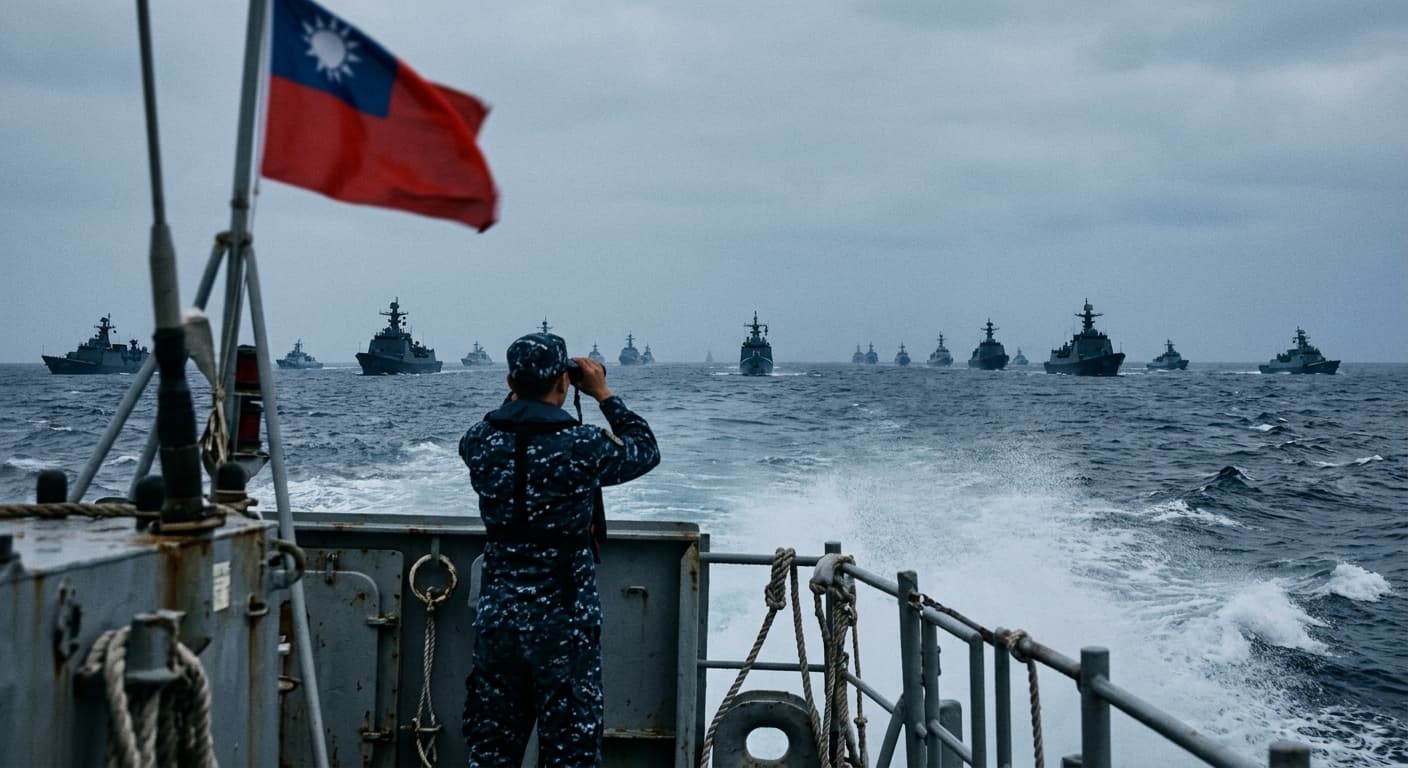
Taiwan is tracking a record 110+ PLA Navy and Coast Guard vessels along the First Island Chain in July 2026 — the clearest sign yet that gray-zone pressure has become standing posture.
On July 3, 2026, Taiwan's National Security Council counted more than 110 People's Liberation Army Navy and China Coast Guard vessels arrayed along the First Island Chain — a record — and by July 6 the National Security Bureau had mapped four PLAN formations in the western Pacific alone. The number itself matters less than what it signifies: the summer 2026 surge is not a drill cycle Taipei can wait out, but the point at which coercive maritime pressure crosses from episodic exercise into permanent posture. That shift, more than any single incident, is what forces Japan, the Philippines and the incoming Trump-era Pentagon to recalculate.
The Taipei Times reported that NSB Director-General Tsai Ming-yen briefed legislators on July 6 that four Chinese naval formations are operating in the western Pacific, one in the South Pacific, two near Okinawa and one off Santa Ana on the northern Philippine coast — "a larger force than usual."
Focus Taiwan quoted him directly: "Overall, we are seeing an upward trend in the mobilization of Chinese naval forces during this peak exercise season." The count was first flagged by NSC Secretary-General Joseph Wu, who wrote on X on July 4 that Taipei had "tracked a record number of over 110 PLA Navy and coastguard vessels," calling the deployment "a clear sign of [China's] expansionism," as
The Straits Times documented.
What the numbers actually show
The July–September window is nominally the PLA's annual "peak exercise season," and one prominent Taiwanese analyst — retired naval captain Chang Ching of the Society for Strategic Studies — offered a deflationary reading: many hulls likely left port to ride out an approaching typhoon (Bavi), a routine preservation move rather than a signal. His caveat is worth honoring on the specific hull count. It does not, however, explain the composition or the geography.
Four formations in the Philippine Sea, one loitering off Santa Ana at the mouth of the Bashi Channel, and two south of Amami Ōshima add up to a deliberate encirclement grid, not typhoon shelter. Ships fleeing weather cluster in leeward anchorages; they do not deploy toward US Enhanced Defense Cooperation Agreement sites in northern Luzon. That geography is the story.
The trend behind the July numbers is now well-documented. The Center for Strategic and International Studies' May 2026 report, "The Geometry of Coercion," found that between January 2020 and December 2025 the daily average of distinct China Coast Guard vessels entering Taiwan's near waters rose more than 500%, and daily incursions into Taiwan's second maritime security ring more than quadrupled. This is the base rate on which July's spike sits.
The Sino-Russian layer is political theater with operational teeth
On July 5, the Chinese Ministry of National Defense and Russian state media announced that "Maritime Joint Exercise 2026" would open in the waters and airspace off Qingdao, in the Yellow Sea. Tsai told legislators the drills are designed, in his phrasing, to counter the "denial and defense strategy" the United States and its allies have built along the First Island Chain.
The bilateral naval choreography is now routine — the Joint Sea series has run annually since 2012 — but the 2025 iteration off Vladivostok added a genuinely new element: a subsequent joint patrol into the Asia-Pacific under a combined Russo-Chinese task group, as Interfax reported and
Al Jazeera relayed. Moscow is a junior partner in blue-water terms, but a useful one: its participation lets Beijing frame simultaneous First Island Chain and Yellow Sea pressure as coalition activity, complicating Japanese and South Korean threat assessments.
Why this is a posture change, not a spike
Three data points, taken together, move this from "seasonal drill" into "new normal."
First, the carrier operating tempo. According to a February 2026 ChinaPower Project tracker at CSIS, China's two operational carriers — Liaoning and Shandong — logged roughly twice as many days operating beyond the First Island Chain in 2025 as the year prior. A separate CSIS analysis, "
China's Carriers Increasingly Venture Beyond the First Island Chain," put the combined 2025 total at 58 days outside the chain. In June 2025 both carriers operated simultaneously in the Philippine Sea for the first time, with the Liaoning transiting the Second Island Chain, per
BBC News. The Fujian, China's electromagnetic-catapult carrier, is expected to enter service by the end of 2026.
Second, the China Coast Guard has normalized patrols east of Taiwan. In June 2026, CCG "Mount Tai"–class vessels ran a publicly announced law-enforcement sweep about 96 km southeast of Lanyu, in what Baird Maritime called continued "salami-slicing." Taiwan's 2025 National Ocean Policy White Paper, as
CSIS has analyzed, records 679 documented CCG unauthorized transits into restricted waters near Kinmen and Matsu in 2024 alone. The 2021 China Coast Guard Law provides the domestic legal scaffolding for what CSIS's Bonny Lin and colleagues have argued would look, in extremis, like a "
quarantine" of the island under law-enforcement cover.
Third, the operational calendar has become continuous. Taiwan's Ministry of National Defense daily PLA activity bulletin — a primary-source count — has become a rolling record of dozens of sorties and ships per day across the ADIZ and median line. On June 3–4, 2026, MND recorded 32 PLA aircraft (25 crossing the median line) and 15 PLA and official ships in a single 24-hour window. That was a quiet day.
Who benefits, who pays
Beijing's leverage is compounding. By fusing PLAN operations, CCG law enforcement and maritime militia into a single continuous pressure campaign, China buys itself two things the West has struggled to counter: escalation control (each individual increment sits below the armed-conflict threshold) and readiness attrition (Taiwan's navy and coast guard, and by extension the JMSDF and US Seventh Fleet, must respond every day). December 2025's "Justice Mission 2025" drill — 130 aircraft and 22 ships around the island in one 24-hour window, per NPR — was the first PLA exercise to publicly declare "all-dimensional deterrence outside the island chain" as a goal. That language is doctrinal, not rhetorical.
Tokyo has already re-priced the risk. Prime Minister Sanae Takaichi's November 2025 statement that a Chinese blockade of Taiwan could constitute a "survival-threatening situation" triggering Japan's 2015 collective self-defense laws was the sharpest verbal escalation from any Japanese government since 1972. Beijing's response — rare-earth export curbs on 20 Japanese entities, tourism cancellations, and reclaimed pandas — is documented in BBC reporting. Japan's fiscal 2026 defense budget hit a record $58 billion, per
Al Jazeera, and Defense Minister Shinjiro Koizumi announced surface-to-air missiles for Yonaguni — 110 km from Taiwan — by March 2031.
Manila is exposed. A PLAN formation loitering off Santa Ana, at the northern tip of Luzon, sits directly between the Batanes islands and the US-Philippines EDCA sites the Marcos government has authorized. The BBC's Chinese-language service documented in June 2026 that Beijing responded to a Japan–Philippines EEZ delimitation announcement with a CCG deployment 52 nautical miles southeast of Lanyu — physically demonstrating that any Manila–Tokyo–Taipei geometry will be contested on the water.
Washington has less time than it thinks. RAND analyst Jeffrey Hornung's March 2026 commentary cited CSIS's "First Battle of the Next War" wargame, which repeatedly found that US forces exhaust long-range anti-ship missiles inside the first week of a Taiwan conflict. A standing 110-ship posture along the First Island Chain magnifies that shortfall by forcing daily peacetime shadowing missions that burn through airframe hours and crew rotation before any shot is fired.
The counter-argument, weighed honestly
Chang Ching's typhoon explanation deserves engagement, not dismissal. Bavi was tracking toward Taiwan on July 5–7, and PLAN home ports in Fujian, Zhejiang and Guangdong do send hulls to sea to avoid harbor damage. That likely inflates the 110 figure at the margin. But the composition — carrier-capable formations off Amami, an amphibious-capable formation off Santa Ana, a South Pacific extended-range detachment — is not a typhoon shelter pattern. And it does not explain the parallel Sino-Russian exercise in the Yellow Sea, the CCG patrols east of Lanyu, or the near-daily median-line crossings MND has logged all year. The seasonal weather explanation is a footnote on one week's count. It is not a rebuttal to the trend line CSIS's Futures Lab has quantified.
Diplomat View
The defensible thesis: the 110-vessel record is not a Taiwan-focused signal — it is a First Island Chain signal, aimed at Japan and the Philippines as much as Taipei, and its purpose is to make daily coercion the strategic baseline rather than an exceptional event. This is Beijing's calibrated response to Takaichi's November 2025 remarks, to Manila's EDCA expansion, and to the Trump administration's mixed messaging on alliance commitments. The forecast: within 12 months, Taiwan's daily tracking floor rises from roughly 20–30 vessels to a sustained 50-plus, and CCG patrols east of Taiwan become weekly rather than episodic. What would revise that call downward: a Xi–Takaichi summit walking back the "survival-threatening" doctrine, a Trump-brokered Taiwan Strait modus vivendi, or PLAN operational-tempo evidence that 2026's spike genuinely was seasonal — visible by November when the exercise window closes and the count should fall back below 40 if this is cyclical. Neither the political nor the operational trendline currently supports that scenario.
What to watch next
- September 2026: Whether the PLA formally launches a "Joint Sword-2026" named exercise as the peak season closes. Naming matters — it is Beijing's signal that the drill is punitive rather than routine.
- Late 2026: Fujian carrier commissioning. A third operational carrier lets China sustain two-carrier operations east of Taiwan while keeping one in the South China Sea — a capability threshold Taipei's navy cannot match.
- October 10, 2026: Lai Ching-te's National Day address. The last two triggered Joint Sword-2024B and Justice Mission 2025 within weeks. The base rate now favors another punitive drill; the question is whether it fuses CCG "law enforcement" with PLAN blockade rehearsal — the doctrinal step Bonny Lin's CSIS team has flagged as the quarantine tripwire.
The bottom line: Taiwan's 110-ship count is the moment gray-zone coercion of the First Island Chain stopped being an exercise pattern and became a standing posture. The strategic winner is Beijing, which now controls the daily tempo across three flashpoints — Taiwan Strait, East China Sea, Luzon Strait — without firing a shot. The loser is any Indo-Pacific defense plan that assumed peacetime and wartime were separable categories.
Discover more

US Politics
US Launches $166B Tariff Refund Portal
The US is launching a $166 billion tariff refund portal to aid importers hit by Trump-era tariffs, with major implications for trade and supply costs.
Global Politics
Xi Jinping Calls China-Russia Ties 'Precious'
Xi Jinping's description of China-Russia ties as 'precious' reflects a strategic imbalance, with Beijing dictating terms in the partnership.

India
Women’s Reservation in India
India's 33% women's reservation law is enacted but won't take effect until after 2029 due to political setbacks and census delays.

Conflict & Security
Drone Warfare Killing Aid Workers at Unprec
Over 1,000 humanitarian workers killed in three years as cheap armed drones collapse legal protections. Gaza, Sudan, Ukraine, and DRC see deliberate targeting of aid convoys and hospitals with zero prosecutions.