Chile's PPD Deal: Kast's Major Win
A pivotal tax deal reshapes Chile's economic landscape.
Model Diplomat9 min readLatin America
Chile PPD Deal Hands Kast First Big Win, Shrinks Tax-Lockin
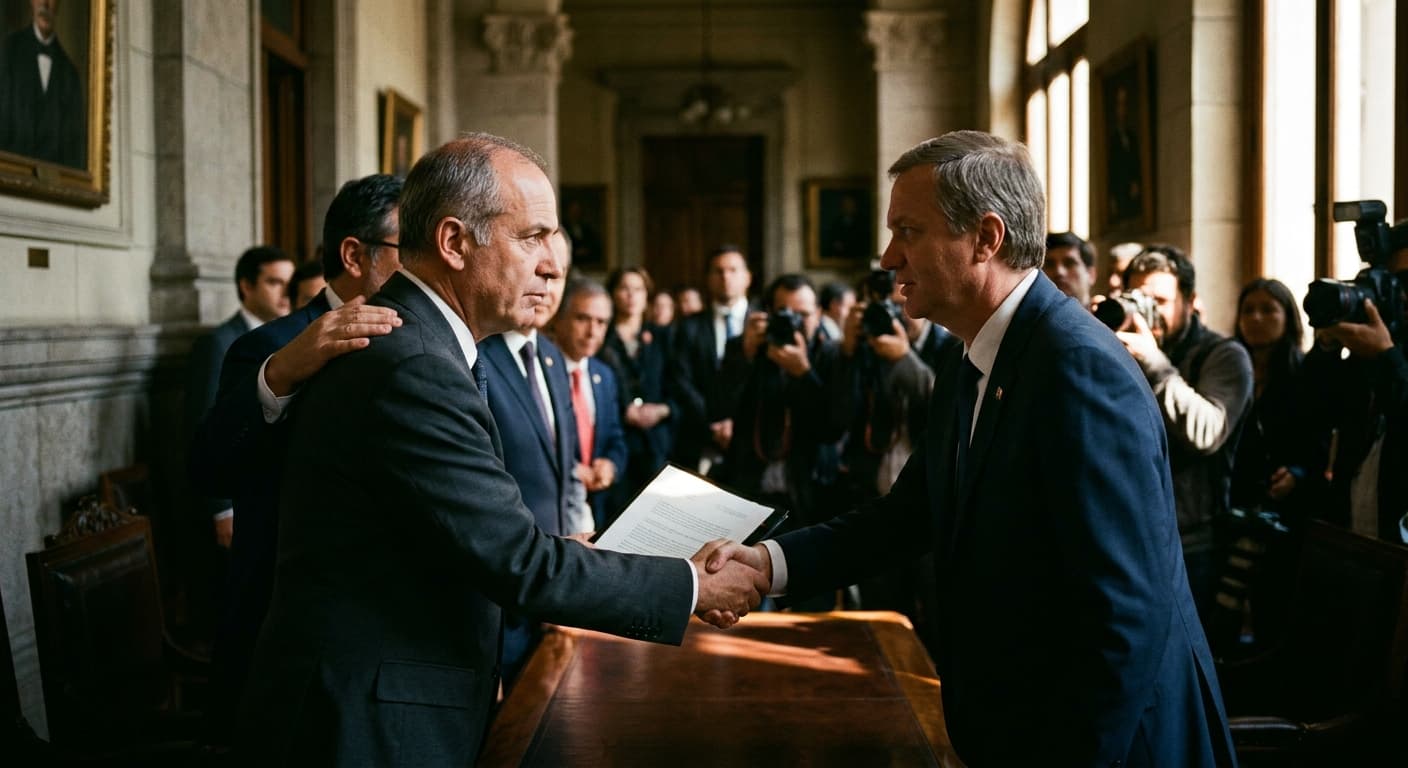
Chilean opposition PPD senators cut a deal on tax invariability in President Kast's megarreforma, splitting the left and clearing the path to passage.
Chile's opposition just handed President José Antonio Kast the vote he needed. On July 8, 2026, senators from the Partido por la Democracia (PPD) closed a deal with Finance Minister Jorge Quiroz to replace the flat 25-year tax-invariability lock proposed in the government's "megarreforma" with a tiered scheme — 10 years for projects up to US$100 million, 15 years up to US$350 million, and a 25-year cap only above US$500 million — plus a 1.5% corporate surtax on beneficiaries. The tweak looks technical. It is not. It is the first crack in the anti-Kast bloc, and it effectively locks in the largest pro-investment tax overhaul Chile has passed since 1990 — while stripping eligibility from the mid-sized projects the center-left most wanted to protect and preserving the mega-project lock-in that captures mining, lithium, and green hydrogen.
A Latin American economic-policy shift arrived not by decree but by defection, and it moved the market frontier in Chile from a Boric-era tax-hike consensus back toward the pro-capital certainty regime that underpinned the copper boom. For a region where "democratic backsliding" is usually shorthand for executive overreach, Chile is doing the opposite: a right-wing president using an opposition-controlled Senate to bind the next government's tax hands for a generation.
What the deal actually changed
The government's Ley de Reconstrucción Nacional y Desarrollo Económico y Social, filed April 15, 2026, bundles a corporate tax cut from 27% to 23%, full integration of corporate and personal income taxes, a permitting reform ("permisología"), a labor-hiring credit, and — the flashpoint — a 25-year tax-invariability guarantee for any project above US$50 million, as BBC News Mundo detailed at launch. Kast justified the corporate cut with an OECD comparison and the line that "el problema no es recaudar más, sino crecer." Chile is the only OECD country to have raised its corporate tax rate in the last 25 years, an outlier status that the Kast team has weaponized in the Senate debate.
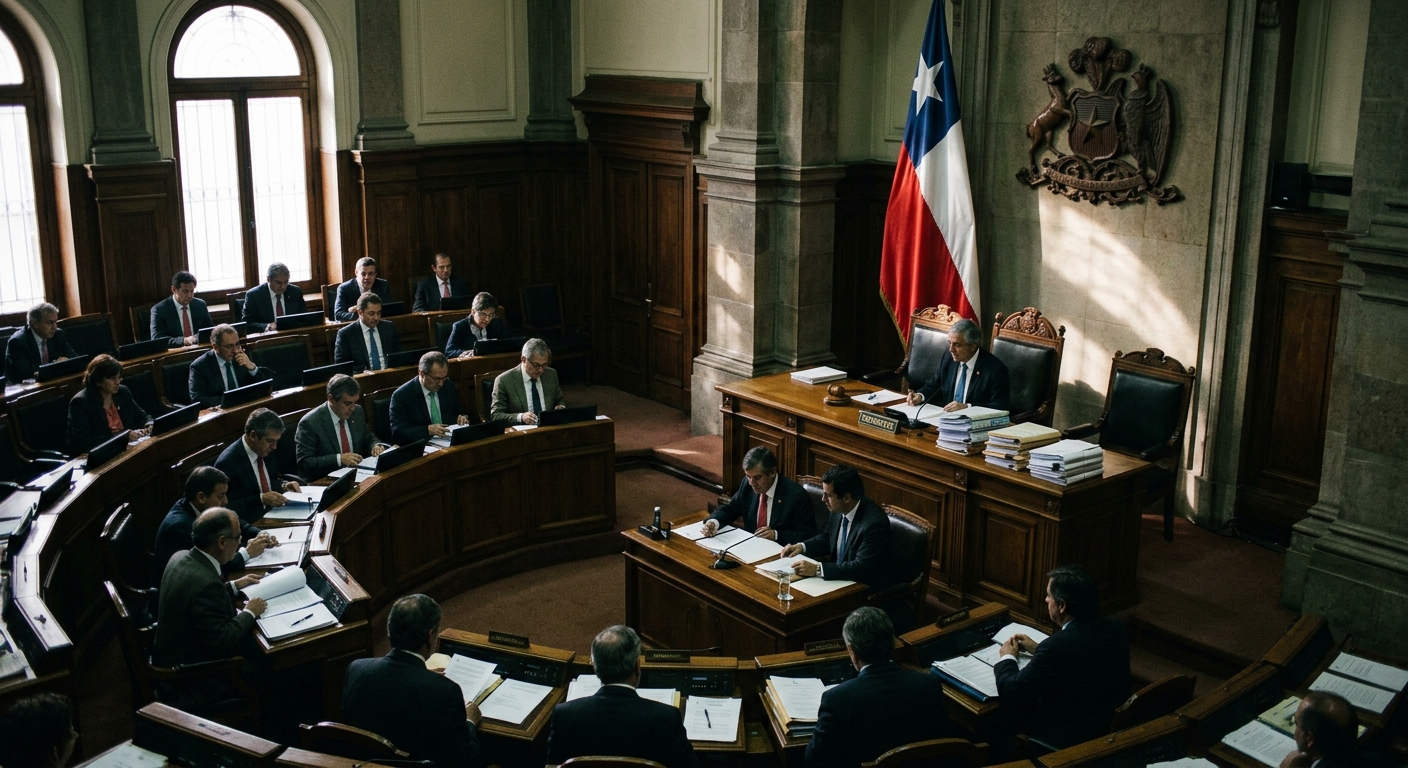
The Chamber approved the bill on general terms with 90 votes against a 78-vote threshold — the tax-invariability article and the reintegration passed by comparable margins — according to Libertad y Desarrollo. In the Senate, where Kast lacks a majority, invariability was the hardest article to sell. The PPD delivered the exit ramp.
Per T13, Quiroz agreed to replace the single 25-year term with the sliding schedule and add a 1.5% surtax on firms that opt into the regime. That surtax is the "delta" the
Centro de Estudios Públicos had explicitly recommended in May: invariability "solo respecto de impuestos a la renta corporativa y pagando un delta por esta mayor seguridad." The mining royalty passed in 2023 stays in place, an important carve-out because it protects roughly US$1.5 billion a year of new fiscal revenue that the previous Boric government had fought hard to secure. According to
El Mostrador, PPD negotiators say the executive absorbed roughly 90% of their proposals — a claim the government has not disputed.
The economic weight is not marginal. According to CEP Chile, the Ministry of Hacienda's own modelling attributes roughly 86% of the expected growth effect of the entire megarreforma to just three levers: the corporate-tax cut, the permitting reform, and the tax-invariability guarantee. Killing invariability would have gutted the bill's growth arithmetic. The PPD did not kill it — it repriced it.
The DL 600 ghost — why the number 25 matters
To understand why Frente Amplio called the pact "peor que el de Pinochet," you need the history. The 1974 Decree Law 600 — the "Estatuto del Inversionista Extranjero" — offered foreign capital a contract-law lock on tax treatment for up to 20 years, extended to 15 years plus rollovers for mining under a 2005 amendment. It powered roughly US$100 billion in foreign direct investment over three decades and, by 2021, Cochilco data cited by CEP showed that 15 mines representing about 90% of Chilean private-copper output still operated under DL 600 invariability contracts, with 78% of that production locked in through 2023. Bachelet's 2014 tax reform derogated DL 600 in 2016, a decision that
Libertad y Desarrollo at the time called a loss of "certeza jurídica" that put Chile at a disadvantage relative to a region "no precisamente amistosa para la inversión extranjera."
The new regime, in its post-PPD form, does something DL 600 never did: it extends the lock to domestic investors on equal terms with foreign ones, prices the guarantee explicitly (the 1.5% surtax), and caps it at 25 years for projects over US$500 million — a longer horizon than the old statute, which is precisely why the FA line about Pinochet landed. But it also does something the original never did well: it tiers the benefit by project size, cutting off the mid-market projects between US$50 million and US$100 million that carry the highest political cost and the least mining logic.
Who broke, who paid
The PPD move fractured what had been a coordinated four-party opposition strategy — PS, PPD, Frente Amplio, PC — organized around a single message that the megarreforma was regressive. That coordination collapsed in 48 hours.
Frente Amplio co-founder Beatriz Sánchez called the pact "un pésimo acuerdo" that "debilita al Estado," according to El Periodista. In a headline that ricocheted through Chilean politics, FA leaders labeled the terms "peor que el de Pinochet," according to
El Mostrador — because the residual 25-year window for the largest projects exceeds the 20-year cap of the original 1974 statute. The Frente Amplio said it will file a challenge before the Tribunal Constitucional; the PPD, per
24horas, has ruled itself out of that action, robbing the challenge of the ten-signature parliamentary quorum it most naturally would have used.
That matters because Chile's TC has not been friendly to left-side opposition requerimientos: a Libertad y Desarrollo review of two decades of filings found the Concertación/Nueva Mayoría succeeded in only about 20% of cases, versus 53% for the center-right. Frente Amplio and PS lawyers know those odds. Without PPD signatures, the challenge is symbolic, not dispositive — which is exactly what Quiroz needed.
The Socialists split down the middle. Senator Paulina Vodanovic — the party's president — walked out of the negotiating table amid internal frictions, La Tercera reported, and other PS senators took over the mesa. The PPD's own party chair, deputy Raúl Soto, publicly distanced the collective party from the senators who cut the deal, according to
El Desconcierto — a distinction that lets the PPD collect both the moderate-governance dividend and the opposition-purity vote. Senator Ricardo Celis, the lead PPD negotiator, defended the pact as necessary to protect the Treasury by pricing the certainty guarantee, per
CNN Chile.
Winners: Kast, Quiroz, and the mega-project sponsors — copper majors, lithium consortia, green-hydrogen developers, and hyperscale data centers — whose CapEx horizons match the 25-year lock and whose deal sizes clear the US$500 million bar. Losers: mid-sized domestic investors between US$50 million and US$100 million, who lose eligibility entirely under the new floor, and SMEs, whose competitive tax gap widens as the general corporate rate falls to 23% while the Pyme rate holds at 12.5%. Politically, the biggest loser is the Frente Amplio, which now carries the isolated-veto seat while the older center-left rebrands as governable.
The fiscal frame the IMF just endorsed
The domestic fight is unfolding inside a hard external constraint. The IMF Executive Board, in its July 6, 2026 Article IV conclusion, projected Chilean growth of just 1.8% in 2026, rising to 2.6% in 2027, and warned that "achieving the government's objective of reaching structural balance by 2030 and keeping the debt-to-GDP ratio below 45 percent will require additional fiscal efforts." The Fund welcomed the pro-growth thrust of the National Reconstruction Plan but urged that "the fiscal costs and growth impact of tax and other reforms should be carefully considered to ensure fiscal sustainability."
That is the vise. The Consejo Fiscal Autónomo — Chile's independent watchdog — had already flagged that 45% of the bill's cost is funded from measures not written into the project itself, according to former CFA president Jorge Rodríguez in an interview with CEP Chile: "El 45% se financia con medidas que no están en el proyecto." Rodríguez warned that Chile sits three GDP points from its 45%-of-GDP prudent-debt ceiling, leaving "un margen muy pequeño" for any growth slippage. Kast's June fiscal decree quietly moved the 2030 structural deficit target from zero to 1.5% of GDP, per
Libertad y Desarrollo — matching, not coincidentally, the IMF's landing zone.
The PPD deal reinforces the IMF frame in a way markets will read quickly: by pricing invariability with a 1.5% surtax rather than giving it away, Quiroz preserved a permanent revenue line the CFA can score against the deficit. CEP Chile had described the original DL 600 design as making "sentido que este beneficio se otorgue sin un cargo recaudatorio adicional" — the PPD just fixed that flaw.
The regional read
Latin America's 2024–2026 political map ran one direction: Milei in Argentina, Bukele in El Salvador, Noboa in Ecuador, and now Kast in Chile — all elected on some combination of security, austerity, and pro-capital signals. What separates Kast's playbook is that Chile has functioning institutional friction. He needs opposition votes. His finance minister has to sit in a room with PPD senators and give up ground.
The regional lesson from July 8, 2026 is not that the right won an economic argument. It is that Chile's institutions absorbed a maximalist proposal, moderated it, and delivered a deal that both the government and the IMF can score as a win — while the losing side of the opposition keeps a viable constitutional challenge in reserve. That is the opposite of democratic backsliding. It is closer to the Concertación-era pattern: an executive with an ambitious agenda, an opposition that extracts concessions, and a Senate that produces text.
Investors will read it that way. The peso and IPSA reactions in the days after July 8 will be the first market vote on whether the deal makes Chile look more like the DL 600 era — steady rules, long horizons, low risk premium — or like a country where the next left-of-center government simply re-litigates the whole thing. The PPD's calculation, implicit in Celis's public defense, is that the 1.5% surtax and the tiered horizon make the regime durable enough to survive a future rotation. That is a bet on political self-enforcement, not on the Tribunal Constitucional.
Diplomat View
The PPD–Hacienda deal is the moment the Kast megarreforma stopped being a campaign promise and started being law. The tiered horizon and the 1.5% surtax are not concessions in any meaningful economic sense — they cost the mega-project sponsors little and buy the government the votes it needed, plus a defensible answer to the IMF and the CFA. Expect the Senate to pass the tax package with a working margin during the second half of July 2026, expect the Tribunal Constitucional challenge from FA and part of the PS to fail on quorum or on the merits, and expect Chile's sovereign risk premium to compress modestly into year-end. The forecast changes if the Consejo Fiscal Autónomo publishes a formal opinion that the invariability regime — even with the surtax — pushes the 2030 structural target out of reach, or if the copper price breaks below the IMF's implicit assumption and forces fiscal renegotiation. Absent those two triggers, the PPD senators who cut this deal will have done more to shape Chilean tax policy through 2035 than any left-of-center government since Bachelet.
What to watch next
- Mid-to-late July 2026: Senate floor vote on the megarreforma tax package; watch for the working majority and whether any PS senators join the PPD.
- Following weeks: Filing (or non-filing) of a Tribunal Constitucional requerimiento by Frente Amplio and dissident PS senators — and whether they clear the ten-signature Senate threshold without the PPD.
- Q3 2026 CFA report: The Consejo Fiscal Autónomo's next Informe on the reform's compatibility with the 1.5%-of-GDP 2030 structural-deficit target — the number that will decide whether the IMF's Article IV language sharpens in 2027.
Discover more

US Politics
US Launches $166B Tariff Refund Portal
The US is launching a $166 billion tariff refund portal to aid importers hit by Trump-era tariffs, with major implications for trade and supply costs.

US Politics
SNAP Food Assistance Faces Legal Challenges
In 2026, SNAP faces stricter eligibility rules and mounting legal challenges, threatening food assistance for the millions of Americans who rely on the program.
US Politics
U.S. House Passes Alert Act for Aviation
The House passed the ALERT Act 396–10, replacing the ROTOR Act after Pentagon intervention, impacting aviation safety regulations.

Conflict & Security
Drone Warfare Killing Aid Workers at Unprec
Over 1,000 humanitarian workers killed in three years as cheap armed drones collapse legal protections. Gaza, Sudan, Ukraine, and DRC see deliberate targeting of aid convoys and hospitals with zero prosecutions.