Burkina Faso's Army Blocks Civilians' Escape
Civilians trapped in jihadist-besieged towns face dire conditions.
Model Diplomat8 min readSub-Saharan Africa
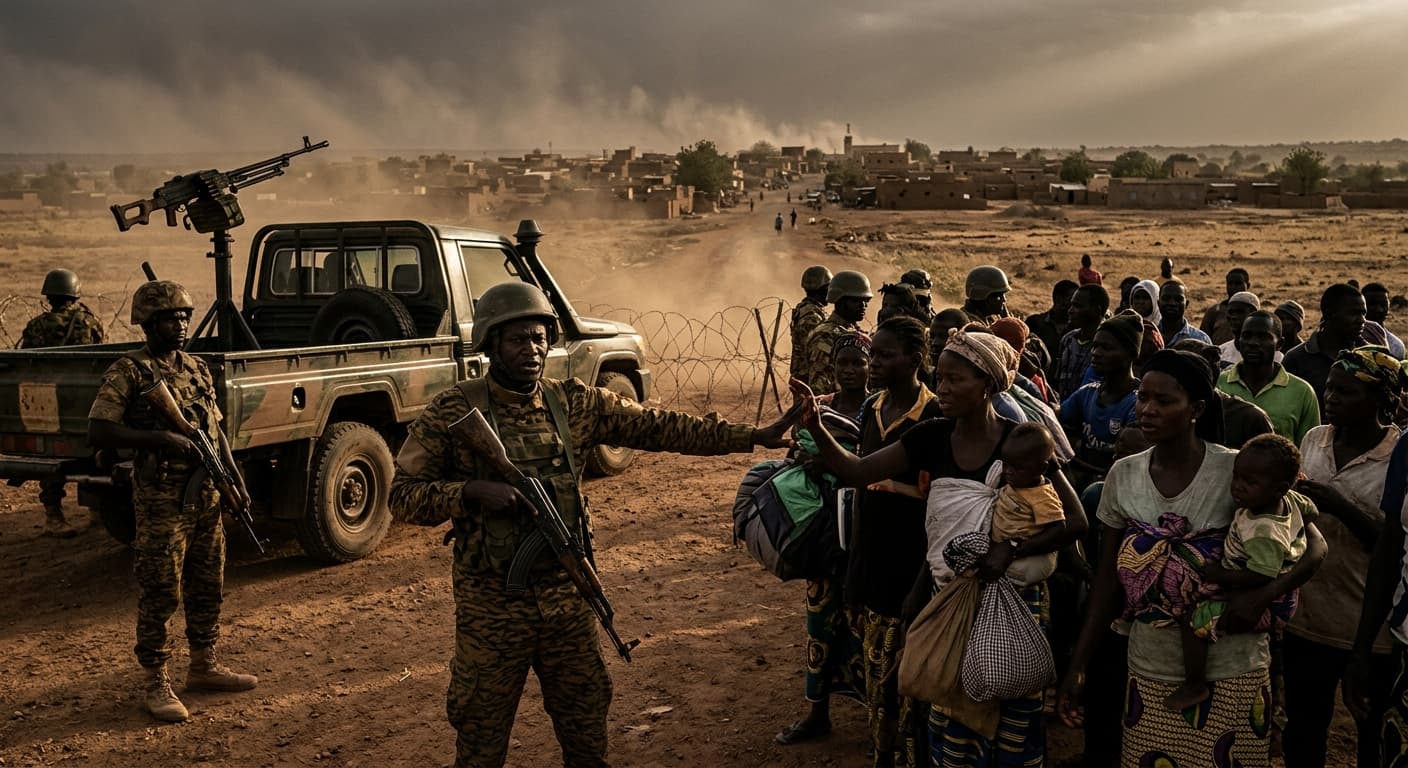
Burkina Faso's Army Is Locking Civilians Into Siege Zones
Soldiers are turning back civilians trying to flee jihadist-besieged towns in Burkina Faso — the second blockade compounds a humanitarian catastrophe and shields a failing counter-insurgency from view.
Burkina Faso's junta has run out of ways to hide the strategic reversal it claims not to be losing — so it is now, according to civilians and aid workers, physically preventing people from leaving the very towns Captain Ibrahim Traoré's army is supposed to be defending. The second blockade is the story: on top of a jihadist siege that has isolated northern and eastern towns for years, the national army has begun turning back evacuees at military convoys, according to a July 6 investigation by The New Humanitarian. That decision converts trapped civilians into political scenery for a regime that has staked everything on the appearance of territorial recovery — and it removes the last exit for a population the same army is already accused of killing at industrial scale.
What the residents describe
More than a dozen civilians and humanitarian workers told The New Humanitarian that soldiers are refusing to let them board military-escorted convoys out of blockaded towns such as Djibo in the north and Kantchari in the east. "He said I had to be prepared to face death just as the soldiers do every day," a Djibo resident recounted after a soldier refused to let him leave, per The New Humanitarian. A shopkeeper from Kantchari told the outlet: "They say we have to accept dying for the homeland. How can we, civilians who don't have weapons and who starve to death, respect these rules?"
The reporting cannot yet determine whether the departure restrictions are ad hoc conduct by field commanders or a written policy — the government did not respond to requests for comment. But the logic is transparent. Traoré's administration insists that displacement has fallen from a 2023 peak of more than two million and that communities are returning home. Empty towns contradict the narrative; populated towns validate it. Keeping the civilians in place is cheaper than retaking the countryside.
The siege inside the siege
Djibo has been under JNIM blockade since 2020, its 35-km approach road salted with roadside bombs and its convoys routinely destroyed — Al Jazeera documented residents reduced to eating leaves at the height of the siege. In May 2025, JNIM briefly overran the town, killing more than a hundred soldiers, paramilitaries and civilians and looting the army camp, gendarmerie and market — the
International Crisis Group called the offensive unprecedented and noted that army reinforcements arrived by helicopter without vehicles, artillery or effective air cover.
The pattern has replicated. After a JNIM attack on the Mansila base in June 2024 killed around 100 soldiers, the army sealed the town: "it is not possible to enter the city without a military convoy," the BBC reported. The Titao base — described by
BBC as one of the best-equipped in the country — was overrun in February 2025, with road access blocked in the aftermath, leaving even Ghanaian traders' bodies unrecovered for days.
Analytically, this matters because the towns being sealed are not incidental to the war — they are the war. JNIM's strategy, as ISS analyst Heni Nsaibia told Al Jazeera back in 2020, is to "suffocate" garrison towns and brittle the relationship between civilians and the state. The junta's new response — sealing the exits from the inside — completes the suffocation.
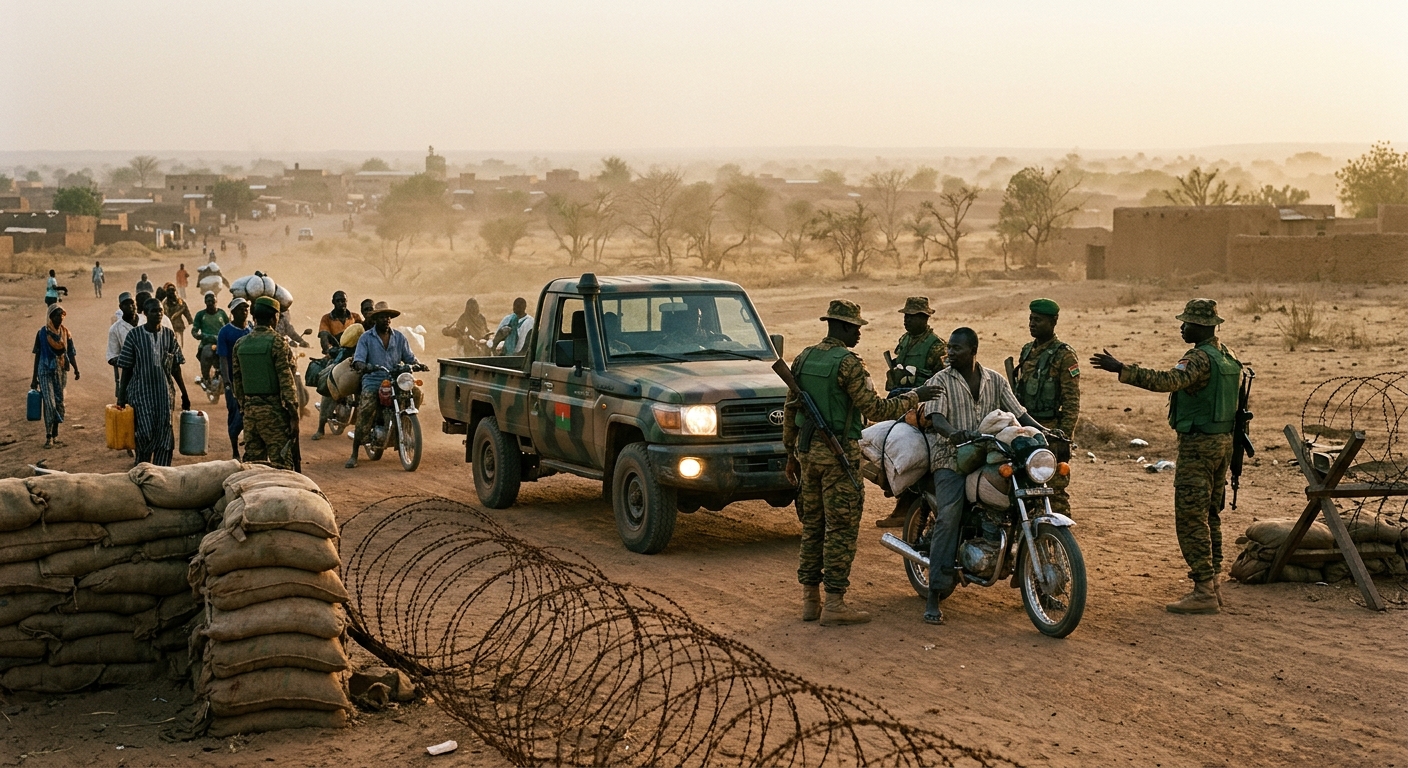
The numbers the junta cannot rewrite
The scale of the country's crisis is now the largest in the Sahel by any measure. The UN's OCHA puts humanitarian need at 4.5 million people in 2026, with the response plan just 15.4% funded against a $658.5 million ask.
IOM's Displacement Tracking Matrix counted 2,062,534 internally displaced Burkinabé as of February 2026 — 76% of all IDPs in the Liptako-Gourma crisis zone, and unchanged year-on-year, contradicting official claims of a mass return home. Regional
OCHA data recorded 2,640 conflict deaths across the central Sahel in the first quarter of 2026 alone.
The military side of the ledger is worse. In its April 2, 2026 report None Can Run Away, Human Rights Watch attributed 1,255 of 1,837 documented civilian killings between January 2023 and August 2025 to the Burkinabé army and its allied Volunteers for the Defence of the Homeland (VDP) militias, and found that Traoré himself and six senior commanders "may be liable as a matter of command responsibility." One December 2023 operation near Djibo killed more than 400 Fulani civilians across some 16 villages. The government dismissed the report as "conjecture," according to the
BBC.
Read against that record, the decision to keep civilians inside besieged towns takes on a darker second meaning. The population that the army is preventing from fleeing is disproportionately Fulani — the same community HRW says has been the target of what it characterises as ethnic cleansing, per Al Jazeera's summary of the report. Whether by design or by improvisation, holding these civilians in place removes the alibi of civilian flight and preserves an army-controlled perimeter around communities the state distrusts.
Legally, this is not a grey area
International humanitarian law treats besieged civilians as protected persons. The Fourth Geneva Convention obliges parties to allow the free passage of relief and, per the Legal Information Institute's overview, prohibits attacks on and collective punishment of civilian populations. Additional Protocol I extends explicit protection against starvation as a method of warfare. Preventing non-combatants from leaving a zone under siege, when a safe corridor exists, is precisely the fact pattern international lawyers characterise as using civilians as de facto human shields.
The forum for testing that argument is closing. On September 22, 2025, Burkina Faso, Mali and Niger jointly announced withdrawal from the Rome Statute, calling the International Criminal Court an "instrument of neocolonial repression," per Al Jazeera. The
Presidency of the ICC's Assembly of States Parties formally acknowledged the notifications on July 1, 2026; withdrawal takes effect a year after UN notification. HRW called the move a "betrayal of victims" in a
July 2, 2026 statement.
The same week, the last independent monitor left. The UN Human Rights Office announced on July 2, 2026 that it will close its Ouagadougou office by 30 November, after Burkinabé authorities suspended its operations in April over a press release calling for the protection of civic space. "Intensive engagement with the authorities since has not resolved the matter," High Commissioner Volker Türk said. The office had trained nearly 4,000 members of Burkina Faso's security forces on international humanitarian law — a capacity that ends this year.
The historical parallel — and who benefits
The reflex to freeze civilians into a besieged town has a Sahelian precedent. In June 2022, the previous junta gave residents 14 days to evacuate two "military interest zones" totalling 13,000 square kilometres, with those who remained implicitly categorised as combatants. Four years on, the incentive has inverted: civilians who leave are the political liability, because their departure would visibly refute the recovery narrative. In both cases, the state uses population movement to redraw the map of who is presumed enemy.
Who wins from this? In the near term, Traoré himself — his domestic legitimacy rests on the claim that Burkina Faso is "winning" the war, a narrative he doubled down on when he told state television that Burkinabé must "forget" democracy, per the BBC. Moscow benefits too: Russian mercenary support and arms flows are now Ouagadougou's principal external lifeline after the
June 26, 2026 rupture with Paris, and a regime insulated from Western scrutiny is a client with fewer alternatives. JNIM benefits in the medium term:
BBC Monitoring data show JNIM claimed more than 280 attacks in Burkina Faso in the first half of 2025 alone — double the same period in 2024 — and every trapped, hungry civilian is a future recruitment argument. As Crisis Group warned after the Djibo assault, "each new massacre has only fuelled jihadist recruitment."
Who loses? Fulani communities, whom HRW says have been systematically targeted. Coastal neighbours — Benin, Togo, Côte d'Ivoire, Ghana — that now host tens of thousands of Sahel refugees and face JNIM spillover along trade corridors from Abidjan and Dakar, as ISS Africa detailed in its analysis of JNIM's blockade tactics. And the humanitarian sector:
IOM's 2026 crisis plan notes that only 1.8 million of 3.7 million targeted people were reached in 2025, with the response 29% funded — numbers that will worsen as departures are physically blocked and monitors depart.
Diplomat View
The junta's move to seal civilians inside besieged towns is not a security tactic — it is a legibility tactic, aimed at the audience in Ouagadougou, Moscow and social media rather than the enemy in the bush. Read together with the ICC withdrawal, the ejection of the UN Human Rights Office, the ban on political parties and the diplomatic rupture with France, it forms a coherent project: strip out every external observer that could contradict the regime's story, then compel the population to physically stand in for that story.
The forecast: the humanitarian floor will drop further before it stabilises, JNIM will exploit the sealed towns as recruitment theatres, and Burkina Faso's IDP figure — flat for the last year — will resume rising once the pretence of return collapses. What would revise this call: a credible, sourced government policy document permitting free civilian departure via military convoys, or a resumption of OHCHR monitoring. Neither is likely before year-end.
What to watch
- November 30, 2026: Formal closure of the UN Human Rights Office in Ouagadougou, ending in-country monitoring capacity.
- September 22, 2026: One-year mark on the AES joint ICC withdrawal notification — the date after which any exit takes legal effect if not rescinded.
- Q3–Q4 2026 hunger season: OCHA projects 15.4 million people in IPC Phase 3+ food insecurity across the Sahel between June and August 2026, a 38% jump on the previous projection; Burkina Faso's besieged towns will be the sharpest edge of that curve.
The Bottom Line
Burkina Faso's army is not just failing to lift jihadist sieges — it is reinforcing them from the inside, keeping civilians in place to preserve the political fiction of a counter-insurgency that is winning. With the ICC exit filed, the UN human rights office closing, and France pushed out, the machinery that could name this pattern as a war crime is being dismantled in the same weeks the pattern is being documented. The trapped population of Djibo and Kantchari is the collateral of that convergence, and, on current trajectory, its scale will grow before it shrinks.
Discover more
US Politics
House Ethics Committee Pushes Sexual Miscond.
The House Ethics Committee has shifted responsibility for sexual harassment settlement records to the Office of Congressional Workplace Rights, complicating disclosure efforts.

US Politics
US Launches $166B Tariff Refund Portal
The US is launching a $166 billion tariff refund portal to aid importers hit by Trump-era tariffs, with major implications for trade and supply costs.
India
Rajnath Singh's Durga Squad for 2026 Polls
Rajnath Singh's Durga Squad promised women's safety in Bengal but has since disappeared from the agenda, revealing BJP's true priorities.
Conflict & Security
Guatemala: El Niño 2026–27 becomes regional security test
UNICEF: 25.8M children face El Niño risks in Latin America; Guatemala maps 188 municipalities for drought and food insecurity amid regional security test.