Britain and Poland's New Security Treaty
A pivotal defense agreement amid shifting European dynamics
Model Diplomat3 min readEurope
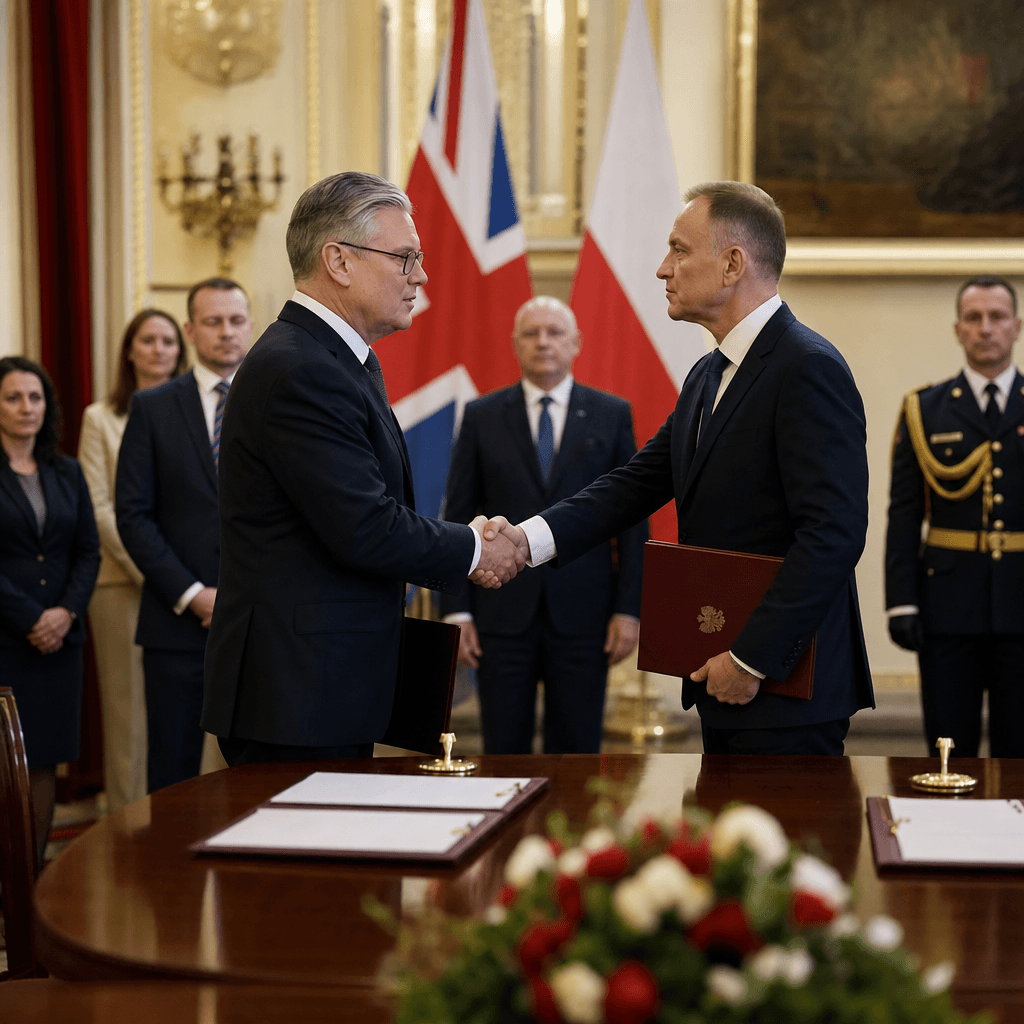
Britain and Poland Are Rewriting Europe’s Security Ledger
Starmer and Tusk are turning Russian pressure and U.S. uncertainty into a bilateral hedge — and a new source of leverage for Warsaw.
Britain and Poland are expected to sign a new defence and security treaty on May 27, with Keir Starmer and Donald Tusk using the moment to signal a deeper alignment at a time when Europe is recalculating who can still be relied on, The Economist reported. Tusk has already said the pact will “genuinely strengthen” cooperation, especially in defence, while British coverage of his remarks described the deal as part of a broader push for more durable military ties with London (
British Poles).
Why this is not just another photo-op
The power shift is the point. Britain wants access to one of NATO’s most serious frontline militaries; Poland wants another major security partner as it hardens its eastern-flank posture. That is a better bargain for Warsaw than for London. Poland is already the largest beneficiary of the EU’s new SAFE defence-finance scheme, with €43.7 billion available to it under the European Commission’s readiness plan, a scale that confirms how central Poland has become to Europe’s rearmament agenda (European Commission;
EuroEFE).
That matters because Poland is no longer just asking for solidarity; it can offer geography, military capacity and urgency. It sits on NATO’s eastern edge, spends heavily on defence, and now has EU money to convert that spending into procurement and industrial expansion. For Britain, a treaty with Poland is a way to remain relevant in European security without re-entering EU structures. For Poland, it is another channel of influence with London, Berlin, Paris and Washington at once. This is part of the wider Global Politics story: Europe is trying to build more of its own security capacity because it can no longer assume U.S. guarantees will look unchanged.
The U.S. factor is the hidden driver
Washington is the real backdrop here, not Moscow alone. In mid-May, Vice President JD Vance said the U.S. wants Europe to “stand on its own two feet,” and NATO officials were already managing fresh anxiety over troop shifts and drone incidents on the Baltic flank (EFE;
EFE). That is the strategic signal London and Warsaw are responding to: even if the U.S. does not abandon Europe, it is pushing allies to absorb more of the burden themselves.
Britain is trying to stay indispensable to that process. Poland is positioning itself as the indispensable buyer, host and planner on NATO’s eastern flank. The Economist noted that this treaty follows earlier British deals with Norway, France and Germany, all designed to compensate for London’s smaller formal role outside the EU while still keeping it inside Europe’s security conversation (The Economist). On that logic, Poland is the best fit: it is militarily consequential, politically open to deeper cooperation, and strategically impossible to ignore.
What to watch next
The issue is not whether the treaty is signed; it is what hard commitments sit inside it. Watch for language on intelligence sharing, air defence, industrial procurement and Ukraine support, and whether London can translate symbolism into contracts and joint planning. If it can, Britain gets a post-Brexit security lane into Europe. If it cannot, Poland still wins: it has used Britain’s need for relevance to extract another layer of outside support, while keeping its main leverage where it already is — on NATO’s eastern edge.
Discover more

India
India-South Korea $50B Trade Expansion Plan
India and South Korea target $50 billion in bilateral trade by 2030, focusing on industrial cooperation and strategic alignment amid US pressures.
India
Romanian Coalition Party Demands PM Resign
Romania's Social Democrats withdrew from coalition, joining far-right AUR to topple PM Bolojan, risking €10 billion in EU funds by August 2026.

Economics
Fed's Amex AML order puts correspondent banking on notice
Federal Reserve's Amex AML order requires board-level controls and a 90-day plan; OCC fined the bank $350 million over enterprise-wide deficiencies.

Conflict & Security
Guatemala: El Niño 2026–27 becomes regional security test
UNICEF: 25.8M children face El Niño risks in Latin America; Guatemala maps 188 municipalities for drought and food insecurity amid regional security test.