Saint Barthélemy's First OCTA Presidency
A tiny Caribbean tax haven takes the helm of Europe's overseas territories.
Model Diplomat4 min readamericas
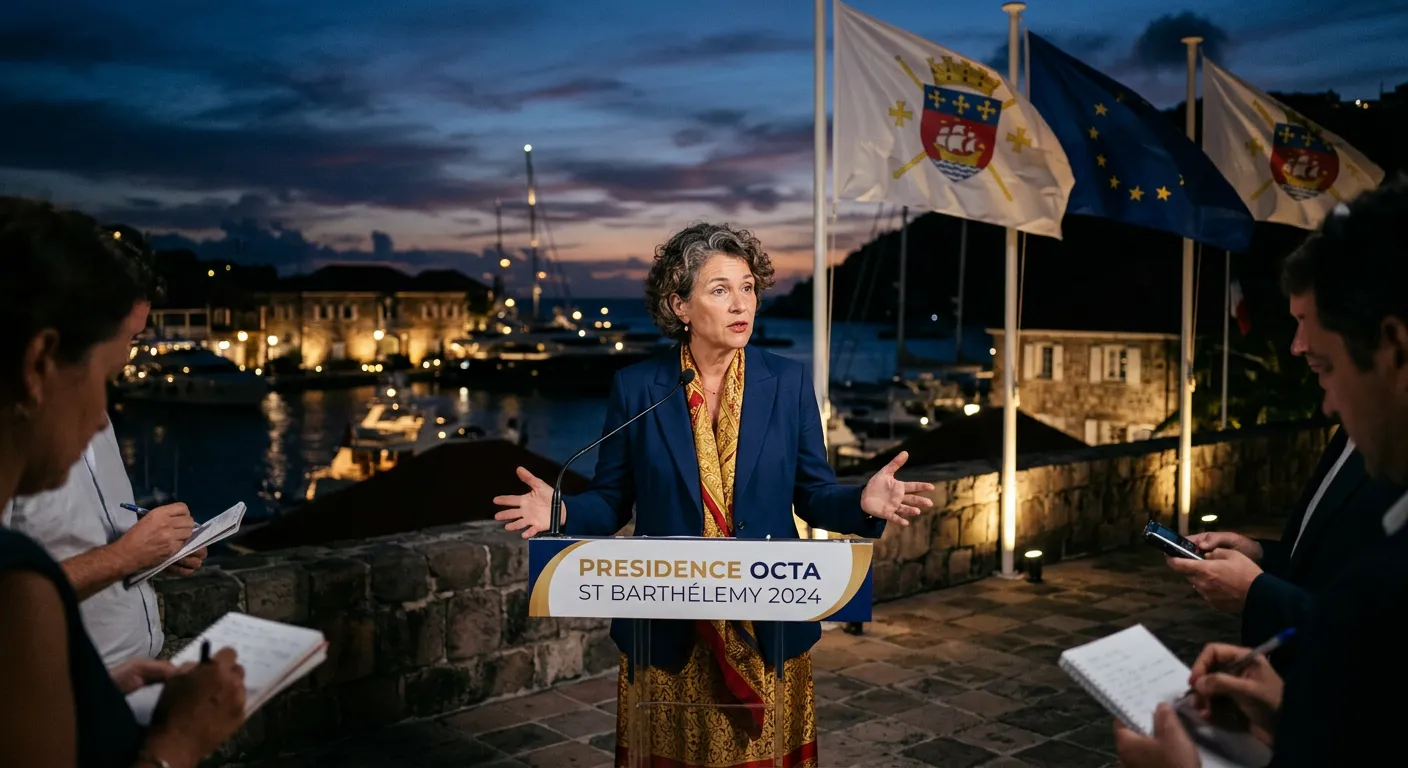
Saint Barthélemy's First OCTA Presidency Signals a Quiet Foreign Policy Awakening
A tiny Caribbean tax haven just took the helm of Europe's overseas territories club — and its agenda reveals more strategic ambition than its "no foreign policy" label suggests.
Saint Barthélemy does not, by law, run its own foreign policy. Under Article 74 of the French Constitution, Paris handles defense, diplomacy, and treaty representation; the island's elected Territorial Council, led by President Xavier Lédée since 2022, governs taxation, land use, and tourism management Model Diplomat. That constitutional firewall has long defined the island's external posture as passive — aligned with Paris, implemented through the local prefect, and functionally invisible.
But a quiet shift is underway. At the 21st OCTA Ministerial Conference in Aruba on April 11, 2026, Saint Barthélemy assumed the presidency of the Overseas Countries and Territories Association for the first time since joining in 2012, and used the platform to table a remarkably substantive agenda: connectivity, energy transition, climate adaptation, waste management, regional Caribbean cooperation, and — most pointedly — a "more balanced partnership" with the European Union Model Diplomat. For a territory of roughly 9,000 residents whose economy depends almost entirely on high-end tourism, these are not abstractions; they are the terms on which the island survives.
The OCT Presidency as a Policy Vehicle
The OCTA groups 13 overseas territories linked constitutionally to Denmark, France, and the Netherlands — including Greenland, New Caledonia, Aruba, and French Polynesia — that sit outside EU territory but remain associated through the Treaty on the Functioning of the European Union HCSS. Saint Barthélemy's arrival in this chair is not ceremonial. The territory was reclassified in 2012 from an EU "outermost region" to an OCT at France's request, precisely to preserve its distinctive fiscal model — no VAT, no metropolitan French tax code — while retaining access to EU development programming and the single market for goods
Egmont Institute.
The presidency gives Lédée's administration a rare institutional megaphone. The five priorities tabled in Aruba — connectivity, energy, climate, waste, and balanced partnership — track closely with the island's material vulnerabilities. Saint Barthélemy imports nearly everything, relies on air and maritime links for its luxury tourism model, and remains acutely exposed to hurricanes: Irma caused severe damage in 2017, flooding the fire station under a meter of water and knocking out power across the island BBC. The EU has since channeled resilience funding through the RESEMBiD program and disaster-risk insurance technical assistance managed by the World Bank and Expertise France — programs Saint Barthélemy now has a stronger hand in shaping
World Bank.
What Paris Still Controls — and What It Doesn't
The French state retains the decisive levers. Emmanuel Macron is head of state; the prefect stationed in Saint-Martin represents Paris locally; and French armed forces provide security. Unlike New Caledonia or French Polynesia — where independence movements have forced Paris into active political management — Saint Barthélemy has shown no appetite for sovereignty disruption. The IRIS think tank notes that the island hosts no military installations and is not integrated into France's Indo-Pacific or Caribbean force posture IRIS. It is, in strategic terms, a non-factor.
Yet precisely because Paris handles the heavy diplomatic lifting, Saint Barthélemy has been free to pursue what amounts to a niche external policy through technical and regulatory channels: fiscal distinctiveness, EU programming access, tourism standards, and environmental regulation. The island's Territorial Council adopted a 2026 budget of €458.5 million — balanced across operating and investment sections — but flagged declining revenues tied to real-estate transfer-tax volatility, a structural vulnerability that OCTA-level coordination on climate adaptation and connectivity directly addresses Model Diplomat.
The Review Clause and the Longer Game
A less visible but potentially consequential development: the French National Assembly's Delegation for Overseas France has recommended a legally binding "review clause" that would require periodic reassessment of Saint Barthélemy's institutional status Model Diplomat. This follows a 300-page report on overseas territories and a fact-finding mission in October 2023. The recommendation does not presage a change in status — Lédée and the council have given no indication they want one — but it signals that Paris is paying closer attention to how overseas collectivities exercise their autonomy, particularly when they begin to use multilateral platforms like the OCTA to advance independent policy priorities.
Al Jazeera's January 2026 mapping of global overseas territories underscores the broader context: France administers 13 such territories with widely varying degrees of autonomy, and Saint Barthélemy's OCT status places it in a category — neither fully integrated like Martinique nor restive like New Caledonia — where the gap between formal non-sovereignty and practical self-governance keeps widening Al Jazeera.
What to Watch
The OCTA presidency runs through 2027. The immediate test is whether Saint Barthélemy can convert its Aruba agenda into concrete EU programming commitments — particularly on connectivity and climate adaptation — before the EU's 2028–2034 Multiannual Financial Framework negotiations reshape the development-aid landscape. Meanwhile, the French National Assembly's review-clause debate will determine whether Paris views the island's growing external engagement as complementary or as a precedent worth constraining. The next Territorial Council budget cycle, set against real-estate revenue volatility, will show whether Lédée's administration can sustain its ambitions without fiscal strain — or whether the island's foreign policy awakening runs into the hard ceiling of a 9,000-person tax.
Discover more

US Politics
White House Pressures Congress for Crypto Leg
The Trump administration's push for the CLARITY Act aims to reshape crypto regulation, impacting trillions in market value and the Trump family's wealth.
US Politics
Virginia's Redistricting Referendum
Virginia's redistricting referendum is drawing a flood of dark money, shaping future elections and the fight for congressional control amid party stakes.
US Politics
SNAP Food Assistance Faces Legal Challenges
In 2026, SNAP faces stricter eligibility rules and mounting legal challenges, threatening food assistance for the millions of Americans who rely on the program.

Conflict & Security
Drone Warfare Killing Aid Workers at Unprec
Over 1,000 humanitarian workers killed in three years as cheap armed drones collapse legal protections. Gaza, Sudan, Ukraine, and DRC see deliberate targeting of aid convoys and hospitals with zero prosecutions.