BJP's Bengal Win
Modi's victory reshapes West Bengal's political landscape
Model Diplomat7 min readSouth Asia
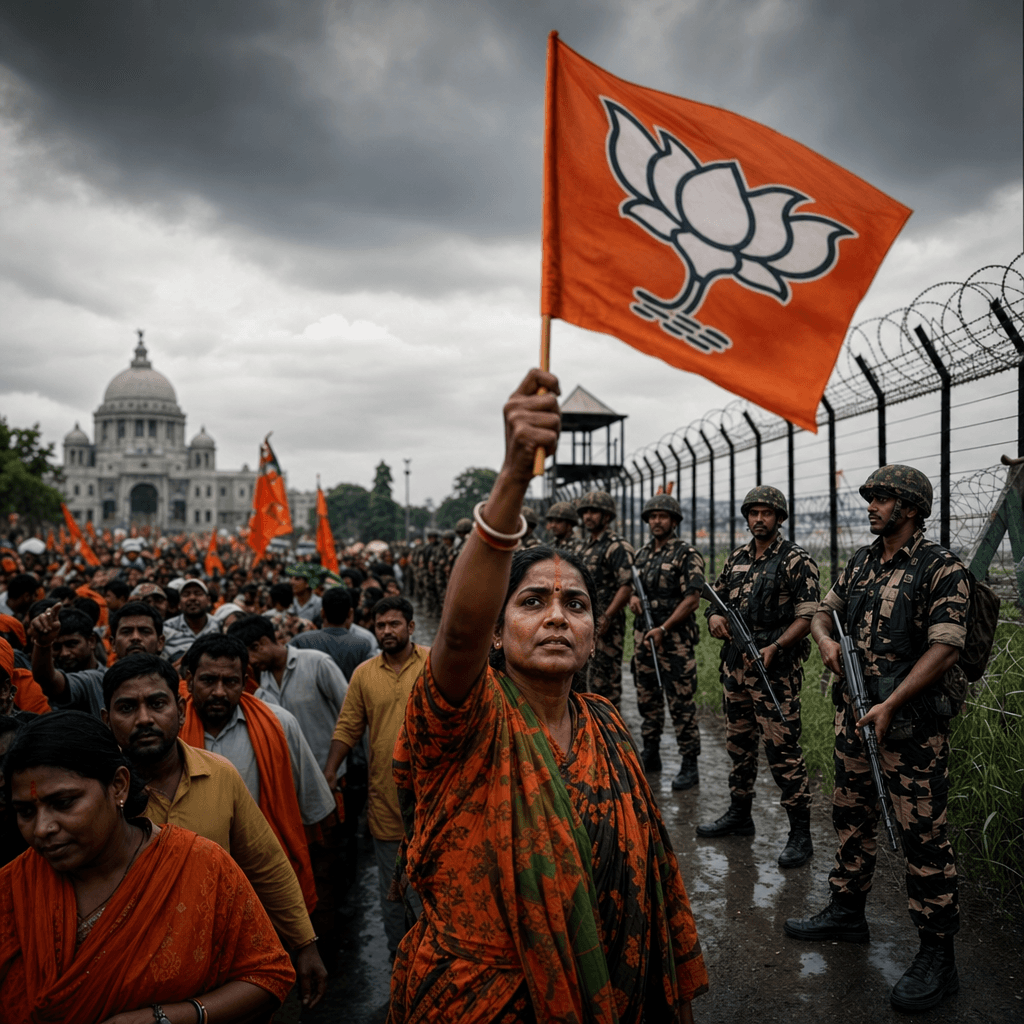
BJP's Bengal Win: How Modi Turned a 77-Seat Base Into 207 Seats
The BJP won 207 of 294 seats in West Bengal on May 4, 2026 — ending Mamata Banerjee's 15-year rule and rewriting Modi's national arithmetic ahead of 2029.
The Bharatiya Janata Party's 207-seat sweep of the West Bengal Assembly on May 4, 2026 is being read as an ideological triumph. That misses the point. The Bengal result is the mechanism by which Narendra Modi undoes his 2024 setback — it hands the BJP a two-thirds state majority, roughly 16 new Rajya Sabha seats over time, and, within eight weeks, most of the sitting Trinamool Congress caucus itself. What looks like an election is functionally a takeover: of a state, of an opposition party, and of the upper-house arithmetic that constrained Modi's third term.
The numbers are stark. The BJP retained all 77 seats it had won in 2021 and flipped 129 more, according to The Indian Express. Vote share climbed from about 38% in 2021 to roughly 46% this time, per the
NUS Institute of South Asian Studies. Turnout hit 92.93% — a state record — as
Al Jazeera reported. And in Bhabanipur, the Kolkata seat Banerjee had held since 2011, her former protégé Suvendu Adhikari beat her by 15,105 votes, ending her bid for a fourth consecutive term.
The engine: consolidation, plus a purged voter roll
Two forces did the work. The first was Hindu consolidation. Bengal's Muslim population — 27% by the 2011 census — has for a decade voted heavily for the TMC as the vehicle most likely to block the BJP. In 2021, the TMC swept 84 of 88 Muslim-dominated seats, per the BBC. This time the TMC won only 23 of 32 seats where Muslims cross 50% of the population,
ISAS-NUS found, with Congress, the Left and small Muslim parties biting into the incumbent's flank. Meanwhile, sharper campaign rhetoric from Adhikari and Assam Chief Minister Himanta Biswa Sarma — including Adhikari's 2025 threat to "physically throw Muslim MLAs out of the assembly" — appears to have delivered a nearly unified Hindu vote across urban Kolkata and the rural west.
The second force is more contested. Between October 2025 and the April 2026 poll, the Election Commission of India ran a Special Intensive Revision that removed roughly nine million names — about 12% of Bengal's 76 million electors, according to the BBC's constituency-level analysis. About 6 million were flagged as absent, shifted or deceased; 2.7 million more sat in tribunal limbo on polling day. The BBC found Muslims accounted for 34% of the deletions despite being 27% of the population. Yogendra Yadav told NDTV that the 2.7 million disputed deletions equalled 4.3% of votes cast, close to the BJP's 5-point statewide lead. ISAS-NUS reckoned deletions exceeded the winning margin on 105 seats the BJP took.
The Election Commission's own release confirms the March 15 schedule and the polling dates but is silent on the deletions dispute; the Supreme Court had, per the BBC, allowed the vote to proceed with tribunals unfinished. Ashoka University's Neelanjan Sircar and the CPR's Rahul Verma both told Al Jazeera the SIR alone could not explain the scale of the loss — but on close seats, it plausibly moved the outcome.

Adhikari's first 60 days: the template, not the exception
Suvendu Adhikari was sworn in on May 9, 2026, on Rabindranath Tagore's birth anniversary. Within 72 hours he ordered every one of Bengal's 23 districts to set up "holding centres" for suspected undocumented migrants — a "detect, delete and deport" policy that Al Jazeera reported had pushed roughly 4,800 people into Bangladesh by early June, exempting Hindus under the 2019 Citizenship Amendment Act framework. The state cabinet also transferred 27 km of border land to the Border Security Force for fencing and 120 acres of the Siliguri Corridor — the "Chicken's Neck" — to the Union government, per the
Observer Research Foundation.
This is not incidental. Bengal's 2,216-km frontier with Bangladesh — with 600 km unfenced, per PIB records — has been the single administrative obstacle to the BJP's national migrant policy since 2019. Banerjee refused to sign land transfers or clear the National Register of Citizens exercise in Bengal. Within eight weeks of taking office, Adhikari has removed both blocks. The border strategy Delhi could not run through Kolkata under Banerjee is now running out of Kolkata.
The knock-on for foreign policy is already visible. ORF notes that Bangladesh's BNP-led government under Tarique Rahman had leaned toward accepting Chinese financing for the Teesta River project and a reported airbase discussion at Lalmonirhat — moves that alarmed Delhi. A cooperative Kolkata gives the Modi government room to reopen Teesta water-sharing talks it had shelved under Banerjee, potentially trading concessions on the river for a slowdown on the border rhetoric.
The upper-house prize: why Modi needed Bengal specifically
The 2024 Lok Sabha election left the BJP with 240 seats, 32 short of a majority, forcing it into dependence on Telugu Desam and Janata Dal (United). The Rajya Sabha, whose members are elected by state legislatures, had also stalled around 100 BJP seats out of 245. Bengal's 16 upper-house seats rotate over six years, and the two-thirds assembly majority now flowing to the BJP will, by 2029, hand it roughly 11 additional Rajya Sabha members — enough, when combined with Assam's third-term return and coalition partners, to push the ruling alliance past the 141 currently held, per the Future for Advanced Research and Studies breakdown. That matters because the constitutional bills the BJP had parked — Uniform Civil Code, One Nation One Election, delimitation — all need the upper house.
The BJP now governs, alone or in coalition, 21 of India's 28 states, covering roughly 80% of the population, Al Jazeera reported. That is a level of single-party dominance not seen since Indira Gandhi's Congress in the late 1960s.
The TMC implosion: an unexpected bonus
The most consequential post-election development was not in Nabanna but in the TMC's own legislative caucus. Within four weeks, roughly 58 of the party's 80 remaining MLAs revolted against Banerjee and her nephew Abhishek Banerjee, seized the legislative wing, and installed their own opposition leader, according to the BBC. By late June, MP Kakoli Ghosh Dastidar publicly claimed 20 of the TMC's 28 Lok Sabha members were leaving to merge with a smaller Nationalist Citizens Party aligned with the NDA — a move
BBC Hindi reports would push the ruling alliance above 300 in the Lok Sabha and effectively free Modi from his coalition constraints.
The BJP has, notably, not formally merged the defectors. Keeping them in a satellite vehicle avoids anti-defection disqualification under the Tenth Schedule, which requires two-thirds of a legislative party to switch as one bloc to survive. The mechanism is legalistic. The outcome is not: Banerjee, who still commands 26 million votes and 40% of the electorate, is losing her institutional infrastructure faster than she is losing voters.
The counter-argument, and why it is weakening
Banerjee's case, restated on July 3 and again this week, is that the mandate was manufactured — that 100 seats were "looted" through voter deletions, and that Bengal's history of "hegemonic" one-party rule (34 years of the Left, 15 years of the TMC) suggests these swings correct themselves once the electorate tires of the new incumbent. Political scientist Mukulika Banerjee of the London School of Economics told the BBC that the "reasonably level playing field" that once allowed regional strongmen to survive "is no longer the case."
That is the strongest reading available to the opposition, but it is retrospective. The forward-looking evidence — TMC defections, upper-house arithmetic, the operationalisation of Delhi's border policy through Kolkata — all point the other way. Bengal was the last populous Indian state that could plausibly host a national opposition pole. It no longer can.
What to watch next
- Late July 2026: Speaker Om Birla's ruling on the 20 TMC MPs' bid to break away and align with the NDA. A green light would move the Lok Sabha ruling bloc past 300 and unlock stalled constitutional bills.
- August–September 2026: Rajya Sabha biennial elections in states where Bengal's newly elected MLAs will vote. First tranche of BJP upper-house gains from the sweep.
- Monsoon Session 2026: Whether the Modi government reintroduces the One Nation One Election bill and Uniform Civil Code framework, now that the numerical path has opened.
- Bangladesh–India talks: The Tarique Rahman government's response to Adhikari's "push-back" deportations and to any renewed Teesta offer from Delhi. BSF–BGB talks began June 8.
Diplomat View
The BJP's Bengal win is best understood not as an ideological breakthrough but as an unlock — the specific state whose capture converts Modi's constrained third term into an unconstrained one. The prize was never Kolkata; it was the Rajya Sabha seats, the border land transfers, and the TMC's own legislative caucus, all of which fall out of the 207-seat result within eight weeks. Our forecast: by the end of 2026, the ruling NDA will command a working majority in both houses of Parliament for the first time since 2019, and the BJP will move at least one of its parked constitutional projects — most likely delimitation or One Nation One Election — through the upper house. We would revise this call if the Supreme Court entertains Banerjee's challenge to the SIR outcomes and orders re-polling on the 105 seats where deletions exceeded the winning margin, or if the TMC's MP-level revolt collapses before Parliament's speaker rules on their status. Neither looks likely on the current evidence. For the wider India story, Bengal is where the 2024 setback stops mattering.
Discover more
India
Modi's Women’s Convention in Varanasi
Modi's Varanasi rally frames women's reservation as a national mission, targeting the 2027 Uttar Pradesh elections with a strategic narrative.
India
Rajnath Singh's Durga Squad for 2026 Polls
Rajnath Singh's Durga Squad promised women's safety in Bengal but has since disappeared from the agenda, revealing BJP's true priorities.
India
Women’s Reservation Bill 2026
The Constitution (131st Amendment) Bill, 2026 was defeated in Lok Sabha, revealing deeper political conflicts over women's reservation and delimitation.

Conflict & Security
Drone Warfare Killing Aid Workers at Unprec
Over 1,000 humanitarian workers killed in three years as cheap armed drones collapse legal protections. Gaza, Sudan, Ukraine, and DRC see deliberate targeting of aid convoys and hospitals with zero prosecutions.