Bangladesh's 4.95 Million Displaced: A Life
Displacement census reveals deep educational and health losses.
Model Diplomat7 min readSouth Asia
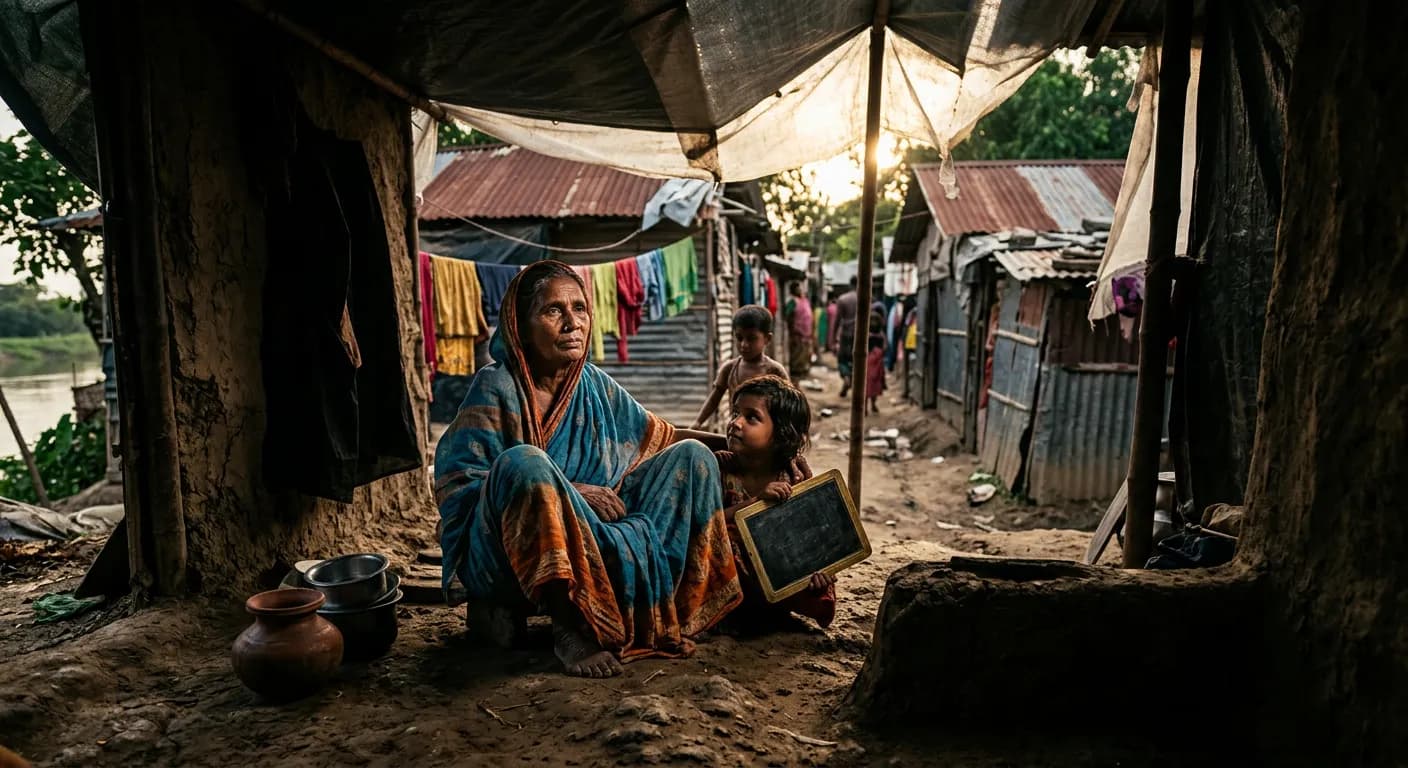
Bangladesh's 4.95 Million Displaced: A Life-Year Reckoning
Bangladesh's first nationwide disaster-displacement census counts 4.95 million people uprooted — and cohort studies show each child exposed loses roughly a year of schooling and half a lifetime of good health.
The most consequential figure in South Asia's climate ledger is not a cyclone tally but a life-year deficit: children born inside Bangladesh's disaster zones lose, on average, close to a year of completed schooling and more than half of their expected lifetime of good health — losses that persist decades after the water recedes. That is the argument, drawn from natural-experiment cohort studies, that reframes the country's newly-verified 4.95 million internally displaced persons. Displacement in Bangladesh is not a snapshot of shelters; it is a life-course tax paid disproportionately by rural girls, migrant children in urban slums, and Rohingya refugees on Cox's Bazar's saturated hillsides — where a landslide killed seven schoolgirls and their teacher on July 8, 2026.
The number the government did not have
Until December 9, 2025, Bangladesh — a country of 165 million people ranked ninth on the World Risk Index — had no verified national count of its disaster-displaced. The International Organization for Migration closed that gap with its first Displacement Tracking Matrix round, canvassing 29,117 key informants across all 64 districts and 4,579 unions to arrive at a figure of 4,955,527 people currently living in displacement from natural hazards, according to IOM Bangladesh.
The composition matters more than the headline. Two-thirds — 63% — of those IDPs were displaced before April 2020, per the IOM DTM Round 1 dataset released in December. Only 12% of the caseload traces to displacements within the past 18 months. That distribution collapses the standard humanitarian framing of "acute response." What Bangladesh is managing is not a series of emergencies but a slow-motion demographic reallocation — populations that left the coastal belt, the Barind drought zone or the eroding riverbanks a decade ago and have never gone home.
Cyclones account for 54% of historical displacement flows and floods for a further 33.8%, according to the IOM's 2023 Migration Snapshot drawing on IDMC data cited by the Displacement Tracking Matrix. Cyclone Amphan alone displaced 4.4 million in 2020; Cyclone Mocha added 1.8 million in 2023; Cyclone Remal in May 2024 impacted 18 million and drove another wave, per the
IOM Bangladesh Crisis Response Plan 2025. Each event refills a pool that never drains.
The life-year lens — and why it changes the policy math
The wire count of "displaced" understates the damage because it counts people, not years of life. The DALY-style framework proposed by Ilan Noy converts mortality, morbidity, and displacement into a common unit — human lifeyears lost — and estimates that low- and middle-income countries absorb roughly 97% of the global disaster burden on that metric, per the analysis published on CEPR VoxEU. Bangladesh is the archetypal case that framework was built to describe.
Applied to Bangladesh, the life-year approach yields numbers the shelter-count cannot. Eskander and Barbier's natural-experiment study of the 1970 Bhola cyclone — which killed over 300,000 people — found that cohorts born in severely affected regions in 1969–71 had a 14.9 percentage-point lower probability of good adult health and a 53.6% shorter duration of good health across their lifetime, according to the working paper archived at the London School of Economics. They also had a 21.8 percentage-point lower probability of completing primary school. Half a century after the storm, its survivors were still paying.
The pattern replicates across cohorts. A 2026 World Development study of the 1991 cyclone finds that children exposed at ages 0–3 lost approximately one full year of completed schooling, with secondary completion falling 12–19 percentage points and higher-secondary completion 10–17 points — with girls absorbing roughly double the loss of boys, according to the abstract indexed by IDEAS/RePEc. Ahsanuzzaman and Islam's work on Cyclones Sidr (2007) and Aila (2009) shows the same signature in the next generation: measurable reductions in height-for-age Z-scores and higher stunting among in-utero and newborn exposures, per the study catalogued at
IDEAS/RePEc. Stunting is not a nutritional statistic; it is a lifetime earnings statistic wearing a different label.
The three losers the aggregate hides
Rural girls carry the largest share. The 1991 cohort study is explicit: educational losses for exposed girls run roughly double those for boys, and rural populations face consistently larger impacts than urban ones. Bangladesh's overall gains in life expectancy — from 58.2 years in 1990 to 74.6 years in 2019, per the Global Burden of Disease systematic analysis on PubMed — mask a divergent trajectory for the girls born into a cyclone belt in a cyclone year.
Migrant children in urban slums are the second loser. Bangladesh's climate migration is overwhelmingly internal and directed toward Dhaka. Under-five mortality among children of rural-to-urban migrants runs at 102 per 1,000 live births, against 62 for life-long urban natives — a 65% excess documented using the Bangladesh Demographic and Health Survey and published in the Journal of Biosocial Science. The mechanism is banal: tarpaulin housing, contaminated water, unhygienic sanitation. The consequence is a life not lived.
Adolescents carry the mental-health load. A 2025 study of 1,220 climate-displaced and non-displaced Bangladeshi adolescents found depression prevalence of 84% among the displaced (30% severe) against 54.8% among those who stayed, published in Climatic Change. The 2024 Feni flash flood produced comparable numbers among adults: 99.3% reported livelihood disruption and over 85% moderate-to-severe psychological distress, per the field study in
Scientific Reports. Years lived with disability is a DALY component that the shelter count never touches.
The Cox's Bazar test case, July 2026
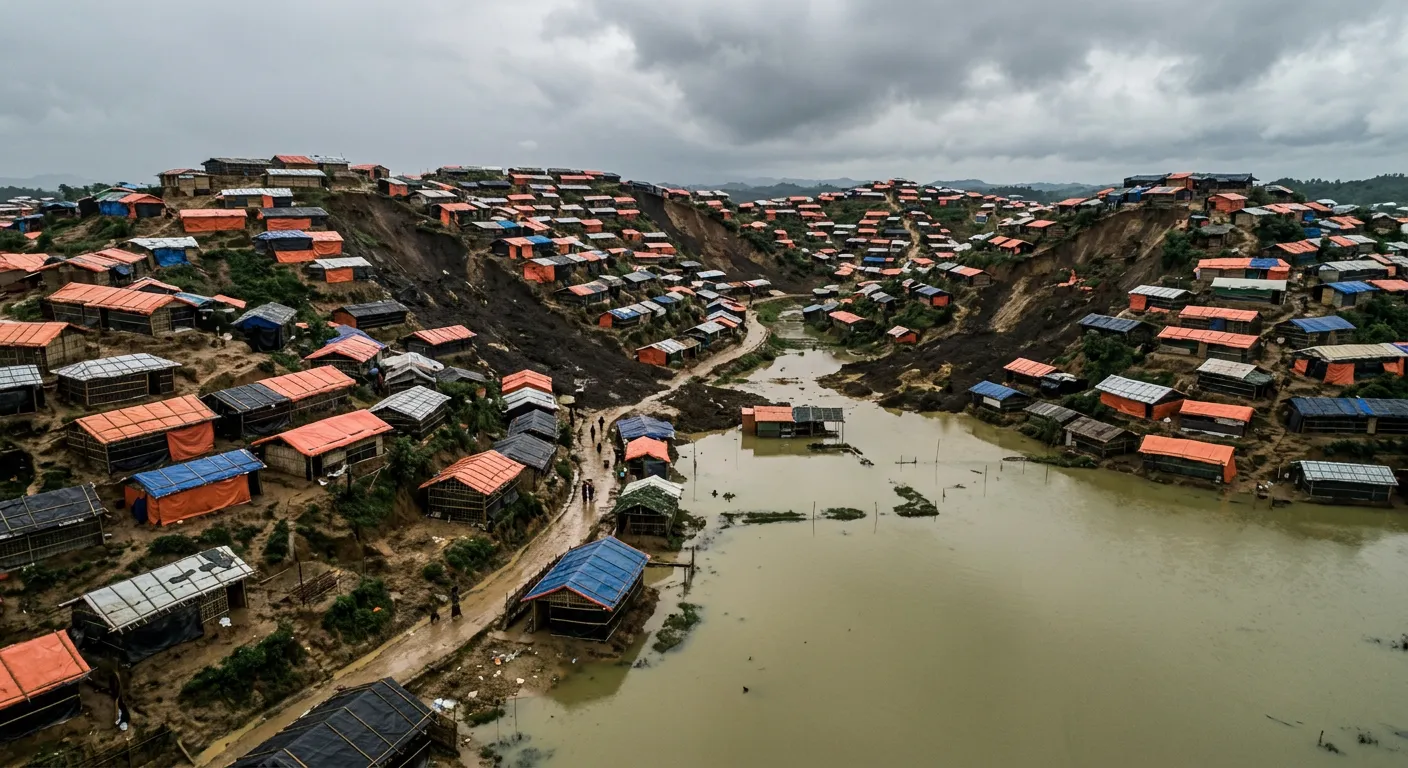
Nothing illustrates the compounding lifetime cost more directly than the seven Rohingya schoolgirls and their teacher killed when a landslide buried an Islamic study centre in a Cox's Bazar refugee camp on July 8. Rescuers pulled 13 people from the mud; eight died, according to Refugee Relief and Repatriation Commissioner Mohammed Mizanur Rahman as reported by the BBC. Earlier in the same week, monsoon-triggered landslides across three camps had killed at least eight other Rohingya refugees — five of them children — per reporting by
Al Jazeera.
The Rohingya camps are a controlled experiment in life-year loss. Over one million people, displaced from Myanmar since 2017, live in bamboo-and-tarpaulin shelters clinging to steep, deforested slopes. When the monsoon hits saturated soil, the school buries the students — an event that removes not just eight lives but decades of potential schooling from a cohort already denied formal education by protracted refugee status. In the life-year accounting, a girl killed at 12 is a loss of ~60 expected years; the survivors pulled from the mud absorb the fetal-origin and adolescent-trauma penalties documented in the cohort literature. The July 8 landslide is a data point in Eskander and Barbier's methodology, not merely a news item.
Second-order effects: the fiscal signal
The life-year frame changes what a shelter dollar buys. If a child exposed at age two loses one year of schooling and 14.9 percentage points of adult health probability, then the return on early recovery spending — cash transfers that let households keep girls in school, mobile clinics that catch stunting — is measured in decades, not the six-month humanitarian appeal cycle. That is the case for anchoring disaster financing to the Bangladesh Delta Plan 2100, the country's long-horizon framework approved on September 4, 2018, which earmarks roughly 35% of Delta investment for flood control and river-erosion management.
The World Bank has begun pricing this. Its Board approved a $270 million financing package on May 14, 2025, to bolster flood recovery and resilience, per the World Bank press release. Set against IOM's crisis response ask of $137 million for 2025, the ratio still favours short-cycle humanitarian spending over the human-capital protection that cohort research suggests actually moves the life-year needle.
What to watch
- Monsoon season through September 2026. The Bangladesh Meteorological Department forecast continuing heavy rainfall after the July 8 landslide, and evacuations from high-risk slopes in Cox's Bazar are ongoing. Each additional camp landslide compounds the Rohingya cohort's life-year deficit.
- IOM DTM Round 2, expected 2026. The December 2025 baseline is the first — the second round will show whether the 4.95 million figure is a floor or a ceiling, and whether pre-2020 displacement is finally resolving or ossifying.
- World Bank flood-recovery disbursement. How the $270 million approved in May 2025 is allocated between engineering (embankments, drainage) and human-capital protection (schooling continuity, child nutrition) will indicate whether Dhaka and its donors are pricing the life-year cost or still buying shelter kits.
- Rohingya repatriation talks. Bangladesh continues to press for a "sustainable, safe, voluntary and dignified" return to Rakhine, per the joint statement archived by the
Bangladesh Ministry of Foreign Affairs. Every additional monsoon inside the camps raises the aggregate life-year debt owed by whichever authority eventually receives them.
The Bottom Line
Bangladesh's 4.95 million disaster-displaced are not a humanitarian caseload; they are a life-year deficit, front-loaded onto rural girls, migrant children and Rohingya refugees, that will keep depressing the country's human capital for another half-century. Cohort evidence from the 1970, 1991 and 2007–09 cyclones shows exposed children lose roughly a year of schooling and half their lifetime of good health — losses that dwarf any single-season shelter response. Until the Delta Plan, donor lending and IOM programming are indexed to life-years averted rather than tents distributed, Bangladesh will keep counting the same displacement twice: once at the shoreline, and again a generation later in the ledgers of adult health, schooling and earnings.
Discover more

US Politics
US Military Strikes Drug Traffickers Pacific
A U.S. military strike in the eastern Pacific killed two amid an anti-drug trafficking campaign, raising questions over sovereignty and regional cooperation.

US Politics
US Military Funding Request for Iran Looms
The White House Budget Director signals a formal funding request for military operations against Iran, foreshadowing rising tensions and congressional clashes.
US Politics
Washington's Scrutiny of Iran War Prediction
The Iran war prediction market scandal exposes political ties and regulatory challenges in Washington, as insider trading concerns rise.

Conflict & Security
Drone Warfare Killing Aid Workers at Unprec
Over 1,000 humanitarian workers killed in three years as cheap armed drones collapse legal protections. Gaza, Sudan, Ukraine, and DRC see deliberate targeting of aid convoys and hospitals with zero prosecutions.