Australia's High Court Demolishes Government
Unanimous ruling opens door to damages for unlawful detention
Model Diplomat8 min readOceania
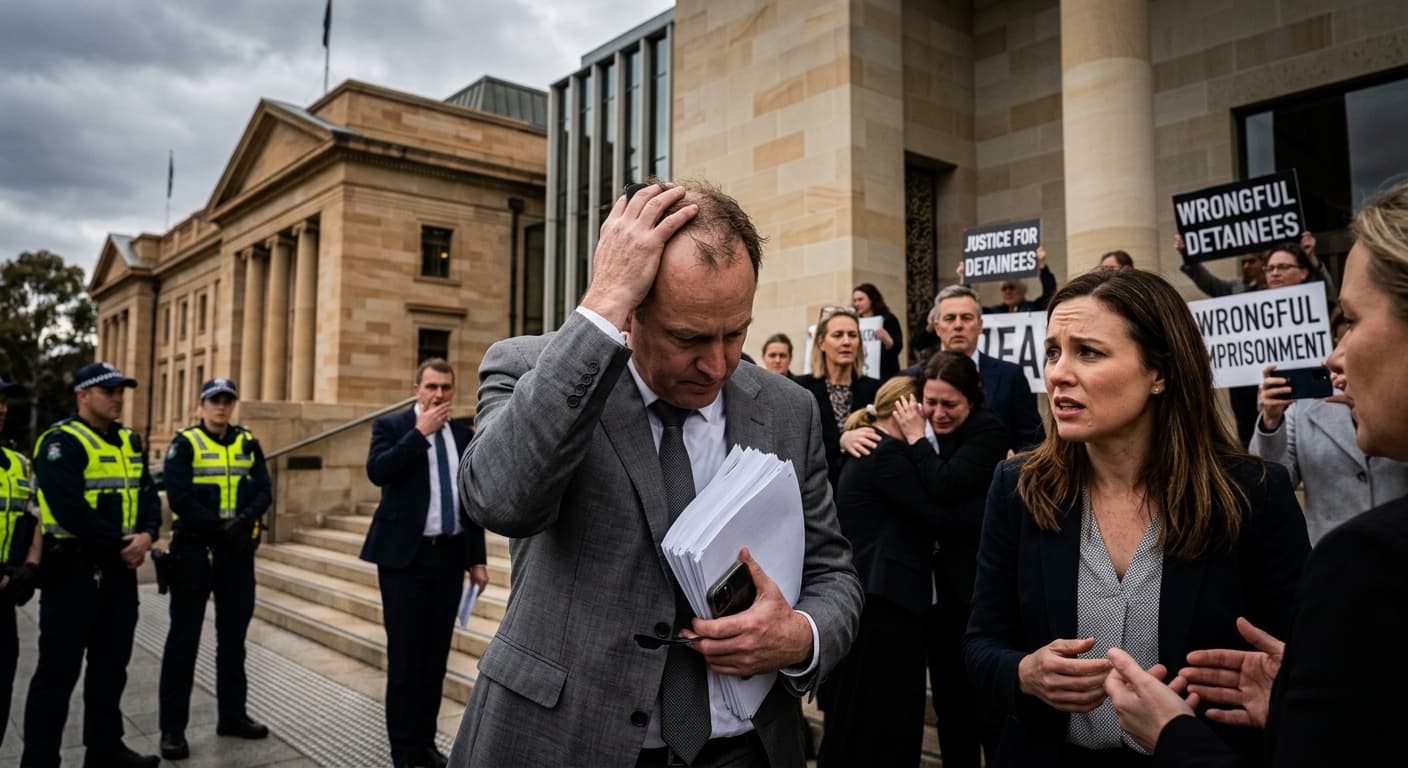
Australia's High Court Demolishes Government's Last Shield on Indefinite Detention
A unanimous 2026 ruling in Abdel-Hady v Commonwealth opens the door to tens of millions in damages claims and exposes the full financial unsustainability of Australia's offshore detention regime.
On June 10, 2026, the full seven-justice bench of the High Court of Australia unanimously rejected the Commonwealth's attempt to shield itself from damages claims for false imprisonment of non-citizens held in indefinite immigration detention. The ruling in Abdel-Hady v Commonwealth of Australia [2026] HCA 17 means the government cannot invoke overruled judicial precedent as a common-law defence when a court later holds the underlying detention was unconstitutional — a principle that transforms the financial and political calculus of Australia's entire immigration detention system, exposing taxpayers to tens of millions in claims on top of the A$2.5 billion already committed to offshore resettlement.
The Ruling and Its Logic
The plaintiff, Safwat Abdel-Hady, an Austrian citizen who first arrived in Australia in 1997, had his visa cancelled on March 31, 2017 under section 501(2) of the Migration Act on character grounds, according to legal analysis of the case. He suffers from an aggressive form of thrombophilia rendering him medically unfit to travel by air. From July 28, 2022, when it became clear that no country would accept him and his medical condition precluded deportation, his continued detention had no legal basis — yet he remained in custody until February 13, 2024, when he was released following the High Court's 2023 ruling in NZYQ.
The Commonwealth conceded that the elements of false imprisonment were satisfied and that the detention had been unlawful. But it pleaded a novel common-law defence: at the time Abdel-Hady was detained, the law as declared by the High Court in Al-Kateb v Godwin (2004) authorised indefinite detention, and officers were therefore acting under "lawful justification" even though that authority was later struck down.
The full bench — Chief Justice Gageler and Justices Gordon, Edelman, Steward, Gleeson, Jagot, and Beech-Jones — rejected the defence unanimously. According to a legal review of the judgment, the Court held that "legislation held invalid by courts is, in legal contemplation, as inoperative as though it had never been passed," and that recognising the propounded defence would "subvert accepted foundational constitutional principles of judicial authority and executive responsibility" (Benchmark Weekly Government Review).
Justice Gordon stated that allowing such a defence would "significantly undermine" the ability of individuals to seek redress when the executive exceeds its authority, according to The Guardian. The Court distinguished the case from situations where officers faithfully execute court orders or warrants later found to be invalid — a narrow category where some common-law protection has historically been afforded.
The practical effect: detention not authorised by law gives rise to liability for false imprisonment, and the Commonwealth bears both direct and vicarious liability. There is no immunity for good-faith reliance on overruled precedent.

From Al-Kateb to Abdel-Hady — A 22-Year Reckoning
The ruling is the culmination of a legal arc that began in 2004, when the High Court held 4-3 in Al-Kateb v Godwin that the Migration Act authorised indefinite detention of a stateless Palestinian man, provided the government maintained an intention to eventually remove him. Academic analysis has noted that Al-Kateb "systematically withdraws the limitations placed on executive detention" and became the constitutional bedrock of Australia's mandatory detention regime for nearly two decades (SSRN).
For 19 years, Al-Kateb insulated the government. Then, on November 8, 2023, the High Court unanimously overruled it in NZYQ v Minister for Immigration, holding that sections 189(1) and 196(1) of the Migration Act were constitutionally invalid in their application to non-citizens when there was no real prospect of removal becoming practicable in the reasonably foreseeable future. The plaintiff was a stateless Rohingya man who had served a criminal sentence but could not be deported because no country would accept him (BBC News).
The NZYQ ruling triggered the immediate release of approximately 220 people, with the government identifying 354 individuals in similar legal limbo — people whose visas had been cancelled, often on character grounds, but who could not be returned to their countries of origin. Nine were stateless; most others faced persecution if returned (Al Jazeera).
The Court did not stop there. In May 2024, it carved out an exception in ASF17, holding that non-citizens who refuse to cooperate with their own removal — for instance, by declining to apply for travel documents from their country of origin — may remain in detention, because the impediment to removal is self-created rather than structural (Al Jazeera). That ruling narrowed NZYQ's reach but left the core holding intact.
The historical parallel is instructive. The United States Supreme Court reached a similar conclusion in Zadvydas v. Davis (2001), holding that the post-removal-period detention statute "does not permit indefinite detention" and establishing a presumptive six-month limit after which an alien may be released if removal is not reasonably foreseeable (Cornell Law Institute — Supreme Court). Australia took 22 years longer to arrive at the same constitutional destination — and the Abdel-Hady ruling now attaches a damages dimension the US precedent lacked.
The Financial Reckoning
Greg Barns SC of the Australian Lawyers Alliance estimates that at least 340 former detainees could now bring false imprisonment claims, with potential damages running into the tens of millions of dollars, according to ABC News.
The exposure is not without precedent. In 2017, the Commonwealth paid A$70 million to settle a class action brought by 1,905 asylum seekers detained on Manus Island, Papua New Guinea — at the time the largest human rights settlement in Australian history. The government denied wrongdoing but settled rather than face a six-month trial with uncertain outcomes (BBC News). That settlement covered claims of false imprisonment, negligent treatment, and inadequate medical care.
The Abdel-Hady ruling makes future settlements harder to avoid. The government can no longer argue that it acted under colour of law, because the Court has held that a law struck down as unconstitutional is "as inoperative as though it had never been passed." Every individual detained under the Al-Kateb regime — from the moment it became clear there was no real prospect of removal — has a colourable claim for false imprisonment.
The Department of Home Affairs said it was considering the judgment and its implications, according to news.com.au. Opposition Home Affairs spokesperson Jonno Duniam called the ruling "another NZYQ disaster" and suggested the government had been warned.
The Nauru Escape Valve — and Its Limits
The ruling compounds the financial pressure on a government already spending unprecedented sums to manage the consequences of NZYQ. In September 2025, Canberra signed a secretive deal with Nauru to resettle up to 354 members of the "NZYQ cohort" — people with no legal right to remain in Australia who cannot be deported to their countries of origin. The agreement carries an estimated total cost of A$2.5 billion over 30 years, including an upfront payment of A$408 million and approximately A$70 million annually thereafter (Al Jazeera).
The first transfers to Nauru began in 2026, with deportees receiving 30-year visas allowing them to live and work on the island of 12,500 inhabitants. But the deal has drawn sharp criticism from human rights groups and legal scholars. In January 2025, the UN Human Rights Committee found that Australia's offshore detention policy had violated two provisions of the legally binding 1966 International Covenant on Civil and Political Rights — one prohibiting arbitrary detention and one protecting the right to challenge detention in court (Al Jazeera).
"A state party cannot escape its human rights responsibility when outsourcing asylum processing to another state. The outsourcing of operations does not absolve states of accountability. Offshore detention facilities are not human rights-free zones."
— Mahjoub El Haiba, UN Human Rights Committee member, January 9, 2025
The UN ruling covered 25 refugees and asylum seekers from Iraq, Iran, Afghanistan, Pakistan, Sri Lanka, and Myanmar, including minors who suffered weight loss, self-harm, and insomnia during years of detention on Nauru. The committee called on Australia to provide adequate compensation — a demand the Abdel-Hady ruling now makes harder to resist at the domestic level.
Who Wins, Who Loses
The winners are the former detainees and their legal advocates. The Human Rights Law Centre, which represented the plaintiff in NZYQ, and the Asylum Seeker Resource Centre, which has campaigned against indefinite detention for years, now have a judicially endorsed pathway to damages that the government cannot legislate away. Every former detainee held beyond the point where removal became impracticable has a claim. The ruling also strengthens the broader constitutional principle that the executive cannot invoke judicial error as a shield for unlawful deprivation of liberty.
The losers are the Commonwealth and Australian taxpayers. The government faces a two-front financial assault: the A$2.5 billion Nauru deal to physically relocate the cohort, and now potentially tens of millions in damages to the same individuals for the period they were unlawfully detained before that relocation occurred. The Albanese government's 2024 amendments to the Migration Act, which bolstered deportation powers and were described by critics as "brutal," have not insulated it from the constitutional constraint the High Court has now twice enforced.
The deeper loser is the architectural logic of Australia's detention regime itself. Al-Kateb permitted the government to detain indefinitely on the strength of a declared intention to remove. NZYQ removed that permission. Abdel-Hady now attaches a price tag — false imprisonment damages — to every day of detention that exceeds constitutional limits. The Nauru deal is an attempt to outsource the problem geographically. The damages exposure is what makes that strategy financially unsustainable at scale.
What to Watch
- Quantification of damages for Abdel-Hady: The High Court answered the stated question of law; the Federal Court will now determine the actual damages award, which will set a benchmark per-day rate for the remaining 340+ claims.
- Legislative response: The Albanese government amended the Migration Act in 2024 after NZYQ and may seek further amendments, though the Court's constitutional reasoning limits what legislation can achieve.
- Nauru transfer pace: Whether Nauru accepts all 354 individuals — it retains final say — will determine how many remain in Australia and eligible to bring damages claims.
- UN follow-up: The UN Human Rights Committee has called on Australia to compensate the 25 Nauru refugees in its January 2025 ruling; the government's response remains outstanding.
The Bottom Line
The bottom line: the High Court's unanimous ruling in Abdel-Hady does what two decades of parliamentary debate could not — it attaches a direct, non-discretionary financial cost to indefinite detention that the government cannot legislate away. With 340+ potential damages claims and a A$2.5bn Nauru deal already running, Canberra's offshore detention architecture is caught between a constitutional ceiling it cannot breach and a financial floor it cannot escape.
Discover more

India
BJP's Misunderstanding of Women's Quota Needs
The BJP's linking of the Women Reservation Bill to delimitation risks delaying women's empowerment in India, misreading the aspirations of female voters.

India
India-South Korea $50B Trade Expansion Plan
India and South Korea target $50 billion in bilateral trade by 2030, focusing on industrial cooperation and strategic alignment amid US pressures.
US Politics
House Ethics Committee Pushes Sexual Miscond.
The House Ethics Committee has shifted responsibility for sexual harassment settlement records to the Office of Congressional Workplace Rights, complicating disclosure efforts.

Conflict & Security
Drone Warfare Killing Aid Workers at Unprec
Over 1,000 humanitarian workers killed in three years as cheap armed drones collapse legal protections. Gaza, Sudan, Ukraine, and DRC see deliberate targeting of aid convoys and hospitals with zero prosecutions.