Assam Elections 2024
BJP's win reshapes Assam's political landscape.
Model Diplomat7 min readAsia
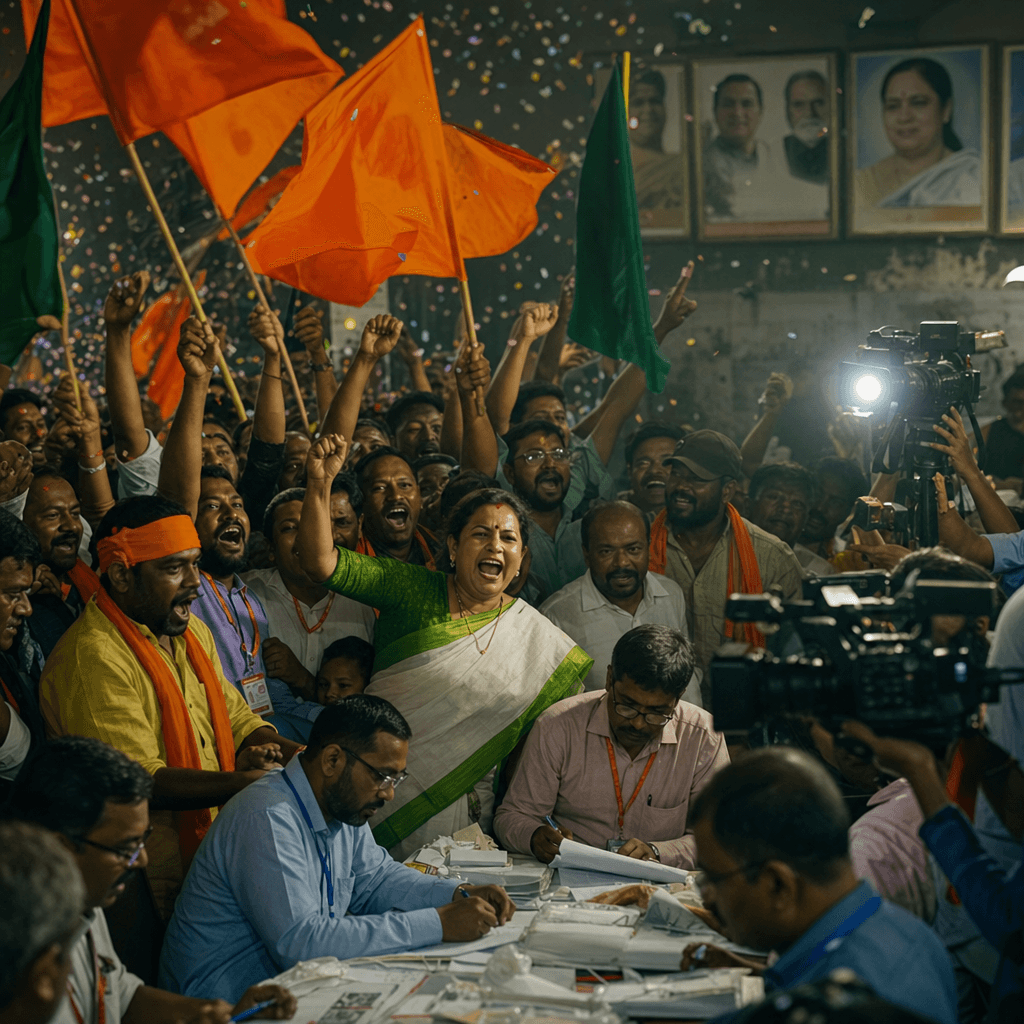
Assam Elections 2024: How Dhubri's Million-Vote Rout Rewrote the Northeast
The BJP-led NDA won 11 of Assam's 14 Lok Sabha seats in 2024. The bigger story was the collapse of AIUDF and what it foreshadowed for 2026.
The BJP-led National Democratic Alliance won 11 of Assam's 14 Lok Sabha seats on June 4, 2024 — but the number that mattered was 10,12,476. That was Congress candidate Rakibul Hussain's margin over sitting MP Badruddin Ajmal in Dhubri, the second-largest victory margin anywhere in India that cycle. The rout ended All India United Democratic Front (AIUDF) as an electoral force, handed the Muslim vote wholesale to the Congress, and — because the state's boundaries had been redrawn a year earlier — quietly guaranteed Himanta Biswa Sarma the 102-seat supermajority he collected in April 2026. Assam 2024 was not an anomaly. It was the dress rehearsal.
The vote, in numbers
Polling ran across three phases from April 19 to May 7, 2024, covering 14 parliamentary constituencies. The BJP took nine seats on its own; ally Asom Gana Parishad (AGP) took Barpeta and the United People's Party Liberal (UPPL) took Kokrajhar (ST). Congress won three — Dhubri, Nagaon and, most symbolically, Jorhat, where state party chief Gaurav Gogoi defeated the sitting BJP MP by 10.5 points, according to constituency data compiled by IndiaVotes. AIUDF, which had entered the cycle with a sitting MP and a claim on being the political home of Bengali-Muslims, drew zero.
Turnout across the state ran at roughly 81%, per the Chief Electoral Officer, Assam, one of the highest state figures in the country. The BJP's own vote share settled near 37% — the same nationwide figure the party posted in the general election, according to a
Congressional Research Service brief filed for the U.S. Congress. The difference in Assam was the seat conversion rate: 37% of votes translated into 64% of seats.
Why Dhubri matters more than Jorhat
Journalists gravitated to Jorhat because Gaurav Gogoi's win rescued Congress from a total wipe-out in Upper Assam and salvaged Rahul Gandhi's national narrative. But the analytically interesting seat was Dhubri, on the Bangladesh border, where roughly two-thirds of voters are Muslim. Ajmal — perfume magnate, cleric, and three-term MP — had built AIUDF into what one Sage journal study of AIUDF called the primary vehicle for immigrant-Muslim political representation in Assam. In 2024 he was crushed.
The Islamabad-based Institute of Strategic Studies noted in a June 2024 issue brief that Ajmal conceded "with the second highest margin — more than a million votes — to Rakibul Hussain, himself a Muslim candidate from Congress." That framing captures the pattern: Muslim voters did not defect from the community; they defected from the community's party. Read across the state, the AIUDF vote share collapsed and Congress absorbed it. The BJP did not need to win a single Muslim vote in Dhubri to benefit — it needed only for the opposition to consolidate into one party it could then out-organise everywhere else.
The invisible variable: the 2023 delimitation
The load-bearing structural change happened a year before anyone voted. On December 27, 2022, the Election Commission of India triggered a delimitation of Assam's constituencies under Section 8A of the Representation of the People Act, 1950, as a Press Information Bureau release formally announced. Public hearings ran in Guwahati from July 19–21, 2023, per a subsequent
PIB release, and the final order was gazetted on August 11, 2023.
The redraw was legally unassailable — the Delimitation Act 2002 provides that a published order "shall have the force of law and shall not be called in question in any court," as reproduced in the statute text hosted by PRS Legislative Research. What the order did was reorganise, not add. An
Observer Research Foundation analysis found that 27 of 126 assembly constituencies now exceed the ideal population by over 10%, and 32 fall short by the same margin — with lower-density (typically Assamese Hindu) districts allotted more seats per capita than the strict population-equality principle would allow.
The political consequence was direct. As an Al Jazeera investigation documented in April 2026, the number of assembly constituencies where Muslims formed a majority fell from about 35 to about 20. The
NUS Institute of South Asian Studies put the count of "decisive" Muslim seats at 23 down from 35 and noted that the BJP fielded zero Muslim candidates in the 2026 assembly cycle, versus nine in 2021. Delimitation didn't disenfranchise voters; it clustered them into fewer, larger, safer opposition constituencies while thinning the seats where a Muslim swing could flip a result.
Sarma's coalition arithmetic
Read against that architecture, the 2024 Lok Sabha map becomes legible. The BJP's ten highest vote shares in the state — Sonitpur (61.1%), Silchar (60.6%), Guwahati (56.7%), Kaziranga (55.9%), Dibrugarh (55.7%), Lakhimpur (55.5%) — all sit in constituencies that are majority-Hindu, Assamese-speaking or tribal-dominant. Sarbananda Sonowal, the former chief minister Sarma displaced in 2021, ran up 22 points in Dibrugarh. In Karimganj (SC), which is nearly evenly split between Hindus and Muslims after the redraw, the BJP's Kripanath Mallah squeezed home by 1.6 points — the only marginal seat, and revealingly still a BJP hold.
The Chief Minister's operating theory is on record. In a March 2026 rally covered by Al Jazeera, Sarma repeated a line he first delivered in 2023: "The BJP does not need 'miya' votes for another 10 years." Miya is a pejorative for Bengali-origin Muslims; Sarma has publicly bracketed them out of the electorate. He simultaneously distinguishes "Indigenous" Assamese Muslims — Goriya, Moriya, Deshi, Jolha, Syed communities the state formally recognised as Indigenous in 2022 — as a targeted outreach group in seven or eight upper-Assam seats where they hold 25–40% of the vote.
The BBC noted that the BJP's Assam vote share has moved from under 12% a decade ago to roughly 38% today. That growth curve is not a swing; it is a re-composition of the electorate that Sarma has orchestrated seat by seat since defecting from the Congress in 2015.
What 2024 predicted, and what 2026 confirmed
Everyone who read the Lok Sabha result carefully forecast 2026 correctly. The NUS-ISAS pre-election brief called the BJP the frontrunner and identified delimitation as the amplifier. It was.
On April 9, 2026, Assam voted in a single phase. According to the BBC's live coverage, the BJP-led NDA finished with 102 of 126 seats — 82 for the BJP alone, 20 for its allies. Congress won 19. As Al Jazeera's
post-election analysis observed, 18 of those 19 Congress winners are Muslim — a mirror image of the BJP's zero-Muslim slate. Gaurav Gogoi, the 2024 giant-killer, lost his own Jorhat assembly segment. The state's second-largest party is now, in practical terms, a Muslim caucus with a Hindu leader in Delhi.
The demographic backdrop is stark. Muslims are roughly 34% of Assam's population according to the 2011 census, the highest of any Indian state outside Kashmir and Lakshadweep. A 2023 Centre for Policy Research working paper predicted that delimitation combined with Hindu-Muslim polarisation would produce exactly this outcome: the community remains numerically large but structurally minoritised in the chamber that governs it. Between May 2021 and early 2024, 22,000 structures were demolished and 20,380 families evicted in state-run "encroachment" drives, per an Al Jazeera reconstruction of Human Rights Watch–adjacent reporting.
The West Bengal template
The 2024 Assam vote is now the operating manual for the BJP's expansion across the northeast and eastern India. In West Bengal's May 2026 assembly election, the party won for the first time in its 46-year history, taking 207 of 294 seats. Al Jazeera's Nadim Asrar argued that "one, in neighbouring Assam in particular, offers a glimpse of what could await West Bengal": a "double-engine" state with a Muslim-population share of 27% governed by a party that ran no Muslim candidates and campaigned on illegal immigration from Bangladesh.
The 2024 Lok Sabha figures were the leading indicator no one weighted correctly. AIUDF's evaporation left Congress the sole vehicle for Muslim voters; that consolidation was legible from Dhubri's million-vote margin; and once delimitation had reduced the number of seats where such consolidation could produce a Congress win, the ceiling on opposition performance was fixed. The 2026 assembly result is what happens when the numerator (Muslim seats) shrinks and the denominator (Hindu-majority and mixed seats where BJP welfare politics competes with Congress governance pitches) grows.
Diplomat View
The dominant read of Assam 2024 — an NDA sweep with three consolation Congress wins — misses the load-bearing fact. The election destroyed AIUDF, forced Muslim voters into a single opposition column, and thereby completed the political geometry that the 2023 delimitation had already drawn. Sarma's third-consecutive BJP mandate in April 2026 was over-determined the moment Ajmal conceded Dhubri. Our forecast: the BJP's Assam formula — statutory redraw plus welfare cash plus surgical outreach to "Indigenous" Muslims plus a hard line against Bengali-origin Muslims — will be replicated in West Bengal's governance and, if the 2027 delimitation of eastern states proceeds, exported nationally. That forecast breaks if the Supreme Court entertains a fresh challenge to the Section 8A order, if the Congress replaces Gogoi with a candidate who can hold Assamese Hindu votes in Upper Assam, or if a national Muslim-and-secular consolidation emerges around a leader other than Rahul Gandhi. None of the three looks likely on today's map.
What to watch next
- August 11, 2026: three-year anniversary of the final delimitation order — a statute of limitations window for further constitutional challenges in the Supreme Court.
- Winter session of Parliament, 2026: any move by the Union government to extend Section 8A delimitation to Nagaland, Arunachal Pradesh and Manipur, which the ECI has flagged as pending since 2020.
- State budget, February 2027: whether the Sarma government converts its Orunodoi cash-transfer scheme from a pre-poll instrument into a permanent line item — the test of whether welfare or Hindutva is the durable half of the coalition.
The Bottom Line
Assam 2024 looked like an NDA sweep with three Congress wins. It was actually the election that erased AIUDF, consolidated Muslim voters into a single, structurally-outnumbered Congress column, and confirmed that the 2023 delimitation had already decided the 2026 assembly race. The state is now the working template for how the BJP intends to govern eastern India — and West Bengal is the first place it has been exported to.
Cross-linked topic: India.
Discover more
India
Rajnath Singh's Durga Squad for 2026 Polls
Rajnath Singh's Durga Squad promised women's safety in Bengal but has since disappeared from the agenda, revealing BJP's true priorities.
India
Women’s Reservation Bill 2026
The Constitution (131st Amendment) Bill, 2026 was defeated in Lok Sabha, revealing deeper political conflicts over women's reservation and delimitation.
India
Modi's Women’s Convention in Varanasi
Modi's Varanasi rally frames women's reservation as a national mission, targeting the 2027 Uttar Pradesh elections with a strategic narrative.

Conflict & Security
Drone Warfare Killing Aid Workers at Unprec
Over 1,000 humanitarian workers killed in three years as cheap armed drones collapse legal protections. Gaza, Sudan, Ukraine, and DRC see deliberate targeting of aid convoys and hospitals with zero prosecutions.