Armenia Court Certifies Pashinyan's Win
Opposition takes seats to challenge government
Model Diplomat8 min readEurasia
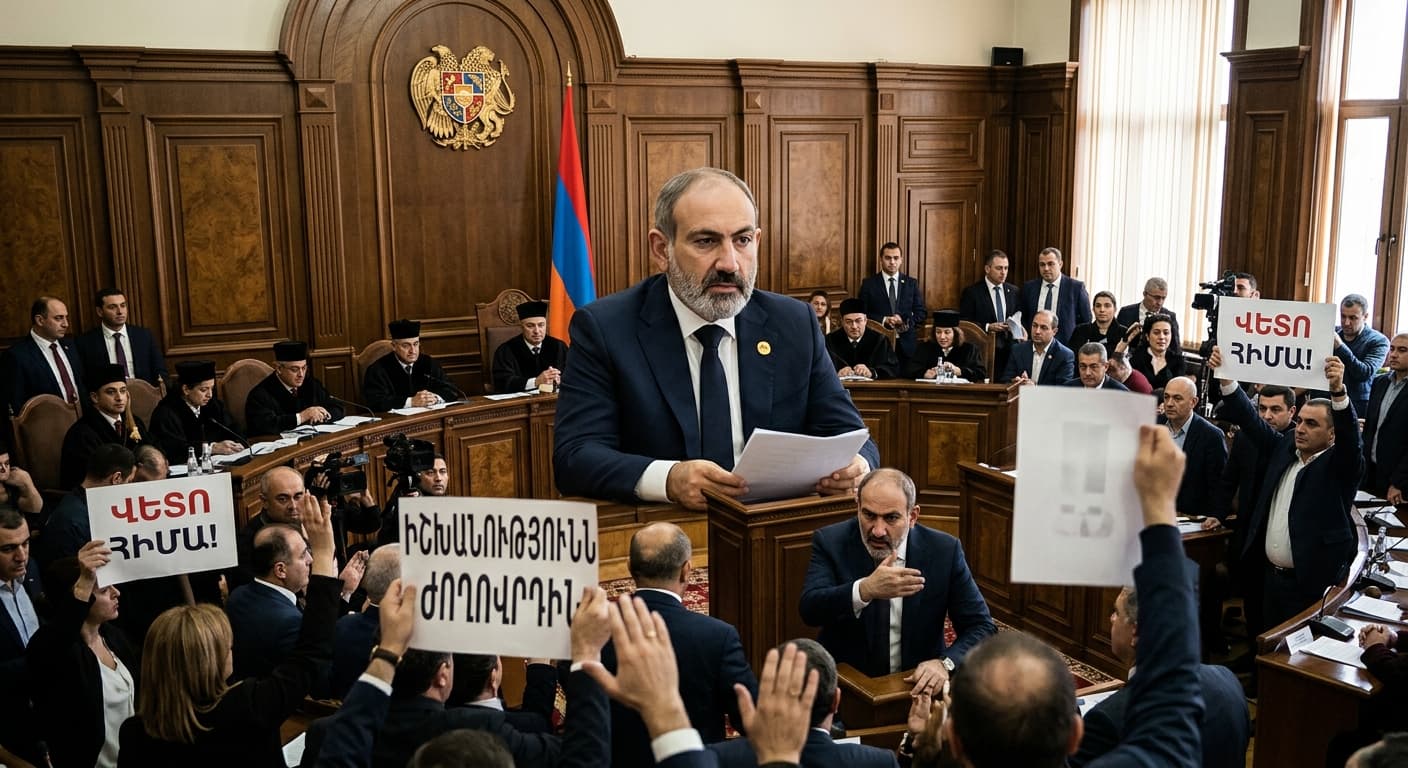
Armenia's top court certifies Pashinyan's win — opposition takes seats to fight next war
Armenia's Constitutional Court on 4 July 2026 rejected all seven opposition appeals against the 7 June parliamentary vote, certifying Prime Minister Nikol Pashinyan's win — but leaving him six seats short of the majority he needs to sign peace with Azerbaijan.
The court's decision, announced by Chairman Arman Dilanyan on 4 July 2026, closes the legal contest over Armenia's most consequential election since 2018 — and opens the political one. Pashinyan's Civil Contract party keeps its 64 seats and a governing majority in the 105-seat National Assembly. But it holds six seats fewer than the 70 needed for the two-thirds supermajority that would let it call a referendum to strip Nagorno-Karabakh references from the constitution — Baku's precondition for signing the peace treaty initialled at the White House in August 2025. The pro-Russian opposition's decision, announced 5–6 July, to take up its combined 41 mandates rather than boycott is therefore not a concession. It is the acquisition of a veto, ratified by a court the opposition still calls illegitimate.
What the court actually decided
The Constitutional Court consolidated seven appeals — from Strong Armenia, the Armenia Alliance, Prosperous Armenia, Wings of Unity, Democracy Law Discipline, New Force and the Alliance of Democracy Defenders for the Republic — into a single case, holding roughly 50 hours of hearings between 26 June and 1 July with seven of the nine judges sitting after two recused themselves over bias concerns, according to JAMnews and
Caucasus Watch. On 4 July the court upheld the Central Election Commission's 14 June certification "on the results of the regular elections to the National Assembly of the Republic of Armenia held on June 7, 2026," CEC chairman Vahagn Hovakimyan confirming the definitive seat distribution: Civil Contract 64, Strong Armenia 29, Armenia Alliance 12, as reported by
ARKA.
Justice Minister Srbuhi Galyan, representing the government, said "justice has prevailed" and congratulated citizens on the "triumph of democracy," per the same ARKA account. Aram Orbelyan, the lawyer who represented Prosperous Armenia before the bench, retorted that the court "had a historic opportunity to invalidate the election results for the first time" and instead "effectively became involved in the theft of votes, or at least failed to stop this process."
That the court sided with the incumbent is not, in Armenian context, evidence of independence lost. It is evidence of a bench Pashinyan has spent six years reconstructing. Since 2020 his government has restructured the Constitutional Court, retired judges appointed under Serzh Sargsyan, and — as Freedom House documented — pushed through vetting mechanisms opposed by the Venice Commission. The court that heard this appeal is largely a Pashinyan-era institution ruling on a Pashinyan-era election. A ruling for the opposition would have been the surprise.
The five percentage points that reshape the region
Pashinyan won 49.8 percent of the vote, a majority his opponents could not credibly overturn. According to the Atlantic Council, that translated into 61 of 105 parliamentary seats on preliminary numbers — a majority "though below Civil Contract's previous 71 seats," and now finalised at 64. The
BBC reported turnout at 59 percent, with 19 parties competing but only three clearing the threshold. That is a Western-oriented mandate in every conventional sense.
It is also a mandate that does not deliver the constitutional supermajority Pashinyan needs. The Egmont Institute laid out the arithmetic bluntly: removing the constitution's preambular reference to the 1990 Declaration of Independence — which invokes Nagorno-Karabakh — requires "a two-thirds parliamentary majority to call a referendum on a new constitution, then approval in the referendum by a majority of those who vote, provided the Yes votes amount to at least a quarter of all registered voters," and Civil Contract "has fallen short of the first bar by several seats," according to Egmont. Six seats, to be exact. As Carnegie's
Politika analysis put it, "for the first time since coming to power in 2018, Pashinyan's party does not have a constitutional majority," and "without supporting votes from the opposition, the Armenian government will not be able to hold a referendum."
The opposition holding those veto seats has every incentive to keep them there. That is why Kocharyan's Armenia Alliance and Karapetyan's Strong Armenia — two blocs whose leaders privately loathe one another, as Al Jazeera noted — have converged on a single, negative programme: block the referendum, defend the Apostolic Church, and free those the opposition calls political prisoners.
Why the opposition took the seats
The five-party joint declaration issued hours after the ruling described the moment as "not the end of the struggle, but the beginning of a new, more systematic, institutional, and large-scale phase of political resistance," per OC Media. The Armenia Alliance, explaining its decision to swear in, framed the mandate as "a tool, a legal and political toolkit, and an opportunity for daily resistance," adding that "voluntarily renouncing it would be irresponsible towards our state and our voters." Narek Karapetyan of Strong Armenia was more direct: "for significant change to occur in Armenia, two important things are needed: street struggle and a large representation of the opposition in [parliament]."
The historical parallel is instructive. In 2021, four opposition forces — including the Armenia Alliance — asked the same Constitutional Court to invalidate that year's snap elections; the court rejected them within a week, per Freedom House. Kocharyan's bloc then boycotted most of the following year's parliamentary sessions before ending the boycott in November 2022. That experiment failed: a boycott handed Pashinyan an uncontested chamber and no independent visibility for the opposition. In 2026 the opposition has learned the lesson. With 41 seats — nearly 40 percent of the assembly — a walkout would surrender the only institutional platform they hold.
The Karapetyan factor and the church
The court ruling cannot be read without the year that preceded it. In June 2025, Pashinyan opened a frontal confrontation with the Armenian Apostolic Church, accusing Catholicos Karekin II of fathering a child in breach of celibacy and later, per Al Jazeera, of leading a "criminal-oligarchic clergy." When Russian-Armenian billionaire Samvel Karapetyan, owner of the Tashir Group and Electric Networks of Armenia, publicly defended the church and warned he would "intervene in the campaign against the Church in our own way," he was arrested within hours and charged with publicly calling to seize power,
BBC News reported. Pashinyan then announced the nationalisation of his electricity company.
Days later, security services detained Archbishop Bagrat Galstanyan and 15 others on charges of plotting a coup timed to Armenia's 21 September Independence Day, according to Al Jazeera. By October 2025, Archbishop Mikael Ajapahyan was sentenced to two years for calling for the government's overthrow, and Bishop Mkrtich Proshyan was arrested; the
Begin-Sadat Center read the sequence as "efforts to curb the consolidation of this opposition before it can mount a formal electoral challenge." OSCE/ODIHR observers, in their preliminary statement of 8 June, said the vote offered "a genuine choice" but flagged that "the concentration of arrests and criminal prosecutions against opposition figures contributed to perceptions of selective justice," per
ODIHR. Strong Armenia's founder is now heading a parliamentary bloc of 29 from a detention cell. That is the political fact the court declined to weigh.
Who wins, who loses
Pashinyan wins the legal war and loses the constitutional one. His mandate is uncontested at home and abroad — the BBC noted the election survived what European capitals openly called an unprecedented Russian interference campaign. But he cannot deliver Baku's condition without opposition votes he will not get. Two-track diplomacy — signing an agreement without ratifying it, or opening the Turkish and Azerbaijani borders without a treaty, as
Carnegie has suggested — becomes the plausible workaround. That is a weaker peace than the one initialled in the White House.
Baku loses tempo. President Ilham Aliyev's condition — that Armenia amend its constitution before Baku signs — assumed a Pashinyan supermajority. Without one, either Azerbaijan accepts a partial normalisation or the treaty stays frozen. RUSI warned in its post-vote commentary that this risks "an eventual return to hostilities."
Moscow wins a durable foothold it did not have on 6 June. RUSI's assessment is that the Kremlin's real objective — restated in a Vedomosti report from April 2026 — was never a Karapetyan victory but "to re-establish a pro-Russian political bloc" in a country where Moscow "had no one to speak for" it since 2018. On that metric, Russia's hybrid campaign, waged for 14 months before the vote, succeeded: Strong Armenia doubled its polled projections, and the pro-Russian opposition now sits inside parliament with a de facto referendum veto. Carnegie's second analysis is unambiguous — "the Kremlin has new levers of influence over Yerevan following the election."
The Constitutional Court loses institutional altitude. Whichever way it ruled, half the country would have called it captured. By upholding the CEC without addressing the substance of opposition irregularity claims — as the joint declaration reported by Hetq emphasised — it hands opposition and Russian media a fresh grievance to seed.
What to watch next
The court's ruling ends the electoral contest and begins the referendum fight. Three concrete catalysts sit on the near horizon:
- Autumn 2026 legislative session. With 41 opposition MPs seated, Civil Contract loses the option of running the National Assembly as an uncontested chamber. Expect early tests on constitutional-amendment legislation and on the church-related prosecutions.
- Karapetyan's trial. He remains in pre-trial detention. A conviction of a sitting bloc leader would trigger a domestic and Russian reaction of a different order than the one Pashinyan managed pre-election.
- The Armenia–Azerbaijan track. Baku's next signal — whether it accepts an unratified treaty, an interim connectivity agreement via the "Trump Route," or holds out for the constitutional change — will determine whether Pashinyan's diplomatic victory of August 2025 survives his parliamentary shortfall of July 2026.
The Bottom Line
The Constitutional Court's 4 July ruling settles who governs Armenia — Nikol Pashinyan, with 64 seats — but not what he can do with the office. By taking their 41 seats rather than boycotting, Kocharyan and Karapetyan have converted a lost election into a structural veto over the one decision that matters most: the constitutional change Baku demands for peace. The real winner of Armenia's 2026 electoral cycle is neither the prime minister nor his challengers, but the Kremlin, which has finally rebuilt a pro-Russian parliamentary bloc capable of stalling Yerevan's Western pivot from the inside.
Discover more

US Politics
SNAP Food Assistance Faces Legal Challenges
In 2026, SNAP faces stricter eligibility rules and mounting legal challenges, threatening food assistance for the millions of Americans who rely on the program.
India
Women's Reservation Bill 2026: A Political Sh
India's Lok Sabha rejected the Women's Reservation Bill, exposing a political maneuver to redraw electoral maps favoring the north over the south.

US Politics
US Launches $166B Tariff Refund Portal
The US is launching a $166 billion tariff refund portal to aid importers hit by Trump-era tariffs, with major implications for trade and supply costs.

Economics
Fed's Amex AML order puts correspondent banking on notice
Federal Reserve's Amex AML order requires board-level controls and a 90-day plan; OCC fined the bank $350 million over enterprise-wide deficiencies.