Anéfis Battle Signals Mali Junta's Loss
Mali's security reshaped by Anéfis assault
Model Diplomat8 min readAfrica
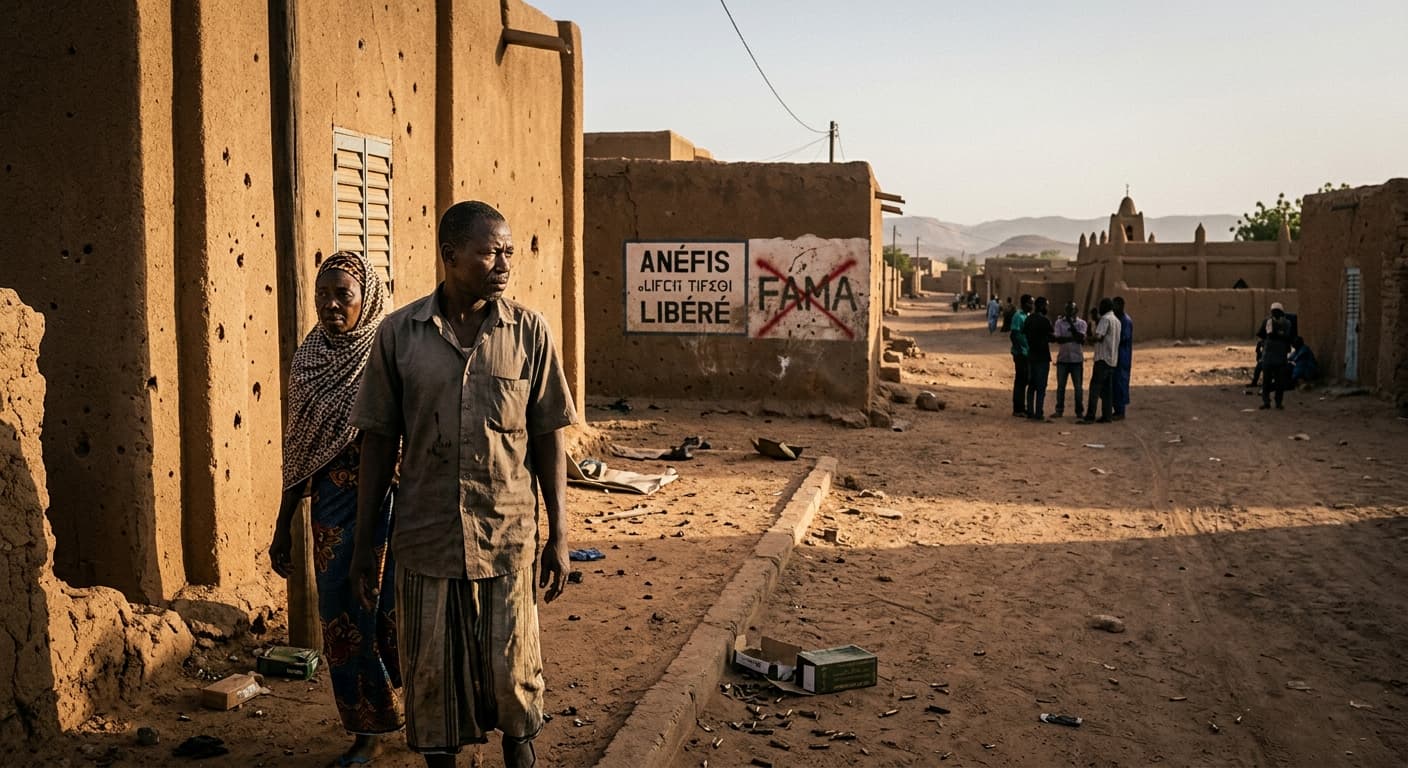
Anéfis Battle Signals Mali Junta's Loss of the North
The July 4 assault on Anéfis by JNIM and Tuareg FLA rebels closes the Kidal–Gao corridor, exposing the limits of Russian Africa Corps and reshaping Sahel security.
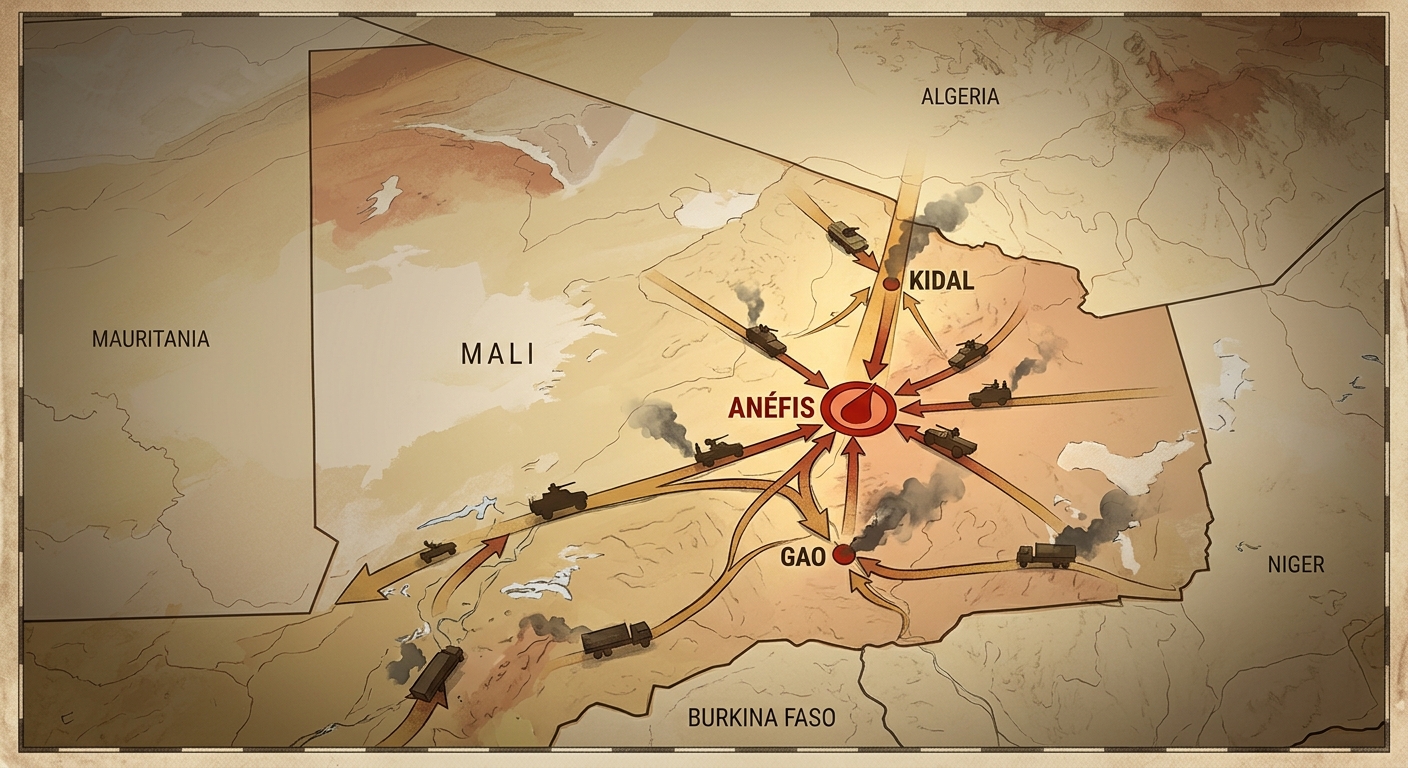
On July 4, 2026, fighters from the al-Qaeda-linked Jama'at Nusrat al-Islam wal-Muslimin (JNIM) and the Tuareg-led Azawad Liberation Front (FLA) opened a coordinated assault on the garrison camp at Anéfis, the last Malian-army position on the desert road between the northern city of Kidal and the regional hub of Gao. The camp itself is a secondary prize — the road is the point. If Anéfis falls, Colonel Assimi Goïta's junta loses the ability to resupply any position north of Gao by land, and Russia's Africa Corps loses the corridor it needs to hold anything in the Kidal region at all. That does not merely extend a Sahelian insurgency — it consolidates a de facto partition of Africa's third-largest gold reserve and hands JNIM the strategic depth to push south toward the Gulf of Guinea.
What actually happened at Anéfis
According to Al Jazeera, FLA and JNIM fighters struck five towns simultaneously before dawn on Saturday, July 4 — Anéfis, Aguelhok and Gao in the north, Sévaré in the centre, and Kenieroba, 74 kilometres from Bamako, in the south. FLA spokesman Mohamed Elmaouloud Ramadane confirmed to Reuters that his fighters attacked Anéfis, where Malian troops and Africa Corps mercenaries had entrenched after losing Kidal to the same alliance in April. JNIM separately claimed control of at least seven positions.
By Monday, July 6, Radio France Internationale reported that Tuareg separatists and al-Qaeda affiliates had "secured control" of the town itself, with Malian soldiers and Russian mercenaries confined inside the camp under drone surveillance and mortar fire. Africa Corps' own Telegram channel showed a drone strike on rebel positions at Anéfis and a Russian soldier atop a building at the Aguelhok base — footage Al Jazeera could not independently verify. On July 5, Tuareg fighters claimed to have
shot down a Russian helicopter in the north. By July 7, Al Jazeera's Nicolas Haque was tracking a
Russian naval shipment of weapons routed to West Africa to keep the junta from collapsing.
Anéfis is not incidental terrain. It sits 113 kilometres south of Kidal at the classic chokepoint of every northern Malian war. In June 2013 the Malian army's recapture of Anéfis was its first solo victory of that campaign — the last stop before Kidal, as Al Jazeera reported at the time. In October 2015 it hosted the so-called "Anéfis pacts" that the
International Crisis Group called the "bottom-up" backbone of the Algiers peace process. Whoever holds Anéfis controls the Kidal–Gao axis — and, with it, the smuggling economy in fuel, gold and cocaine that funds every armed actor along it, as
Clingendael's mapping of northern Mali's trade corridors documented.
The thesis: a de facto Azawad, funded by gold
The April 25 offensive killed Defence Minister Sadio Camara at his fortified residence in Kati, the BBC reported, and forced Africa Corps to abandon Kidal after negotiating a safe withdrawal — a scene documented in verified rebel footage of Russian armour left behind, per
BBC Verify. Russian defence officials claimed 12,000 fighters took part; the International Crisis Group's Jean-Hervé Jézéquel called it a "major escalation" over anything JNIM had previously attempted. On May 4, state broadcaster ORTM confirmed that Goïta had, by presidential decree, taken over the defence portfolio himself, per
Al Jazeera — a signal of just how thin the junta's bench had become.
The July 4 strikes were not a follow-up flourish. They were the second phase of a campaign designed to seal the north. Crisis Group data show JNIM has tripled its urban attacks over five years and now strikes 14 of Mali's 19 regional capitals; the group has explicitly borrowed HTS's Syria playbook, publicly offering Russian forces non-aggression in exchange for withdrawal, as the
Stimson Center has documented. Alex Vines of the European Council on Foreign Relations told Al Jazeera that Malian authority has been squeezed into "securitised enclaves and corridors." Anéfis is where that description becomes literal: cut the corridor at Anéfis, and Tessalit, Aguelhok and Kidal are stranded.
What makes this different from the 2012 or 2015 rebellions is gold. Mali extracted roughly 100 tonnes in 2024, worth about $4.3 billion — nearly 80% of exports, according to Al Jazeera's mapping of IMF and US Commerce Department data. Africa Corps is reportedly paid partly in gold and mining concessions, Chatham House's Alex Vines told the BBC in a piece on the region's
"blood gold" — a model that ex-UN mercenaries expert Sorcha MacLeod called "unsustainable" for Bamako. The junta laid the foundation stone in mid-2025 for a 200-tonne Russian-partnered refinery in Senou, framed by Goïta as
"economic sovereignty". But the refinery sits in the south. The mines the state can still protect sit in the south. The territory it is losing sits in the north — and JNIM already taxes artisanal gold along the axes it controls.
The Russians are the biggest loser
Moscow's Africa Corps, which replaced Wagner in 2025 under the direct command of Deputy Defence Minister Yunus-Bek Yevkurov and GRU officer Maj-Gen Andrey Averyanov, has roughly 2,500 troops in Mali, a senior French military source told BBC Verify. That is not enough to hold a country the size of Texas plus France. Africa Corps has already been forced to withdraw from Kidal and Tessalit, and its main compound in Bamako came under small-arms fire during the April assault. On July 6, MacLeod told the BBC that "other states that have hired Africa Corps will be watching very closely" — a pointed reference to the Central African Republic, Burkina Faso and Libya, where Moscow's regime-protection model is priced against the same balance sheet.
The Real Instituto Elcano argued in a July 1 analysis that Africa Corps is institutionalising Russia's regime-protection model across the central Sahel, "sidelining European actors." That claim now looks fragile. A Norwegian Institute of International Affairs policy brief published after the April attacks put it bluntly: "Russia is not the answer" — the Africa Corps "helped repel a coordinated attack but could not prevent it from striking the capital, the Kati base, and cities across the country," per
NUPI. Konrad Adenauer Foundation Sahel head Ulf Laessing told Al Jazeera that Camara's death may itself damage Bamako's relationship with Moscow, since the defence minister was "the brain behind" the Russian partnership.
The regional spillover no one is stopping
The Alliance of Sahel States — Mali, Burkina Faso and Niger — pledged in January 2025 to raise a 15,000-strong joint force under the Liptako-Gourma Charter. It did not deploy on April 25. Burkinabé aircraft reportedly participated in airstrikes near Kidal a few days later and Niger provided cross-border support, per Crisis Group sources, but Laessing's assessment stands: AES members are "all fighting extremist armed groups and none of them has troops to spare." On June 18, JNIM overran Diori Hamani International Airport in Niamey, killing 11 soldiers and two civilians. The alliance was designed to project sovereignty; it is struggling to defend its own airports.
The southward drift is measurable. The Institute for Economics and Peace's 2026 Global Terrorism Index found the Sahel accounted for over half of all terrorism deaths in 2025, with six African states in the global top ten. The
Stimson Center documents JNIM's first claimed attack on Nigerian soil in October 2025 near the Benin border, and ACLED tallies a "disproportionate increase in fatalities" in the Benin–Niger–Nigeria triangle between 2024 and 2025, according to
ISPI. Every Malian battalion pulled north to Anéfis is a battalion not patrolling the borders with Côte d'Ivoire, Ghana and Togo.
Humanitarian numbers are catching up. According to the UN Office for the Coordination of Humanitarian Affairs, 5.1 million Malians need aid in 2026, with a $577.9 million appeal — of which the 2025 plan received just 21%, the lowest funding level in a decade. OCHA's April 25
situation report recorded schools closed across Mopti, a Gao health centre attacked, and telecommunications infrastructure destroyed in Rhaous, Tessit, Ménaka and Kidal — with 600 people newly registered as refugees in Niger. Across Burkina Faso, Mali and western Niger, OCHA counts
2.8 million internally displaced, 415,000 of them Malian.
Who benefits, who loses
The Institute for Security Studies argues Bamako itself will not fall — JNIM lacks the firepower to occupy a capital, and urban public sentiment remains hostile. That is the ceiling. The floor is worse: further coups. ISS notes that the 2012 Malian coup and Burkina Faso's January 2022 coup were both triggered by military setbacks, not by insurgent victories. Goïta, having named himself defence minister after losing his last one, has narrowed the number of people who can plausibly move against him — and widened the number of officers with a grievance.
Turkey benefits quietly. It supplied the Bayraktar drones that helped Bamako take Kidal in 2023, and BBC analyst Ochieng told the broadcaster there are reports of a Turkish contractor now training the presidential guard. The Trump administration, having lifted certain Mali-related sanctions and dispatched State Department Africa chief Nick Checker to Bamako earlier in 2026 to signal a "new course," is positioned as the outside power most likely to fill the gap Moscow's failures open — precisely the
Council on Foreign Relations reading of the geopolitical opportunity. Algeria, sidelined since Bamako scrapped the 2015 Algiers accord in 2024, quietly brokered the Russian withdrawal from Kidal in April, per CFR — proof that regional mediation is still available if Bamako wants it.
The clearest loser, beyond the junta and its Russian patrons, is the Malian state itself. Anéfis is now the tenth northern town or base from which government forces have withdrawn or been ejected since April. The Global Terrorism Index recorded a 42% decline in Mali fatalities in 2025 — a statistic that in 2026 looks less like progress than the calm before a redrawn map.
Diplomat View
The forecast: within six months, the Kidal–Gao axis will function as the northern border of an unrecognised Azawad, administered by the FLA in the population centres and taxed by JNIM in the countryside — a "single front" JNIM openly called for on April 30. The junta will hold Bamako, Ségou, Sikasso and the western gold belt, and will lean harder on Turkish drones and, quietly, on US intelligence-sharing, while Africa Corps shrinks toward a Bamako-Kati enclave. What would change this forecast: a decisive break between JNIM and the FLA over sharia versus autonomy — the ICG and Stimson both flag this as the alliance's structural weakness — or a Turkish or Emirati intervention with enough airpower to reopen the Anéfis corridor. Neither is likely before year's end. The reason to watch Mali is not Mali. It is Cotonou, Lomé and Abidjan, where the next JNIM claim will land.
What to watch next:
- July–August 2026: whether Africa Corps' Anéfis garrison holds or negotiates a Kidal-style withdrawal.
- September 2026: AES summit; test of whether the 15,000-troop joint force is real or paper.
- Q4 2026: progress at the Senou gold refinery, the junta's central bet on revenue sovereignty as northern mines slip from its grasp.
The Bottom Line
The bottom line: Anéfis is not a town, it is the hinge on which northern Mali swings. If JNIM and the FLA close it, Africa's second-biggest gold producer is functionally partitioned, Russia's regime-protection model in the Sahel is exposed as a bluff, and the jihadist frontier moves 500 kilometres closer to the Gulf of Guinea coast. The next Sahelian capital to fall will not fall to jihadists — it will fall to its own soldiers, and the trigger will be a defeat like this one.
Discover more

US Politics
US Launches $166B Tariff Refund Portal
The US is launching a $166 billion tariff refund portal to aid importers hit by Trump-era tariffs, with major implications for trade and supply costs.
Global Politics
Xi Jinping Calls China-Russia Ties 'Precious'
Xi Jinping's description of China-Russia ties as 'precious' reflects a strategic imbalance, with Beijing dictating terms in the partnership.
India
Women's Reservation Bill 2026: A Political Sh
India's Lok Sabha rejected the Women's Reservation Bill, exposing a political maneuver to redraw electoral maps favoring the north over the south.

Conflict & Security
Drone Warfare Killing Aid Workers at Unprec
Over 1,000 humanitarian workers killed in three years as cheap armed drones collapse legal protections. Gaza, Sudan, Ukraine, and DRC see deliberate targeting of aid convoys and hospitals with zero prosecutions.