Alianza Verde Backs De la Espriella, Isolates
Colombia's Green Alliance recognizes new president, sidelining Petro.
Model Diplomat8 min readLatin America
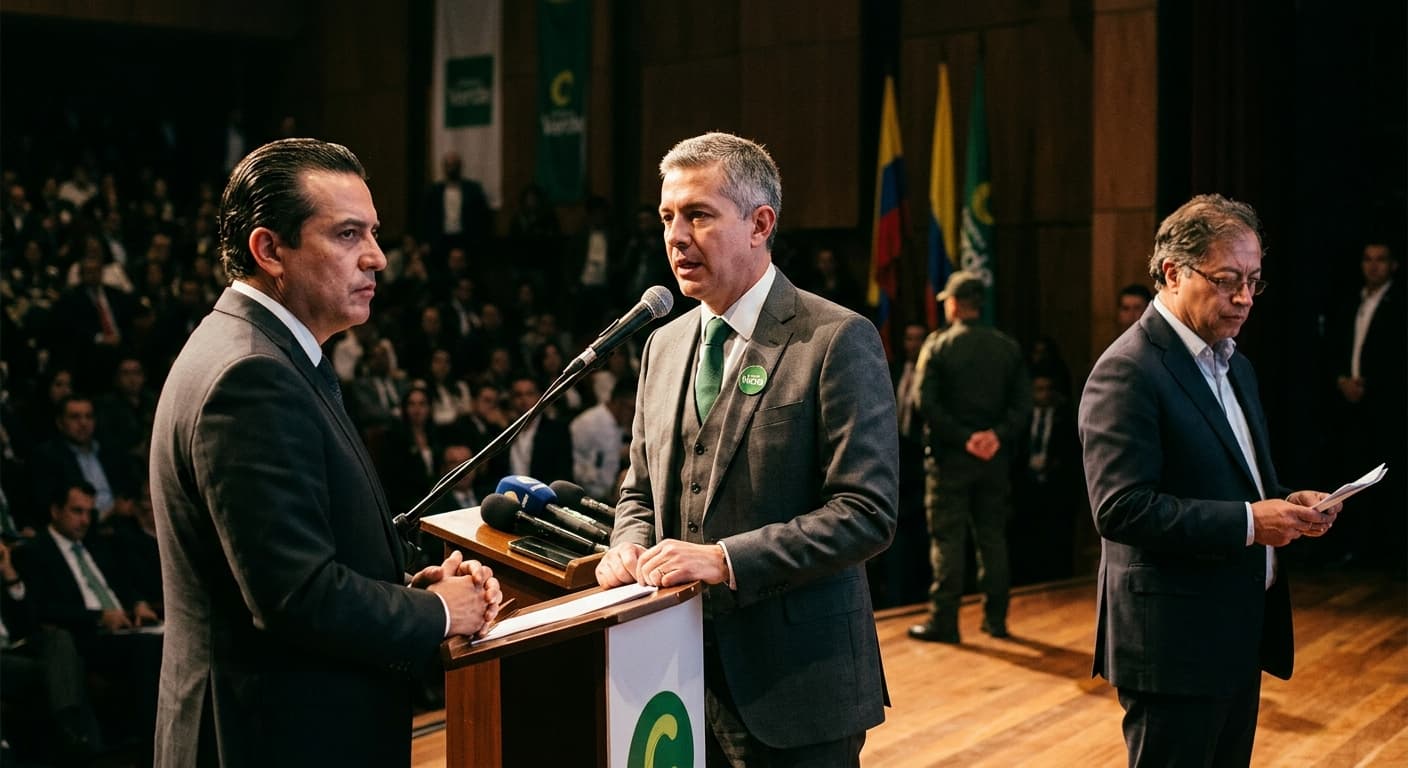
Alianza Verde Recognizes De la Espriella, Isolating Petro
Colombia's Green Alliance, which backed Iván Cepeda, has recognized Abelardo de la Espriella as president-elect — leaving Gustavo Petro alone in denying the June 21 result.
The most consequential concession in Colombia's 2026 election did not come from Iván Cepeda on June 24. It came on July 8, when Alianza Verde — the progressive party that endorsed Cepeda in both rounds — recognized Abelardo de la Espriella as the constitutionally elected president, demanded a "transparent and responsible" handover from Gustavo Petro, and instructed its cadres to route any remaining disputes through the courts. That single communiqué, published while Petro was still insisting from the Casa de Nariño that Cepeda was the "true winner," collapsed the political coalition around the outgoing president's non-recognition strategy. Petro is now not leading a movement; he is leading a rump.
The vote the Greens accepted
De la Espriella, the media lawyer heading the Defensores de la Patria movement, won the June 21 runoff with 49.65% to Cepeda's 48.70% — a lead of roughly 250,000 votes out of nearly 26 million cast, per the Registraduría Nacional bulletins compiled by BBC Mundo. Turnout hit 63.56%, the highest since the two-round system was introduced by the 1991 Constitution. He took a record 13 million votes; Cepeda also exceeded Petro's 2022 record, and lost anyway.
The count was not close in a procedural sense. The Registraduría reported that the preliminary tally matched the judicial scrutiny at 99.997% accuracy, a figure cited by Cepeda himself in his June 24 concession, BBC Mundo reported. The European Union's Election Observation Mission, led by Esteban González Pons, had already dismissed fraud rumors after the first round, telling
Al Jazeera that its 143 observers found the vote had "proceeded peacefully, in an orderly manner, with broad citizen participation and respect for democratic institutions."
That is the record against which Petro is asking Colombians to disbelieve the outcome. His case rests on an analogy: after the 2022 legislative election, his Historic Pact coalition recovered roughly half a million votes in the judicial scrutiny, and he argues the same could theoretically happen now. But as Al Jazeera noted in its concession coverage, the Registry recorded high accuracy in both the March legislative preliminary count and the May 31 first round — the 2022 discrepancy is looking increasingly like an artifact, not a pattern.
What Alianza Verde actually did
The Green Alliance's statement, reproduced by regional outlet Vive el Meta, does three things that matter beyond the ritual language of "respect for democracy."
First, it explicitly recognizes "the official declaration by the electoral authorities that accredited Abelardo de la Espriella as president-elect and José Manuel Restrepo as vice president." That anchors the recognition to the Registraduría's constitutional certification — the same body whose functions are set out in Decree 1010 of 2000, which makes the Registry the constitutional guarantor of "the transparency of the electoral process, and the timeliness and reliability of scrutinies and electoral results." By pinning itself to the Registry's declaration, Alianza Verde forecloses any argument that recognition is a political favor to the incoming right.
Second, it insists disputes must move "exclusively through the mechanisms provided by the Constitution and the law" — a direct rebuke of Petro's calls for civil disobedience. Under Decree 2241 of 1986, Colombia's electoral code, the National Electoral Council reviews contested scrutinies and the Consejo de Estado hears any nullity actions. The Greens are telling their base: if you have a grievance, file it, don't march it.
Third, the party demanded that Petro's team conduct an "empalme — transparente, responsable y oportuno*" — a transition that is transparent, responsible, and on time. That language landed the day after the handover collapsed.
The transition that broke
On July 7, according to reporting by HCN Times, De la Espriella ordered vice president-elect José Manuel Restrepo to suspend all transition meetings immediately, citing Petro's and Cepeda's refusal to recognize the result. Finance Minister Germán Ávila, coordinating the handover for the outgoing government, then suspended talks on Petro's side "citing a lack of institutional guarantees." The same day, Petro's lawyer filed a criminal defamation complaint against Carlos Alonso Lucio, a member of the incoming administration's transition team who had said Petro should be tried.
Petro's response was characteristic: he asked the Procuraduría (Inspector General) and the Contraloría (Comptroller) to act as formal guarantors of a handover the incoming government has walked out of, and instructed each ministry to publish its exit report on public digital platforms if the counterpart never returns to the table. The move, as HCN Times put it, is "consistent with a president who has repeatedly sought direct visibility with Colombians throughout his time in office."
Into this vacuum the Greens stepped. The party is not large — Alianza Verde holds roughly 10-11 Senate seats, a minority within the outgoing progressive bloc, per BBC Mundo's legislative maps. But its symbolic weight is disproportionate: it is the environmental, urban, centrist face of the Petrista coalition, the party of Claudia López and Antanas Mockus. If it stays inside the "fraud" narrative, Petro has a coalition. If it leaves, he has a faction.

The president-elect and the geometry of the new right
De la Espriella is not a normal center-right restoration. He is 47, a criminal defense lawyer with a media persona ("El Tigre"), an admirer of Nayib Bukele, Javier Milei, and Donald Trump, and, as BBC Mundo has documented, a naturalized U.S. citizen who ran openly against Petro's "total peace" policy and the 2016 FARC accord's Special Jurisdiction for Peace. He announced his candidacy in July 2025, a month after the shooting of Senator Miguel Uribe Turbay in Bogotá reset the security debate.
Trump endorsed him after the first round with a "total and absolute" backing on Truth Social, calling Cepeda "a marxist of the radical left." Marco Rubio phoned to congratulate him on election night, per the same BBC Mundo live blog. That external embrace is now Petro's principal grievance — and Cepeda's too. In his concession, Cepeda denounced "the open and undue foreign interference in Colombia's internal affairs, particularly the interventions carried out from the government of the United States and, in particular, the interventions of President Donald Trump in favor of Abelardo de la Espriella's candidacy,"
BBC Mundo reported.
The problem for the losing side is that grievance is not evidence, and the numbers do not move. De la Espriella will govern without a congressional majority — his Movimiento Salvación Nacional holds only three or four Senate seats — meaning the Pacto Histórico remains the largest force in the chamber. His agenda, from dismantling "paz total" to a Bukele-style security architecture, requires votes he does not have. Which is why the Alianza Verde recognition, ostentatiously coupled with a demand for dialogue and reforms "through Congress," is also a bid: the Greens are positioning themselves as the swing bloc of the next legislature.
The historical parallel — and why this one is different
Colombia has seen a losing coalition dispute a result before. In the 2014 legislative scrutiny, the Consejo de Estado found irregularities and reallocated seats. But those disputes moved through the institutions. What is unusual in 2026 is a sitting president refusing to recognize a certified successor while conceding, in the same breath, that he will still leave office on the constitutional handover date. According to Vive el Meta, Petro has now signaled he will hand over power on August 6-7 while continuing to insist the election was tainted by U.S. interference.
That is a Trumpian playbook run in reverse — the outgoing leader delegitimizing the incoming one, then leaving anyway. The closest regional analog is Jair Bolsonaro's 2022-23 refusal to concede to Lula, which culminated in the January 8, 2023 assault on Brasília. Colombian institutions are trying to head that off. The Registraduría has already declared. The EU mission has already certified. And now Alianza Verde has publicly told its own voters that the fight is over.
Who wins, who loses
De la Espriella wins twice. First, he gets the imprimatur of a party that campaigned against him — a real inoculation against the "illegitimate president" label Petro is trying to affix. Second, he gets a plausible negotiating partner inside the progressive bloc for the reforms he cannot pass with his own thin caucus.
Alianza Verde wins the medium term. It has now separated itself from Petro's post-electoral strategy without renouncing its progressive identity, positioning itself as a governable center-left for 2030.
Iván Cepeda is the ambiguous case. He conceded on June 24 with a speech that simultaneously accepted the result and denounced the process, per BBC News. He has claimed the mantle of opposition leader for the next four years. The Greens' move validates the "accept the result" half of that speech and quietly buries the "denounce the process" half.
Gustavo Petro loses the most. His non-recognition strategy required a coalition; that coalition is fragmenting in public, on a specific date, over a specific document. His fallback — televising each ministry's exit report on state media — is a communications strategy, not a political one. Petro leaves office on August 7 with a legacy (tax, pension, labor reforms; a battered "paz total") but with the last chapter written by his own refusal to hand over power gracefully.
What to watch next
- August 7, 2026 — the constitutional handover. Whether Petro attends, hands over the presidential sash, and whether the sword of Bolívar makes an appearance will set the tone for De la Espriella's first hundred days.
- The Procuraduría and Contraloría responses to Petro's request that they act as "guarantors" of a broken transition. If they accept, Petro gets institutional cover; if they demur, the outgoing government finishes in isolation.
- The Pacto Histórico's July mobilizations and any counter-demonstrations by Defensores de la Patria. The Alianza Verde communiqué explicitly calls for calm; whether Cepeda's base heeds it will show whether the Greens still speak for a slice of the progressive electorate.
- The Constitutional Court and Consejo de Estado dockets for any nullity actions filed by the Petro camp. Under the 1986 electoral code, this is the only legal route left to contest the result. So far, none of substance has been filed.
The Bottom Line
The bottom line: Alianza Verde's July 8 recognition of Abelardo de la Espriella is not a courtesy — it is the moment Gustavo Petro's non-recognition strategy stopped being a coalition position and became a solo one. With the Registraduría's 99.997% audit, EU observers finding no fraud, and Cepeda himself already conceded, the outgoing president now faces August 7 with only his own faction behind him. In Colombian politics that is not a legacy; it is a warning to the next progressive candidate about the cost of losing the institutional argument. *
Discover more
International Relations
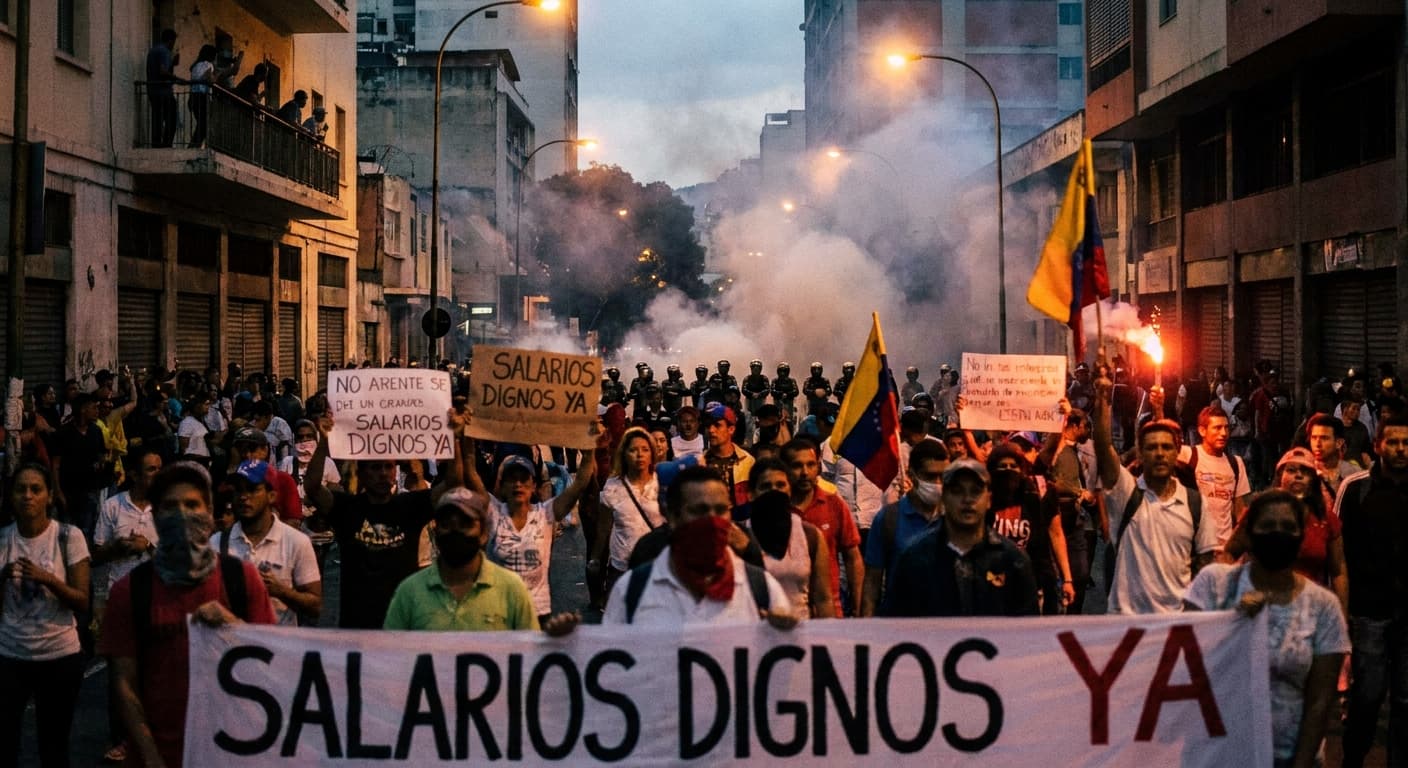
Venezuela Protests Demand Economic Reforms
Protests across Venezuela spotlighted deepening economic hardship under Maduro as workers demanded higher wages and pensions amid growing public discontent.

US Politics
US Launches $166B Tariff Refund Portal
The US is launching a $166 billion tariff refund portal to aid importers hit by Trump-era tariffs, with major implications for trade and supply costs.

Global Politics
US Naval Blockade on Iran
The US fully imposed a naval blockade on Iranian ports, escalating tensions even as Trump hinted the conflict may soon end while serious risks of war remain.

Economics
Fed's Amex AML order puts correspondent banking on notice
Federal Reserve's Amex AML order requires board-level controls and a 90-day plan; OCC fined the bank $350 million over enterprise-wide deficiencies.