Algeria Elections 2026: Court Certifies Vote
Constitutional Court certifies Algeria's election results amid low turnout.
Model Diplomat6 min readNorth Africa
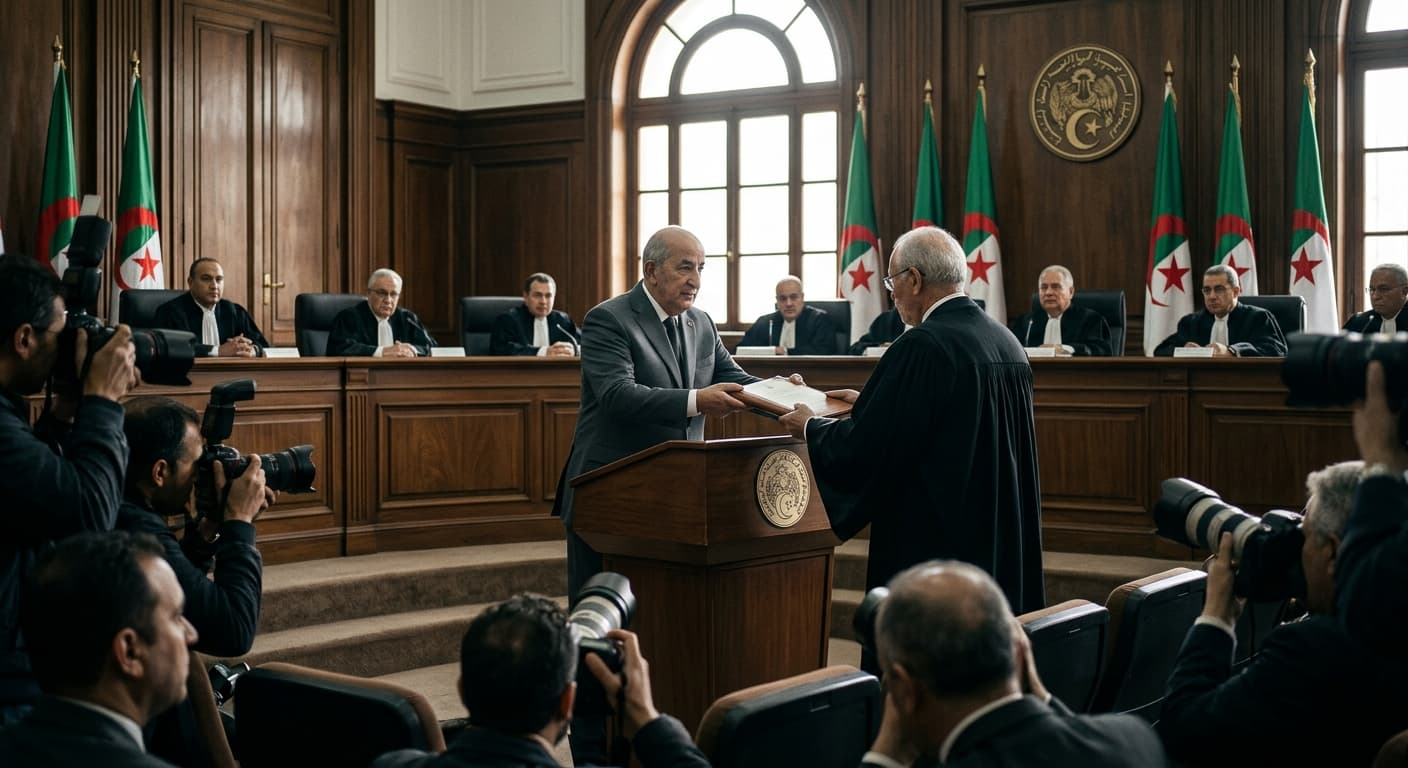
Algeria elections 2026: Constitutional Court now holds the certified vote
What happens after Algeria's July 2 provisional election results: the 10-day Constitutional Court certification, appeal window, and government-formation timeline explained.
Algeria's Constitutional Court has 10 days to certify a legislative election in which parties loyal to President Abdelmadjid Tebboune won a working majority on the lowest official turnout in the country's history — a result that clears the last procedural obstacle to a fully compliant parliament ahead of the 2029 presidential succession. The Independent National Electoral Commission (ANIE) transmitted the provisional records of the July 2 vote to the court on July 8, opening a 48-hour appeals window, a mandatory judicial review, and — once certified — the constitutional sequence that produces Algeria's next government. The Anadolu Agency explainer lays out the mechanics; the political reality is that the mechanics are the point.
Where the votes went — and who now holds the majority
Provisional figures announced on July 6 by acting ANIE chief Karim Khelfane gave the National Liberation Front (FLN) 90 seats, the National Democratic Rally (RND) 73, and the Future Front 59, according to DZWatch. The Movement of Society for Peace (MSP), the sole opposition bloc in the outgoing chamber, took 43 seats; the pro-government National Construction Movement (El Bina) won 38. Independents collapsed from 84 seats in 2021 to 32.
Add the three core presidential parties (FLN, RND, Future Front) to the presidential-leaning Voice of the People party (17 seats), and Tebboune's camp commands roughly 239 of 407 deputies — an outright majority of 58%. In the 2021 legislature, the FLN and RND together held only 156 of 407 seats, forcing the presidency to govern through a technocratic cabinet and shifting coalitions, as Barcelona-based think tank CIDOB has documented. That arithmetic is now gone.
The return of the Socialist Forces Front (12 seats), the Rally for Culture and Democracy (4), and the Workers' Party (3) — three historic opposition forces that boycotted 2021 — is the headline concession to pluralism. It is a small one. Combined, they hold 19 seats, or 4.7% of the chamber. Their re-entry was itself extracted under duress: Organic Law No. 26-08 of April 23, 2026 threatens dissolution of any party that skips two consecutive votes, ISPI analyst Massensen Cherbi notes.
The 21.24% number the court cannot fix
Turnout was 21.24%, ANIE announced — BBC Arabic reported the figure directly from the authority's press conference — undercutting the 23.03% floor set in 2021 that had itself been the lowest since independence in 1962. In Kabyle-majority provinces the collapse was near-total in the last cycle: Béjaïa recorded 0.42% and Tizi-Ouzou 0.90% in 2021, according to
ISPI's Caterina Roggero. The Constitutional Court can annul a constituency, order a recount, or reshuffle vote shares, as it did in the 2024 presidential race when it trimmed Tebboune's official score from 94.65% to 84.3% —
Al Jazeera reported that Court President Omar Belhadj cited "correction of the errors noted in the counting." What the court cannot do is invent voters.
That legitimacy gap is the frame every subsequent step sits inside.
What the court actually does — and by when
Under Article 211 of the electoral law (Organic Ordinance 21-01 of March 10, 2021, Journal Officiel de la République Algérienne No. 17), the Constitutional Court has 10 days from receipt of the provisional records to publish certified results. That places the deadline around July 18, 2026. The court, now presided over by Leïla Aslaoui — who told a public gathering in May 2026 that the outgoing parliament's absence of conflict was a national virtue, as quoted by
ISPI — receives appeals during a 48-hour window that opened on July 6. It rules on each in writing.
If an appeal is upheld, three remedies are available: annul the constituency vote (triggering a re-run), amend the tallies, or reallocate a seat. Historically, the court's interventions in legislative disputes have been marginal. A DOAJ-indexed study on the court's electoral jurisdiction — the successor to the pre-2020 Constitutional Council under the November 2020 constitutional revision — describes it as an "impartial arbiter" of electoral integrity; in practice, its composition remains heavily executive-appointed, as Amnesty International warned in its
2020 review of the draft constitution. Four of 12 judges are appointed directly by the president, who also names the court's president.
Once certified, the results are published in the Official Gazette. The new People's National Assembly then convenes in a special session to elect a speaker.
Government formation: which article governs
The route to a cabinet is written into three articles of the constitution as amended in the Constitutional Revision Law of 2026 (JORA No. 22), which further concentrated presidential powers.
- Article 103 distinguishes two paths depending on whether the election produces a "presidential majority" or a "parliamentary majority."
- Article 105 applies where the president's camp wins: Tebboune appoints a prime minister tasked with executing the presidential program — not negotiating one.
- The alternative track — a "head of government" drawn from an opposition parliamentary majority, with a 30-day deadline to form a cabinet or trigger a second attempt — is dormant. It has never been used since the 2020 constitution created the dual model.
With the presidential bloc at roughly 239 seats, Article 105 is the only operative pathway. That gives Tebboune complete discretion. Sifi Ghrieb, the industrial-sector technocrat appointed acting prime minister on August 28, 2025 after Tebboune dismissed Nadir Larbaoui, is the incumbent — CIDOB notes he was named to signal an economic-diversification agenda. Whether he stays, or Tebboune uses the new parliament to install a partisan FLN figure who owns the pre-2029 legislative program, is the first meaningful decision of this cycle.
The wider context: the Middle East Institute has documented that since a September 2023 decree, presidential advisers already function as a "smaller cabinet," bypassing the government on policy. A more compliant Assembly makes that arrangement legally cleaner.
The candidate filter that shaped the ballot
The election that Algerians did not turn out for was already curated. Under Article 200(7) of the electoral law, ANIE rejected 3,700 prospective candidates on grounds including "connections with dubious money" and "suspicious activities," acting ANIE head Khelfane confirmed in comments to Al Jazeera. Only 120 of 2,370 appeals to administrative courts succeeded, per ISPI's tally.
Almost half of the 250 outgoing deputies were barred from re-running — including many from the FLN and RND, whose lists lost approximately 450 and 300 candidacies respectively. As Cherbi writes in his ISPI paper:
"The regime wants an Assembly that functions 100% without the slightest criticism."
That is not a claim about vote-counting. It is a claim about the shape of the field before ballots were printed. The Constitutional Court's certification role — genuine in form, procedural in effect — sits downstream of that filter.
The economics behind the timeline
The presidency's insistence on a smoothly-timed legislative sequence is not purely political. The IMF's July 6, 2026 Article IV mission concluding statement — released two days before the vote-record transfer to the Constitutional Court — flagged fiscal pressure from lower hydrocarbon receipts and the need for a coherent macroeconomic framework. A parliament that ratifies without amending the 2027 budget is, from the presidency's viewpoint, a feature. The presidential-camp majority delivers that.
What to watch next
- On or before July 10, 2026: deadline for parties, lists and individual candidates to lodge appeals with the Constitutional Court under the 48-hour rule. Watch the FFS and RCD, which fielded lists that were partly rejected pre-vote; whether they file constituency-level appeals will indicate whether their return to parliament is confrontational or symbolic.
- By July 18, 2026: Constitutional Court publishes certified results under Article 211. Any seat reallocation would most likely affect the smaller opposition tallies rather than the presidential majority.
- First half of August 2026: People's National Assembly special session to elect a speaker. The choice will telegraph FLN internal factional balance and Tebboune's preferred successor architecture ahead of the 2029 presidential race, in which he is
constitutionally barred from standing again.
- Autumn 2026: local elections. Any party that skipped both these and the July vote faces dissolution under Organic Law No. 26-08.
The Bottom Line
The Constitutional Court's 10-day certification of Algeria's July 2 vote is a legal formality laid over a political outcome that was decided long before voters stayed home: a 21.24% turnout, a filtered ballot, and a presidential camp handed roughly 239 of 407 seats. The real question is not who governs — Tebboune does, via a prime minister of his choosing under Article 105 — but whether an Assembly this compliant can be used to engineer the 2029 succession without the constitutional revision that would otherwise be required to keep the current arrangement in place.
Discover more
India
Modi's Women’s Convention in Varanasi
Modi's Varanasi rally frames women's reservation as a national mission, targeting the 2027 Uttar Pradesh elections with a strategic narrative.

India
Congress Advocates 33% Women’s Quota
Congress calls for a 33% women's reservation in the existing 543 Lok Sabha seats, countering Modi's plan to expand the house to 850 seats.
India
Rajnath Singh's Durga Squad for 2026 Polls
Rajnath Singh's Durga Squad promised women's safety in Bengal but has since disappeared from the agenda, revealing BJP's true priorities.

Economics
Fed's Amex AML order puts correspondent banking on notice
Federal Reserve's Amex AML order requires board-level controls and a 90-day plan; OCC fined the bank $350 million over enterprise-wide deficiencies.