Abyei's Collapse Tests AU Authority
Abyei's crisis challenges the African Union's peacekeeping role.
Model Diplomat8 min readAfrica
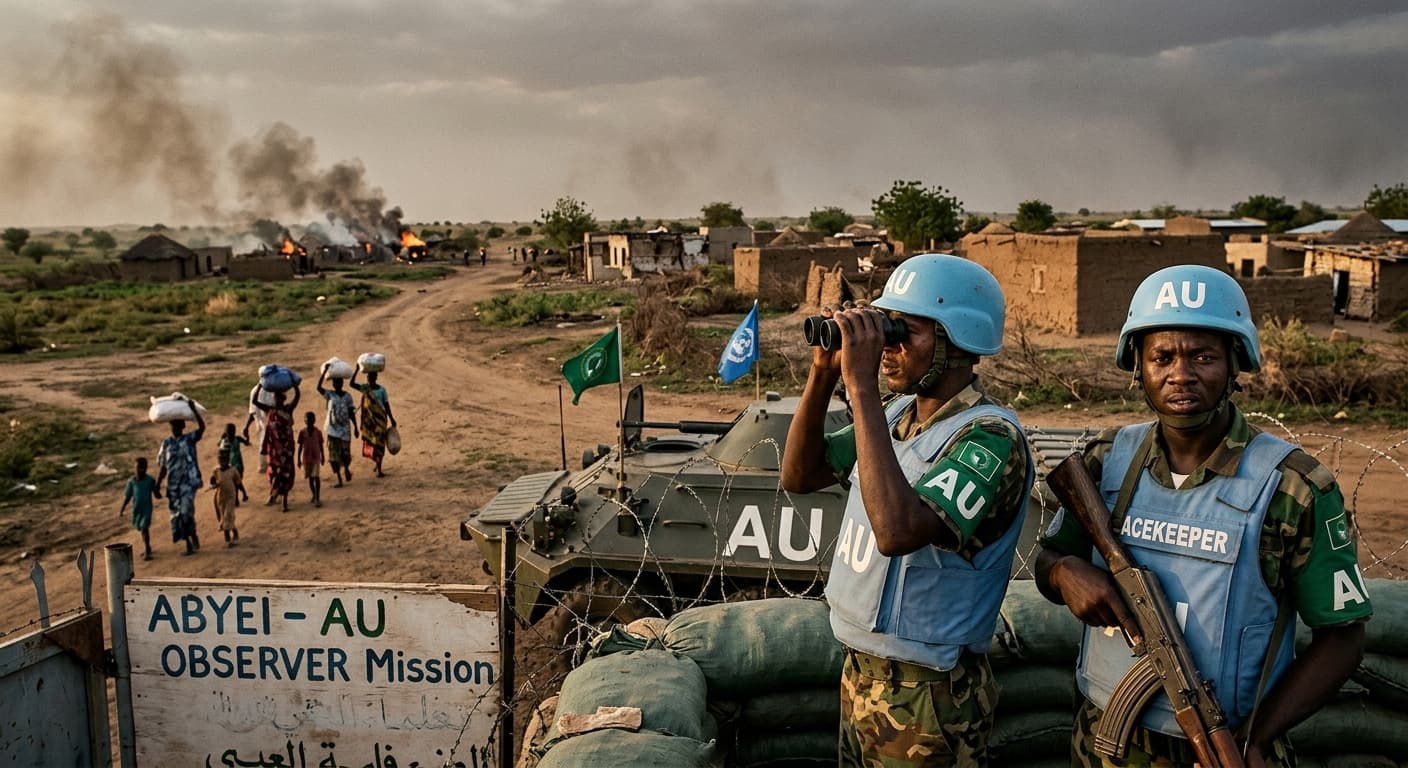
Abyei's collapse tests the African Union's authority
The AU Peace and Security Council returns to Abyei on July 8, 2026 after a four-year silence. Sudan's war, South Sudan's fragility and 196 security incidents in six months have made the disputed zone the AU's clearest test yet.
The African Union Peace and Security Council will receive an update on Abyei on July 8, 2026 — its first structured engagement with the disputed Sudan–South Sudan territory since September 2022, a 46-month gap during which the region absorbed a full-scale war, the killing of six UN peacekeepers and a documented spillover of Sudan's Rapid Support Forces onto ground the AU itself insists must remain demilitarised. The thesis is uncomfortable: the deteriorating security picture in Abyei is no longer a bilateral border dispute the AU can defer to Sudan and South Sudan; it is a live test of whether the PSC's own protocol can withstand a member state's veto by absence. Fail that test in public, and the AU signals to every fragile border on the continent — from the Sahel to the Horn — that its peace architecture bends when the guns get loud.
According to the pre-session briefing published by Amani Africa, the July 8 meeting will open with Uganda's Rebecca Amuge Otengo, the PSC chair for the month, and a statement by Bankole Adeoye, the AU Commissioner for Political Affairs, Peace and Security. IGAD, the UN and South Sudan are all scheduled to intervene. Sudan, suspended from AU activities since the April 2023 war, cannot formally participate — but "its views may be sought." That single procedural line is where the whole session's credibility now sits.
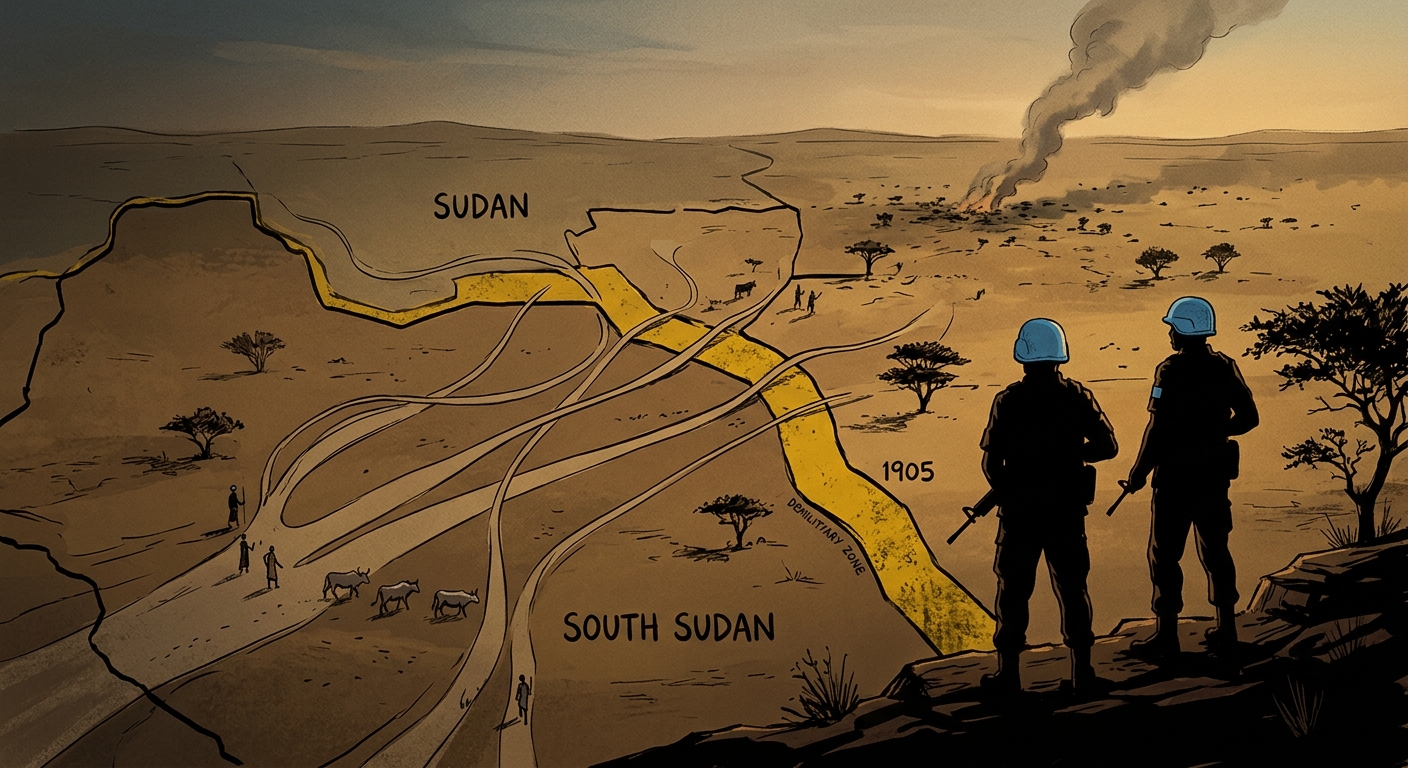
What actually happened on the ground
UNISFA — the UN Interim Security Force for Abyei, established by Security Council Resolution 1990 in June 2011 — recorded 196 security incidents and 58 fatalities in Abyei over the past six months, according to a July 4, 2026 analysis by
African Security Analysis. Amani Africa's own briefing confirms the mission's finding of a "sharp increase" over the preceding baseline.
The composition of that violence has changed. Where pre-2023 assessments were dominated by intercommunal disputes between the Ngok Dinka and the Misseriya over land, water and cattle-migration corridors, the current threat picture includes a paramilitary belligerent from a different war. The RSF, one of the two principal combatants in Sudan's civil war, now operates in the northern Abyei localities of Goli, Diffra and Gibdud. In southern Abyei, the South Sudan People's Defence Forces (SSPDF) and the South Sudan National Police Service maintain checkpoints and occupy civilian infrastructure despite Abyei's demilitarised status.
Both presences are unlawful under the framework Sudan and South Sudan themselves signed. Assistant Secretary-General Martha Ama Akyaa Pobee told the Security Council in May that the SSPDF's expansion in southern Abyei and the RSF's activities in the north "violate the 2011 Agreement on Interim Arrangements and applicable Council resolutions," according to the UN press release covering the meeting. She also confirmed that the Abyei Joint Oversight Committee has not convened since 2017 and the Joint Political and Security Mechanism has been suspended since January 2023 — the two bodies specifically designed to manage precisely this kind of drift.
The humanitarian numbers are the second-order shock. More than 20,000 people are currently displaced inside the Abyei Area, according to a May 7, 2026 UK statement at the Security Council, and roughly 41,000 people displaced by the Sudan war have crossed into Abyei, per Pobee's briefing. OCHA's sub-office head, Alexis Huliro Bisanukuri, described the ratio bluntly in a
UN interview: one doctor per 70,000 people, roughly 16,000 children out of school, and donor funding shrinking as needs climb.
The Kadugli line — and why the AU cannot pretend it didn't happen
On December 13, 2025, drones struck the UN peacekeeping logistics base in Kadugli, South Kordofan. Six Bangladeshi peacekeepers serving with UNISFA were killed and nine were wounded, according to the UN Secretary-General's noon briefing of December 15. Sudan's army attributed the attack to the RSF, according to
Al Jazeera. Secretary-General António Guterres said attacks on peacekeepers "may constitute war crimes under international law" and demanded accountability.
The operational consequence was decisive. The strike forced UNISFA to relocate personnel and suspend its physical presence in the Safe Demilitarised Border Zone — the buffer created under the 2012 Cooperation Agreements to keep Sudanese and South Sudanese forces apart. Speaking on December 22, 2025, the UK's James Kariuki told the Council that the Kadugli strike produced "the first complete suspension of the [Joint Border Verification and Monitoring] Mechanism's physical presence since its creation," according to the UK's FCDO record of the statement. AU Commission Chairperson Mahmoud Ali Youssouf condemned the attack on December 14, per Amani Africa's briefing — but the AU has taken no operational step since to compensate for the monitoring gap the strike opened.
Resolution 2802 and the benchmarks that give the PSC leverage
The Security Council extended UNISFA's mandate to November 15, 2026 on November 14, 2025, adopting Resolution 2802 (2025) under Chapter VII by a vote of 12 in favour, none against, with abstentions from China, Pakistan and the Russian Federation, according to the
UN meetings record.
The resolution is not a routine roll-over. It ties any further renewal — meaning the mission's survival beyond November 2026 — to "demonstrable progress" by Sudan and South Sudan against a defined set of benchmarks: the withdrawal of all unauthorised armed forces from Abyei and progress toward full demilitarisation; the resumption and regular documentation of JPSM meetings; and the establishment of joint administrative and policing arrangements, including the long-delayed Abyei Police Service. Guterres is required to report by August 2026 on whether tangible progress has been made, according to Al Jazeera.
That August report is the pivot. It hands the PSC something rare — a concrete, external, dated benchmark against which the AU can align its own July 8 communiqué. The question is whether the Council uses that leverage or defers it.
The obstruction the AU has to name
Behind the security data sits a specific institutional failure. When the PSC tried to schedule an informal consultation and briefing on Abyei in March 2024, Sudan's representative in Addis Ababa declined the invitation, submitted a formal letter asking the PSC to refrain from proceeding, and called for Abyei's removal from the agenda entirely. That request has no standing. Article 8 of the PSC Protocol, cited by Amani Africa, is unambiguous: the inclusion of an agenda item may not be opposed by a member state. Yet the session did not go ahead.
"Sudan's request to remove Abyei from the PSC agenda has no standing under the institutional framework that governs the Council's operations. That it succeeded — through a combination of informal diplomatic pressure and the procedural complications of Sudan's suspended status — in delaying the Council's engagement for sixteen months is a damaging precedent whose effects on the PSC's institutional authority extend well beyond the Abyei file." — African Security Analysis, July 4, 2026
Put plainly: a member state that has been suspended from the AU used its suspension as a veto against the AU's own peace and security organ. That inversion — punishment converted into leverage — is the precedent Youssouf's commission is now being tested on. The July 8 communiqué will either reassert Article 8 or normalise its violation.
What the AU's regional stakes look like
Abyei is often described as peripheral. It is not. The Amani Africa briefing places it at the intersection of the two conflict systems the AU has been least able to contain: Sudan's civil war and South Sudan's stalled transition. According to the SIPRI/NUPI Climate, Peace and Security Fact Sheet, the arrival of Nuer displaced from Unity State in early 2025 triggered a violent clash with the Misseriya in Leu in March 2025 that killed eight — a textbook demonstration of how a Sudan-war shock, a South Sudan governance shock and Abyei's climate-stressed livelihoods now compound into a single insecurity.
There is a narrower AU institutional stake as well. Youssouf, elected AU Commission Chairperson in early 2025, campaigned on a "more proactive Peace and Security Council" and reform of the African Standby Force, as ISS Africa documented. His September 2025
meeting with Guterres explicitly welcomed progress on operationalising Security Council Resolution 2719 on financing AU-led peace operations. Abyei is where that ambition meets its cheapest possible test — no new mission required, no African Standby Force deployment, just a communiqué that names the RSF, names Sudan's obstruction, and endorses the 2802 benchmarks. Anything less exposes the reform agenda as rhetoric.
Who benefits from the status quo
Two actors benefit from Abyei's frozen collapse. Khartoum's Sovereignty Council, preoccupied with the war against the RSF, gains from an AU that treats Abyei as too politically radioactive to touch — a de facto extension of the status quo that has held since the 2011 referendum was never conducted. Juba benefits from the same paralysis: SSPDF checkpoints in southern Abyei entrench a physical presence the eventual final-status negotiation will have to bargain around. As OCHA's Bisanukuri told the UN: "Neither Sudan nor South Sudan wants to give up control due to Abyei's economic value." Abyei sits on oil.
The losers are the Ngok Dinka and Misseriya communities, UNISFA's Bangladeshi contingent — the largest troop contributor and the one that has now paid in blood — and the AU itself, whose institutional authority erodes each session Abyei is not properly addressed.
What to watch
- July 8, 2026: PSC session communiqué. Watch for three specifics — an explicit call for RSF withdrawal from Goli, Diffra and Gibdud; language endorsing the Resolution 2802 benchmarks; and any reference to Article 8 of the PSC Protocol. Their absence is the story.
- August 2026: UN Secretary-General's benchmark report to the Security Council under Resolution 2802 — the document that will shape whether UNISFA is renewed, right-sized or wound down in November.
- November 15, 2026: UNISFA mandate expiry. The US delegation has publicly signalled "serious doubts" about continued support absent concrete progress, per the
UN press release.
Diplomat View
The AU's July 8 session on Abyei is a low-cost, high-signal test of the Youssouf commission's stated reform agenda, and the base case is that it fails cleanly — a communiqué that condemns violence in general terms, endorses dialogue between Sudan and South Sudan, and avoids naming the RSF or citing Article 8 against Khartoum's obstruction. That outcome would be diplomatically comfortable and analytically damning: it would confirm that a suspended member state can veto the PSC's agenda by refusing to engage, and it would leave UNISFA's benchmarks to be enforced by the Security Council alone. The forecast revises if the communiqué does three specific things — names the RSF presence in northern Abyei as a distinct threat requiring withdrawal, explicitly aligns the AU with Resolution 2802's benchmarks, and reasserts Article 8 as procedurally binding. Two of the three would signal genuine institutional recovery. Zero of the three, which remains the most likely outcome, tells every armed actor along an African disputed border that the PSC's authority is negotiable when the shooting starts.
The bottom line
Abyei is no longer a bilateral border problem; it is the AU's clearest institutional test of 2026. The July 8 Peace and Security Council session will either reassert the PSC Protocol's authority over a suspended Sudan and align the AU with the UN's Resolution 2802 benchmarks, or it will confirm that a member state can veto Africa's peace architecture simply by refusing to sit at the table — with UNISFA's November 15 mandate deadline as the price of getting it wrong.
Discover more

US Politics
US Launches $166B Tariff Refund Portal
The US is launching a $166 billion tariff refund portal to aid importers hit by Trump-era tariffs, with major implications for trade and supply costs.

US Politics
House Ethics Committee Pushes Sexual Miscond.
The House Ethics Committee has shifted responsibility for sexual harassment settlement records to the Office of Congressional Workplace Rights, complicating disclosure efforts.

India
Delhi CM Rekha Gupta Blasts Opposition's Delm
Delhi CM Rekha Gupta's remarks on women's quota defeat reveal BJP's strategy for the 2029 Lok Sabha elections, focusing on delimitation.

Conflict & Security
Drone Warfare Killing Aid Workers at Unprec
Over 1,000 humanitarian workers killed in three years as cheap armed drones collapse legal protections. Gaza, Sudan, Ukraine, and DRC see deliberate targeting of aid convoys and hospitals with zero prosecutions.