2026 Assembly Polls
Major political shifts in India's state elections
Model Diplomat7 min readAsia
The 2026 Assembly Polls Rewrote India's Political Map
The 2026 Assembly Polls handed Modi's BJP its first-ever West Bengal, ended Tamil Nadu's DMK–AIADMK duopoly, and left the Indian Left without a single state.
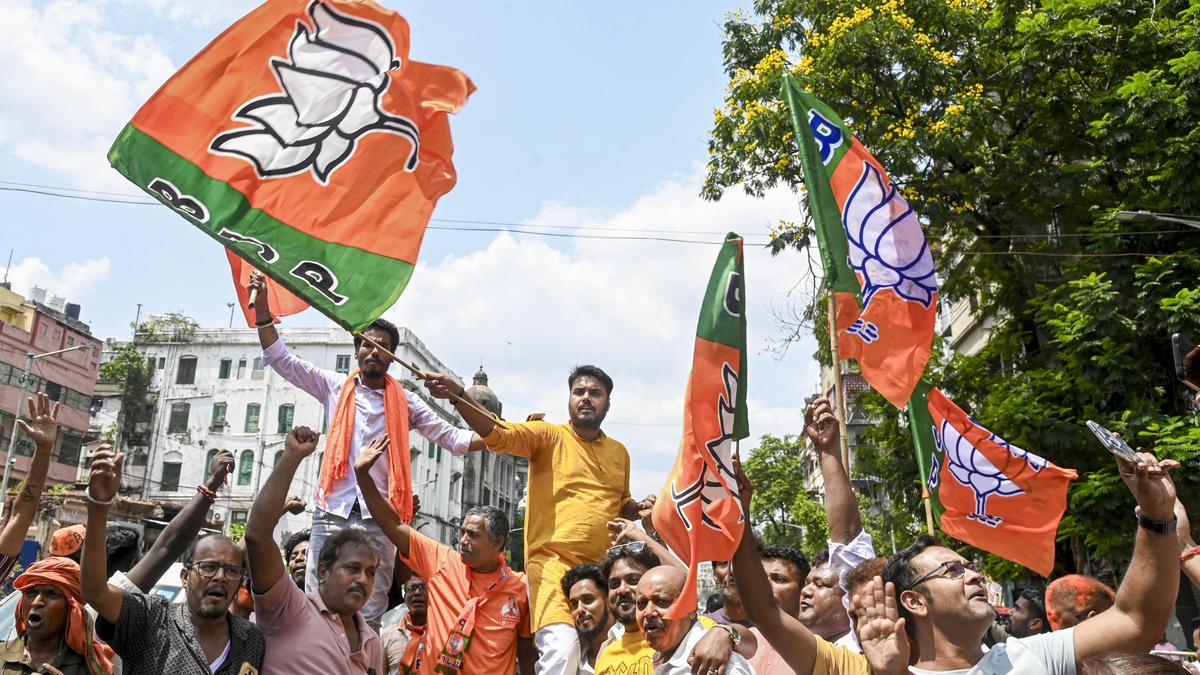
On May 4, 2026, four Indian state legislatures and one Union Territory changed hands in a single evening — and the shape of the country's politics changed with them. The Bharatiya Janata Party (BJP) won 207 of West Bengal's 294 seats, ending Mamata Banerjee's 15-year rule; a two-year-old party led by film star C Joseph Vijay took 108 seats in Tamil Nadu and dismantled a 60-year Dravidian duopoly; the Congress-led United Democratic Front (UDF) swept Kerala; and Chief Minister Himanta Biswa Sarma's BJP returned to Assam with a larger majority than in 2021. The story of these polls is not four separate verdicts — it is one national result: an opposition bench without a single populous state to campaign from, delivered by a rewritten voter roll and a rewritten political map.
Prime Minister Narendra Modi's alliance now governs, or is part of the governing coalition in, 21 of India's 28 states — roughly 80% of a 1.4-billion-person country, Al Jazeera reported citing post-result tallies. That is the largest single-party footprint since Congress's peak in the 1960s, and it arrives midway through a third Modi term that began, in 2024, with the BJP short of a Lok Sabha majority.
The Bengal breakthrough — and the 9 million missing voters
West Bengal was the prize. It is India's fourth-most-populous state, home to nearly 100 million people, and the last major eastern citadel the BJP had never won. The party's vote share jumped from 10% in 2016 to 46% in 2026, against the Trinamool Congress's (TMC) 41%, analysts at the NUS Institute of South Asian Studies wrote. Turnout hit a record 92.93%, according to
Al Jazeera.
But before a single ballot was cast, roughly 9 million names — about 12% of the state's 76 million electorate — were struck from the rolls under the Election Commission of India's (ECI) Special Intensive Revision (SIR). Of those, 2.7 million cases were still under tribunal review when polling began, the BBC reported. Muslims made up 34% of deletions in a state where they are 27% of the population.
The Supreme Court allowed the April 23 and 29 polls to proceed without resolving those 2.7 million disputed cases, directing only that the ECI publish the affected names. Chief Election Commissioner Gyanesh Kumar defended the exercise as producing a "pure electoral roll," according to BBC reporting.
The margin math is where the argument sharpens. Psephologist Yogendra Yadav has argued that the 2.7 million contested deletions amount to 4.3% of votes cast — in an election the BJP won by roughly 5 points. "If these 27 lakh persons were allowed to vote, how would it have affected the outcome?" he wrote in the Indian Express, quoted by Al Jazeera. Banerjee, who lost her own Bhabanipur seat to BJP state chief Suvendu Adhikari, called the ECI "the BJP's commission" and told supporters her party would "bounce back,"
the BBC reported.
The ECI rejects the allegation. The Commission had briefed 282 central observers across Assam, Kerala and Puducherry alone before polling, according to a Press Information Bureau release dated April 1, 2026, and stationed a record 2,400 companies of central paramilitary forces in Bengal for the vote itself. Whether one reads that as institutional rigour or institutional pressure is now the central dispute in Indian democracy.
Tamil Nadu: the celebrity insurgent nobody priced in
If Bengal confirmed a BJP thesis, Tamil Nadu shredded a Dravidian one. Chandrasekaran Joseph Vijay — the 51-year-old superstar known to fans as Thalapathy — launched Tamilaga Vettri Kazhagam (TVK) barely two years before the poll. Almost every analyst put him in single-digit-seat territory. TVK won 108 of 234 seats and 35% of the vote, relegating the ruling DMK to 59 seats, ISAS-NUS reported. Chief Minister M K Stalin lost his own Kolathur seat. The AIADMK–BJP alliance managed 47 seats and one respectively.
Vijay was sworn in as chief minister after a tense week in which Governor Rajendra Vishwanath Arlekar demanded written proof of majority support before invitation — a departure from convention that Hindi-language BBC analysts called "contrary to the Supreme Court's S R Bommai judgment." Small parties — the CPI, CPI(M), VCK and Indian Union Muslim League with two seats each — plus five Congress MLAs pushed TVK to 120, above the 118-seat threshold, the BBC reported.
What makes the TVK result more than a curiosity is its demographic pattern. Voters aged 18–39 — 42% of the state's electorate — broke heavily for Vijay, especially first-timers, according to BBC field reporting. This happened even as Tamil Nadu recorded 11.2% growth in 2024-25 under Stalin — India's fastest — with strong human-development indicators. The lesson, echoed by King's College London political scientist Louise Tillin in
a BBC analysis, is that welfare delivery has become table stakes: "Election after election, we've seen that welfare alone is not enough to win."
Vijay has cast the BJP as his ideological adversary and positioned TVK as an anti-Delhi Tamil-identity vehicle. That framing has an edge in mid-2026: it lets him ride the delimitation backlash that Stalin was already building.
Delimitation: the fight that made these polls a proxy war
To understand why these state polls matter far beyond state capitals, look at what parliament did while voters were still voting. During a special session convened April 16–18, 2026, the Modi government introduced the Constitution (131st Amendment) Bill, the Delimitation Bill, and the Union Territories Laws (Amendment) Bill — a package that would expand the Lok Sabha from 543 to roughly 850 seats and redraw constituencies for the 2029 general election, the Carnegie Endowment for International Peace documented.
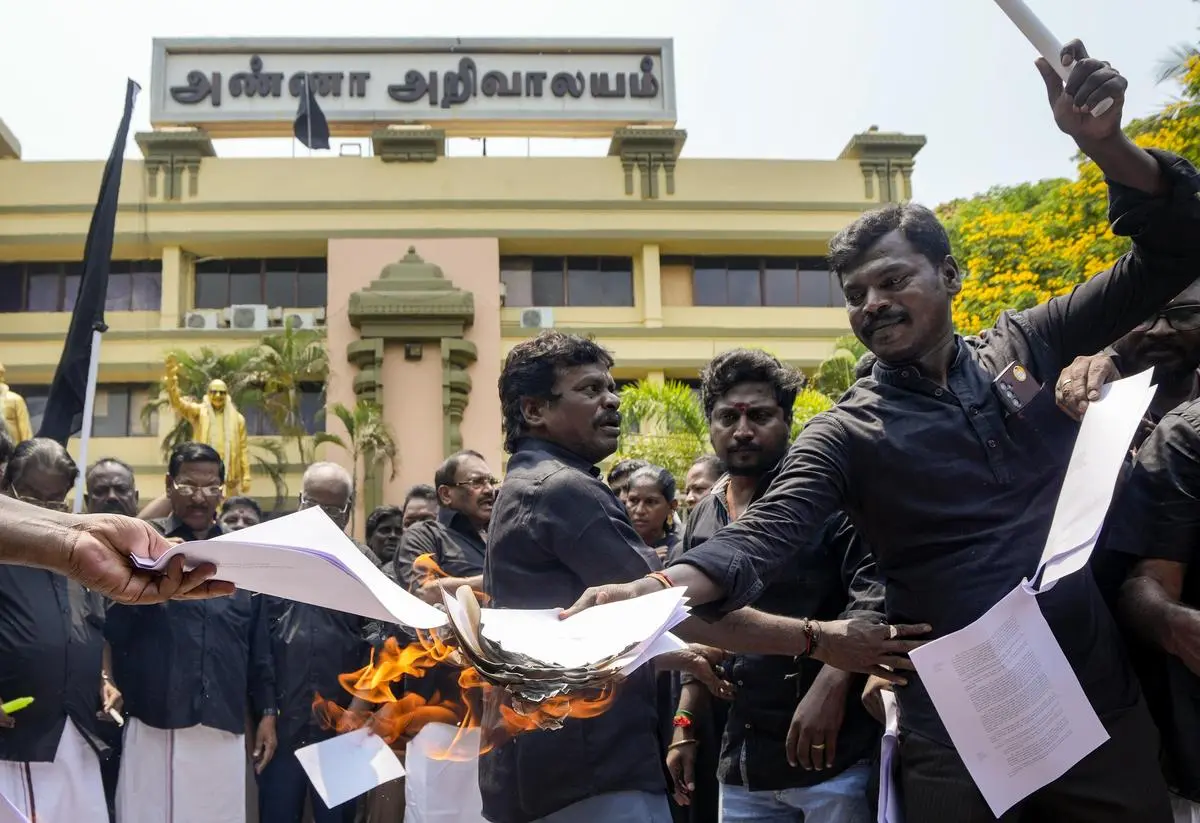
If reallocation follows 2011 census figures, the five southern states — Tamil Nadu, Andhra Pradesh, Karnataka, Kerala, Telangana — would collectively lose 27 Lok Sabha seats to faster-growing northern states, per Carnegie's modelling. Under 2026 population projections, the imbalance widens further. Stalin burned a copy of the bill in Chennai and urged Tamils to raise black flags, Al Jazeera reported. The BJP tabled the bills days before Tamil Nadu voted. Vijay's win must be read against that backdrop: Dravidian politics did not die, it fragmented — and the fragment that grew was the one least contaminated by DMK's assumed complicity in the pre-delimitation status quo.
The bill has not yet passed. The government's National Democratic Alliance holds 293 Lok Sabha seats; a two-thirds constitutional amendment requires 360, and delimitation is legally frozen until the ongoing 2026 census is officially published, according to Carnegie's constitutional read. But the BJP's Bengal sweep gives it options: fresh regional-party defections, a Rajya Sabha arithmetic that is drifting its way, and — crucially — a demonstration that state-level opposition citadels are no longer inviolable.
Kerala and Assam: the quieter verdicts that matter
Kerala looked like textbook Malayali alternation. The UDF won 97 of 140 seats; the CPI(M)-led LDF collapsed to 35, ISAS-NUS reported. But it is the first time since the 1957 Kerala experiment that no Indian state is governed by a Left party — a fact
Al Jazeera called the end of "one of the world's most enduring experiments in democratic communism." The BJP took three seats and about 10% vote share, with state president Rajeev Chandrasekhar winning Nemom in Thiruvananthapuram — a foothold that matters more for 2029 than for 2026.
Assam is the template the BJP wants elsewhere. Sarma's NDA took 102 of 126 seats, a larger majority than in 2021, Al Jazeera reported. Of the 19 Congress MLAs elected, 18 are Muslim — a stark map of religious polarisation compressed into a single legislature. A prior delimitation in 2023, which opposition parties called gerrymandering, had already redrawn Muslim-influential constituencies. Applied nationally, this is the Assam-to-Bengal transmission belt: a redrawn roll, a redrawn map, and a hardened Hindu vote consolidation.
Diplomat View
The forecast: the 2026 Assembly Polls will be read in hindsight not as five state elections but as the trial run for a new electoral architecture heading into 2029 — the SIR abroad and the delimitation bill at home. On current evidence, the BJP's expanded state footprint gives Modi the political capital to force the delimitation package through, either via a Rajya Sabha arithmetic that is drifting his way or via post-defeat regional-party defections in Bengal and Tamil Nadu (both plausible in Bengal's political culture, per BBC reporting). Vijay's win complicates that path in the south — but only if he holds a fractious 120-MLA coalition together for the year it will take the 2026 census data to become actionable.
What would revise the forecast: (a) a Supreme Court ruling that reopens the 2.7 million disputed Bengal deletions and requires re-polling; (b) TVK's coalition collapsing before mid-2027, restoring DMK-AIADMK bipolarity; (c) the census data landing later than 2028, pushing delimitation past 2029 and freezing today's map. Absent one of those, the working assumption should be that the opposition's national campaign in 2029 will be fought on constituencies drawn under BJP-majority rules — a structural advantage no welfare scheme has been shown to overcome.
What to watch next:
- Constitution (131st Amendment) Bill vote: the government needs 360 Lok Sabha votes; whip lists and southern-state defections are the tell.
- Supreme Court hearings on SIR petitions: Banerjee's challenge to the "opaque, hasty and unconstitutional" revision remains live; a substantive ruling before the Bihar 2025 SIR is replicated in Uttar Pradesh (due 2027) would be the constitutional inflection point.
- TVK-DMK equations by December 2026: whether Vijay's coalition survives its first budget session determines whether Tamil Nadu is a 2029 opposition anchor or another BJP frontier.
The Bottom Line
The 2026 Assembly Polls did not just replace three chief ministers — they removed the last three large-state opposition citadels from India's political map while parliament was mid-way through rewriting the map itself. The BJP's Bengal win, delivered against a backdrop of 9 million voter deletions, and Vijay's Tamil Nadu insurgency, rising on anti-delimitation anger, are two halves of the same story: Indian federalism is being renegotiated in real time, and the opposition has fewer bargaining chips than at any point since 1977.
Discover more
India
Women’s Reservation Bill 2026
The Constitution (131st Amendment) Bill, 2026 was defeated in Lok Sabha, revealing deeper political conflicts over women's reservation and delimitation.
India
Rajnath Singh's Durga Squad for 2026 Polls
Rajnath Singh's Durga Squad promised women's safety in Bengal but has since disappeared from the agenda, revealing BJP's true priorities.
India
Modi's Women’s Convention in Varanasi
Modi's Varanasi rally frames women's reservation as a national mission, targeting the 2027 Uttar Pradesh elections with a strategic narrative.

Conflict & Security
Drone Warfare Killing Aid Workers at Unprec
Over 1,000 humanitarian workers killed in three years as cheap armed drones collapse legal protections. Gaza, Sudan, Ukraine, and DRC see deliberate targeting of aid convoys and hospitals with zero prosecutions.