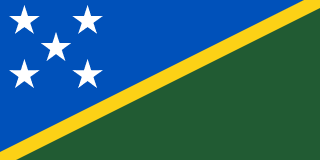
Inside Solomon Islands’ foreign policy.
Oceania · UN voting record, treaty positions, and alliances — every claim primary-sourced.
In short
Solomon Islands is a small Pacific state with outsized strategic weight because its government is balancing Chinese security ties against deep economic and geographic dependence on Australia and the wider Pacific system.
Capital
HoniaraSolomon Islands's government & politics
Leadership, governance, and democratic trajectory.


Solomon Islands's UN voting record
How Solomon Islands votes at the UN General Assembly — ideological trajectory, voting partners, topic patterns, and key recent roll calls.
Ideological trajectory
Top voting partners
Topic-level voting
Source: Erik Voeten, “United Nations General Assembly Voting Data”, Harvard Dataverse (CC0). Aggregated by Model Diplomat. Last refresh tracked in profile freshness.
Solomon Islands's foreign policy
Bilateral posture, key relationships, and live diplomatic statements.
Foreign Policy
Solomon Islands’ foreign policy is a hedging strategy built around regime security and economic need, with the prime minister and cabinet controlling the file in practice under a parliamentary system headed formally by King Charles III; after the April 2024 election, Jeremiah Manele became prime minister on 2 May 2024, replacing Manasseh Sogavare, and Peter Shanel Agovaka remained foreign minister in the new government National Parliament of Solomon Islands, Government of Solomon Islands – Office of the Prime Minister, Ministry of Foreign Affairs and External Trade. Solomon Islands is a constitutional monarchy and UN member since 19 September 1978, and it remains embedded in Pacific institutions including the Pacific Islands Forum, Melanesian Spearhead Group, the Commonwealth, and AOSIS, which frame its diplomacy as pro-development, pro-climate finance, and strongly protective of sovereignty United Nations Digital Library, Pacific Islands Forum, Melanesian Spearhead Group, AOSIS. Its core interests rank clearly: survival through climate adaptation and disaster resilience, regime security through external partners that can deliver policing and political support, economic interests through aid, infrastructure, fisheries, and market access, and status through acting as a sovereign Pacific voice rather than an Australian dependency UNFCCC, World Bank, Asian Development Bank.
There is no single published grand strategy document equivalent to a formal doctrine; the clearest stated line comes from government statements describing a “friends to all, enemies to none” approach and a demand that partners respect Solomon Islands’ sovereign choices, especially after the 2019 switch in diplomatic recognition from Taiwan to the People’s Republic of China Government of Solomon Islands – Office of the Prime Minister, PRC Ministry of Foreign Affairs, Reuters. That switch was the decisive foreign-policy break of the last decade. It unlocked Chinese grants, infrastructure, and elite access, but also triggered sharper security competition with Australia, New Zealand, and the United States, especially after the 2022 China–Solomon Islands security agreement, whose text allowed Chinese police and potentially naval logistics access at Solomon Islands’ request Australian Strategic Policy Institute, Reuters, U.S. Department of State. The reported June 2026 review of that pact under Manele matters because it suggests recalibration, not realignment: Honiara appears to want leverage from Beijing without paying the full regional trust cost with Canberra and Wellington RNZ, Reuters.
Australia remains Solomon Islands’ most important security partner in operational terms even after the China opening. Canberra led the Regional Assistance Mission to Solomon Islands from 2003 to 2017 and then signed a bilateral security treaty in 2017; under that framework Australia deployed police and defense personnel during the 2021 Honiara unrest, showing that when the government faces immediate internal instability, it still turns first to Australian-led support Australian Government, Department of Foreign Affairs and Trade, Australian Federal Police, Reuters. China, by contrast, has become the politically useful counterweight and a fast-growing development partner, funding stadiums, roads, and police cooperation linked to the 2023 Pacific Games and beyond Xinhua, Lowy Institute, Center for Strategic and International Studies. New Zealand is less central than Australia but remains a steady development and regional partner, while ties with the United States improved after Washington reopened its embassy in Honiara in 2023, largely in response to the China security pact rather than a broad bilateral reset driven by Solomon Islands itself U.S. Embassy in Solomon Islands, New Zealand Ministry of Foreign Affairs and Trade. This is the key bilateral pattern: Solomon Islands uses Chinese engagement to widen its options, but its hard-security fallback, labor mobility links, and much of its administrative support still sit with the traditional Pacific partners.
In multilateral forums, Solomon Islands usually aligns with the Pacific Islands Forum and AOSIS on climate finance, loss and damage, ocean governance, and defense of small-island developing states Pacific Islands Forum, AOSIS, United Nations Framework Convention on Climate Change. It has also supported the 2050 Strategy for the Blue Pacific Continent, which emphasizes regional agency and resistance to outside domination by major powers Pacific Islands Forum. At the UN, however, its alignment is less mechanically “Pacific bloc” than many assume. The country’s positions have increasingly reflected sensitivity to Chinese preferences after 2019, particularly on questions touching Taiwan representation and some sovereignty-heavy resolutions, even while it continues voting with small-island states on climate and development UN Digital Library Voting Data, Carnegie Endowment for International Peace, Lowy Institute


Solomon Islands's treaties & memberships
UN multilateral treaty positions and IGO memberships.
International Organizations
Society & economy
Macro-economic snapshot and demographic context.
GDP (nominal)
$1.6B
#192/250GDP per capita
$1,933.555
#171/250Currency
—
HDI
0.56
#155/250GDP (nominal USD)
GDP per capita (USD)
Top trading partners


In the news
Stories surfacing across Solomon Islands’s authoritative outlets, plus headline events and the diplomatic calendar.
Headlines
Solomon Islands | Congress.gov
Summary: - Geography and society: The Solomon Islands (Solomons) is a Melanesian Pacific nation with about 700,000 people across six main islands and 70 language groups. It is one of the Pacific’s more aid-reliant economies and has the region’s third-largest economy. - Political system and leadership: The country is a parliamentary constitutional monarchy under the British crown. As of May 2024, Prime Minister Jeremiah Manele leads the government, having survived a no-confi
Solomon Islands Turns West — China's Anchor W
New PM Matthew Wale reviews security pact with China, signaling a shift in foreign policy and potential realignment with Australia.
Solomon Islands PM Reviews China Pact
New PM Matthew Wale plans to review the controversial security agreement with China, raising questions about future relations.
Explore Solomon Islands in depth
Frequently asked questions about Solomon Islands
Quick answers to the most common questions about Solomon Islands.
What type of government does Solomon Islands have?
Solomon Islands is governed as a unitary parliamentary constitutional monarchy, with its capital at Honiara.
Who is the head of state of Solomon Islands?
Charles III is the head of state of Solomon Islands, in office since 2022-09-08.
Who leads the government of Solomon Islands?
Jeremiah Manele serves as the head of government of Solomon Islands, since 2024-05-02.
What is the population of Solomon Islands?
Solomon Islands has a population of approximately 819 thousand people, making it the 166th most populous country.
What is the economy of Solomon Islands like?
Solomon Islands has a nominal GDP of about $2 billion, or roughly $1,934 per capita.
What languages are spoken in Solomon Islands?
The official language of Solomon Islands is English.
When did Solomon Islands join the United Nations?
Solomon Islands has been a member of the United Nations since 1978.
Who are Solomon Islands's closest allies?
Solomon Islands's key allies include China, Australia, and New Zealand.
More about Solomon Islands
Solomon Islands is a small Pacific state with outsized strategic weight because its government is balancing Chinese security ties against deep economic and geographic dependence on Australia and the wider Pacific system. It is a unitary parliamentary constitutional monarchy in which King Charles III is head of state, represented domestically by the governor-general, and Prime Minister Jeremiah Manele leads the government after his election by parliament in May 2024 [CIA World Factbook](https://www.cia.gov/the-world-factbook/countries/solomon-islands/), [Reuters](https://www.reuters.com/world/asia-pacific/solomon-islands-lawmakers-elect-jeremiah-manele-prime-minister-2024-05-02/). Manele succeeded Manasseh Sogavare but emerged from the same governing camp, the Ownership, Unity and Responsibility Party–linked coalition that retained enough parliamentary support to stay in office after the 2024 election [Reuters](https://www.reuters.com/world/asia-pacific/solomon-islands-lawmakers-elect-jeremiah-manele-prime-minister-2024-05-02/), [Al Jazeera](https://www.aljazeera.com/news/2024/5/2/solomon-islands-lawmakers-elect-jeremiah-manele-as-new-prime-minister). Foreign policy is driven less by ideology than by regime security and development finance. The decisive institutional actors are the prime minister, cabinet, and foreign ministry, but in practice the prime minister’s office has dominated major external decisions, including the 2019 switch of diplomatic recognition from Taiwan to the People’s Republic of China and the 2022 China–Solomon Islands security pact [Australian Parliament](https://www.aph.gov.au/Parliamentary_Business/Committees/Joint/Foreign_Affairs_Defence_and_Trade/SolomonIslands/Report), [Reuters](https://www.reuters.com/world/asia-pacific/china-solomon-islands-security-pact-what-we-know-2022-04-20/). That has made Solomon Islands a test case in great-power competition in the Pacific: Honiara says it is pursuing a “friends to all, enemies to none” line, but its security cooperation with Beijing has produced sustained concern in Canberra, Wellington, Washington, and across parts of the Pacific Islands Forum [Solomon Islands Government Portal](https://solomons.gov.sb/), [Pacific Islands Forum](https://www.forumsec.org/), [Reuters](https://www.reuters.com/world/asia-pacific/why-solomon-islands-is-key-frontline-us-china-battle-pacific-2024-04-17/). The economy is narrow, import-dependent, and vulnerable to shocks. GDP was about $1.6 billion in current prices in 2023, with population a little over 800,000, leaving the country fiscally constrained and heavily reliant on external assistance [World Bank](https://data.worldbank.org/country/solomon-islands), [IMF](https://www.imf.org/en/Countries/SLB). Logging has long been the dominant export earner, but the World Bank and IMF both describe the model as unsustainable because natural forest stocks are being depleted while growth remains too concentrated in low-value extractives [World Bank](https://www.worldbank.org/en/country/solomonislands/overview), [IMF](https://www.imf.org/en/News/Articles/2024/03/11/pr2486-solomon-islands-imf-executive-board-concludes-2024-article-iv-consultation). Fisheries, agriculture, aid flows, and public spending matter heavily, and the reopening of the Gold Ridge mine has been treated by government as one route to revenue, though mining in Solomon Islands repeatedly carries governance and landowner-risk issues [IMF](https://www.imf.org/en/News/Articles/2024/03/11/pr2486-solomon-islands-imf-executive-board-concludes-2024-article-iv-consultation), [World Bank](https://www.worldbank.org/en/country/solomonislands/overview). Three issues define the country’s current trajectory. First is external alignment: the China security pact and related policing cooperation remain the single most important strategic question because they affect Solomon Islands’ relations with Australia, New Zealand, the United States, and other Pacific partners [Reuters](https://www.reuters.com/world/asia-pacific/china-solomon-islands-security-pact-what-we-know-2022-04-20/), [United States Department of State](https://www.state.gov/u-s-relations-with-solomon-islands/). Second is state capacity and internal stability. The 2021 unrest in Honiara exposed how provincial grievances, perceptions of unequal development, and elite competition can quickly become foreign-policy issues when outside partners are asked to restore order [BBC News](https://www.bbc.com/news/world-australia-59384455), [Australian Government Department of Foreign Affairs and Trade](https://www.dfat.gov.au/geo/solomon-islands/solomon-islands-country-brief). Third is climate and development vulnerability: as a small island developing state and member of AOSIS, Solomon Islands treats climate finance, adaptation, and disaster resilience as survival-level interests, not branding language [UN-OHRLLS](https://www.un.org/ohrlls/content/list-sids), [AOSIS](https://www.aosis.org/member-states/). The country’s practical position in the world is therefore dual-track. It is internationally active through the UN, Pacific Islands Forum, Melanesian Spearhead Group, Commonwealth, and AOSIS, and it uses those arenas to defend small-state sovereignty and climate priorities [United Nations](https://www.un.org/en/about-us/member-states/solomon-islands), [Melanesian Spearhead Group](https://msgsec.info/), [Commonwealth](https://thecommonwealth.org/our-member-countries/solomon-islands). At the same time, its bargaining power comes from strategic geography and partner competition more than from hard capabilities: military capacity is negligible, fiscal space is tight, and domestic fragmentation limits how far any government can push externally without triggering backlash at home [CIA World Factbook](https://www.cia.gov/the-world-factbook/countries/solomon-islands/), [IMF](https://www.imf.org/en/News/Articles/2024/03/11/pr2486-solomon-islands-imf-executive-board-concludes-2024-article-iv-consultation). The near-term read is continuity with softer language: Manele is likely to preserve ties with China while