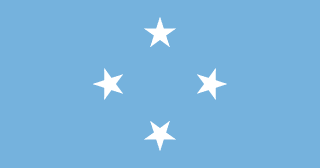
Inside Micronesia’s foreign policy.
Federated States of Micronesia
Oceania · UN voting record, treaty positions, and alliances — every claim primary-sourced.
In short
Micronesia is a small Pacific state whose foreign policy is shaped less by ideology than by dependence, geography, and strategic competition.
Capital
PalikirGovernment
Federal parliamentary republicMicronesia's government & politics
Leadership, governance, and democratic trajectory.

Micronesia's UN voting record
How Micronesia votes at the UN General Assembly — ideological trajectory, voting partners, topic patterns, and key recent roll calls.
Ideological trajectory
Top voting partners
Topic-level voting
Source: Erik Voeten, “United Nations General Assembly Voting Data”, Harvard Dataverse (CC0). Aggregated by Model Diplomat. Last refresh tracked in profile freshness.
Micronesia's foreign policy
Bilateral posture, key relationships, and live diplomatic statements.
Foreign Policy
Micronesia’s foreign policy is a sovereignty-maximizing alignment strategy built around one hard fact: its security and much of its public finance still depend on the United States, but its diplomacy is increasingly shaped by competition over whether the North Pacific remains a U.S.-anchored space or becomes a contested arena for Chinese influence. The decision structure is unusually centralized for a parliamentary federation: President Wesley W. Simina, elected by Congress in May 2023, is both head of state and head of government, while the Department of Foreign Affairs implements rather than drives grand strategy Congress of the Federated States of Micronesia FSM Department of Foreign Affairs. The core interests hierarchy is clear. Survival sits first, because the FSM’s exclusive economic zone, maritime domain awareness, and disaster resilience exceed its own enforcement capacity Pacific Islands Forum Fisheries Agency World Bank Data. Regime and system security comes second, visible in repeated official warnings about foreign political influence and elite capture risks in a small-state federal system The Diplomat. Economic security is third and heavily externalized through grants, migration access, and service linkages under the Compact of Free Association with the United States U.S. Department of State U.S. Congress.
FSM’s stated doctrine is not a single published white paper but a consistent line across official speeches, Compact negotiations, and regional diplomacy: preserve strategic denial in favor of the United States, defend Pacific Island state sovereignty, and extract development resources without surrendering political autonomy FSM Government U.S. Department of State. The Compact is the anchor. Under the amended Compact framework approved by the U.S. in 2024, Washington retains full authority and responsibility for FSM defense and secures military operating rights, while FSM receives long-term economic assistance and federal program access U.S. Department of the Interior, Office of Insular Affairs The White House. That makes the United States not just a partner but the external guarantor of the state’s top-tier survival interest. Australia, Japan, and New Zealand matter as second-ring partners through development finance, maritime security, climate support, and Pacific Islands Forum coordination Australian Department of Foreign Affairs and Trade Ministry of Foreign Affairs of Japan New Zealand Ministry of Foreign Affairs and Trade. Palau is politically important because the two Compact states increasingly read the same threat picture on strategic penetration and maritime vulnerability, even when they differ tactically inside regional forums Government of Palau The Diplomat.
Regionally, FSM works through the Pacific Islands Forum, the UN, and the Alliance of Small Island States because status and climate diplomacy give a very small state leverage it cannot generate alone Pacific Islands Forum United Nations Digital Library AOSIS. Climate is both a development issue and a survival-tier issue for Micronesia, and its diplomacy usually tracks the broader Pacific line on loss and damage, oceans governance, and stronger emissions commitments from major powers UNFCCC AOSIS. At the UN, however, FSM is one of the clearest outliers in the Pacific because it often aligns more closely with the United States and Israel than with the median Small Island Developing State position on Middle East resolutions. The most visible example is its repeated tendency to oppose or abstain on UN General Assembly resolutions critical of Israel where many Global South and Pacific states vote yes United Nations Digital Library Voting Records U.S. Department of State. That divergence is analytically valuable because it shows the Compact relationship can outweigh small-state solidarity when status politics collide with security dependence.
China is the stress test. FSM recognizes the People’s Republic of China rather than Taiwan and has maintained formal relations with Beijing since 1989, so its foreign policy is not anti-China in a diplomatic-recognition sense Ministry of Foreign Affairs of the People’s Republic of China United Nations Member States. But recent Micronesian elite discourse has become markedly sharper about Chinese “political warfare,” pressure operations, and attempts to exploit local patronage networks, particularly after former president David Panuelo’s letters and subsequent public debate inside the federation The Diplomat Reuters. Simina has not severed relations with Beijing; instead he has moved toward a tighter balancing formula that keeps formal diplomatic ties while hardening the political perimeter around strategic sectors and leaning more openly into U.S. and like-minded security ties PINA Responsible Statecraft. This is where FSM breaks from the softer hedging seen in some Pacific states


Micronesia's treaties & memberships
UN multilateral treaty positions and IGO memberships.
International Organizations
Society & economy
Macro-economic snapshot and demographic context.
GDP (nominal)
$471M
#205/250GDP per capita
$4,166
#141/250HDI
0.628
#133/250GDP (nominal USD)
GDP per capita (USD)
Top trading partners

In the news
Stories surfacing across Micronesia’s authoritative outlets, plus headline events and the diplomatic calendar.
Headlines
Micronesia’s President Writes Bombshell Letter on China’s ‘Political Warfare’ – The Diplomat
Summary: - FSM President David Panuelo writes a landmark letter detailing Beijing’s political warfare and grey-zone efforts in Micronesia, framing them as a direct threat to national sovereignty and regional stability. - He argues China seeks to pull FSM away from the US and Taiwan, potentially guiding FSM to abstain or align with the PRC in the event of a conflict over Taiwan. - The letter reveals China’s maritime reconnaissance in FSM waters and mapped EEZ activity, warning
Federated States of Micronesia - Model Diplomat
Summary: - Governance and politics: The Federated States of Micronesia (FSM) is a four-state federation with a strong national government. Most political power and foreign investment regulation reside at the state level, creating a layered regulatory environment. The president is elected from among national senators; Wesley Simina has been FSM President since May 2023. There are no formal political parties. Recent state elections (Chuuk, March 2025) were marked by violence an
Dialogue: Micronesia’s leaders confront a region caught in someone else’s war plan | PINA
Micronesia’s leaders and security officials gathered in Guam for a two-day Micronesia Security Dialogue to confront how regional islands are being mapped into rival power strategies. Key takeaways: - The dialogue showcased a reality that major powers are already shaping Micronesia’s strategic landscape, raising questions about sovereignty and defense. - Participants included officials from Guam, Palau, FSM, Marshall Islands, and CNMI, along with security analysts and academi
Diplomatic calendar
Upcoming key dates
- Mar 2, 2027Electionin 5mo
2027 Micronesian general election
Explore Micronesia in depth
Frequently asked questions about Micronesia
Quick answers to the most common questions about Micronesia.
What type of government does Micronesia have?
Micronesia is governed as a federal parliamentary republic, with its capital at Palikir.
Who is the head of state of Micronesia?
Wesley Simina is the head of state of Micronesia, in office since 2023-01-01.
What is the population of Micronesia?
Micronesia has a population of approximately 113 thousand people, making it the 196th most populous country.
What is the economy of Micronesia like?
Micronesia has a nominal GDP of about $471 million, or roughly $4,166 per capita.
What languages are spoken in Micronesia?
The official language of Micronesia is English.
When did Micronesia join the United Nations?
Micronesia has been a member of the United Nations since 1991.
Who are Micronesia's closest allies?
Micronesia's key allies include United States, Australia, Japan, New Zealand, and Palau.
More about Micronesia
Micronesia is a small Pacific state whose foreign policy is shaped less by ideology than by dependence, geography, and strategic competition. It is a federal republic in free association with the United States, and that Compact relationship still defines its security, migration pathways, and a large share of public finance [U.S. Department of State](https://www.state.gov/u-s-relations-with-the-federated-states-of-micronesia/), [Government of the Federated States of Micronesia](https://gov.fm/). President Wesley W. Simina, elected by Congress in 2023, serves as both head of state and head of government under FSM’s constitutional system, where the president is chosen from among the four at-large senators by the unicameral Congress rather than by a national popular vote [FSM Congress](https://www.cfsm.gov.fm/), [FSM Public Information Office](https://gov.fm/index.php/fsm-public-information-office/). FSM does not operate through strong national political parties in the way larger parliamentary systems do; politics is driven more by state-level coalitions, personalities, and congressional bargaining than by disciplined party competition [CIA World Factbook](https://www.cia.gov/the-world-factbook/countries/micronesia-federated-states-of/), [Britannica](https://www.britannica.com/place/Micronesia). The current government is therefore best understood as a congressional administration around Simina rather than a party government. The president took office after the 2023 leadership transition and has pushed a line that is strongly pro-Compact, wary of Chinese political influence, and closely aligned with the United States and other like-minded Pacific partners such as Australia, Japan, and Palau [FSM Public Information Office](https://gov.fm/index.php/fsm-public-information-office/), [The Diplomat](https://thediplomat.com/2026/06/micronesias-president-writes-bombshell-letter-on-chinas-political-warfare/). That orientation is not symbolic. Under the amended Compact of Free Association, the United States retains full authority and responsibility for FSM’s security and defense matters, while providing long-term economic assistance and access arrangements that make FSM one of the key “Compact states” in the North Pacific strategic map [U.S. Department of the Interior](https://www.doi.gov/oia/compacts-of-free-association), [U.S. Department of State](https://www.state.gov/u-s-relations-with-the-federated-states-of-micronesia/). In practical terms, Micronesia sits at the intersection of Pacific regional diplomacy, U.S.-China rivalry, and climate-vulnerability politics, with more diplomatic relevance than its size suggests [Pacific Islands Forum](https://www.forumsec.org/), [United Nations Office of the High Representative for the Least Developed Countries, Landlocked Developing Countries and Small Island Developing States](https://www.un.org/ohrlls/content/list-sids). Its economy is narrow, aid-dependent, and highly exposed to shocks. The World Bank classifies FSM as a small island economy where public spending, external grants, fisheries access fees, and services matter more than diversified domestic production [World Bank](https://data.worldbank.org/country/federated-states-of-micronesia). Nominal GDP was about $471 million in the country context provided here, broadly consistent with the scale reported in international datasets for recent years, while population is just over 100,000 and dispersed across four states and hundreds of islands, which raises the cost of infrastructure, transport, health care, and administration [World Bank](https://data.worldbank.org/country/federated-states-of-micronesia), [Asian Development Bank](https://www.adb.org/countries/micronesia-federated-states/economy). Tuna and other fish products dominate exports, and the marine zone is economically more important than the domestic land market; government revenue and household welfare are also closely tied to grants, overseas employment, and mobility rights linked to the Compact [Observatory of Economic Complexity](https://oec.world/en/profile/country/fsm), [Asian Development Bank](https://www.adb.org/countries/micronesia-federated-states/economy). This is why fiscal sustainability and Compact implementation are not secondary administrative issues for FSM; they are regime-capacity issues. Three issues define Micronesia’s current trajectory. The first is strategic pressure from U.S.-China competition. Simina’s government has signaled unusual bluntness about what it sees as Chinese “political warfare,” making FSM one of the more openly hawkish Pacific island governments on Beijing’s influence operations compared with some neighbors that prefer hedging language [The Diplomat](https://thediplomat.com/2026/06/micronesias-president-writes-bombshell-letter-on-chinas-political-warfare/). The second is climate security. FSM is an active member of the Alliance of Small Island States and consistently frames sea-level rise, disaster resilience, and adaptation finance as core national interests rather than peripheral environmental concerns [AOSIS](https://www.aosis.org/member-states/), [UNFCCC](https://unfccc.int/). The third is state capacity: the government must convert external money and strategic attention into functioning transport, health, education, and maritime governance across a geographically fragmented country, or external alignment will not translate into domestic legitimacy [Asian Development Bank](https://www.adb.org/countries/micronesia-federated-states/overview), [World Bank](https://www.worldbank.org/en/country/fsm/overview). Micronesia’s place in the world today is therefore clear: it is a microstate with outsized strategic value, reliable Western alignment, and limited room for error. Its diplomacy is strongest when security guarantees, development finance, and climate advocacy reinforce each other; it is most vulnerable when major-power rivalry sharpens faster than its institutions can absorb. For MUN purposes, the key read is that FSM usually approaches international issues through three filters in this order: sovereignty and external security under the Compact, economic survivability through grants and ocean resources, and climate diplomacy as an existential claim rather than branding [U.S. Department of the Interior](https://www.doi.gov/oia/compacts-of-free-association), [Pacific Islands Forum](https://www.forumsec.org/), [AOSIS](https://www.aosis.org/member-states/).