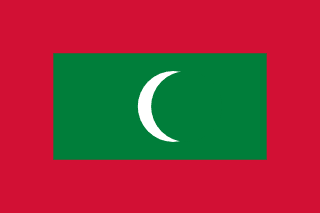
Inside Maldives’ foreign policy.
Republic of Maldives
Asia · UN voting record, treaty positions, and alliances — every claim primary-sourced.
In short
The Maldives is a small presidential republic that matters above its size because it sits astride Indian Ocean sea lanes, depends heavily on tourism and imported essentials, and is trying to balance India, China, and Gulf partners without surrendering room to maneuver…
Capital
MaléGovernment
Unitary presidential republicMaldives's government & politics
Leadership, governance, and democratic trajectory.

Head of state & government
Mohamed Muizzu
Head of State
Maldives's UN voting record
How Maldives votes at the UN General Assembly — ideological trajectory, voting partners, topic patterns, and key recent roll calls.
Ideological trajectory
Top voting partners
Topic-level voting
Source: Erik Voeten, “United Nations General Assembly Voting Data”, Harvard Dataverse (CC0). Aggregated by Model Diplomat. Last refresh tracked in profile freshness.
Maldives's foreign policy
Bilateral posture, key relationships, and live diplomatic statements.
Foreign Policy
Maldives under President Mohamed Muizzu runs a hedging foreign policy, not a clean geopolitical realignment. Muizzu has been President since November 2023, combining head-of-state and head-of-government authority in the Maldives’ presidential system, which gives the presidency decisive control over foreign policy execution through the Ministry of Foreign Affairs rather than through a coalition cabinet or parliament The President's Office, Ministry of Foreign Affairs of Maldives. The stated line is “India first” language softened into “Maldives first” sovereignty politics at home, while in practice Malé tries to widen its room for maneuver by deepening ties with China, preserving essential security and economic links with India, and using climate diplomacy to maintain profile in the UN and small-island forums The Diplomat, Ministry of Foreign Affairs of Maldives, UN Member States: Maldives.
Its interests pyramid is clear. Survival sits first: Maldives is one of the world’s most climate-vulnerable states, and its governments consistently frame sea-level rise, coastal erosion, and financing for adaptation as existential rather than developmental issues UNFCCC, Alliance of Small Island States. Regime security comes next under Muizzu: the administration’s sovereignty messaging, including scrutiny of foreign military presence and sensitivity to perceived Indian overreach, is aimed as much at domestic political legitimacy as at external balancing The Diplomat, Reuters. Economic interests are third but immediate: tourism directly contributed 21.9% of GDP in 2023 and remains the country’s main foreign-exchange engine, making stable air connectivity, investor confidence, and diversified infrastructure finance central foreign-policy concerns World Bank, Asian Development Bank. Status comes fourth, and Maldives pursues it disproportionately through climate leadership, Islamic diplomacy in the Organisation of Islamic Cooperation, and visibility in AOSIS, the Commonwealth, SAARC, and the Non-Aligned Movement Commonwealth, OIC, SAARC.
The key bilateral relationship is still India, even when rhetoric sours. India remains central to Maldives’ security assistance, medical access, trade in essentials, connectivity, and emergency response capacity, and the two governments moved in 2024 to replace Indian military personnel operating aviation platforms with civilian technical staff rather than rupture defense cooperation outright Ministry of External Affairs, India, Reuters. China is the main counterweight and the preferred partner for Muizzu’s autonomy signaling; his January 2024 state visit to Beijing produced agreements on economic and technical cooperation and reaffirmed Chinese support for infrastructure and trade ties Xinhua, The President's Office. Yet this is not bandwagoning with Beijing. India remains geographically inescapable, and even governments elected on anti-India mobilization have had to normalize with New Delhi once in office because Maldives’ import dependence, debt pressures, and tourism exposure make confrontation too costly The Economic Times, World Bank. Saudi Arabia and Turkey matter more as supplementary political and development partners than as strategic substitutes for India or China Ministry of Foreign Affairs of Maldives.
In multilateral forums, Maldives usually votes with the small-state, climate-vulnerable, and broadly Global South mainstream, but with sharper Islamic-world positioning on Palestine than some Indian Ocean peers. It has been a UN member since 21 September 1965 and is active in AOSIS, where it backs stronger language on mitigation, loss and damage, and concessional climate finance for vulnerable states UN Member States: Maldives, AOSIS. In the General Assembly, Maldives has supported resolutions demanding humanitarian protection in Gaza and backing Palestinian rights, aligning closely with the OIC and wider Global South rather than with Western states UN Digital Library, Ministry of Foreign Affairs of Maldives. The more interesting divergence is elsewhere: despite membership in SAARC and habitual “neighborhood” language, Maldives does not vote as an Indian adjunct, and under Muizzu it has been willing to use UN and public diplomacy to stress sovereign equality and strategic autonomy even when that complicates Indian preferences The Diplomat, France 24.
That divergence is the analytically useful point. Maldives breaks less from its formal blocs than from the expectation that a tiny South Asian island state must choose one patron and stay there. Its actual pattern is issue-splitting: climate with AOSIS, Palestine with
Allies


Maldives's treaties & memberships
UN multilateral treaty positions and IGO memberships.
International Organizations
Society & economy
Macro-economic snapshot and demographic context.
GDP (nominal)
$7.1B
#163/250GDP per capita
$13,379.351
#88/250Currency
—
HDI
0.75
#89/250GDP (nominal USD)
GDP per capita (USD)
Top trading partners


In the news
Stories surfacing across Maldives’s authoritative outlets, plus headline events and the diplomatic calendar.
Headlines
What the China-Maldives-India Triangle Tells Us About 21st Century Balancing – The Diplomat
The Diplomat article analyzes how the Maldives navigates great-power competition in the 21st century, using the China–Maldives–India triangle as a case study. Key points: - Maldives–China ties strengthened: President Muizzu’s state visit to China produced a “comprehensive strategic cooperation” upgrade, with 20 agreements spanning tourism, blue economy, infrastructure, media, and Belt and Road cooperation, and a reaffirmation of the One China principle. The Maldives expresse
Landslide win for pro-China president's party in Maldives parliamentary elections - France 24
Summary: - The Maldives’ parliamentary elections delivered a landslide for President Mohamed Muizzu’s party, the People’s National Congress (PNC), which won 66 of 86 seats declared, soon solidifying a super-majority in the 93-seat parliament. - This result tilts the country toward closer ties with China, continuing Muizzu’s pro-China agenda, and contrasts with the previous pro-India stance of the rival Maldivian Democratic Party (MDP), which secured about a dozen seats. - Mui
Balancing internal and external obligations in the Maldives' foreign ...
The article analyzes how internal Maldivian politics shapes its foreign policy, diplomacy, elections, economy, and security. Key points: - Domestic politics drive external choices: President Mohamed Muizzu pursues a “national development approach” that balances relations with major powers (China, India, the US, Australia, the UK) to safeguard sovereignty and gain mutual benefits, while maintaining internal support. - Sovereignty and rules-based order: Since independence, Mal
Explore Maldives in depth
Frequently asked questions about Maldives
Quick answers to the most common questions about Maldives.
What type of government does Maldives have?
Maldives is governed as a unitary presidential republic, with its capital at Malé.
Who is the head of state of Maldives?
Mohamed Muizzu is the head of state of Maldives, in office since 2023-11-17.
What is the population of Maldives?
Maldives has a population of approximately 528 thousand people, making it the 175th most populous country.
What is the economy of Maldives like?
Maldives has a nominal GDP of about $7 billion, or roughly $13,379 per capita.
What languages are spoken in Maldives?
The official language of Maldives is Maldivian.
When did Maldives join the United Nations?
Maldives has been a member of the United Nations since 1965.
Who are Maldives's closest allies?
Maldives's key allies include China, Saudi Arabia, and Türkiye.
More about Maldives
The Maldives is a small presidential republic that matters above its size because it sits astride Indian Ocean sea lanes, depends heavily on tourism and imported essentials, and is trying to balance India, China, and Gulf partners without surrendering room to maneuver [World Bank](https://data.worldbank.org/country/maldives), [Encyclopaedia Britannica](https://www.britannica.com/place/Maldives), [The Diplomat](https://thediplomat.com/2026/06/what-the-china-maldives-india-triangle-tells-us-about-21st-century-balancing/). President Mohamed Muizzu is both head of state and head of government, and his People’s National Congress-led camp tightened control after winning a parliamentary supermajority in the April 2024 election, giving the presidency unusual freedom to steer foreign and economic policy [Election Commission of Maldives](https://www.elections.gov.mv/en/elections/parliamentary-election-2024), [Reuters](https://www.reuters.com/world/asia-pacific/maldives-president-muizzus-party-wins-landslide-parliamentary-election-2024-04-22/), [President's Office Maldives](https://presidency.gov.mv/President). The Maldives is a unitary presidential republic under the 2008 constitution, with the president combining executive authority and significant influence over cabinet, security policy, and external relations [Constitute Project](https://www.constituteproject.org/constitution/Maldives_2008), [President's Office Maldives](https://presidency.gov.mv/President). Muizzu took office in November 2023 after defeating incumbent Ibrahim Mohamed Solih, and he appointed Moosa Zameer as foreign minister in September 2024 after a cabinet reshuffle, a change confirmed by the foreign ministry and presidency [Reuters](https://www.reuters.com/world/asia-pacific/pro-china-candidate-mohamed-muizzu-wins-maldives-presidential-election-2023-09-30/), [Ministry of Foreign Affairs Maldives](https://foreign.gov.mv/index.php/en/ministry/minister), [President's Office Maldives](https://presidency.gov.mv/Press/Article/32136). The ruling coalition’s center of gravity is the PNC, allied with the Progressive Party legacy network built by former president Abdulla Yameen, and that alignment helps explain Muizzu’s emphasis on sovereignty language, infrastructure diplomacy, and a less India-dependent public posture [Reuters](https://www.reuters.com/world/asia-pacific/maldives-opposition-coalition-candidate-mohamed-muizzu-wins-presidential-runoff-2023-09-30/), [Carnegie Endowment for International Peace](https://carnegieendowment.org/research/2024/02/india-out-maldives-election). Economically, the Maldives is service-heavy, import-dependent, and unusually exposed to shocks. Tourism directly and indirectly anchors growth, foreign exchange, employment, and fiscal revenues; travel and tourism accounted for about two-thirds of foreign exchange earnings and more than one-fifth of GDP before recent revisions, while real GDP rebounded strongly after the pandemic on the back of visitor arrivals [Asian Development Bank](https://www.adb.org/countries/maldives/economy), [World Bank](https://www.worldbank.org/en/country/maldives/overview), [IMF](https://www.imf.org/en/Countries/MDV). The country’s nominal GDP was about $7.1 billion in the user-provided context and the World Bank classifies it as an upper-middle-income economy, but its macro position remains fragile because it runs persistent external deficits, relies on imported fuel and food, and faces high public debt linked partly to large infrastructure projects [World Bank](https://data.worldbank.org/country/maldives), [IMF](https://www.imf.org/en/Publications/CR/Issues/2024/02/06/Maldives-2023-Article-IV-Consultation-Press-Release-Staff-Report-and-Statement-by-the-544026). Fisheries remain the main goods export sector, especially tuna, but they do not offset the structural weight of tourism in the balance of payments [FAO](https://www.fao.org/fishery/en/facp/mdv), [Observatory of Economic Complexity](https://oec.world/en/profile/country/mdv). Three issues define the country’s current trajectory. First is strategic balancing: Muizzu came in on an “India Out” political wave, asked India to withdraw military personnel operating aviation platforms in the Maldives, then moderated into a more transactional relationship while expanding ties with China, Türkiye, and Gulf partners rather than fully aligning with any one camp [Reuters](https://www.reuters.com/world/asia-pacific/maldives-president-asks-india-withdraw-military-personnel-by-march-15-2024-2024-01-14/), [The Diplomat](https://thediplomat.com/2026/06/what-the-china-maldives-india-triangle-tells-us-about-21st-century-balancing/), [Economic Times](https://economictimes.indiatimes.com/news/india/modi-muizzu-masala-how-maldives-went-from-india-out-to-strategic-warmth/articleshow/121401205.cms). Second is debt and fiscal stress: IMF staff assessed the Maldives at high risk of external and overall debt distress, making financing terms and investor confidence central foreign-policy concerns, not just economic ones [IMF](https://www.imf.org/en/Publications/CR/Issues/2024/02/06/Maldives-2023-Article-IV-Consultation-Press-Release-Staff-Report-and-Statement-by-the-544026). Third is climate vulnerability: as one of the world’s lowest-lying states, the Maldives treats sea-level rise, coastal erosion, and adaptation finance as survival issues and uses forums such as AOSIS, the UN, and the Commonwealth to convert physical vulnerability into diplomatic leverage [UN Maldives](https://maldives.un.org/en), [Alliance of Small Island States](https://www.aosis.org/member-states/), [World Bank Climate Knowledge Portal](https://climateknowledgeportal.worldbank.org/country/maldives). In the world today, the Maldives is not a swing power but it is a swing venue. Its geography gives it visibility in Indo-Pacific competition, its resorts and investment projects attract external capital, and its votes and advocacy matter in climate and small-state diplomacy [Carnegie Endowment for International Peace](https://carnegieendowment.org/research/2024/02/india-out-maldives-election), [