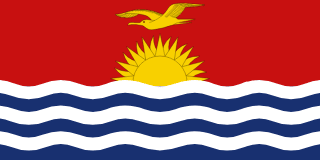
Inside Kiribati’s foreign policy.
Republic of Kiribati
Oceania · UN voting record, treaty positions, and alliances — every claim primary-sourced.
In short
Kiribati is a small Pacific atoll state whose foreign policy is driven less by ideology than by survival: climate vulnerability, fiscal dependence on fisheries and external aid, and intensifying competition between China, Australia, New Zealand, Japan, and the wider Pacific partners all shape its choices…
Capital
South TarawaGovernment
Unitary presidential republicKiribati's government & politics
Leadership, governance, and democratic trajectory.

Kiribati's UN voting record
How Kiribati votes at the UN General Assembly — ideological trajectory, voting partners, topic patterns, and key recent roll calls.
Ideological trajectory
Top voting partners
Topic-level voting
Source: Erik Voeten, “United Nations General Assembly Voting Data”, Harvard Dataverse (CC0). Aggregated by Model Diplomat. Last refresh tracked in profile freshness.
Kiribati's foreign policy
Bilateral posture, key relationships, and live diplomatic statements.
Foreign Policy
Kiribati’s foreign policy is narrow in instruments but clear in hierarchy: survival comes first in the form of climate adaptation and protection of its dispersed atolls; regime security comes next through tight executive control of diplomacy; economics follows through aid, fisheries revenue, and infrastructure financing; status matters mainly through Pacific and small-island diplomacy rather than hard-power projection IMF Article IV for Kiribati, 2026, DFAT Kiribati country brief, UN Climate Change profile: Kiribati. Kiribati is a unitary presidential republic in which President Taneti Maamau, re-elected in 2024, is both head of state and head of government, which concentrates foreign-policy authority in the presidency more than in an autonomous foreign ministry or parliament Pacific Islands Forum leaders information: Kiribati, Parliament of Kiribati election information. That structure matters because Kiribati’s sharpest diplomatic moves, especially on recognition and regional alignments, have tracked presidential choice rather than broad bureaucratic consensus Australian Strategic Policy Institute, Strategic Competition in the Pacific: A Case for Kiribati.
Kiribati’s stated doctrine is built around “friends to all, enemies to none” Pacific diplomacy, but in practice it behaves as a highly aid-sensitive small state that uses diplomatic recognition, access, and forum participation to widen bargaining space DFAT Kiribati country brief, Commonwealth country profile: Kiribati. The decisive bilateral fact is its 2019 switch of diplomatic recognition from Taiwan to the People’s Republic of China, after which Beijing restored ties, opened an embassy, and expanded assistance and political presence PRC Ministry of Foreign Affairs, China and Kiribati relations, Reuters, Kiribati switches diplomatic recognition to China from Taiwan. Australia and New Zealand remain indispensable because they provide major development support, labor mobility pathways, transport links, policing and governance assistance, and access to regional institutions DFAT Kiribati country brief, New Zealand MFAT: Kiribati. Japan also matters as a long-term fisheries, maritime, and infrastructure partner, especially through Pacific Islands Leaders Meeting frameworks and development cooperation Ministry of Foreign Affairs of Japan, Japan-Kiribati relations.
Regionally, Kiribati’s memberships give it voice far beyond its size. It is a member of the United Nations since 1999, the Pacific Islands Forum, the Commonwealth, and the Alliance of Small Island States, and it uses AOSIS and wider climate negotiations to press for stronger mitigation commitments and adaptation finance from major emitters United Nations member states: Kiribati, Pacific Islands Forum members: Kiribati, AOSIS members. Its multilateral messaging is unusually consistent on sea-level rise, ocean governance, and the legal rights of low-lying island states threatened by climate change, including support for preservation of maritime zones despite physical coastal change UN General Assembly, Oceans and the law of the sea records, International Law Commission sea-level rise materials. Economically, that activism is backed by structural vulnerability: the IMF describes Kiribati as highly exposed to climate shocks and dependent on fisheries, public spending, and external support, which explains why climate finance is not rhetoric for Tarawa but a core external objective tied directly to state viability IMF Article IV for Kiribati, 2026.
At the UN, Kiribati usually aligns with the broad small-island and Pacific pattern on climate, decolonization, oceans, and sustainable development, but its record is less uniformly “Western-aligned” on geopolitical votes than Australia or New Zealand would prefer UN Digital Library voting records, AOSIS members. The key divergence is that Kiribati’s China relationship has produced greater diplomatic distance from Taiwan’s backers and, at times, a more cautious line on issues where Pacific solidarity collides with Chinese preferences, especially around representation and strategic access Reuters, Kiribati switches diplomatic recognition to China from Taiwan, ASPI, Strategic Competition in the Pacific: A Case for Kiribati. That does not make Kiribati a Chinese proxy; it still depends heavily on Australia, New Zealand, multilateral lenders, and regional legitimacy DFAT Kiribati country brief, IMF Article IV for Kiribati, 2026.


Kiribati's treaties & memberships
UN multilateral treaty positions and IGO memberships.
International Organizations
Society & economy
Macro-economic snapshot and demographic context.
GDP (nominal)
$308M
#206/250GDP per capita
$2,289
#165/250HDI
0.624
#135/250GDP (nominal USD)
GDP per capita (USD)
Top trading partners

In the news
Stories surfacing across Kiribati’s authoritative outlets, plus headline events and the diplomatic calendar.
Headlines
New Zealand’s Kiribati Aid Review Further Opens Door for Chinese Influence – The Diplomat
New Zealand’s review of aid to Kiribati after a diplomatic rift is signaling Washington that Kiribati’s trajectory away from the West could open room for China to deepen influence. Kiribati remains a major aid recipient (NZ contributed $57 million from 2021–2024; aid ~18% of GDP), so NZ’s pivot or realignment could impact Kiribati’s budget and policy space, including transportation, education, and healthcare. The August 2024 Kiribati ban on foreign officials through 2025 unde
Kiribati country brief - DFAT
Key points on Kiribati from the DFAT country brief: - Politics and governance - Independent since 12 July 1979; 45-member unicameral Parliament (44 elected, 1 appointed by the Rabi Council for Banaba descendants in Fiji’s Rabi). - MPs serve four-year terms; after elections, Parliament nominates 3–4 presidential candidates. President (Te Beretitenti) is elected by popular vote (first-past-the-post). - Speaker is elected ex-officio by MPs, must meet MP qualifications but
Kiribati: 2024 Article IV Consultation-Press Release; Staff Report; and Statement by the Executive Director for Kiribati
Summary tailored to your query: - Economy and policy: The IMF’s 2024 Article IV for Kiribati notes an economic rebound after COVID-19 restrictions ended in late 2022 but underscores ongoing vulnerabilities from climate change, dependence on imports, and infrastructure gaps. The IMF recommends a medium- to long-term fiscal consolidation (cutting recurrent spending and strengthening fiscal policy) alongside broad structural reforms to boost private sector employment, investmen
Explore Kiribati in depth
Frequently asked questions about Kiribati
Quick answers to the most common questions about Kiribati.
What type of government does Kiribati have?
Kiribati is governed as a unitary presidential republic, with its capital at South Tarawa.
Who is the head of state of Kiribati?
Taneti Maamau is the head of state of Kiribati, in office since 2016-03-11.
What is the population of Kiribati?
Kiribati has a population of approximately 135 thousand people, making it the 193rd most populous country.
What is the economy of Kiribati like?
Kiribati has a nominal GDP of about $308 million, or roughly $2,289 per capita.
What languages are spoken in Kiribati?
The official languages of Kiribati are English and Gilbertese.
When did Kiribati join the United Nations?
Kiribati has been a member of the United Nations since 1999.
Who are Kiribati's closest allies?
Kiribati's key allies include China, Australia, New Zealand, and Japan.
More about Kiribati
Kiribati is a small Pacific atoll state whose foreign policy is driven less by ideology than by survival: climate vulnerability, fiscal dependence on fisheries and external aid, and intensifying competition between China, Australia, New Zealand, Japan, and the wider Pacific partners all shape its choices [DFAT Kiribati country brief](https://www.dfat.gov.au/geo/kiribati/kiribati-country-brief), [IMF 2024 Article IV Consultation for Kiribati](https://www.imf.org/en/News/Articles/2026/05/28/pr26208-kiribati-imf-executive-board-concludes-2024-article-iv-consultation). Politically, it is a unitary presidential republic, with President Taneti Maamau serving as both head of state and head of government after retaining power through the 2024 election cycle, and his Tobwaan Kiribati Party remains the central vehicle of executive control [Commonwealth Secretariat: Kiribati Constitution and politics](https://thecommonwealth.org/our-member-countries/kiribati), [Reuters, Kiribati votes in test for pro-China government](https://www.reuters.com/world/asia-pacific/kiribati-votes-test-pro-china-government-2026-05-28/). Decision-making in foreign policy is highly centralized around the presidency rather than dispersed across a large bureaucracy, which matters because Kiribati’s limited state capacity gives the executive unusual leverage over both diplomatic recognition and development partnerships [DFAT Kiribati country brief](https://www.dfat.gov.au/geo/kiribati/kiribati-country-brief), [The Diplomat, New Zealand’s Kiribati Aid Review Further Opens Door for Chinese Influence](https://thediplomat.com/2026/06/new-zealands-kiribati-aid-review-further-opens-door-for-chinese-influence/). Kiribati’s place in the world is therefore larger than its size suggests: it is a member of the United Nations, the Pacific Islands Forum, the Commonwealth, and the Alliance of Small Island States, and its votes, recognition choices, and maritime geography give outside powers reasons to compete for influence there [United Nations member states: Kiribati](https://www.un.org/en/about-us/member-states/kiribati), [Pacific Islands Forum members](https://www.forumsec.org/who-we-arepacific-islands-forum/). The clearest example is its 2019 switch in diplomatic recognition from Taiwan to the People’s Republic of China, a move that still frames outside assessments of Kiribati’s alignment [PRC Ministry of Foreign Affairs on China-Kiribati relations](https://www.mfa.gov.cn/eng/wjb_663304/zzjg_663340/yzs_663354/gjlb_663358/2786_663500/), [Reuters, Kiribati votes in test for pro-China government](https://www.reuters.com/world/asia-pacific/kiribati-votes-test-pro-china-government-2026-05-28/). Economically, Kiribati is narrow-based and exposed. The IMF describes growth as supported by public spending and fisheries revenue, while warning about high vulnerability to external shocks and climate costs [IMF 2024 Article IV Consultation for Kiribati](https://www.imf.org/en/News/Articles/2026/05/28/pr26208-kiribati-imf-executive-board-concludes-2024-article-iv-consultation). Government income depends heavily on fishing-license fees linked to its vast exclusive economic zone and on returns from the Revenue Equalization Reserve Fund, its sovereign wealth buffer, while imports, infrastructure finance, and basic service delivery rely substantially on development partners [IMF 2024 Article IV Consultation for Kiribati](https://www.imf.org/en/News/Articles/2026/05/28/pr26208-kiribati-imf-executive-board-concludes-2024-article-iv-consultation), [DFAT Kiribati country brief](https://www.dfat.gov.au/geo/kiribati/kiribati-country-brief). That profile gives Kiribati little room for doctrinal foreign policy; economic security usually outranks bloc loyalty. Three issues define Kiribati’s current trajectory. First is climate survival: sea-level rise, coastal erosion, freshwater stress, and adaptation costs are not advocacy themes for Tarawa but core state-security issues, and Kiribati consistently uses small-island forums to press for stronger international climate action [UN member states: Kiribati](https://www.un.org/en/about-us/member-states/kiribati), [AOSIS members](https://www.aosis.org/about/aosis-members/). Second is strategic competition: Chinese engagement has expanded, but Australia, New Zealand, Japan, and other partners remain deeply involved, so Kiribati is managing rivalry while trying to convert it into infrastructure and budget support rather than formal alignment [DFAT Kiribati country brief](https://www.dfat.gov.au/geo/kiribati/kiribati-country-brief), [The Diplomat, New Zealand’s Kiribati Aid Review Further Opens Door for Chinese Influence](https://thediplomat.com/2026/06/new-zealands-kiribati-aid-review-further-opens-door-for-chinese-influence/), [Strategic Competition in the Pacific: A Case for Kiribati](https://www.csis.org/analysis/strategic-competition-pacific-case-kiribati). Third is governance capacity: the state’s limited administrative reach makes implementation slower and increases the political value of whoever can deliver visible projects quickly, which in turn feeds the competition among external partners [IMF 2024 Article IV Consultation for Kiribati](https://www.imf.org/en/News/Articles/2026/05/28/pr26208-kiribati-imf-executive-board-concludes-2024-article-iv-consultation), [DFAT Kiribati country brief](https://www.dfat.gov.au/geo/kiribati/kiribati-country-brief). The practical read is that Kiribati will keep hedging. It is unlikely to abandon ties with China absent a major domestic political break, but it is equally unlikely to accept exclusive dependence on Beijing if Australia, New Zealand, Japan, and multilateral lenders continue to offer credible finance and services [Reuters, Kiribati votes in test for pro-China government](https://www.reuters.com/world/asia-pacific/kiribati-votes-test-pro-china-government-2026-05-28/), [DFAT Kiribati country brief](https://www.dfat.gov.au/geo/kiribati/kiribati-country-brief), [IMF