Zimbabwe's Power Shift: Mnangagwa's Changes
Constitutional amendments reshape Zimbabwe's political landscape.
Model Diplomat8 min readSouthern Africa
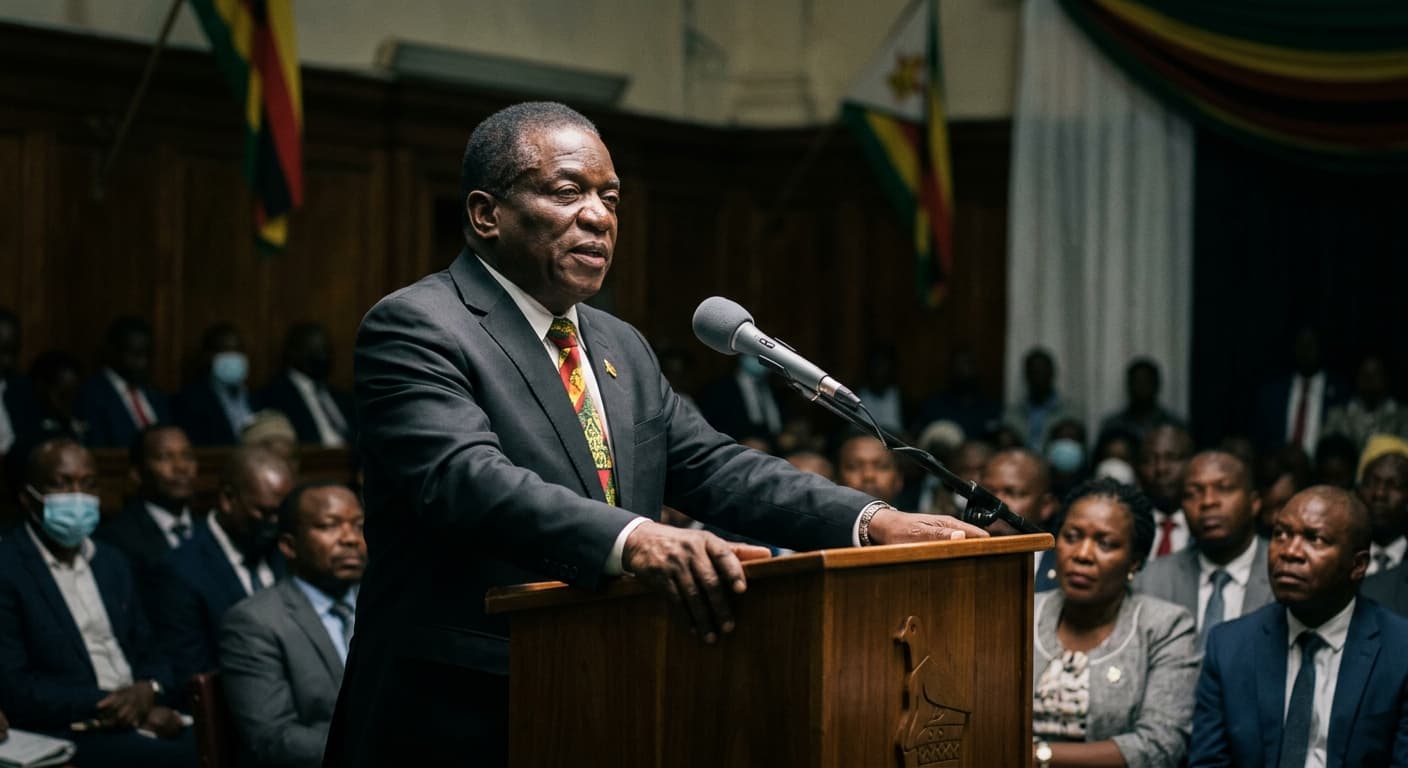
Zimbabwe's Power Shift: What Mnangagwa's Constitutional Changes Mean
Mnangagwa signed the Constitutional Amendment (No. 3) Act on July 7, 2026, extending his rule to 2030, scrapping direct presidential elections, and importing a template that reshapes Southern African politics.
Emmerson Mnangagwa's signature on July 7, 2026 did not just extend his rule by two years — it retired direct presidential elections in Zimbabwe and delivered a working template for how a Southern African democracy can be quietly re-engineered without a coup or a referendum, in a region that until this decade had been the continent's firewall against constitutional self-succession. Act No. 6 of 2026, gazetted the same day, lengthens presidential and parliamentary terms from five to seven years, postpones the 2028 vote to 2030, and — most consequentially — transfers the power to elect a president from Zimbabwean voters to a joint sitting of the National Assembly and Senate. The immediate winner is Mnangagwa. The structural winners are ZANU-PF's parliamentary machine and Beijing's mining partners. The loser is the 2013 constitutional bargain — and, by demonstration effect, every term-limit clause south of the Zambezi.
What the Act actually does
The bill's short title is technocratic. Its architecture is not. Under the amendment, presidents will be chosen by a joint electoral college of MPs, with a run-off among the top two if no candidate secures an outright majority — a structure lifted almost verbatim from Togo's 2024 "parliamentary system" reform that opposition groups called a constitutional coup. Voter registration and maintenance of the roll are transferred from the Zimbabwe Electoral Commission to the Registrar-General under a new Section 43A, a separate Delimitation Commission takes over boundary-drawing, and the delimitation window widens from six to 18 months. The National Peace and Reconciliation Commission is dissolved and folded into the Zimbabwe Human Rights Commission — quietly retiring the last body created after the 2008 election violence specifically to investigate state abuses.
The National Assembly passed the bill 216-42 on June 18, above the 187-vote two-thirds threshold, according to the BBC; the Senate followed on June 24 with a 74-4 margin,
Al Jazeera reported. The Constitutional Court dismissed the last live legal challenge on June 17 on technicalities,
striking off war-veterans' petitions and clearing the path to assent. The full text of the Act was
gazetted and reproduced by parliamentary trackers on the day of signing.
The government's own defence rests on a narrow reading of Section 328(7) of the 2013 Constitution, which requires a double referendum before any amendment "that has the effect of extending" a sitting president's term. Justice Minister Ziyambi Ziyambi and ZANU-PF legal spokesman Patrick Chinamasa insisted the two-term cap is untouched — only the length of each term is changing — and therefore no popular vote is required. Constitutional lawyer Tendai Biti, arrested this year while mobilising against the bill, called that reading "semantic cover" for the outcome the 2013 text was drafted to prevent. Brookings scholars Chipo Dendere and Miles Tendi, writing on the day of the Senate vote,
called it a "significant blow to anti-authoritarian efforts" and noted the process was "fast tracked to avoid a referendum."
Who holds the leverage — and who lost it
The decisive move was not the vote in July 2026. It was the recall campaign that began in October 2023, when a self-declared CCC interim secretary-general, Sengezo Tshabangu, expelled dozens of opposition MPs elected under Nelson Chamisa's ticket. ZANU-PF swept the subsequent by-elections and lifted itself over the two-thirds threshold the 2023 electorate had denied it. By the June 2026 vote, more than 30 nominally opposition lawmakers crossed the floor to support the bill —
Al Jazeera's Farai Matiashe reported that one CCC MP, Susan Matsunga, received a vehicle from ZANU-PF-linked businessman Wicknell Chivayo before backing the amendment. A parliamentary committee then declared that 99.4 percent of submissions in public hearings favoured the changes, a figure activists dispute given documented abductions and beatings of opponents during the March consultations.
The internal ZANU-PF loser is Vice President Constantino Chiwenga, the former army general who led the November 2017 coup against Robert Mugabe on the understanding — never written down — that he would inherit power in 2028. The most vocal critic of the extension, war veteran Blessed "Bombshell" Geza, was a Chiwenga ally who used YouTube livestreams to denounce Mnangagwa and was expelled from ZANU-PF for "disloyalty" in early 2025. Geza
died in February 2026 under circumstances his supporters dispute, removing the highest-profile insider voice against the extension. Chiwenga himself has said nothing publicly since October 2025, and the security services have been reshuffled repeatedly — moves
Al Jazeera characterised as coup-proofing by a leader aware that the same generals who installed him could remove him.
The external winner is Beijing. Zimbabwe holds Africa's largest lithium reserves and exported 1.128 million metric tonnes of spodumene concentrate in the year ending December 2025, an 11 percent rise on the year before. Chinese firms — Zhejiang Huayou Cobalt, Sinomine, Chengxin, Yahua — have committed more than $1 billion since 2021, and the South African Institute of International Affairs
documented integrated mining-energy investments tied directly to Zimbabwe's export-ban strategy, with Huayou's $400m sulphate plant and Sinomine's planned $500m refinery anchored to Harare's beneficiation timeline. The Zimbabwe Investment Development Agency received 160 lithium applications from Chinese investors in the first half of 2023 against just five from Americans,
Observer Research Foundation reported. Mnangagwa's "Agenda 2030" is materially a Chinese-financed mining beneficiation plan targeting a $12 billion mining economy. A seven-year presidential horizon running through that target date is not a coincidence — it is the operating assumption written into contracts already signed.
The regional template — and the SADC silence
Zimbabwe was, until this month, one of the few Southern African states where a sitting president had not successfully engineered his own extension. That firewall is now down. Chad abolished term limits in October 2025 and extended presidential mandates from five to seven years — the same numeric shift Harare has just adopted — according to Human Rights Watch. Togo's 2024 switch to a "parliamentary" system that hands presidential selection to legislators is the direct architectural precedent for Zimbabwe's new electoral college. In the DRC,
a Senate revision bill adopted on June 15, 2025 would reset Félix Tshisekedi's clock. The Carnegie Endowment's January 2026 survey of the continent
catalogued Cameroon, Uganda, Côte d'Ivoire and the Central African Republic as adjacent cases in the same 24-month window.
The Institute for Security Studies has analysed 24 attempts across Africa between 2002 and 2023 to amend constitutions to extend political power, of which 19 succeeded — a 78 percent success rate that helps explain why the AU Peace and Security Council's Article 23(5) prohibition on such amendments has become effectively dead letter. SADC, chaired by Mnangagwa himself until August 2024 and now by Zambia's Hakainde Hichilema, has issued no statement on Zimbabwe's amendment. The bloc's public position on constitutional change remains the
May 2024 communiqué condemning attempted destabilisation of the DRC — a formula that condemns coups while tolerating the constitutional variety. The AU's own charter has not been invoked.
The precedent matters most for South Africa, where the ANC's parliamentary arithmetic since the 2024 loss of its majority has made coalition governance the norm. If Harare's model normalises legislative selection of presidents in the region, the pressure on Pretoria to explore similar architectures — always framed as "stability" — will grow, particularly if the Government of National Unity fractures before 2029.
The economic paradox
Here is the counter-current worth naming: Zimbabwe's economy is, for the first time in a generation, stabilising. The IMF's July 8, 2026 staff-level agreement on the first review of the Staff-Monitored Program — released the day after Mnangagwa's signature — endorsed the government's macro path. The Fund's
February 2026 SMP announcement recorded inflation at 4.1 percent in January 2026, down from three-digit territory two years earlier, and projected 2026 growth of around 5 percent with a primary fiscal surplus of about half a percent of GDP. Zimbabwe's public debt still stood at $23.3 billion — 72.9 percent of GDP — at end-2024, with $7.4 billion in external arrears,
according to the IMF's 2025 Article IV report, and the Fund continues to classify Zimbabwe as in debt distress. But the trajectory has reversed.
This is the political economy Mnangagwa is buying time to complete. The U.S. sunset of country-based sanctions in March 2024 in favour of targeted Global Magnitsky designations, documented by CSIS, opened the door to Western re-engagement — but only through the Structured Dialogue Platform on arrears clearance, which requires demonstrable governance reform. Extending the presidency by parliamentary fiat is not obviously the reform Paris Club creditors had in mind. The wager is that mining royalties, Chinese capital, and a friendly IMF track record will make Zimbabwe too economically useful for creditors to punish politically. It is the same bet Rwanda has run for a decade.
What to watch
The next inflection points are dated. The 2028 general elections have been formally postponed; the next parliamentary and presidential vote is now scheduled for 2030, giving the incumbent parliament three additional years of tenure alongside the president. Watch three catalysts:
- The IMF's next SMP review, due in early 2027. A collapse of the primary-surplus path would remove the economic cover for the political extension.
- Chiwenga's response to the ZANU-PF congress in December 2027, the last party gathering before the president's succession must be sequenced. His silence or defection will determine whether the extension holds internally.
- The 2027 SADC Summit, where any formal statement — or ostentatious absence of one — will signal whether the regional bloc treats Zimbabwe's precedent as tolerable or contagious.
Diplomat View
The bottom line: Mnangagwa's amendment is not primarily about staying until 2030 — the 83-year-old may not. It is about closing the direct-election escape hatch so that whoever succeeds him, whether Chiwenga or a Mnangagwa loyalist, inherits a system in which the presidency is decided inside ZANU-PF's parliamentary caucus rather than at a ballot box the opposition could theoretically still win. That is the durable win, and it is why the 2028-to-2030 postponement matters less than the transfer of electoral power from voters to MPs. Our forecast: the amendment holds, the succession fight moves entirely inside ZANU-PF, and by 2028 at least one other SADC state tables a "parliamentary system" bill citing the Zimbabwe precedent. We would revise this forecast if the IMF suspends the SMP over governance grounds, if Chiwenga publicly breaks with Mnangagwa before the 2027 party congress, or if a Constitutional Court composed under the new Judge President reopens the referendum question — three specific, dated conditions on which the entire trajectory turns.
Discover more

US Politics
White House Pressures Congress for Crypto Leg
The Trump administration's push for the CLARITY Act aims to reshape crypto regulation, impacting trillions in market value and the Trump family's wealth.
US Politics
Virginia's Redistricting Referendum
Virginia's redistricting referendum is drawing a flood of dark money, shaping future elections and the fight for congressional control amid party stakes.
US Politics
Washington's Scrutiny of Iran War Prediction
The Iran war prediction market scandal exposes political ties and regulatory challenges in Washington, as insider trading concerns rise.

Economics
Fed's Amex AML order puts correspondent banking on notice
Federal Reserve's Amex AML order requires board-level controls and a 90-day plan; OCC fined the bank $350 million over enterprise-wide deficiencies.