Vijay’s Victory Ends Tamil Nadu’s Two-Party Comfort
TVK’s 108-seat debut gives Vijay the biggest shock in Tamil politics in decades, but coalition arithmetic now governs his room to move.
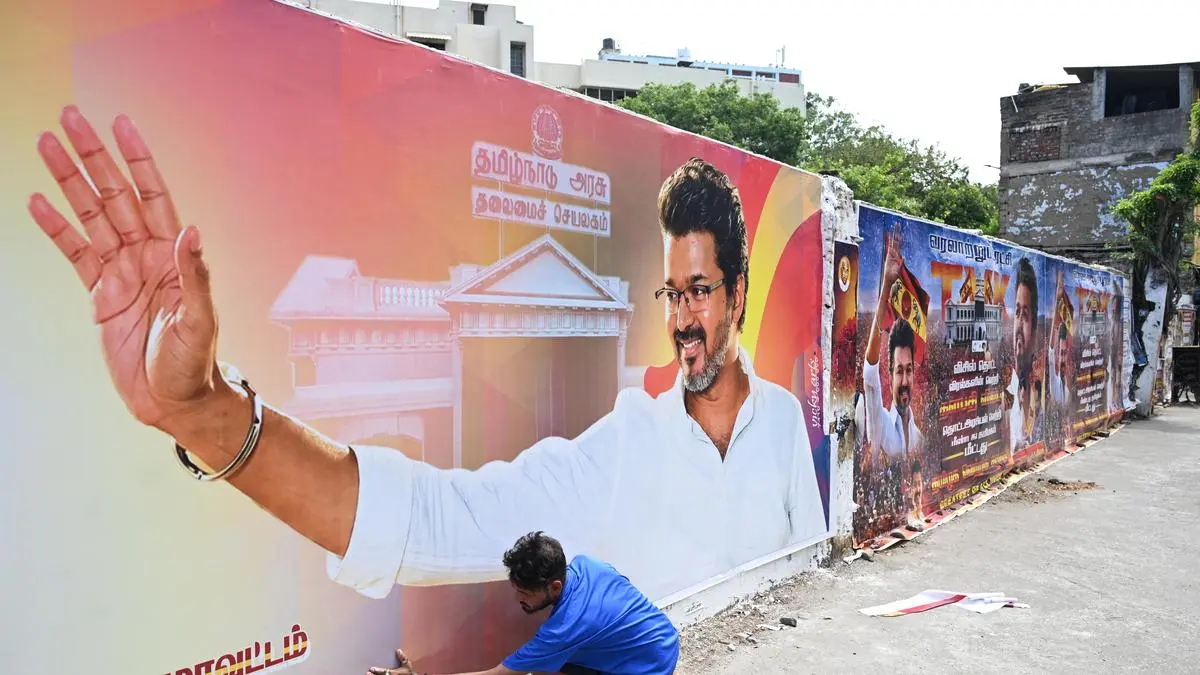
Vijay has done the hard part: he turned a new party’s first election into a statewide rupture. In Frontline’s account, the Tamilaga Vettri Kazhagam won 108 of 234 seats, while Vijay personally won both constituencies he contested and the party polled 34.92% of the vote — enough to finish ahead of the DMK, yet still short of a majority ( Frontline). The Hindu’s tally puts the same result in starker terms: TVK emerged as the single largest party, the DMK was pushed into second place, and the AIADMK slid further behind in a three-cornered contest (
 The Hindu).
Why this breaks the old Tamil Nadu model
For half a century, Tamil Nadu politics has run on a recognizable script: DMK versus AIADMK, with smaller parties attaching themselves to one pole or the other. Vijay has not abolished that system so much as exposed how brittle it had become. Frontline notes that the vote was especially strong in cities and municipal towns, with TVK taking 32 seats in urban areas and 29 in municipal towns, while the DMK was routed in Chennai and the AIADMK’s erosion was sharper in the west (Frontline). The Hindu adds that TVK swept Greater Chennai and cut into both established parties’ core areas, which is the key political fact: Vijay did not just attract fans, he displaced the old urban anti-incumbency vote (The Hindu).
That makes this election bigger than a celebrity upset. It is a generational transfer of leverage. The DMK and AIADMK still have structures, cadres and history, but Vijay has shown that a fresh vehicle can capture first-time voters, younger urban voters and anti-establishment sentiment at scale. For  India, that matters because Tamil Nadu has long been one of the country’s most stable regional party systems; when it moves, coalition politics elsewhere watches.
Coalition arithmetic now constrains the winner
The catch is that TVK’s headline win was not a governing majority. The Hindu reports that Vijay secured the backing of Congress, CPI, CPI(M), VCK and IUML to reach 120 MLAs-elect and cross the 118-seat mark needed to form government; the Governor then appointed him chief minister-designate and set a confidence test deadline for May 13 (The Hindu; The Hindu). That means allies are not passengers — they are creditors. Congress gets a rare return to power in Tamil Nadu, while the VCK and IUML used the hung assembly to extract relevance without formally abandoning their broader alliances.
This is the real power dynamic now: Vijay controls the brand and the mandate, but he does not control the House alone. If he governs as a solo command center, the coalition frays; if he yields too much, TVK starts to look like another umbrella for familiar bargaining.
What to watch next
The immediate test is not the celebration in Chennai; it is whether Vijay can convert a fan surge into cabinet discipline and legislative survival. Watch the confidence vote deadline, the shape of the first ministry, and whether the Congress and left parties treat TVK as a one-off arrangement or the start of a new alignment. The larger question is whether this debut is a one-cycle shock — or the beginning of a durable third pole in Tamil Nadu politics.