US Cuts Threaten AU's Somalia Mission
US funding cuts jeopardize AUSSOM operations in Somalia.
Model Diplomat8 min readAfrica
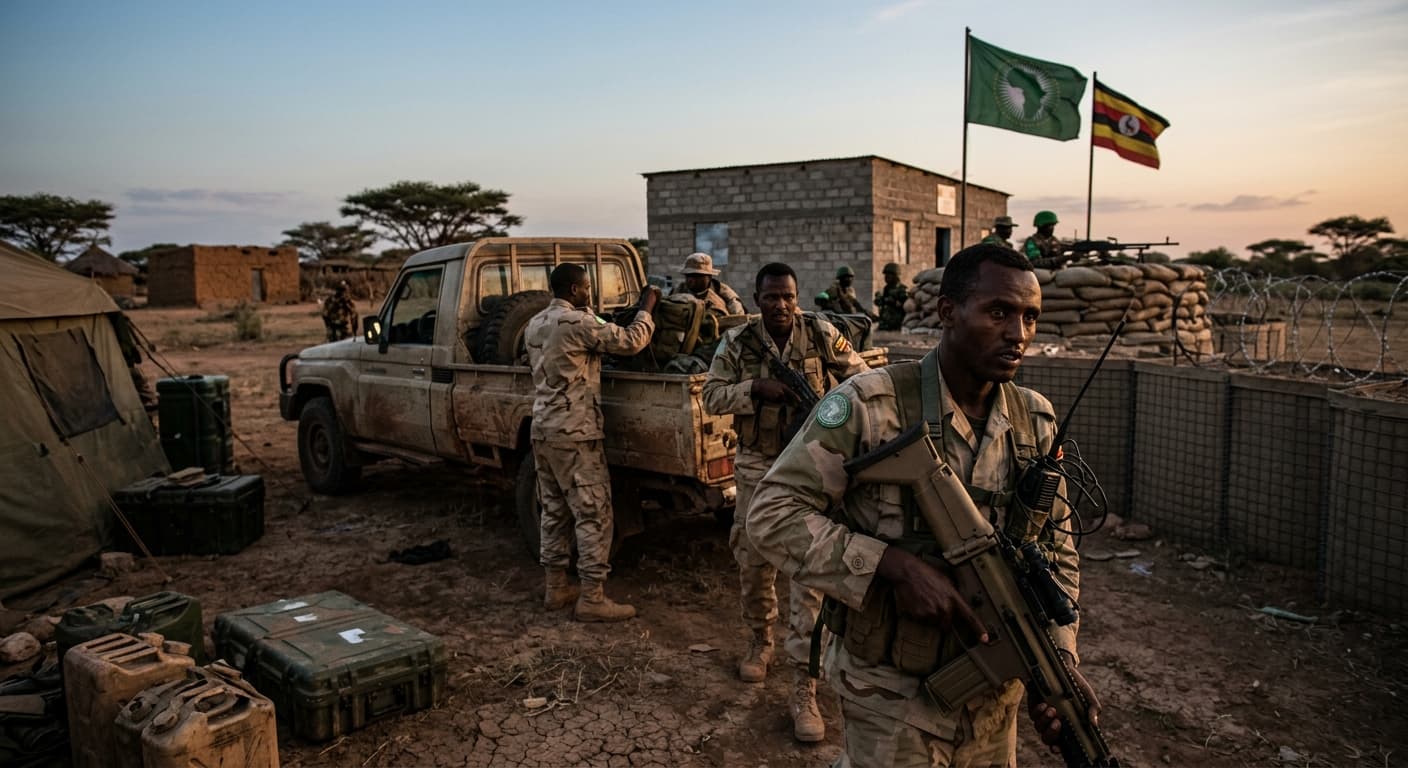
AUSSOM at the Brink: US Cuts Threaten AU's Somalia Mission
US pulls UN logistics funding for AUSSOM from January 2027, leaving the AU's 11,900-strong Somalia mission unable to sustain operations against al-Shabaab.
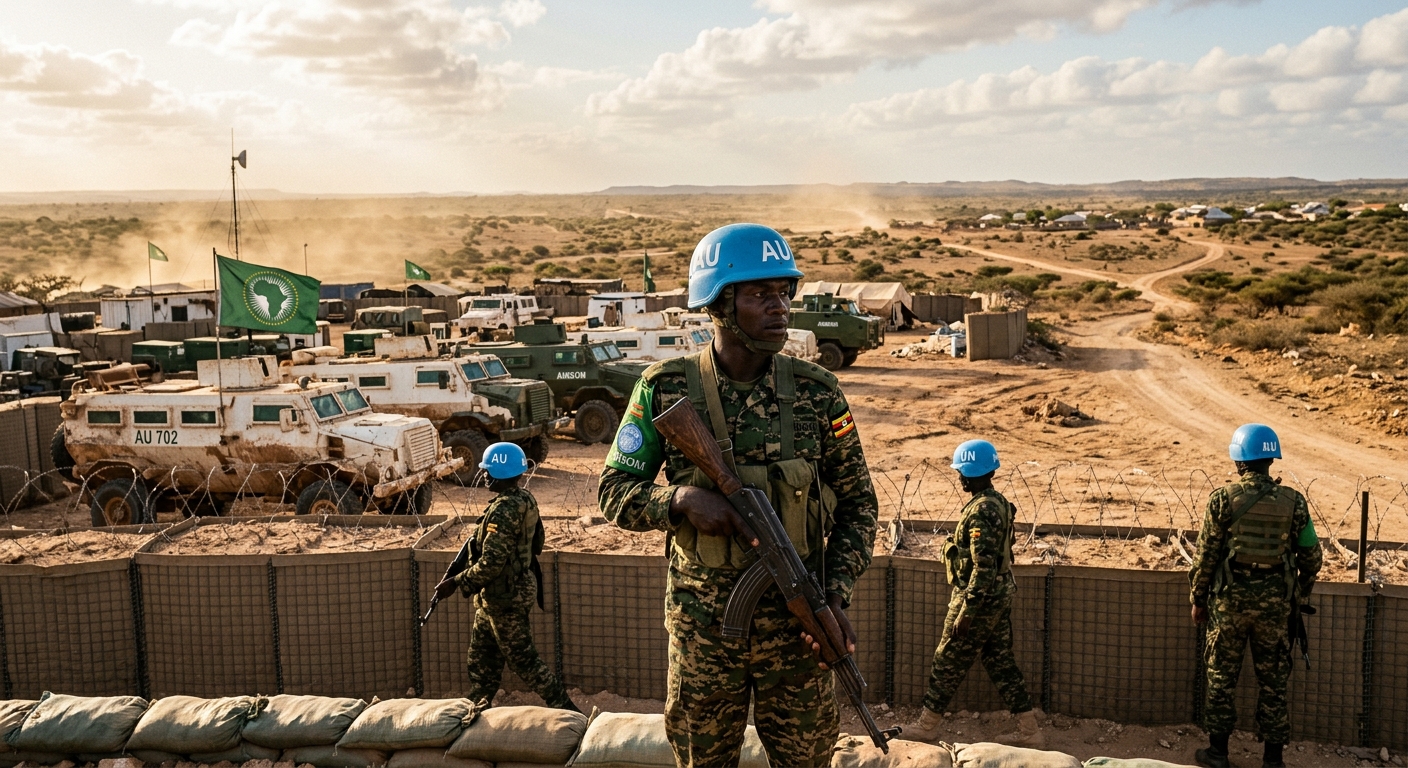
On July 1, 2026, Washington sent a diplomatic note to the African Union informing it that the United States will not support the roughly $500 million UN Support Office in Somalia (UNSOS) budget beyond December — and will oppose any Security Council mandate extension that keeps the UN paying for AUSSOM's food, fuel, water and casualty evacuation. The immediate risk is operational collapse of the 11,900-troop African Union Support and Stabilisation Mission in Somalia (AUSSOM) within months. The deeper consequence is the death of the "hybrid" UN–AU peacekeeping financing model that African diplomats spent a decade designing — and the return, by default, to bilateral security deals between Somalia and its heavily armed neighbours.
The move, first reported by Reuters and summarised in a BBC Somali briefing on July 3, ends the ambiguity that had held AUSSOM together since it replaced ATMIS on January 1, 2025. It also ends, in practice, the first attempted application of UN Security Council Resolution 2719 — the 2023 framework meant to channel up to 75% of AU mission budgets through UN assessed contributions.
What Washington actually said
The US note does two things at once. First, it commits Washington to blocking any Security Council resolution that continues to route UNSOS logistics support to AUSSOM into 2027. Second — and this is where the political sting lies — it links the decision to a critique of the Somali government: that "internal fighting and political discord" in Mogadishu is undermining the fight against al-Shabaab and Islamic State affiliates, and that international support will be "limited until Somali leaders unite." A State Department spokesperson confirmed to Reuters that Washington will not sustain UNSOS operations, telling the BBC's Somali service that "peacekeeping is at risk because ultimately you need to be able to sustain it."
That framing matters. Washington is not walking away from Somalia militarily — under President Donald Trump, US airstrikes on al-Shabaab and ISIS-Somalia targets doubled in 2025 compared with the previous year, according to Al Jazeera. It is walking away from multilateral peacekeeping as the delivery vehicle. That distinction is the story.
The pattern is now legible across the administration's ledger. In January 2026, the State Department suspended all assistance to the Federal Government of Somalia over an alleged WFP warehouse seizure. The same week, Trump signed an executive order withdrawing the US from 66 international organisations, per an
NPR account of the review. By February, the UN was publicly
pressing Washington for clarity on $2.19 billion in unpaid budget dues plus $2.4 billion in peacekeeping arrears. UNSOS was never going to survive that squeeze intact.
The 2719 experiment is dead
To understand why this is a rupture rather than a spending cut, read Resolution 2767 (2024) — the text authorising AUSSOM — which the Security Council adopted 14–0 on December 27, 2024, with the United States the sole abstention. Paragraph 39 of that text asked the Secretary-General, "within existing resources made available by the rightsizing of UNSOS," to implement the "hybrid implementation" of Resolution 2719 to AUSSOM from July 1, 2025, "including access to United Nations assessed contributions not exceeding 75 percent of AUSSOM's annual total budget." That trigger was contingent on a follow-up Council decision by
May 15, 2025.
That decision never came. As Paul D. Williams and colleagues document in a June 2025 LSE IDEAS paper, Senator Jim Risch, chair of the Senate Foreign Relations Committee, introduced the
AUSSOM Funding Restriction Act (S.1583) in 2025. The text prohibits US assessed contributions from being obligated for "any activity related to the implementation of Resolution 2719 in support of AUSSOM or any other African Union-led peace support mission in Somalia," and directs the US Ambassador at the UN to "oppose any United Nations Security Council resolution that would authorize funding prohibited under subsection (a)." That bill locked congressional Republicans and the White House onto the same position. By the May 2025 deadline, no consensus was possible.
The Council responded on December 23, 2025, with Resolution 2809 (2025), which extended AUSSOM's authorisation to December 31, 2026, and kept UNSOS support intact — but only, in the words of the UK's explanation of vote, "creates a process to enable an informed review of the logistical support provided by the UN." That review is now the vehicle through which Washington will formally sever the arrangement. The Copenhagen-based Danish Institute for International Studies (DIIS) had already concluded in early 2025 that diplomatic sources in Addis Ababa and New York considered the hybrid model "
politically unviable, irrespective of challenges in the country."
As the Institute for Security Studies argued in a December 2025 assessment, 2719's collapse in the Somali case has broader implications for the Sahel, Sudan and eastern DRC: it signals that the UN-assessed-contribution route for African-led peace support is closed for the foreseeable future, and pushes the AU back toward ad hoc pledging conferences that history shows do not deliver.
Who backfills, and who cannot
The arithmetic is brutal. AUSSOM's 2025–26 operational budget is around $166.5 million; UNSOS runs at roughly $500 million more in logistics. According to a 2025 ISS analysis, by October 2025 confirmed pledges totalled: $40 million from the AU Peace Fund, £16.5 million (~$22 million) from the UK, roughly €60 million from the EU split between the Federal Government of Somalia and the mission, and about $5.6 million combined from China, Japan and South Korea. That covers the operational budget — barely — and does nothing for logistics. UNSOS is the harder problem: it pays for the trucks, the medevac helicopters, the fuel and the field hospitals that keep 11,826 uniformed personnel in-country. There is no plausible donor coalition to replace half a billion dollars in the next six months.
The European calculation is already clear. As DIIS documented in a 2025 field study, an EU official in Mogadishu described the retrenchment plainly: "Our contribution to ATMIS was EUR 75 million, then EUR 70 million in 2024, and now EUR 60 million [in 2025]. The logic of engagement is that we want to build Somali capacity — less multilateral and more bilateral." The direction of travel — bilateral rather than multilateral — mirrors Washington's, only slower.
The historical parallel and the second-order effect
The parallel is 2016. When AMISOM's Ethiopian contingent withdrew from Adan Yabaal that year, al-Shabaab retook the town within months and used it as a training base until Somali and clan Macawisley forces recaptured it in December 2022. In April 2025, al-Shabaab launched a new offensive that reached villages within 50 kilometres of Mogadishu and, according to Al Jazeera reporting from April 24, 2025, briefly seized Adan Yabaal again along with Wargaadhi in Middle Shabelle. Moqokori in Hiiraan — the strategic crossroads linking Hiiraan, Middle Shabelle and Galgaduud —
fell to al-Shabaab in mid-2025, a symbolic reversal in the region where the Macawisley uprising against the group began.
What the current 2026 crisis threatens is that same dynamic at scale. As DIIS warned in a June 2025 policy brief, "mounting deficits will force troop-contributing countries to withdraw unpaid forces. This will strip the mission of its AU legitimacy and reduce it to ad hoc bilateral security arrangements with Kenya and Ethiopia, which, being direct neighbours, have more acute security interests." One AU official quoted in the study went further: "If the money for AUSSOM does not come through, the mission(s) have to withdraw, which could force the Somali president to negotiate with Al-Shabaab."
The IMF, in its June 25, 2025 country report, had already flagged the fiscal contagion: "Amid declining foreign assistance, Somalia's security challenges have risen… The security challenge has been further exacerbated by the reduction in security-related foreign assistance, as well as the limited progress in securing funding for a new African Union Support and Stabilization Mission." Somalia's own tax base cannot substitute — the IMF's third ECF review disbursed just $10 million in budget support.
Winners: Ethiopia, Egypt, Türkiye and, quietly, al-Shabaab
The named beneficiaries of a multilateral collapse are specific. Egypt entered AUSSOM as a new contributor with 1,091 troops under the mission and, per the Observer Research Foundation, roughly the same number again in a bilateral deployment — a foothold in Ethiopia's western flank driven by the Nile dispute. Ethiopia, which under ATMIS held 2,500 mission slots plus a bilateral presence in Gedo and Hiiraan, gains freedom of action as the AU frame weakens. Türkiye, which brokered the June 2024 Ankara Declaration that de-escalated the Somalia–Ethiopia rift and signed a 2024 oil-and-gas exploration deal with Mogadishu, becomes indispensable — its drones already operate over Somalia, and its trainers already run the Turksom base. Analysts at
ISS identify a potential "financing coalition" of the UAE, Qatar, Türkiye and Saudi Arabia as the natural replacement — a Gulf-underwritten security architecture rather than a multilateral one.
The quiet winner is al-Shabaab. The group extracts taxes from ports, checkpoints and businesses estimated by the UN Panel of Experts at over $100 million annually, and it does not need to defeat AUSSOM — it needs only to outlast it. A funding-driven drawdown is functionally identical to a military retreat.
The named losers are Burundi, which has already fought over troop allocations and depends on AU stipends as a foreign-exchange lifeline, per an ISS analysis; the Federal Government of Somalia, whose leverage in negotiations with the Federal Member States collapses without external security guarantees; and the AU Commission, whose Resolution 2719 project — the flagship product of a decade of African diplomatic effort — is now a cautionary tale rather than a template.
What to watch next
- Late July 2026: AU Peace and Security Council emergency session outcome. The Commission has already warned members of "significant impact on the sustainment, structure and financing of the operation." Watch for a formal appeal to Gulf capitals.
- October 2026: The UN Transitional Assistance Mission (UNTMIS) is
scheduled to conclude all mandated tasks on October 31 under Resolution 2809 (2025) — removing the UN's political mission just as the security mission wobbles.
- December 31, 2026: AUSSOM's current authorisation expires. The Council must either renew, restructure, or terminate the mission — and Washington has now signalled it will veto any text preserving UNSOS logistics support into 2027.
Diplomat View
The forecast: AUSSOM in its current form will not survive 2027. The most likely outcome is a residual AU political headquarters in Mogadishu paired with a patchwork of bilateral deployments — Ugandan and Kenyan troops paid partly by Gulf states, Egyptian and Turkish forces operating on their own terms, Ethiopian units defending their border zones. This is not peacekeeping; it is regionalised counterinsurgency with a Somali flag over it. The Somali federal government will lose leverage first, al-Shabaab will consolidate second, and the AU's Resolution 2719 project — the entire African case for equitable burden-sharing at the UN — will be shelved for a generation. The forecast changes only if two things happen: a Gulf-led financing coalition materialises with at least $200 million in the next six months, or the Somali government delivers a visible political reconciliation with the Federal Member States sufficient to change the US posture. Neither is on the current trajectory. The bottom line: Washington's July 1 note is not about $500 million. It is the moment the multilateral African peacekeeping model died — and the moment bilateral security in the Horn of Africa became the default.
Discover more
Global Politics
US-Iran Tensions Rise
Tensions escalate in the Strait of Hormuz as Iran and the US clash over maritime control, with a ceasefire hinging on a contested MoU paragraph.

Global Politics
US Proposes Pakistan for Iran Talks Amid Ties
The US-Iran negotiations are now mediated by Pakistan, highlighting Islamabad's strategic role and the implications for regional diplomacy.

US Politics
US Launches $166B Tariff Refund Portal
The US is launching a $166 billion tariff refund portal to aid importers hit by Trump-era tariffs, with major implications for trade and supply costs.

Conflict & Security
Drone Warfare Killing Aid Workers at Unprec
Over 1,000 humanitarian workers killed in three years as cheap armed drones collapse legal protections. Gaza, Sudan, Ukraine, and DRC see deliberate targeting of aid convoys and hospitals with zero prosecutions.