Tshisekedi's Third-Term Gambit in DRC
Opposition protests against potential term limit reset
Model Diplomat5 min readAfrica
Tshisekedi's Third-Term Gambit Is Africa's Next Constitutional Coup Test
DRC opposition marches July 8 against a Senate-passed bill that could reset Felix Tshisekedi's term limits — the sharpest African term-limit fight since Guinea 2020.
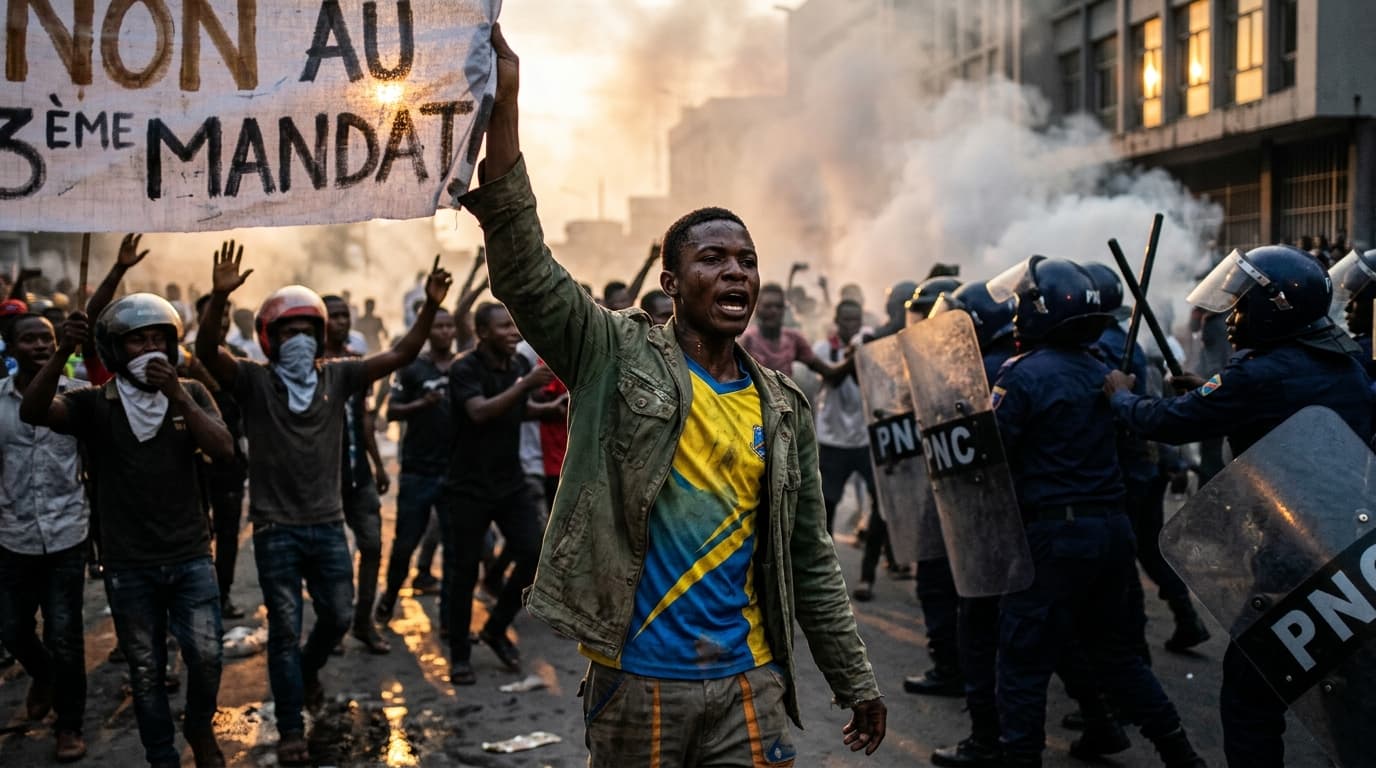
On July 8, 2026, four Congolese opposition parties are marching on the Palais de la Nation in Kinshasa to demand President Félix Tshisekedi's resignation — three weeks after his allies in the Senate passed a bill, on June 15, that would clear the legal path to a third term. The gambit matters far beyond Congo: it is the first test since Guinea's 2020 crisis of whether the African Union's "zero tolerance" doctrine on unconstitutional changes of government has any grip on a sitting president who wraps a term-limit reset inside a war-emergency clause. If Tshisekedi succeeds, the template — reset the counter via referendum while a rebellion in the east makes normal elections "impossible" — becomes portable across the Great Lakes and southern Africa, where at least four leaders face term-limit endgames before 2030.
The bill, the ban, and the march
The DRC Senate adopted the constitutional revision text on June 15, with 89 senators in favour and 20 abstentions, according to the Council on Foreign Relations' Global Conflict Tracker. The mechanism is narrow but decisive: the bill authorises the president to initiate constitutional change in the event of a "major dysfunction" paralysing state institutions, potentially validated by referendum,
Al Jazeera reported after violent clashes at the National Assembly on June 12. A referendum on a new constitution would, by the logic Tshisekedi's camp is deploying, reset the two-term clock — his 2019 and 2023 mandates would no longer count.
That interpretation runs headlong into Articles 219 and 220 of the 2006 constitution, which lock the number and duration of presidential mandates and forbid any constitutional revision during war or emergency. In their July 8 protest notification — dated June 23 and stamped by several government institutions — opposition leaders Martin Fayulu, Moïse Katumbi, Augustin Matata Ponyo and Delly Sesanga called the plan a "constitutional coup d'état," citing Articles 64, 219 and 220 directly, ChimpReports reported. Fayulu, who was among those injured on June 12 when tear gas and pro-government activists broke up the C64 rally, urged Congolese to "gather in large numbers" for the march on the Palais de la Nation.
The government's counter-move is characteristically clever. On June 27, Kinshasa banned public gatherings in four provinces, citing the Bundibugyo-strain Ebola outbreak that the World Health Organization warned on July 7 was "not yet stabilising," with confirmed cases climbing above 1,300 and deaths reported near 600. Opposition figures called the ban "politically motivated," noting it landed 11 days before the scheduled march, according to Al Jazeera's June 30 report. The public-health emergency is genuine; the timing is not accidental.
The opposition itself is a novelty. C64, launched in May, unites four leaders — Fayulu, Katumbi, Kabund and Sesanga — who have refused to share a platform since 2018, when Tshisekedi walked away from a joint opposition candidacy in Geneva, Al Jazeera reported at the time. Nobel laureate Denis Mukwege has publicly condemned the referendum plan. That coalition, plus the National Episcopal Conference of Congo (CENCO), constitutes the widest domestic front against a Congolese president since the 2016 movement against Joseph Kabila's late-term overstay.
Why this is the AU's problem, not just Kinshasa's
The African Union built its rulebook after the 2019–2022 coup wave to distinguish military takeovers — automatically punished by suspension — from the harder category of "constitutional coups." Article 23(5) of the African Charter on Democracy, Elections and Governance explicitly classifies as unconstitutional "any amendment or revision of the constitution or legal instruments which is an infringement on the principles of democratic change of government," according to a European Parliamentary Research Service briefing. Only 36 of the AU's 55 members have ratified it, and enforcement against sitting presidents has been near-nonexistent. A
follow-up EPRS analysis acknowledges the AU "is not endowed with similar tools to react to leaders who want to extend their stay in power through potentially unconstitutional means" — and notes that in Guinea in 2020, the Peace and Security Council did not react to Alpha Condé's third-term amendment before the coup that removed him.
An ISS Africa analysis published June 30 makes the strategic point sharpest: Kinshasa "cannot afford to fight two legitimacy battles at once — one against Rwanda in eastern Congo and another over constitutional succession at home." A president who resets term limits while asking Washington, Brussels and the UN Security Council to sanction Kigali for backing M23 is handing Rwanda the counter-narrative for free. Only 12% of the DRC population expresses trust in electoral processes, ISS notes, citing Afrobarometer — a floor that shrinks every time the state chooses procedural creativity over the letter of Article 220.
The AU's designated mediator is Togo's Faure Gnassingbé — the same leader who, in 2024, engineered his own term-limit workaround by converting Togo into a parliamentary system with himself as the newly powerful "President of the Council of Ministers." UN Secretary-General António Guterres urged partners in his September 2025 report to back Gnassingbé's mediation and the merged AU–EAC–SADC structure. The optics — a term-limit evader mediating a term-limit dispute — capture the enforcement gap precisely.
Regional mediation, meanwhile, is running through Burundi. AU chair Évariste Ndayishimiye met C64 leaders in Bujumbura on June 6, brokering the pause in nationwide protests, Volta Fame reported. Ndayishimiye is compromised as a neutral arbiter: Burundian troops are fighting alongside the Congolese army against M23 in South Kivu, and Ndayishimiye has publicly warned that "war will even arrive in Burundi" if Rwanda's Paul Kagame continues advancing,
the BBC reported. His mediation therefore doubles as regime-survival diplomacy — Bujumbura needs Kinshasa functional, not necessarily democratic.
The comparative case: this is the Ouattara playbook, updated
The technique Tshisekedi is deploying is not new. It is the sub-Saharan template refined over 15 years, catalogued in the Journal of Democracy's "Africa's Leaders for Life" analysis: draft a new constitution or trigger a referendum, argue the old term count no longer applies, and dare regional institutions to call it a coup. Côte d'Ivoire's Alassane Ouattara used exactly this argument — that a 2016 constitution reset the counter — to win a contested third term in 2020, in violence that killed more than 80 people. Cambridge University Press's
Journal of African Law survey documents parallel cases in Burundi (2015) and Rwanda (2015), where courts either sanctioned the reset or referendum campaigns were held before continental litigation could catch up.
The empirical record on how often this works is grim. A Cambridge dataset covering 49 sub-Saharan states from 1990 to 2019 finds that in 62% of cases where an incumbent tried to bypass term limits, the president succeeded in outright removing them; in most of the remainder, they extended or reset the clock. Only a minority failed. The reset-via-new-constitution route — the one Tshisekedi is preparing — is the most legally opaque and therefore the most likely to escape international sanction.
Discover more

Global Politics
US Proposes Pakistan for Iran Talks Amid Ties
The US-Iran negotiations are now mediated by Pakistan, highlighting Islamabad's strategic role and the implications for regional diplomacy.

US Politics
US Launches $166B Tariff Refund Portal
The US is launching a $166 billion tariff refund portal to aid importers hit by Trump-era tariffs, with major implications for trade and supply costs.

International Relations
U.S.–Iran Peace Deal
A narrow US-Iran deal on nuclear and regional issues could reshape Middle East diplomacy, offering a pragmatic path forward despite grand bargain obstacles.

Economics
Fed's Amex AML order puts correspondent banking on notice
Federal Reserve's Amex AML order requires board-level controls and a 90-day plan; OCC fined the bank $350 million over enterprise-wide deficiencies.