Thailand's 500bn Baht Deficit: Ekniti's Race
Finance Minister warns of a looming economic crisis
Model Diplomat8 min readSoutheast Asia
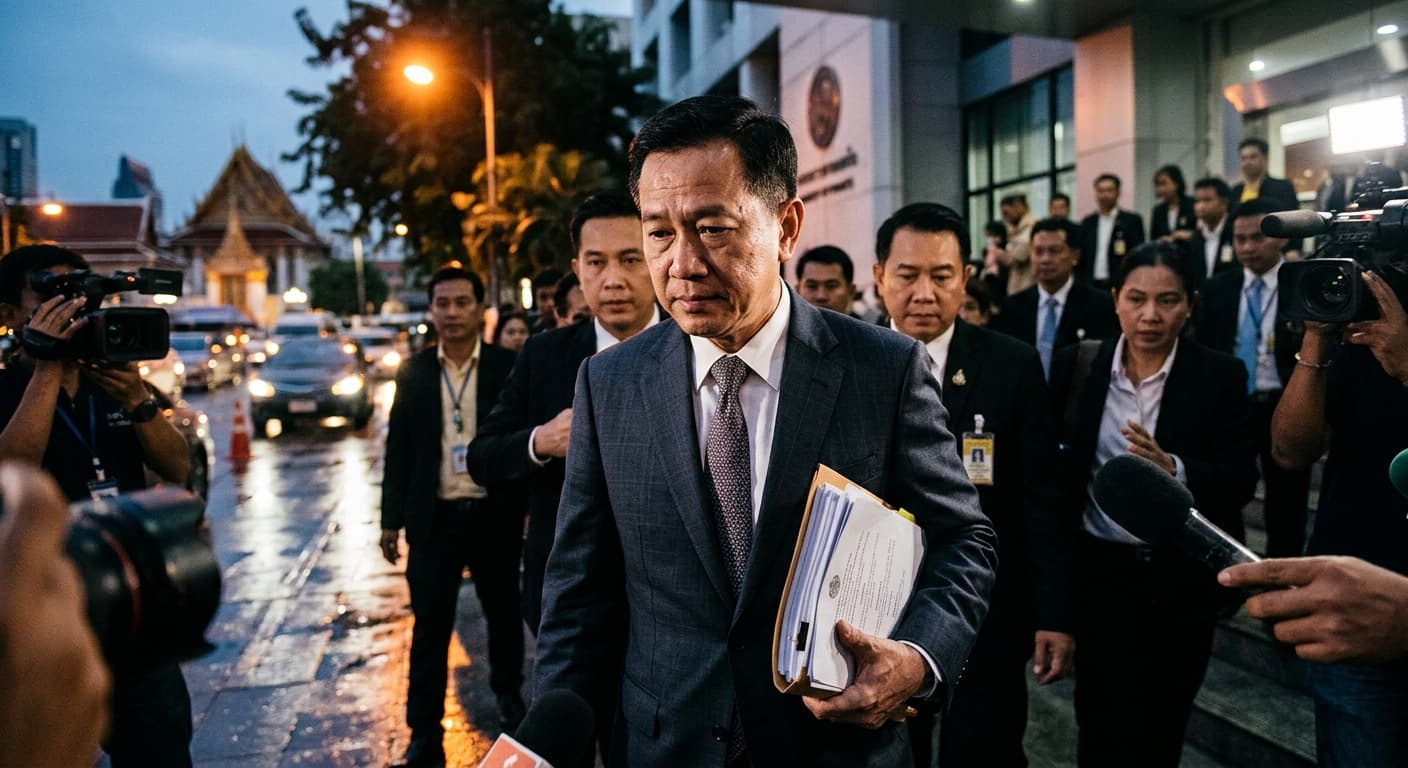
Thailand's 500bn Baht Deficit: Ekniti's Race to Avert a 1997 Rerun
Finance Minister Ekniti Nitithanprapas warns Thailand's current account has swung to a ~500 billion baht deficit in two months, forcing an oil-shock energy pivot before a July 9 court ruling.
Thailand's Finance Minister Ekniti Nitithanprapas told the country on July 7, 2026 that the current account had swung into a deficit of nearly 500 billion baht over April and May — a two-month reversal from the structural surplus Bangkok has run since the Asian Financial Crisis. His message, delivered on Facebook and picked up on the front page of the Bangkok Post, was blunt: unless the Anutin Charnvirakul government pushes through a 200-billion-baht clean-energy loan and a "Thailand FastPass" investment drive, the country risks "one crisis on top of another." The thesis of this piece: Ekniti is using an oil-shock external deficit to force a structural pivot he could not otherwise pass — and the Constitutional Court's July 9 ruling on the emergency loan decree will decide whether
Thailand rewires its energy stack or slides back into the balance-of-payments geometry that broke the baht in 1997.
The number itself is the story. In 2023, Thailand ran a current-account surplus of 1.4% of GDP; the IMF's 2025 Article IV projected the surplus to stabilise around 2.8% of GDP through the medium term, anchored by tourism receipts and electronics exports. Two months of surging crude and LNG import bills — a direct consequence of the Iran war and the Strait of Hormuz disruptions since mid-2025 — have inverted that picture. Roughly 40% of Thailand's oil and LNG imports transit Hormuz,
according to the Observer Research Foundation, and the Carnegie Endowment estimates
Thailand imports 69% of its oil consumption and 28% of its LNG/LPG from Gulf sources.
Why Ekniti reached for the 1997 comparison
The "current account crisis" reference is deliberate, and it should be read as political framing rather than a live forecast. In 1996, Thailand ran a current-account deficit of about 8% of GDP for the second consecutive year, financed by hot capital flows into property and finance companies; Peterson Institute analysis later identified that deficit as the primary early-warning signal missed before the July 1997 baht flotation. The 500-billion-baht two-month gap Ekniti cited is roughly 2.5% of quarterly GDP — closer to a shock than a crisis, but the direction of travel is what the minister needs voters and the court to see.
The parallel is imperfect, but the transmission channel is the same one that broke Thailand three decades ago: an external shock forces the central bank into a trilemma between defending the baht, cutting rates to support growth, and preserving reserves. The Atlantic Council's June 2026 assessment of the Asian energy crisis warned that "weaker currencies make energy imports more expensive, which further increases costs and intensifies pressure" — a negative feedback loop that Bangkok has not lived with in 25 years. The Bank of Thailand's Oil Fuel Fund is already in deficit sustaining diesel caps, and further borrowing is under discussion.
The court ruling that decides the strategy
The immediate leverage point is not the Bank of Thailand — it is the Constitutional Court. On July 9, 2026, nine justices are due to rule on whether the Anutin cabinet's 400-billion-baht emergency loan decree violates Thailand's 2018 Fiscal Responsibility Act, which restricts off-budget borrowing to genuine emergencies. Of that 400 billion baht, 200 billion is earmarked for grid expansion, rooftop-solar net metering, and EV/biodiesel promotion — the core of what Ekniti calls the "Transition Now" pillar of his "5T" framework.
Two petitioner groups have asked the court to strike the decree down as unconstitutional political spending. If it survives, the government gains fiscal room in a year when the general-government deficit is projected at 3.2% of GDP and public debt at 66% of GDP, according to the IMF's January 2025 Selected Issues paper. If it falls, Ekniti loses both the money and the political narrative that has kept his fragile coalition — Bhumjaithai plus reformist crossover support — in office.
The fiscal stakes are tight. IMF staff has warned that once contingent liabilities and climate-adaptation spending are included, the "adequate" debt ceiling for Thailand is closer to 66% of GDP than the current statutory 70%, in a Selected Issues paper published in May 2025. Thai Development Research Institute analysts note the public debt-to-GDP ratio has already risen from an average of 41.8% before COVID to 61.1% in 2021–2024,
with a "medium-term fiscal framework" projecting it to approach the ceiling. In other words: Ekniti is asking the court to bless one more push against the wall.
The regional read: who else is doing this playbook
Thailand's move is not idiosyncratic. Across ASEAN, the 2025–26 oil shock has forced governments to convert what were framed as long-term green transitions into short-term balance-of-payments defence. The Carnegie Endowment's April 2026 note on Southeast Asian agency called the crisis "a black swan" and warned that repricing of risk is inevitable unless alternative oil supplies materialise — which, it argued, "is quite unlikely." The Philippines has suspended fuel taxes; Indonesia is expanding LPG subsidies; Malaysia, less exposed at 25% import dependence, is exporting refined product to the region at a premium.
Thailand is the pivotal case for one reason: it is the largest ASEAN economy that combines high oil import dependence with a statutory debt ceiling and a fragile minority government. If Ekniti's decree survives the court, it becomes the template — off-budget financing for grid and EV infrastructure, dressed as emergency spending, blessed by an external shock. If it fails, Vietnam and the Philippines lose their most obvious argument for their own emergency energy borrowing programmes. That is the second-order effect the wires are missing.
The FDI pitch, and why Chinese money is not a clean win
The offset Ekniti is banking on is foreign direct investment. His "Thailand FastPass," modelled on Singapore's fast-track investment approvals, is targeting roughly 900 billion baht of actual FDI inflows this year, per Money & Banking Magazine. The
World Bank's February 2026 Thailand Economic Monitor confirms FDI applications nearly doubled in the first nine months of 2025, concentrated in EVs, batteries, data centres, and digital infrastructure. Growth is still projected at just 1.6% in 2026 before recovering to 2.2% in 2027.
The catch, flagged by TDRI, is composition. Where 1990s FDI was Japanese, integrated, and jobs-heavy, the post-COVID wave is dominated by Chinese conglomerates and hyperscale data centres that "rely more heavily on their own workers and supply chains, limiting spillovers to local labour and suppliers." Headline FDI numbers rise; local supply-chain benefits do not follow. Ekniti gestured at this in his own post, arguing the goal is not "merely to increase investment figures" but to connect Thai SMEs to global supply chains — an implicit acknowledgement that the FDI pipeline he needs to plug the current account gap may not do much for Thai wages.
That matters because domestic investment has collapsed from 40% of GDP before the 1997 crisis to roughly 20% today, and Ekniti's target of restoring investment to 30% of GDP requires both public capital (the 200-billion-baht loan) and private matching that is not yet showing up in the loan data. Business-loan growth averaged only 2.3% in 2021–2024 versus 4.3% before the pandemic, TDRI reports.
The political fragility underneath
Every piece of this strategy runs through a government that was not designed to last. Prime Minister Anutin Charnvirakul's Bhumjaithai Party won a surprise plurality in the February 8, 2026 snap elections, ahead of the reformist People's Party that most polls had leading. Anutin himself was first elevated to the premiership in September 2025 after the Constitutional Court removed Paetongtarn Shinawatra over a leaked call with Cambodia's Hun Sen — a sequence
documented in a Congressional Research Service brief for the U.S. Congress.
That court — the same one now weighing Ekniti's loan decree — has dissolved 34 political parties since 2006, most of them aligned with the Shinawatras or the reformist movement. It is not a body that has historically favoured heterodox fiscal manoeuvres by populist finance ministers. And the ruling coalition's parliamentary majority is thin; Bhumjaithai holds a plurality but depends on smaller conservative parties whose loyalty to a large off-budget borrowing programme is untested.
The math is that Ekniti's 5T framework — Target, Transition, Transform, Transparency, Together — is a coherent economic strategy competing for oxygen with the daily reality of a coalition government one court ruling from a confidence vote.
Diplomat View
Ekniti is not warning of a current account crisis. He is invoking one to move policy that would otherwise sit in a parliamentary queue for years. The 500 billion baht deficit is real; a full 1997-style crisis, on current reserves and floating-baht regime, is not the base case. Thailand held roughly $220 billion in foreign reserves at end-2025 and runs a floating exchange rate — two structural features that were absent in 1997 and that make speculative attack far harder to engineer. What is at risk is not the peg (there is no peg) but the medium-term current-account surplus that has anchored Thai macro stability since 2000.
Our call: if the Constitutional Court upholds the 400-billion-baht decree on July 9, expect the baht to stabilise, the Bank of Thailand to hold its policy rate through Q3, and Thailand's sovereign rating to be reaffirmed by year-end. If the court strikes the decree, Ekniti's position becomes untenable within weeks, the FDI pipeline slows as investors price in political drift, and Moody's downgrade risk — flagged by TDRI — moves from theoretical to imminent. We would revise this call if Brent crude sustains above $110/barrel through Q4 2026, or if the People's Party files a no-confidence motion before the court rules. Both would compress Ekniti's runway to nothing.
What to watch
- July 9, 2026 — Constitutional Court ruling on the 400-billion-baht emergency loan decree. This is the fulcrum for the entire strategy.
- August 2026 — Bank of Thailand Monetary Policy Committee meeting. A rate cut into an external deficit would signal the BoT is prioritising growth over the current account; a hold suggests it is watching the baht.
- September 2026 — First Board of Investment quarterly report on FastPass FDI conversions. The 900-billion-baht target requires roughly 225 billion baht of actual inflows per quarter to be credible.
The Bottom Line
Thailand is not facing a 1997-style crisis; it is facing a finance minister who needs the language of one to push through an energy-transition programme that a fragmented parliament and a hostile court would otherwise smother. The 500-billion-baht deficit is the leverage, the July 9 ruling is the choke point, and the "Thailand FastPass" is the offset. If Ekniti wins the court, ASEAN gets its template for oil-shock-financed decarbonisation. If he loses, Bangkok's macro story reverts to structural drift — and the region's most exposed importer will discover how much of its stability depended on a surplus that vanished in sixty days.
Discover more
India
Congress Accuses Modi of Stalling Women's Law
Congress accuses Modi of stalling women's reservation law by linking it to delimitation, revealing a deeper electoral strategy.
India
Rajnath Singh's Durga Squad for 2026 Polls
Rajnath Singh's Durga Squad promised women's safety in Bengal but has since disappeared from the agenda, revealing BJP's true priorities.
US Politics
Congress Targets AI Chatbot Access for Terror
The House passed the Generative AI Terrorism Risk Assessment Act, focusing on AI's role in terrorism and potential surveillance implications.

Conflict & Security
Drone Warfare Killing Aid Workers at Unprec
Over 1,000 humanitarian workers killed in three years as cheap armed drones collapse legal protections. Gaza, Sudan, Ukraine, and DRC see deliberate targeting of aid convoys and hospitals with zero prosecutions.