Taiwan's Warning on China's Expansionism
Taiwan urges global democracies to act against China.
Model Diplomat8 min readEast Asia
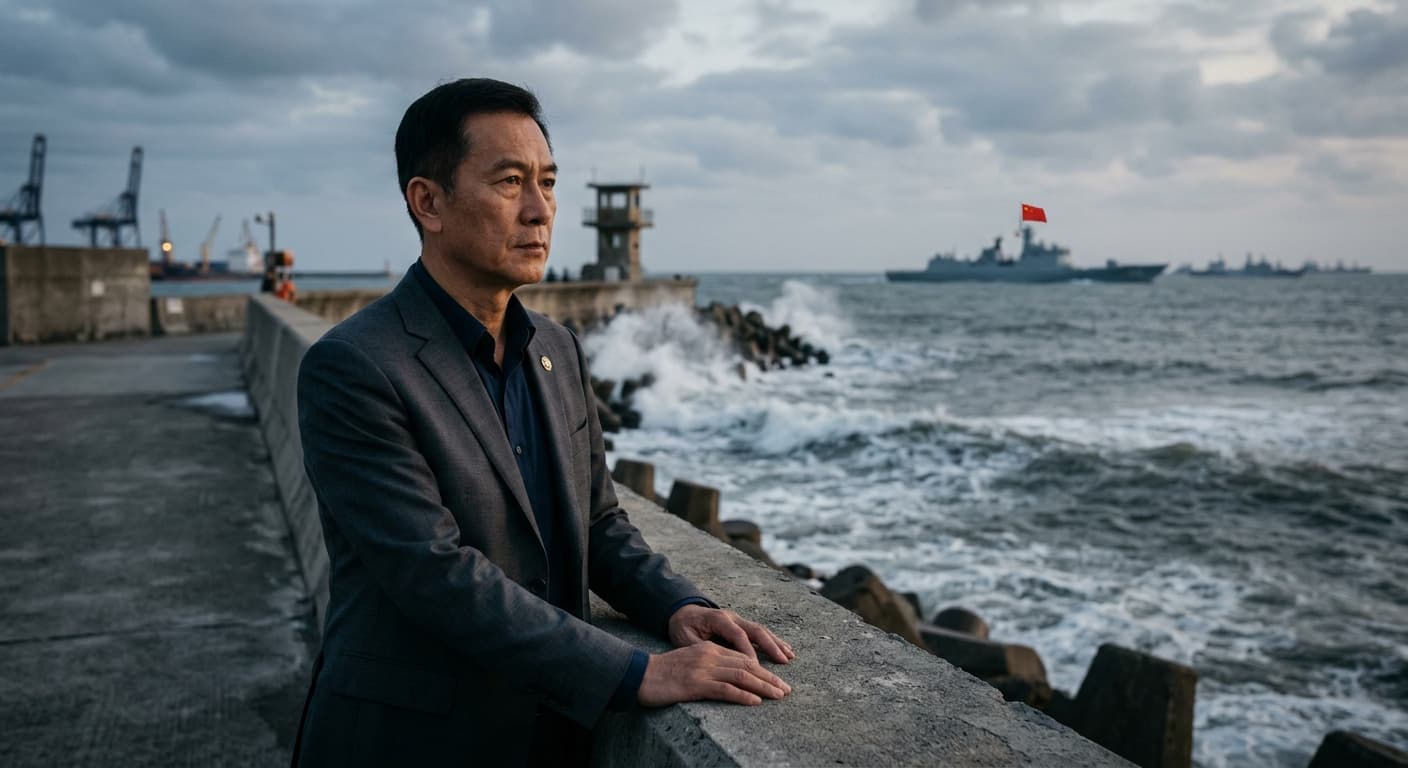
Taiwan warns China's 'salami slicing' will not stop without global action
Taiwan's National Security Council says China's maritime coercion around Taiwan, the Senkakus and the South China Sea will accelerate unless democracies push back — as US arms flows slow.
Taiwan's National Security Council warned on July 8, 2026 that China's "authoritarian expansionism" in East Asian waters will keep grinding forward unless the world's democracies raise the cost — a marker laid down at the precise moment the US arms pipeline to Taipei is stalled and Taiwan's own defence budget has been cut by roughly a third. Deputy Secretary-General Lii Wen told an international forum in Taipei that Beijing is "constantly pushing the limits through an incremental salami-slicing approach," using coast guard, maritime militia and research vessels to "transform international waterways into internal waters," according to The Straits Times. The warning is a policy signal, not a lament: Taipei is telling Tokyo, Manila and Brussels that the ring is closing while Washington is distracted, and that the next slice — persistent Chinese Coast Guard patrols east of Taiwan — is already being cut.
What Lii Wen actually said, and why the venue matters
The remarks were delivered on the sidelines of the Ketagalan Forum, Taiwan's flagship Indo-Pacific security convening, and the line-up was chosen for effect. Ocean Affairs Minister Kuan Bi-ling told the same forum that Taiwan, Japan and the Philippines faced the "same pattern of actions" that were "deliberately controlled to remain below the threshold of conventional warfare," per The Straits Times. US Democratic Senator Tammy Duckworth used the platform to urge partners to keep transiting waters Beijing claims and to "overtly reject" China's attempt to set new rules. Ocean Affairs Deputy Minister Sung Chen-en went further, telling AFP the new Chinese coast guard patrols east of Taiwan sat "within our exclusive economic zone" and pledging they would not become "permanent."
Read that in sequence and the choreography is clear: Taipei is not asking the world to notice. It is asking three specific capitals — Tokyo, Manila and Washington — to co-own the response before persistence congeals into precedent.
The trigger was the previous day. On July 7, Japanese and Chinese coast guard vessels squared off near the Senkaku/Diaoyu islands, with each side claiming to have driven the other from its territorial waters, Taipei Times reported. China Coast Guard vessels have now maintained a presence around the Senkakus on more than 330 days a year since 2020, according to the
Sasakawa Peace Foundation — a tempo Japanese scholars describe as an effort to "normalize constant presence" and undermine Tokyo's administrative control.
The June slice: patrols east of Taiwan
The specific move that put steel behind Lii's warning happened in June. The China Coast Guard began, for the first time, near-continuous patrols in waters east of Taiwan — beyond the first island chain — using talks between Japan and the Philippines to delimit their overlapping EEZ claims as the pretext. AEI's Institute for the Study of War tracking cell, citing Starboard Maritime Intelligence data, found CCG vessels operating there almost continuously since June 1. The PRC Ministry of Natural Resources' East China Sea Bureau deployed the research vessel Xiang Yang Hong 22 on a "marine environmental survey" east of Taiwan from June 16 to 18, and a state-media–linked account, Yuyuan Tantian, flagged that Beijing may treat that zone as PRC "near-shore waters."
The operational implication is the point. As the Atlantic Council documented after the April 2026 PLA exercise, the CCG is operationally controlled by the Eastern Theater Command's joint operations centre; extending its writ east of Taiwan frees PLA Navy assets for longer-range missions and rehearses the eastern arc of a future quarantine. This is the "Kinmen model" — the same coast-guard-as-jurisdiction template Beijing rolled out around Taiwan's outlying islands in February 2024 — expanded 300 kilometres seaward.
The CSIS Futures Lab's Geometry of Coercion study puts numbers on the trajectory: between January 2020 and December 2025, the daily average of distinct CCG vessels in Taiwan's near waters rose by more than 500%, and incursions into Taiwan's second maritime security ring more than quadrupled. What Lii Wen calls "salami slicing" is, in the data, an S-curve.
Why the warning lands now: the US insurance policy has asterisks
The reason Taipei's rhetoric has hardened is that its principal backstop has softened.
President Donald Trump and Xi Jinping met on May 15, 2026, and the summit — as Berlin's SWP assessed — produced no clarity on whether Washington will continue to backstop Taiwan. Beijing has since made cuts to arms deliveries a precondition for further talks. In May, a senior US military official said Washington was pausing a $14 billion Taiwan arms package to preserve munitions for the US-Israel campaign against Iran,
Al Jazeera reported.
The domestic picture is no more comforting. President Lai Ching-te's US$40 billion special defence budget was cut to roughly US$25 billion by the KMT-controlled Legislative Yuan in May 2026, according to a European Parliamentary Research Service briefing. Taipei's answer, unveiled in early July, is a new NT$210 billion (US$6.59 billion) package running to 2031, aimed at surveillance, coastal-attack and small unmanned surface drones — the "hornet's nest" model publicly endorsed on July 2 by de facto US ambassador Raymond Greene.
Put together, Beijing has read the signal: an unusually favourable window. The Australian Strategic Policy Institute's The Strategist argues that China, "comfortable in a truce with the US," is deliberately using the trade détente to squeeze Taipei harder on the diplomatic and maritime tracks.
The legal architecture Taipei is trying to build
Lii's "global action" is not a rhetorical flourish. It maps to a specific lawfare and coalition strategy Taipei has been advancing for two years.
First, the UN General Assembly Resolution 2758 fight. Taiwan and its European partners are working to erode Beijing's claim that the 1971 resolution — which seated the PRC at the UN — also settled Taiwan's status. The European Parliament resolution of October 24, 2024 formally rejected China's "misinterpretation" of Resolution 2758 and condemned coast guard actions against Philippine vessels in the South China Sea. That resolution is the primary document doing the diplomatic work behind Lii's warning.
Second, UNCLOS-anchored coordination. Taiwan's Institute for National Defense and Security Research has explicitly urged "pushing international lawfare" — using UNCLOS to challenge China's 2021 Coast Guard Law, which authorises weapons use in "waters under PRC jurisdiction," a phrase Beijing leaves deliberately elastic. The 2016 arbitral tribunal award under UNCLOS rejecting China's nine-dash line remains the load-bearing precedent; the July 8 forum was a push to keep it alive.
Third, coast-guard-to-coast-guard cooperation. The US FY2026 National Defense Authorization Act authorised deepened US Coast Guard training with Taiwan's Coast Guard Administration and directed the Pentagon to co-develop uncrewed and counter-uncrewed capabilities with Taipei, according to a US congressional primer on South China Sea disputes and the INDSR brief. The UK Foreign Office, in a December 2025
statement, reiterated that "any unilateral attempts to change the status quo" would be met with concern — language Taiwan actively lobbies for.
The forum on July 8 was, in effect, a coordinated push to convert those documents into standing operational patterns before the CCG's eastern patrols become routine.
The non-obvious angle: Pratas as the leading indicator
If there is a single laboratory for what Beijing intends around Taiwan proper, it is the Pratas atoll, roughly 400 kilometres southwest of Kaohsiung. The Observer Research Foundation's July 2026 assessment counted 39 Chinese incursions involving 12 different vessels around Pratas between February 2025 and May 2026, plus a January 2026 drone incursion designed to test Taiwan's response thresholds without triggering escalation. By 2025, satellite imagery showed at least twelve Chinese drilling and production platforms at the Vereker Banks, inside the Pratas EEZ — commercial infrastructure with dual-use surveillance and helicopter capability.
That is the template Taipei fears will be exported eastward: coast guard normalization, hydrocarbon and research installations to lock in presence, drones to probe. CSIS's Marshall Papers warned that a plausible Chinese objective is not "reunification" via invasion, but "a slice of salami that the United States and Taiwan will not be willing or able to defend" — the seizure or de facto annexation of an outlying island that produces a Western non-response and shreds deterrence credibility across the first island chain.
What to watch next
- Han Kuang 41 exercise (July 9–18, 2026): Taiwan's largest annual war game, restructured this year to simulate rapid transitions from grey-zone coercion into full blockade and invasion scenarios; the drill's realism, and PLA response to it, will signal whether Beijing views the current tempo as sufficient or plans a July–August escalation cycle.
- US$14 billion arms package status: whether the Pentagon un-pauses the sale before the FY2027 budget process opens in September will be the clearest test of whether the Iran diversion is temporary or structural.
- Fujian carrier full combat certification (expected late 2026): Beijing's third carrier reaches operational capability. A first "far-sea" training deployment east of Taiwan would harden the perimeter Lii Wen described from a coast-guard presence into a naval one.
- Japan-Philippines EEZ delimitation talks: any signed instrument gives Tokyo and Manila legal standing to jointly protest PRC operations east of Taiwan — the coalition Taipei is quietly counting on.
Diplomat View
The July 8 warning is not the plea it reads as. It is Taipei publicly committing Tokyo, Manila and Brussels to a coordinated maritime response before the CCG's eastern patrols acquire the same "constant presence" status China has manufactured around the Senkakus — 330-plus days a year, uncontested in law, contested only at sea. Our forecast: absent a formal Japan-Philippines EEZ instrument or a US Coast Guard joint patrol inside Taiwan's contiguous zone by year-end, Beijing will treat waters east of Taiwan as de facto Chinese jurisdictional space by mid-2027, matching the Kinmen and Pratas timelines. The forecast would flip if three conditions arrive together: the paused $14 billion US arms package clears; the Legislative Yuan restores at least half of the cut defence spending; and the G7 issues explicit language endorsing UNCLOS jurisdiction in waters east of Taiwan. Nothing on the current calendar suggests all three. The Ketagalan Forum was Taipei's last low-cost off-ramp before the ring closes.
The Bottom Line
Taiwan's warning is a bet: that a coalition of second-tier powers — Japan, the Philippines, the EU — can substitute for a distracted Washington in denying Beijing the eastern maritime perimeter it is quietly locking in. If the bet fails, the operative fact about the Taiwan Strait by 2027 will not be whether an invasion is coming — it will be that a de facto quarantine perimeter already exists, built with white hulls and research ships while nobody fired a shot.
Discover more

US Politics
White House Pressures Congress for Crypto Leg
The Trump administration's push for the CLARITY Act aims to reshape crypto regulation, impacting trillions in market value and the Trump family's wealth.
US Politics
Washington's Scrutiny of Iran War Prediction
The Iran war prediction market scandal exposes political ties and regulatory challenges in Washington, as insider trading concerns rise.

US Politics
US Military Funding Request for Iran Looms
The White House Budget Director signals a formal funding request for military operations against Iran, foreshadowing rising tensions and congressional clashes.

Conflict & Security
Drone Warfare Killing Aid Workers at Unprec
Over 1,000 humanitarian workers killed in three years as cheap armed drones collapse legal protections. Gaza, Sudan, Ukraine, and DRC see deliberate targeting of aid convoys and hospitals with zero prosecutions.