Taiwan Warns of New Indo-Pacific Status Quo
Taiwan's minister highlights China's maritime pressure tactics.
Model Diplomat7 min readIndo-Pacific
China's 'Kinmen Model' Goes East: Taipei Warns of a New Indo-Pacific Status Quo
Taiwan's ocean affairs minister says Beijing's gray-zone playbook is quietly rewriting maritime norms from Kinmen to Pratas to the waters east of Taiwan — before the world reacts.
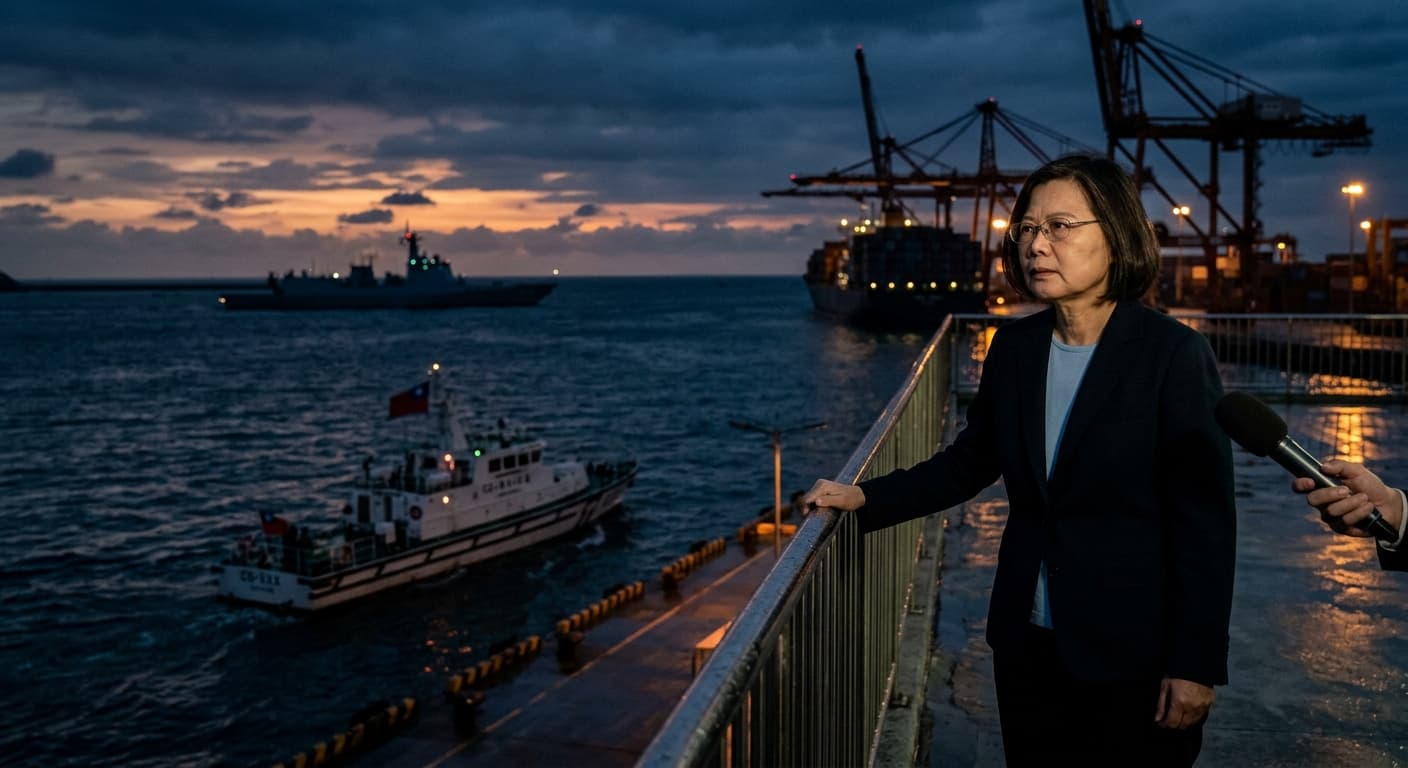
Taiwan's Ocean Affairs Council Minister Kuan Bi-ling warned on July 8, 2026 that China's incremental maritime pressure risks locking in "an entirely new status quo" in the Taiwan Strait before allies notice it has changed — a claim the underlying data now supports. Chinese Coast Guard (CCG) patrols east of Taiwan have run near-continuously since June 1, days at station around Pratas Island jumped from 25 in 2024 to 60 in 2025, and Beijing has explicitly cited Japan–Philippines maritime boundary talks to justify law-enforcement operations beyond the first island chain. The angle worth reading past the wire copy: Taipei is no longer arguing that gray-zone tactics might redraw regional norms. It is telling democratic partners that the redrawing has already begun, and that the reference case is no longer the Taiwan Strait but the entire arc from the Senkakus to Scarborough Shoal.
Kuan made the warning at the Taiwan International Ocean Forum in Taipei, where U.S. Senator Tammy Duckworth sat in the audience and Taiwanese national security officials laid out a case that the same pattern — coast guard patrols, survey ships, maritime militia, "law-enforcement" broadcasts — is now being applied around Japan and the Philippines in near-identical form, according to the Taipei Times. Reuters, in coverage carried by
Head Topics, quoted her arguing that international shipping and insurance markets are already pricing in the new baseline. That is the story: not the rhetoric, but the fact that the private sector has begun to price coercion Beijing has never formally declared.
The evidence: a status quo built quietly, 400 nautical miles at a time
The pressure curve is not subtle. According to a CSIS Futures Lab report, The Geometry of Coercion, the daily average of distinct China Coast Guard vessels entering Taiwan's near waters rose more than 500 percent between January 2020 and December 2025; incursions into Taiwan's second maritime security ring more than quadrupled. PLA aircraft flew 3,764 sorties into Taiwan's Air Defense Identification Zone in 2025, a 22.4 percent increase on 2024's record year, per the
ChinaPower Project at CSIS.
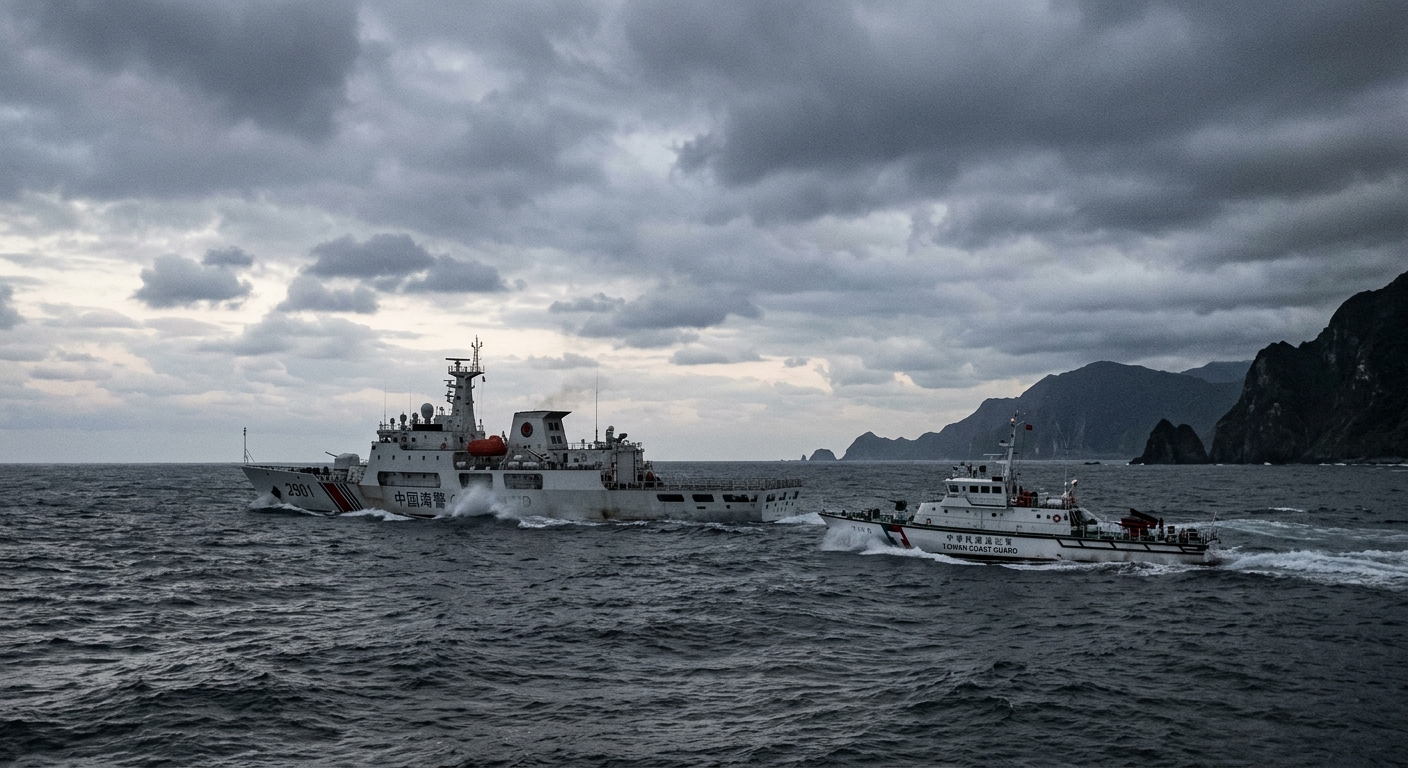
The maritime numbers matter more than the sortie count. Taiwan's own 2025 National Ocean Policy White Paper, summarised by CSIS, documented 679 unauthorised CCG transits into Kinmen and Matsu restricted waters in 2024 — the operational template Beijing calls the "Kinmen model." The Asia Maritime Transparency Initiative shows the model migrating outward: CCG and Maritime Safety Administration ships spent 60 days on-station in Pratas waters in 2025, versus 25 the year before and effectively zero in 2021, according to
AMTI.
The June 2026 escalation is what turned Kuan's warning from familiar to urgent. Between June 1 and June 18, per an American Enterprise Institute tracking brief, the CCG maintained near-continuous patrols east of Taiwan while the research vessel Xiang Yang Hong 22 ran a "marine environmental survey" in the same waters. On June 6, a CCG cutter and survey ship staged a coordinated 34-hour standoff off the Pratas Islands, broadcasting that "Taiwan's future lies in national reunification" — the first joint law-enforcement operation of its kind,
RUSI reported. Beijing's stated pretext: EEZ delimitation talks between Manila and Tokyo, which overlap with PRC claims east of Taiwan.
The angle: the "Kinmen model" is now a regional export
Read alone, each incident is minor — no shots fired, no casualties, a fishing boat expelled, a standoff ended. Read as a series, they are the same operational grammar being tested in three theatres at once.
Around the Senkakus, China Coast Guard vessels now enter contiguous or territorial waters at a pace Tokyo describes as unprecedented, while three new oil and gas platforms have gone up in the East China Sea over the past year, AMTI documented in June. Around Scarborough Shoal and Second Thomas Shoal, Beijing has declared a "natural reserve," used water cannons on Philippine resupply missions, and, per Congressional testimony from FDD's Craig Singleton before the Senate Foreign Relations Committee, pursued a "slow-motion campaign to coerce and condition" the region,
Senate.gov shows. Around Taiwan's outlying islands, the CCG has moved from Kinmen to Matsu to Pratas to waters east of Hualien in roughly 24 months.
The connective tissue is a Chinese state-media argument, first floated by the CCTV-affiliated account Yuyuan Tantian in 2024 and reprised on June 20, 2026, that these are "near-shore waters" subject to routine PRC "law enforcement." That framing matters because it converts military coercion into a jurisdictional claim — the kind of documentary record that, cited enough times, becomes evidence of "effective control" under international law.
Taiwan's National Security Council official Lii Wen called this "authoritarian expansionism" designed to "gradually transform international waterways into internal waters," in remarks reported by The Epoch Times. The Congressional Research Service, in its
current Taiwan brief, reaches the same functional conclusion: PRC leaders "would prefer to gradually assume control over Taiwan through gray zone coercion and political warfare rather than risk a large-scale conflict."
Why the private sector matters more than the fleet math
The novel element in Kuan's July 8 speech was the invocation of shipping and insurance. That is not rhetoric — it is where a jurisdictional claim becomes a market fact. Marine insurers already charge war-risk surcharges for transits of the Taiwan Strait; if the "near-shore waters" framing east of Taiwan hardens, underwriters will start pricing Chinese permission, not Taiwanese permission, into rates on the Bashi Channel and the deep-water approaches to Kaohsiung and Keelung. That is the moment at which a gray-zone claim becomes a de facto sovereignty transfer — long before any shot is fired.
A Brookings analysis by Ryan Hass and Stephen Tan makes the sharper point: Washington and Taipei have "failed to deter Chinese coercion below" the invasion threshold, and Taiwan's default response — scrambling jets and frigates to shadow every incursion — is draining readiness that would matter in a real crisis, Brookings argues. In January 2026, a PLA drone crossed Taiwan's territorial airspace over Pratas for the first time in decades, per an
AEI update — and Taiwan's response, absent effective interceptors at that range, was diplomatic.
The counter-view, worth surfacing: the Royal United Services Institute notes that Taiwan's status itself constrains the response. States that endorse Beijing's "One China" principle treat coercion as an internal matter, and Taiwan risks isolation if it "escalates" in ways even friendly capitals dislike, RUSI writes. This is precisely the ambiguity Beijing exploits.
What Washington and its allies are doing — and where the gap sits
The U.S. National Defense Authorization Act for Fiscal Year 2026 directs deepened Coast Guard–to–Coast Guard training with Taiwan and a joint program on unmanned and counter-unmanned systems, according to Taiwan's INDSR Defense Security Brief. The U.S. Department of Defense's
2025 Annual Report to Congress reiterates Xi Jinping's directive for the PLA to be capable of a Taiwan operation by 2027 — the reference date under which every gray-zone escalation is being timed.
But the gap is at the coast-guard-to-coast-guard level. The CCG is the world's largest, with roughly 150 oceangoing vessels; Taiwan's Coast Guard Administration is building 141 hulls under a program that runs to 2027, CSIS has noted. Duckworth's presence in Taipei this week was, in that sense, less about the forum and more about signalling that a bipartisan Senate coalition is prepared to push CCG capacity-building through Congress even as the Trump administration equivocates on the arms package — a dynamic the senator's
own office framed as the first post-summit congressional visit.
The Manila Bulletin's Indo-Pacific coverage, summarising remarks by Philippine Defense Secretary Gilberto Teodoro at the Shangri-La Dialogue, notes he now openly discusses Philippines–
Taiwan coordination in "non-taboo areas" — a marked shift from Manila's traditional silence, and one Beijing has publicly demanded he "rein in."
Diplomat View
Kuan's warning should be read as a policy prompt, not a lament. The specific bet Taipei is placing is that documenting the campaign in aggregate — not incident by incident — will force allies to respond to the sum rather than the parts. That is a falsifiable strategy. If, by the end of 2026, the U.S., Japan, the U.K., and the EU issue a coordinated statement naming the CCG's east-Taiwan patrols and the Pratas standoffs as unlawful under UNCLOS, and if insurance markets hold the Bashi Channel at pre-2026 rates, the bet is working. If instead the Trump administration continues to treat gray-zone incursions as bilateral cross-Strait noise, and Japan–Philippines EEZ talks stall under Chinese pressure, then Beijing will have proven that "war behind the scenes," in RUSI's phrase, can deliver jurisdictional gains that a war cannot. Revisions to this forecast should trigger on two conditions: a CCG boarding of a Taiwan-flagged vessel in international waters, or a Japanese Coast Guard use-of-force incident around the Senkakus. Either would collapse the ambiguity Beijing depends on.
What to watch next:
- August 2026 — Han Kuang exercises. Taiwan's largest annual war games; the drill scenario now explicitly includes rapid transition from "routine" gray-zone activity to invasion, per
AEI.
- Autumn 2026 — Japan–Philippines EEZ delimitation round two. The pretext Beijing has already used to justify east-of-Taiwan patrols; any signed framework text will draw a fresh CCG response.
- FY27 U.S. defense authorization markup. Watch whether Congress adds standalone authorities and appropriations for U.S. Coast Guard training and joint patrols with Taiwan's CGA — the single most testable metric of whether Washington has absorbed Taipei's argument.
The Bottom Line
China is not waiting for a Taiwan war to redraw the Indo-Pacific map — it is redrawing it now, one coast guard patrol at a time, and the "Kinmen model" is being exported east and south faster than Washington's deterrence framework is being updated. The decisive variable over the next 18 months is not the PLA's invasion clock but whether allied coast guards, insurers, and legislatures treat Beijing's incremental jurisdictional claims as the strategic act they are. If they do not, the status quo Kuan Bi-ling warned about on July 8 will have hardened before it was ever formally declared.
Discover more

US Politics
White House Pressures Congress for Crypto Leg
The Trump administration's push for the CLARITY Act aims to reshape crypto regulation, impacting trillions in market value and the Trump family's wealth.
US Politics
Virginia's Redistricting Referendum
Virginia's redistricting referendum is drawing a flood of dark money, shaping future elections and the fight for congressional control amid party stakes.
US Politics
Washington's Scrutiny of Iran War Prediction
The Iran war prediction market scandal exposes political ties and regulatory challenges in Washington, as insider trading concerns rise.

Economics
Fed's Amex AML order puts correspondent banking on notice
Federal Reserve's Amex AML order requires board-level controls and a 90-day plan; OCC fined the bank $350 million over enterprise-wide deficiencies.