Senegal's Sonko Gains Power Amid Debt Crisis
Ousmane Sonko's speakership reshapes Senegal's political landscape.
Model Diplomat8 min readAfrica
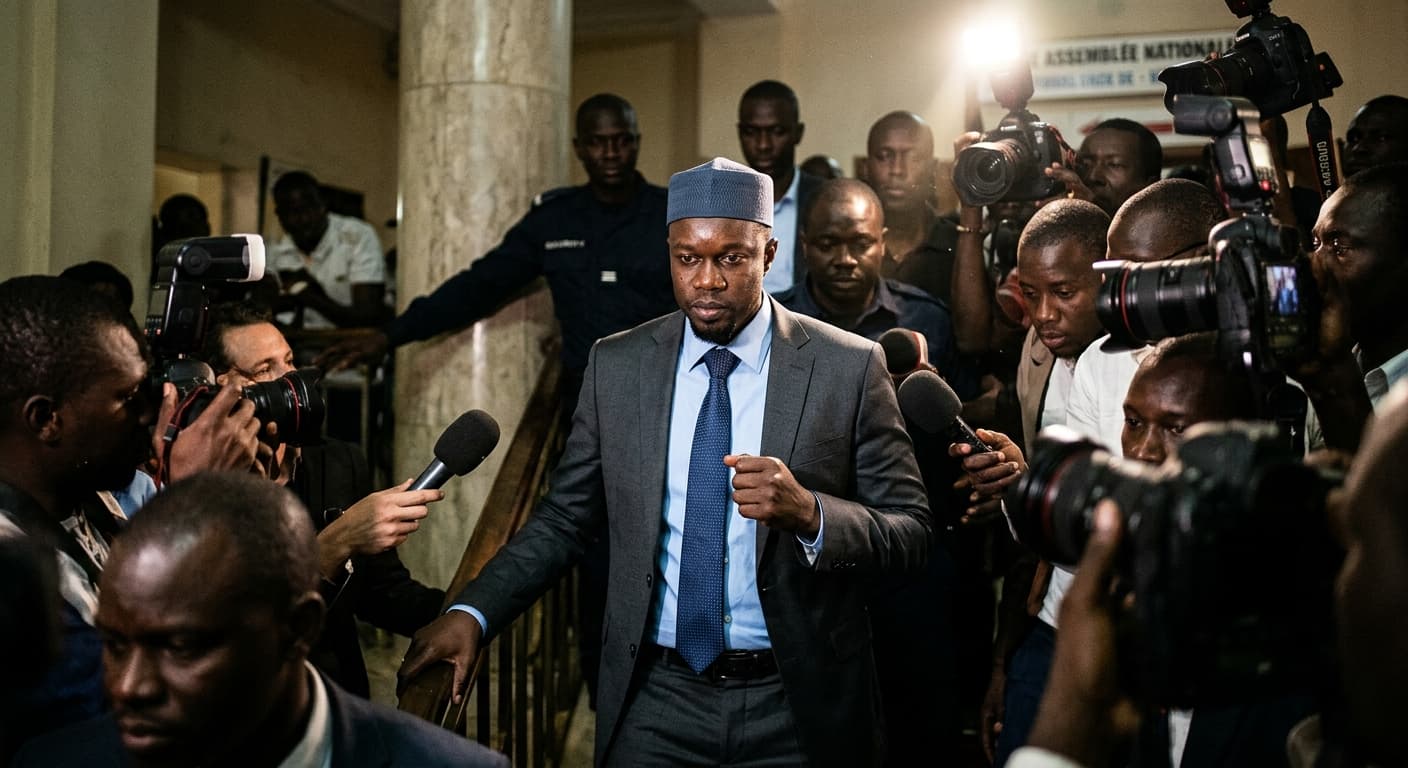
Senegal: Sonko's Speakership Turns a Debt Crisis into a Cohabitation
Ousmane Sonko's election as Speaker on May 26 hands Pastef veto power over any IMF deal, splitting Senegal's executive as public debt hits 132% of GDP.
Ousmane Sonko was elected Speaker of Senegal's National Assembly on May 26, 2026 with 132 of a possible 165 votes — four days after President Bassirou Diomaye Faye sacked him as prime minister. The vote does more than reshuffle Dakar's political furniture: it hands the man who publicly rejected an IMF debt restructuring the second-highest office in the republic, and a legislative chokehold over every budget line, subsidy cut and Eurobond rollover Faye needs to close a deal with the Fund. Senegal now has two competing governments — a technocratic presidency negotiating with Washington, and a Pastef-controlled parliament that can rewrite whatever they sign. That is the story, and the reason it matters far beyond Dakar.
From "Diomaye moy Sonko" to cohabitation
The pair rode to power together in March 2024 under the slogan "Diomaye is Sonko, Sonko is Diomaye" — Faye standing in after Sonko was barred by a defamation conviction. Within 26 months, the alliance has inverted. Faye fired Sonko on May 22, dissolved the cabinet, and on May 25 appointed Ahmadou Al Aminou Lo, a 60-year-old former senior official of the Central Bank of West African States (BCEAO), as prime minister. According to BBC Afrique, Lo spent his career at the BCEAO from 1987, running market operations and later serving as national director for Senegal, before becoming minister secretary-general of Faye's government in April 2024. He is the anti-Sonko: a technocrat whose CV was built inside the WAEMU monetary union Sonko has spent a year criticising.
Sonko's counter-move was faster. Speaker El Malick Ndiaye, a Pastef loyalist, resigned on May 24 citing a "sense of duty," a phrasing Al Jazeera treated as choreography. Two days later, in a session boycotted by the opposition, Sonko ran unopposed. The presiding member, Ismael Diallo, recorded no votes against and one abstention. Aissata Tall Sall, who leads the main opposition, called it an "institutional coup" prepared under duress, arguing on the record that Sonko should have formally resigned as prime minister before returning to a legislative seat.
Legally, the manoeuvre is now settled. Politically, it created what the Carnegie Endowment calls "two openly competing centers of power at a critical moment." On June 1, Sonko announced Pastef would not sit in Lo's cabinet. On June 6, Pastef's inaugural congress confirmed him as party president. Faye, who remains a Pastef member but no longer holds a party role, controls the state but not the machinery that elected him.

The 132% number that started the fight
The proximate cause of the rupture is a single figure. Senegal's public-sector debt hit roughly 132% of GDP at end-2024 on the IMF's consolidated measure — up from around 74% previously reported. The revelation came from a September 2024 audit ordered by the new Pastef government. The Court of Auditors' report, published in February 2025, found "hidden" deficits averaging about 5.5% of GDP between 2019 and 2023 under President Macky Sall, according to VoxDev's technical review of the audit. The IMF called it a "conscious decision" to mask the true stock and, as
Al Jazeera reports, froze a $1.8 billion Extended Fund Facility/Extended Credit Facility programme approved in June 2023 — after $700 million had already been disbursed.
That programme, whose terms are laid out in the IMF Executive Board press release of June 26, 2023, was anchored on reaching a 3% fiscal deficit by 2025 and putting debt on a downward path. Those anchors are now fiction. A November 2025 CEPR working paper on Senegal's optimal-default choice,
DP21322, models the revelation as an exogenous 50-percentage-point upward shift in debt and concludes the corrected stock "exceeds the model's repayment region, implying that default would have been optimal from 2023 onward." A separate
CEPR paper argues avoiding restructuring is possible only under "narrow — and to some extent — unlikely" assumptions, requiring extreme fiscal compression and heavy WAEMU support.
Faye read those numbers and moved toward Washington. Sonko read the same numbers and told a Pastef meeting on November 8, 2025 that he had rejected the IMF's proposed restructuring. Bond markets punished the position immediately: Senegal's 2031-dollar bonds fell 4% to $73.10 on November 10, and credit-default swaps almost doubled to 1,120 basis points, according to Al Jazeera's reporting citing Oxford Economics analyst Leeuwner Esterhuysen, who said the market was "clearly" pricing distress.
Sonko compounded the divergence by opposing Finance Minister Cheikh Diba's proposal to raise fuel prices — a move needed to close a projected $2 billion subsidy gap — and pushing renegotiation of oil and gas contracts with the majors operating in the Sangomar and GTA fields. Faye, per Carnegie's account, agreed to personally oversee debt talks with a target of an outline agreement by June 30. That target has now slipped into July with no announced breakthrough.
The constitutional maths favour Sonko
The president's problem is that dismissing Sonko did not remove him — it relocated him. Pastef holds 130 of 165 National Assembly seats. Any IMF programme requires budget legislation, tax changes, subsidy reform and, likely, borrowing authorisations that must clear that chamber. Sonko chairs it.
Faye's escape hatches are narrow. Under Article 87 of the constitution, the president cannot dissolve parliament until two years after its first session — held in December 2024 — meaning the earliest dissolution date is roughly December 2026, as the BBC and Carnegie both confirm. Article 52 emergency powers exist, but any decree lapses within 15 days unless ratified by the assembly Sonko now runs. And Pastef has already moved to narrow the presidency further: on June 29, MPs passed a constitutional overhaul that, according to the
BBC, would create a Constitutional Court, bar a sitting president from leading a party, expand parliamentary investigative powers and require disclosure of natural-resource contracts to the legislature. Justice Minister Moussa Sarr announced Faye would send the text to a national referendum under Article 103.
BBC Afrique notes the reform would also let the prime minister chair the Council of Ministers by presidential delegation — a shift toward semi-presidentialism with Sonko's fingerprints on it.
The Brookings Institution, in a June 2026 analysis by Alexander Noyes and Louison Sall, frames the risk plainly: "Sonko's hold over Pastef and the National Assembly could doom any IMF deal, which requires parliamentary approval. This is particularly worrying as two Eurobond deals are due in June and July 2026, respectively, on which Senegal could default."
The non-obvious angle: this is a WAEMU problem, not just a Senegalese one
The consensus reading of the Faye–Sonko split treats it as a domestic sovereignty drama. That misses the balance-sheet exposure sitting north of Dakar. Because Senegal is inside the WAEMU monetary union, its financing is not just a national issue — it is a regional one. VoxDev's analysis notes that after the IMF froze its programme, Dakar effectively lost access to international capital markets and became "increasingly reliant on domestic and WAEMU regional market financing to cover large gross financing needs" — with some collateralised, opaque bank lending filling gaps.
That matters for the Speaker. Ahmadou Al Aminou Lo's entire career was spent inside BCEAO, the central bank underwriting that regional exposure. Faye did not appoint him because he is a debt hawk in the abstract; he appointed him because Lo is the person WAEMU peers trust to prevent contagion into Ivorian, Beninese and Togolese paper. Sonko's counter-move — refusing restructuring and rejecting fuel-subsidy reform — pushes precisely the risks Lo was hired to contain onto the shared currency zone. That is why the CEPR debt-strategy paper explicitly warns that a no-restructuring path would require "large net financing from regional banks, thus transferring risks to the monetary union."
The under-appreciated audience for Senegal's constitutional theatre, in other words, sits in Abidjan and at BCEAO headquarters in Dakar. If Sonko forces default without a Common Framework treatment involving France and China — Senegal's principal bilateral creditors — the shock does not stop at the Casamance.
What Sonko wants, and what he'll trade
The Speaker's game plan is not opaque. An electoral-code amendment passed by the National Assembly in April 2026 removed the conviction-based barrier that kept Sonko off the 2024 ballot. If Faye signs, Sonko can run in 2029; if he refuses, Sonko gets a fresh grievance. As Carnegie put it, "Sonko gains an additional grievance narrative atop an already formidable political platform." At the June 6 Pastef congress, Sonko declared, "Le PROS — President Ousmane Sonko — is back among you, and Senegal is going to shake."
Sonko's incentives therefore run the wrong way for stabilisation. Every fiscal concession Faye makes to the IMF strengthens Sonko's sovereignty narrative for 2029; every default risk Sonko manufactures raises Faye's domestic cost. The Pastef Speaker does not need to govern — he needs Faye to look like he cannot.
That is why the historical parallel is not Sall's 2024 election delay. It is the Kenya finance-bill protests of June 2024 and Madagascar's 2025 collapse — youth-led movements that turned IMF-adjacent reforms into regime crises. Sonko has both the street and the gavel. Faye has neither.
What to watch next
- IMF talks by end-July 2026. Finance Minister Cheikh Diba told parliament, before Sonko's dismissal, that Dakar hoped for agreement on "key points" by June 30. That deadline has already passed. The next credible marker is a staff-level agreement — or its absence — as the IMF's Article IV cycle progresses. IMF Managing Director Julie Kozack briefed the press on Senegal on June 4, 2026, per the
Fund's country page, signalling continued engagement without breakthrough.
- The July Eurobond payment. Brookings flags a second Eurobond due in July 2026; a missed coupon would move Senegal from "distressed" to formally defaulted and force the IMF's hand on the frozen $1.8 billion package.
- The referendum on Pastef's constitutional overhaul. No date has been set. If Faye delays, Sonko will call it obstruction. If he holds it and loses, his presidency effectively ends.
- December 2026. The earliest date Faye can dissolve parliament under Article 87. A snap election would be a Sonko–Faye proxy war — and, on current polling logic, Pastef would win it.
Diplomat View
The forecast: Faye cannot govern through Sonko's parliament, and Sonko has no incentive to let him. Expect a partial IMF staff-level agreement by autumn 2026 that Faye signs and that Pastef's Assembly then guts in implementation — the worst of both worlds for creditors. A missed Eurobond coupon in the July–October window is now the base case rather than the tail. The referendum, if held before year-end, is likely to pass and lock in a semi-presidential drift that turns Faye into a caretaker until 2029. What would change this call: a formal Faye–Sonko truce restoring Pastef cabinet participation before the referendum date; a Common Framework treatment engaging Paris and Beijing that gives Sonko political cover to accept restructuring; or a Constitutional Council ruling that Sonko's speakership was procedurally void — the last of which the opposition has flagged but not yet litigated. Absent one of those, Africa's "democratic beacon" is heading into cohabitation with a hostile Speaker, a shared currency zone absorbing the risk, and 2029 already on the ballot.
Read today's full |
Discover more
India
Rajnath Singh's Durga Squad for 2026 Polls
Rajnath Singh's Durga Squad promised women's safety in Bengal but has since disappeared from the agenda, revealing BJP's true priorities.
US Politics
SNAP Food Assistance Faces Legal Challenges
In 2026, SNAP faces stricter eligibility rules and mounting legal challenges, threatening food assistance for the millions of Americans who rely on the program.
US Politics
Congress Targets AI Chatbot Access for Terror
The House passed the Generative AI Terrorism Risk Assessment Act, focusing on AI's role in terrorism and potential surveillance implications.

Conflict & Security
Drone Warfare Killing Aid Workers at Unprec
Over 1,000 humanitarian workers killed in three years as cheap armed drones collapse legal protections. Gaza, Sudan, Ukraine, and DRC see deliberate targeting of aid convoys and hospitals with zero prosecutions.