Senegal Hires Lazard, Signaling Debt Restruct
Dakar ends denial on debt restructuring as Lazard appointment signals creditor talks ahead.
Model Diplomat8 min readAfrica

Senegal Hires Lazard: The Tell That Restructuring Resistance Is Over
Senegal's expected appointment of Lazard as debt adviser signals Dakar has stopped resisting a restructuring the bond market already priced in — the fight now is whether a deal can pass a parliament run by the president's ousted rival.
Senegal is set to name Lazard as financial adviser on its debt, three sources confirmed on July 16, 2026, in a move that quietly ends 18 months of official resistance to restructuring. The hiring — alongside Paris-based Global Sovereign Advisory, already retained in November 2025 — is the standard precursor to creditor talks, and the bond market has been trading Senegal's paper at 52 to 58 cents on the dollar for weeks. The appointment is the moment Dakar stops pretending restructuring is off the table. What remains unresolved is whether any deal can survive a National Assembly now controlled by Ousmane Sonko, the prime minister President Bassirou Diomaye Faye dismissed in May.
The numbers driving the decision are stark. A court-ordered audit in February 2025 found that former president Macky Sall's administration had concealed roughly $7 billion in borrowing — a figure later revised to exceed $13 billion, pushing debt-to-GDP from under 75 percent to between 119 and 132 percent depending on the measure, according to Foreign Affairs. The IMF, which had approved a $1.8 billion facility in June 2023 and already disbursed $700 million, suspended the program after endorsing auditors' conclusion that the understatement was a "conscious decision" by the Sall government, as
Al Jazeera reported. S&P downgraded Senegal to CCC+ in November 2025, citing "precarious" public finances and the absence of a comprehensive support program.
The Debt Inheritance and the End of Denial
Until this week, Dakar's official line was that restructuring was a "disgrace" — Sonko's word — and that the country could muddle through on domestic tax mobilization and regional WAEMU market borrowing. The Lazard appointment, reported by Boursorama via Reuters, drops the pretense. As the IMF's own Sovereign Debt Restructuring Playbook notes, mandating financial and legal advisors is Step Zero before any formal restructuring launch: "Given the complexities of sovereign debt restructurings, it is essential to hire a law firm and a financial advisory firm with significant expertise in this area," the
IMF Global Sovereign Debt Roundtable guidance states.
The bond market reached the same conclusion before the government did. Citi analysts told clients on July 15 that "a renegotiation of the debt will be necessary" and that "a significant nominal haircut" on external debt would be required, according to the Boursorama report. Senegal's euro- and dollar-denominated Eurobonds trade at 52 to 58 cents, down as much as 0.8 cent on the day of the announcement. That is distressed territory — a level where investors price in principal losses, not mere maturity extensions.
The academic literature backs the market's verdict. A March 2026 CEPR paper by Louphou Coulibaly and Abdoulaye Ndiaye applied a quantitative sovereign default model to Senegal's 2024 debt audit, which revised government debt upward by 50 percentage points of GDP. Under their baseline calibration, "the corrected debt stock exceeds the model's repayment region, implying that default would have been optimal from 2023 onward — before the audit was conducted." The paper places Senegal near the default boundary, where "a 3 percent adverse income shock would make restructuring optimal within a year," as the CEPR publication notes. In other words: the debt was unsustainable before anyone admitted it.
Why Lazard, and Why Now
Lazard's Sovereign Advisory Group is the dominant restructuring adviser for emerging-market sovereigns. Managing director Eric Lalo has "advised numerous sovereign and quasi-sovereign clients across Europe, Africa, Central Asia and Latin America in Capital Raising transactions, Debt Restructurings (Paris & London Clubs), Banking Sectors Reorganizations, and Credit Rating enhancement strategies," according to his World Bank biography. The firm has guided workouts from Ukraine in 2015 to Ghana, Zambia, and Sri Lanka in the current Common Framework cycle. Its research shapes how the market thinks about creditor coordination: a Lazard white paper cited by the
Council on Foreign Relations argues that bondholder concentration — a handful of large asset managers like BlackRock, Fidelity, and Ashmore — makes coordinated restructurings more feasible than the "atomized creditors" narrative suggests. Lazard's own Thomas Lambert, a managing director in the Sovereign Advisory Group, discussed these practitioner lessons in a
Sciences Po DebtTalks episode on recent restructuring cases.
The pairing with Global Sovereign Advisory, founded by Anne-Laure Kiechel, adds a political-economy layer. GSA, with offices in Paris and Abu Dhabi, pitches itself as offering "holistic" sovereign advice spanning policy, transactions, and macro research, according to its website. For Senegal, the combination matters: Lazard brings technical restructuring muscle and creditor relationships; GSA brings the strategic framing and connections to French and Gulf official creditors. France and China are Senegal's two main bilateral creditors, and any Common Framework process runs through them.
The timing reflects a political opening. Faye sacked Sonko on May 22, 2026, after months of open disagreement over debt strategy — Faye willing to engage the IMF, Sonko publicly opposing restructuring and even renegotiating oil and gas contracts in ways that rattled investors, according to Brookings. Faye replaced him with Ahmadou Al Aminou Lo, a former head of Senegal's BCEAO branch, signaling a pivot toward fiscal stabilization. By late June, Sonko had softened his opposition, likely to clear a path for a 2029 presidential run, as
Foreign Affairs reported. The adviser selection process launched the same week.
The WAEMU Trap: Why This Restructuring Is Harder Than Ghana's
Senegal is not Ghana or Zambia, and that makes the restructuring both more necessary and more dangerous. The key constraint is the West African Economic and Monetary Union (WAEMU). Senegal shares the CFA franc — pegged to the euro — and a regional banking system with seven neighbors. Roughly half its debt is domestically held within WAEMU, much of it on bank balance sheets.
Research from the Finance for Development Lab at Sciences Po and CEPR, published in 2026, argues that restructuring is likely unavoidable — but that the perimeter must exclude domestic-currency liabilities held within WAEMU to prevent regional contagion. "Preserving domestic-currency liabilities held within WAEMU is not merely a distributional preference; it is rather a macro-financial imperative to prevent regional contagion and a broader credit crunch that would ultimately worsen outcomes for Senegal and its external creditors," Ndiaye and Kessler write in a CEPR paper covered by VoxEU. The same paper estimates that external debt service-to-revenue will stay above 50 percent from 2026 to 2028, while the IMF's Debt Sustainability Analysis deems 23 percent "safe" — and Senegal stays above that threshold through 2040.
That leaves external Eurobonds and bilateral loans as the restructuring perimeter. The problem: a March 2026 Eurobond amortization has already begun to come due, and continued reliance on short-maturity and collateralized structures "risks tightening the sovereign-bank relationship and shifting the problem onto the regional balance sheet," the VoxEU analysis warns. Delays are costly: "the costs of delaying a restructuring are higher" than the costs of proceeding, the CEPR Discussion Paper concludes.
Ghana's recent experience is instructive — but the parallels are imperfect. Ghana completed its domestic debt restructuring in 2023, reached an agreement in principle with its Official Creditor Committee in January 2024, formalized an MOU in June 2024, and finalized its Eurobond exchange in October 2024, according to a World Bank DSA. By April 2026, the IMF reported that Ghana and Zambia were "close to full completion" of their restructurings, with residual claims at less than 5 percent of the pre-restructuring perimeter, according to the
IMF GSDR Cochairs Progress Report. But Ghana could restructure its domestic debt without threatening a monetary union. Senegal cannot.
The Political Guillotine
The institutional deadlock between Faye's presidency and Sonko's legislature is the binding constraint. After his dismissal, Sonko was elected speaker of the National Assembly with 132 of 165 votes, confirmed by Pastef's 130-seat majority, as the Carnegie Endowment detailed. Any budget legislation or structural reform accompanying an IMF agreement must pass through that legislature — now controlled by Faye's most powerful political adversary.
Sonko warned in June that "even if Senegal enters a crisis involving the dissolution of parliament, there will never be an agreement with the IMF," according to Foreign Affairs. He has since softened — but the incentive structure is corrosive. If restructuring proceeds and imposes painful conditions (removing fuel subsidies, cutting spending), Faye absorbs the political damage. If it fails, Senegal defaults, and Faye absorbs that damage too. Either way, Sonko benefits: he can campaign against the "disgrace" of IMF capitulation in 2029, when an electoral code amendment passed in April 2026 may clear his path to the ballot, as
Carnegie notes.
The IMF has its own conditions: a 40 percent increase in national tax revenues, clearance of arrears with bilateral creditors, and full disclosure of several total return swap loans from First Abu Dhabi Bank, Société Générale, and the Africa Finance Corporation — instruments the IMF worries are opaque, according to Brookings. A TRS is essentially a loan where domestic bonds serve as collateral; if bond prices fall, the government must post more collateral or repay in cash — a mechanism that deepens the debt spiral.
Diplomat View
Senegal's appointment of Lazard is not a decision to restructure — it is a decision to prepare to restructure, which in sovereign debt is the same thing. The cover of "advisory" lets Faye save face domestically while the technical machinery of a Common Framework process gears up. The bet is that a deal can be structured fast enough — the GSDR's target is 2-3 months from staff-level agreement to IMF program approval, per the IMF Playbook — to lock in before Sonko can mobilize parliamentary opposition.
That bet is fragile. If Sonko's softened stance holds, a narrow window opens in late 2026 for an IMF-supported restructuring that shields WAEMU and delivers nominal haircuts to Eurobond holders and bilateral creditors. If Sonko reverts to obstruction — or if Faye dissolves parliament and triggers elections — the process stalls, arrears accumulate, and the default boundary the CEPR model identifies gets crossed. The three things to watch:
- IMF staff-level agreement: the next mission will signal whether Faye's fiscal plan and the Lazard-prepared restructuring envelope meet the Fund's debt sustainability test. Target: September–October 2026, ahead of the IMF-World Bank Annual Meetings.
- Sonko's parliamentary move: any attempt to block a supplementary budget or reject structural reform legislation tied to an IMF program would freeze the process. Watch the National Assembly's September session.
- Eurobond prices: a break below 50 cents would signal the market is pricing disorderly default rather than negotiated restructuring — and would tighten the squeeze on TRS collateral arrangements.
The thesis: Lazard's appointment is the last off-ramp before a restructuring that the math, the market, and the academic literature all say is already overdue. Whether Senegal takes it depends less on financial engineering than on whether two men who once governed together can stop governing against each other.
Discover more
US Politics
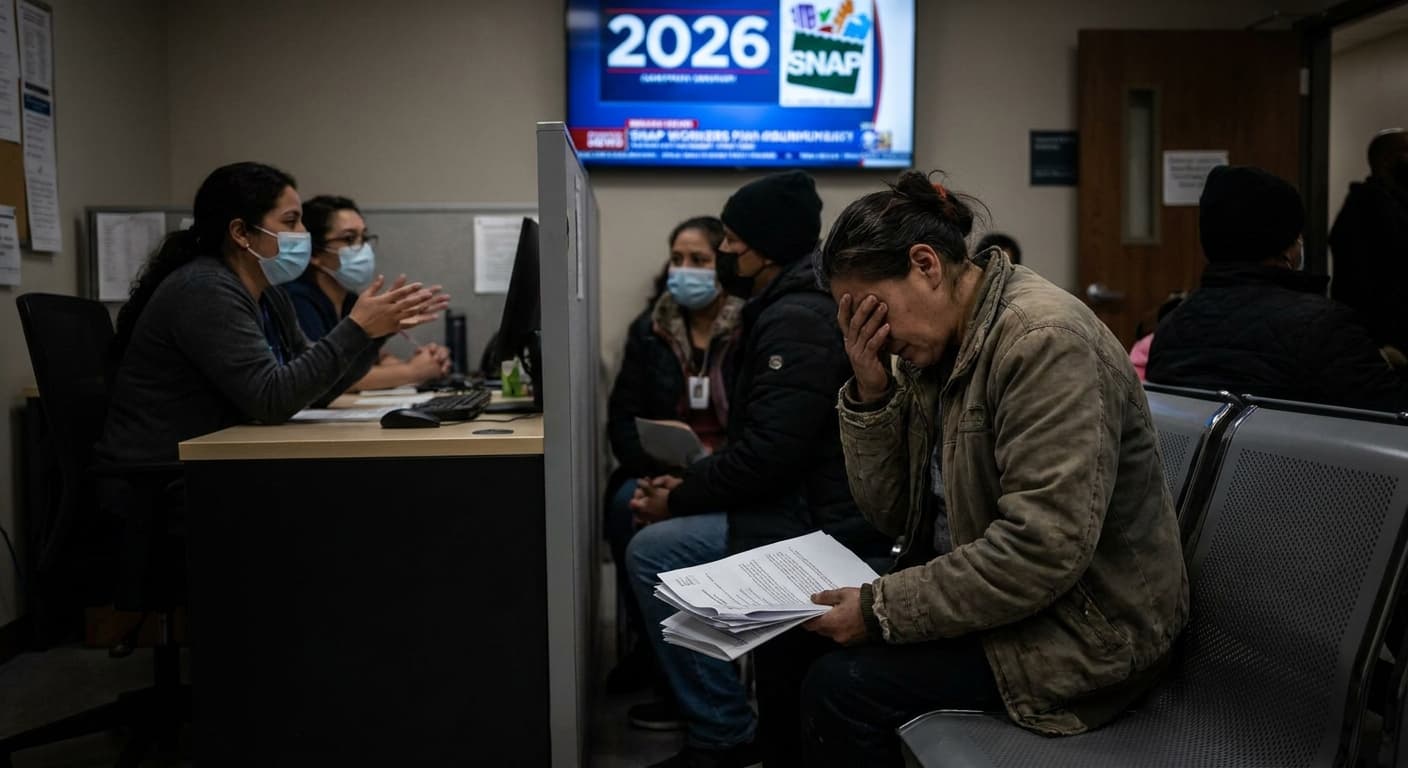
SNAP Food Assistance Faces Legal Challenges
In 2026, SNAP faces stricter eligibility rules and mounting legal challenges, threatening food assistance for the millions of Americans who rely on the program.
US Politics
Congress Targets AI Chatbot Access for Terror
The House passed the Generative AI Terrorism Risk Assessment Act, focusing on AI's role in terrorism and potential surveillance implications.
India
Rajnath Singh's Durga Squad for 2026 Polls
Rajnath Singh's Durga Squad promised women's safety in Bengal but has since disappeared from the agenda, revealing BJP's true priorities.

Economics
Fed's Amex AML order puts correspondent banking on notice
Federal Reserve's Amex AML order requires board-level controls and a 90-day plan; OCC fined the bank $350 million over enterprise-wide deficiencies.