Petro Rejects Colombia Election Results
Petro disputes De la Espriella's certified victory.
Model Diplomat8 min readLatin America
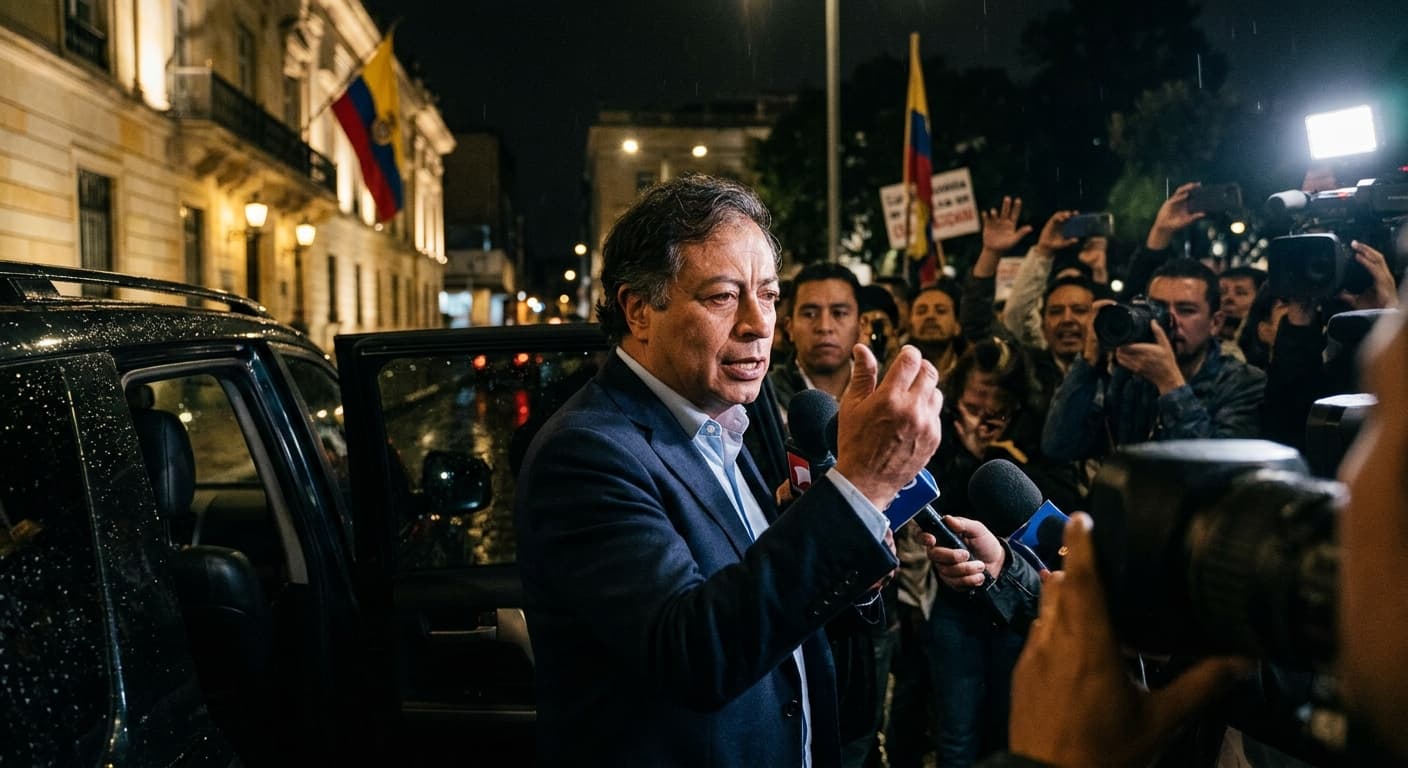
Petro rejects Colombia vote after certified De la Espriella win
Colombia's outgoing president disputes the certified June 21 runoff results as Abelardo de la Espriella prepares to take office August 7.
On July 6, 2026, outgoing Colombian president Gustavo Petro publicly refused to recognize the legitimacy of president-elect Abelardo de la Espriella's incoming government, insisting — without submitting evidence to any court — that the June 21 runoff was manipulated by "algorithm fraud." The claim lands two weeks after Petro's own candidate, Iván Cepeda, conceded, after the national vote registry closed a certified count matching the preliminary tally to 99.997 percent, and after the European Union observation mission called the runoff "transparent" and "well-organised." The fraud framing is unlikely to overturn a result the institutions have already ratified. Its real function is to seed a four-year opposition narrative around the leftist bloc that will still control the largest bench in the Congress installed on July 20.
The certified numbers Petro rejects
De la Espriella, a 47-year-old lawyer running under the Defensores de la Patria movement, won the runoff with 12,959,542 votes (49.66 percent) against Cepeda's 12,708,712 (48.70 percent), a margin of roughly 250,000 votes on 63.6 percent turnout — the highest participation in a Colombian presidential race since the 1991 constitution, according to BBC News Mundo. Cepeda formally conceded on June 24, 2026, saying "Abelardo de la Espriella is the new president of the Republic," even as he denounced foreign interference and alleged vote-buying by the winner's campaign, per
Al Jazeera.
Petro's July 6 statement, posted on X and reported by EFE via Noticias SIN, goes further than any position taken by Cepeda. Petro said he "does not recognize the legitimacy of the incoming government" and claimed the president chosen "by the decision of Colombians is the philosopher Iván Cepeda." He offered no filings or exhibits with the statement. The map itself argues against the fraud thesis: as
BBC News Mundo's cartographic analysis documented, the 2026 result reproduces the same structural polarization visible in 2016, 2018 and 2022 — Cepeda winning Bogotá, Cali, Cartagena and the Pacific and Caribbean peripheries, De la Espriella carrying Medellín, Antioquia, Cundinamarca and the central Andean corridor. A national-scale manipulation would have had to reproduce, precisely, the geography of a decade of Colombian voting behavior.
What the observers actually found
The EU Election Observation Mission, led by European Parliament vice-president Esteban González Pons and staffed with 141 observers, issued its preliminary statement on June 23, 2026 — before Cepeda's concession. Its title is unambiguous: "A transparent, well-organised run-off, supported by solid democratic institutions, closes a highly polarised process." The mission's statement reports that voting "was assessed positively in all polling stations observed," that the escrutinio — the legally binding count conducted before judges — was "transparent and well organised," and that:
"The results management system is both reliable and efficient and complies with the international standards for transparency, integrity and traceability of election results."
The EU EOM also notes that an international audit commissioned by the Registraduría reviewed the source code of the results software and issued a positive assessment, and that candidate auditors were given renewed access to the code. That is a direct, documented rebuttal of Petro's central claim — that a private firm's software was altered in the final days to add 800,000 phantom voters, an accusation he first made after the May 31 first round and repeated on the night of the runoff. The EU mission had also monitored the March 8 legislative election and the first round; in both, the Registraduría's preliminary counts tracked the certified figures with the same near-perfect fidelity, as
Al Jazeera reported.
The EU report does record what did go wrong: a "highly polarised" online campaign, an "unprecedented use of AI and deepfakes," reciprocal unsubstantiated vote-buying accusations, and — pointedly — "official government accounts continued to promote the administration's record in contravention of national legislation and international standards on use of state resources." State-run media, the mission found, "slightly privileged the coverage of Cepeda" while covering De la Espriella "mainly in a negative tone." In other words, the observable irregularity in campaign conduct cut toward Petro's side, not against it.
The legal path, and why it dead-ends
Petro is not only issuing statements. He has said he will back a demanda de nulidad electoral — an election-annulment suit — before the Consejo de Estado, Colombia's top administrative court, and told supporters that the progressive movement will respond "not with violence but with legal action," according to Santa Marta Al Día. The filing is being prepared by Pacto Histórico lawyers who cite the same alleged software irregularities Petro has raised since May,
360 Radio reported.
Two facts constrain the case. First, the Registraduría reported the preliminary count and the certified escrutinio diverged by less than one hundredth of one percent — well below the 0.96-point margin. Reversing the outcome would require invalidating hundreds of thousands of votes at the mesa level. Cepeda's own campaign impugned some 33,000 tables on election night and later expanded the figure toward 50,000; those challenges were adjudicated during the escrutinio and did not move the result, per BBC News Mundo. Second, Petro's own memory of 2022 — when the Historic Pact recovered roughly 500,000 votes during the legislative escrutinio — is the analytic anchor for his suspicion, but that recovery involved intra-list allocation, not a presidential margin, as
Al Jazeera's Bogotá dispatch explained.
The suit will run. But even Sergio Guzmán, director of the Bogotá consultancy Colombia Risk Analysis, told Al Jazeera that Cepeda's concession "suggests some sort of schism between Petro and Cepeda. While Petro's term is sunsetting, Cepeda will likely become the leader of the opposition." That schism matters: the legal case has Petro's signature and Cepeda's distance.
Why Petro is doing this now
Three variables explain the timing.
One: the new Congress. The legislature that installs on July 20, 2026 — the same date Petro has now chosen to leave the presidency, per Diario de Arequipa — will be led by the Pacto Histórico as the largest single bench in the Senate, with roughly 23 percent of seats won on March 8. De la Espriella's Defensores de la Patria has no direct representation and will govern through the allied Movimiento Salvación Nacional's four seats plus negotiated coalitions, as
BBC News Mundo noted before the vote. A fragmented Congress and an incoming president lacking any legislative base means the leftist bloc's leverage over reforms — labor, pensions, health, land — depends on maintaining street-level mobilization and a moral narrative of illegitimacy.
Two: extradition and personal risk. De la Espriella, a dual US-Colombian citizen, has publicly pledged to bring Petro and his aides before US courts. Washington has already sanctioned Petro and his family and revoked his US visa. Cepeda has vowed "the road of civil disobedience" if De la Espriella does not renounce his American citizenship or cease "any attempt to extradite" Petro, according to Diario de Arequipa. The fraud allegation reframes any future prosecution as political persecution by an "illegitimate" government — a defensive framing with real value to Petro personally.
Three: the Trump variable. Petro has argued that Donald Trump's public endorsement of De la Espriella "nullifies" the election, Al Jazeera reported. That claim is not a legal doctrine anywhere in Colombian law, but it is a potent geopolitical talking point across a Latin American left that watched the Trump administration's Colombia intervention up close. Cepeda himself denounced "the open and undue foreign interference in Colombia's internal affairs, particularly the interventions carried out from the government of the United States," in his concession speech reported by
BBC News Mundo.
The historical parallel — and why Petro knows it well
Colombia has done this before, in reverse. In 2013, then-mayor of Bogotá Gustavo Petro was removed from office by the Procuraduría in a disciplinary process he framed as an assault on the popular vote. He convoked mass rallies in the Plaza de Bolívar for what he called "the largest popular mobilization in the history of Bogotá" and told supporters he was defending democracy itself, per BBC News Mundo's contemporary reporting. He was ultimately restored to office by the Consejo de Estado. That episode — plaza politics as a lever against institutional decisions — is the template he is now reproducing from the opposite direction: no longer defending a mandate against removal, but delegitimizing a mandate held by his opponent.
The playbook has one important weakness in 2026. In 2013, Petro was defending a vote he had won. In 2026, he is contesting a vote he lost by 250,000 ballots after his own candidate, his own coalition, and independent international observers accepted the process. The moral asymmetry is visible even to Cepeda, who moved to the concession his mentor refused to make.
The July 20 test
Petro has called nationwide rallies for July 20 — Independence Day, the day the new Congress installs, and now the day he ceremonially vacates the Casa de Nariño. In his X announcement quoted by Diario de Arequipa, he said:
"No lo haremos el 6 ni el 7 de agosto, es fecha trágica. Lo haremos el 20 de julio en todas las plazas públicas de Colombia."
Refusing to hand over the presidential sash in person on August 7 — the constitutional transfer date — and rejecting a face-to-face meeting with the president-elect is unprecedented in Colombia's modern democratic history. According to EFE via Noticias SIN, the handover is being conducted only through technical teams, with Vice President-elect José Manuel Restrepo meeting outgoing finance minister Germán Ávila while Petro traveled to Rome for an audience with Pope Leo XIV. Meanwhile the president-elect's transition team has announced it detected "hundreds of irregularities" in the outgoing administration and will pursue them, according to
CDN — a mirror-image delegitimization aimed back at Petro.
The economic backdrop complicates both narratives. Petro leaves office with monetary poverty at roughly 28 percent of the population and unemployment at 8 percent — the lowest in two decades — but with the worst security crisis in ten years, BBC News Mundo reported. That mix — social gains, security losses — is exactly the terrain on which the July 20 mobilizations will be judged.
What to watch
- July 20, 2026 — installation of the new Congress (Pacto Histórico as largest bench), Petro's ceremonial exit, and the scale of the nationwide rallies. Turnout is the metric that determines whether "illegitimacy" becomes a movement or a hashtag.
- The Consejo de Estado docket — formal filing of the demanda de nulidad. The court's admission or rejection at the preliminary stage will signal whether Petro's fraud narrative carries any judicial weight.
- August 7, 2026 — De la Espriella's inauguration without a personal handover from Petro. First test of whether the incoming government can command constitutional legitimacy over a symbolic breach.
- US action on extradition — any move by the incoming Colombian government or Washington against Petro or his aides after August 7 will be read through the fraud framing Petro is establishing now.
The Bottom Line
Petro's refusal to recognize the De la Espriella government is not a legal strategy — it is a legacy strategy. The certified numbers, the EU observers, the international audit of the vote software, and Cepeda's own concession make an annulment vanishingly unlikely; what remains achievable is the construction of an "illegitimate government" narrative that arms the Pacto Histórico's congressional majority, insulates Petro from post-presidential prosecution, and keeps the Colombian left mobilized through the next electoral cycle. The winner of this maneuver is not Cepeda, who has already stepped into the role of opposition leader — it is Petro himself, buying a political afterlife with a claim the institutions have already rejected.
Discover more

US Politics
Virginia GOP Rallies Rural Voters Against Red
Virginia Republicans are mobilizing rural voters against a Democratic-led redistricting referendum, a fight seen as pivotal to control in the 2026 midterms.

US Politics
US Launches $166B Tariff Refund Portal
The US is launching a $166 billion tariff refund portal to aid importers hit by Trump-era tariffs, with major implications for trade and supply costs.
India
Rajnath Singh's Durga Squad for 2026 Polls
Rajnath Singh's Durga Squad promised women's safety in Bengal but has since disappeared from the agenda, revealing BJP's true priorities.

Economics
Fed's Amex AML order puts correspondent banking on notice
Federal Reserve's Amex AML order requires board-level controls and a 90-day plan; OCC fined the bank $350 million over enterprise-wide deficiencies.