Niger's ICC Exit: Sahel's Neo-Colonial Shift
Niger's withdrawal from the ICC marks a significant governance shift.
Model Diplomat8 min readAfrica
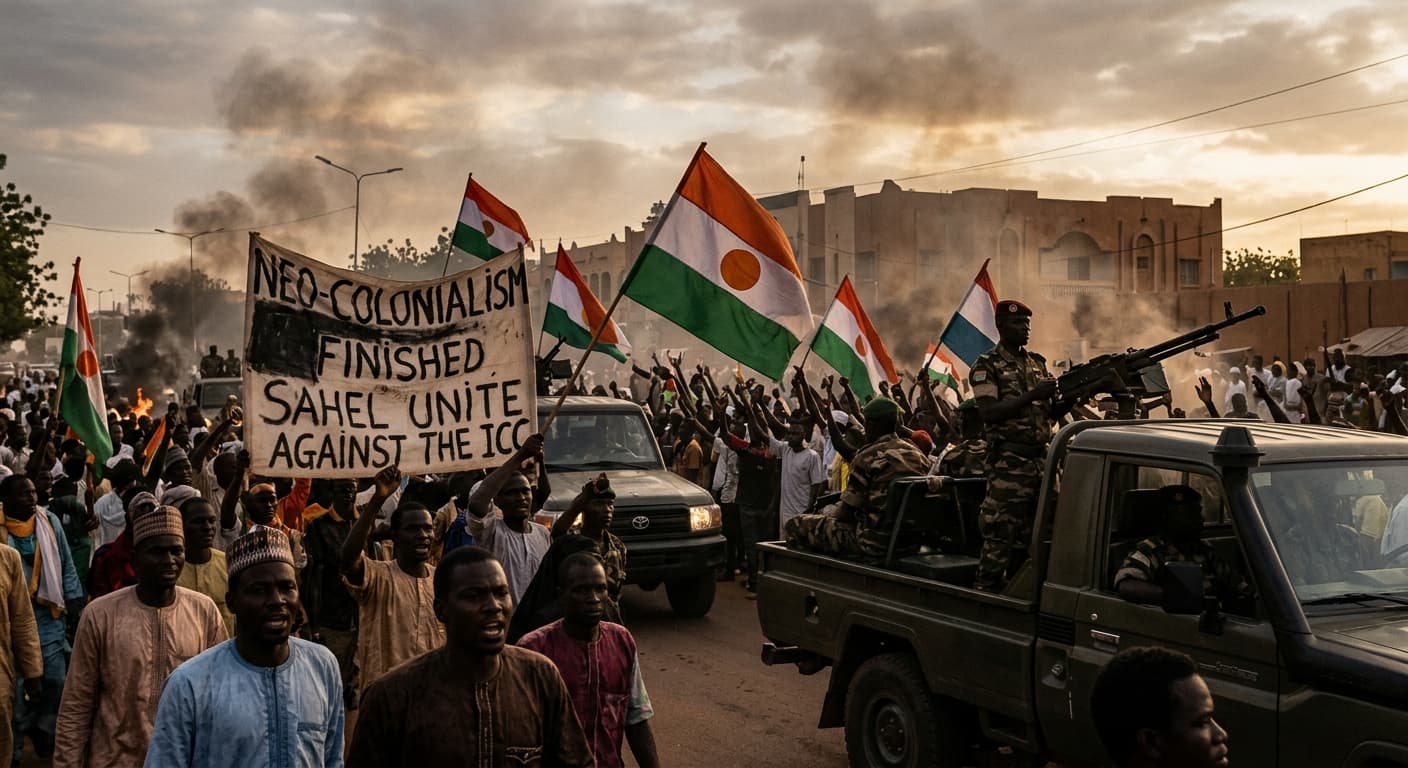
Niger's ICC exit: the Sahel's neo-colonial rebrand hardens
Niger became the third state to leave the International Criminal Court on 18 June 2026, deepening a Sahel bloc breakaway that trades Western justice for junta-run alternatives.
Niger's formal withdrawal from the International Criminal Court on 18 June 2026 completes a three-country secession from the international justice system that is best read not as a legal dispute but as a governance play: the Sahel juntas have priced the political cost of ICC scrutiny — for themselves and their Russian partners — above the diplomatic cost of walking out, and they are betting that a captive regional court and a captive population will absorb the fallout. Niger, Mali and Burkina Faso together lost more than 6,600 people to armed violence in the first half of 2025 alone, according to the Centre for Democracy and Development's West Africa Security Tracker. The withdrawal insulates the men in charge of the counter-insurgency from the one court with jurisdiction to prosecute them.
What Niger actually did
Niamey deposited its instrument of withdrawal from the Rome Statute with the UN Secretary-General on 18 June 2026, nine months after a joint communiqué by the Alliance of Sahel States (AES) — Mali, Burkina Faso and Niger — labelled the court an "instrument of neo-colonialist repression". Under Article 127(1) of the Rome Statute, the withdrawal takes effect one year after notification, meaning 18 June 2027, per the ICC's statement on the Philippines' earlier exit. Niger becomes the third state ever to leave, after Burundi (2017) and the Philippines (2019), and the first Francophone African country to do so.
The Presidency of the Assembly of States Parties, in a statement issued on 1 July 2026, said it "regrets these developments" and warned that "decisions by States Parties to disengage from the Rome Statute risk undermining the collective pursuit of justice", per the ICC press release. The Presidency's operative reminder is legal rather than rhetorical: withdrawal "does not relieve a State Party of obligations arising during the period in which it remained a Party to the Statute" — the article-127(2) carve-out that keeps existing investigations alive.
That matters concretely. Mali self-referred its territory to the ICC in July 2012 during the northern jihadist takeover, and the Court's Office of the Prosecutor opened its investigation in January 2013. On 26 June 2024 Trial Chamber X convicted Al Hassan Ag Abdoul Aziz Ag Mohamed Ag Mahmoud, the Timbuktu jihadist "police" chief, of war crimes and crimes against humanity, with a sentence of ten years finalised on 20 November 2024, per the ICC's Mali situation page. A reparations order followed on 28 April 2026. Withdrawal does not shut this file — but it does end future cooperation on new counts, including any concerning the Malian army or its Russian auxiliaries.
The neo-colonial argument, and its uncomfortable ledger
The AES statement, issued on 22 September 2025 in the name of Malian junta leader Col. Assimi Goïta, argued the ICC "has proven itself incapable of handling and prosecuting" war crimes, crimes against humanity, genocide and aggression, calling it a tool of "imperialism" in the joint communiqué reported by Al Jazeera. The evidentiary base is real: of 33 cases opened since the court's creation in 2002, all but one involve African defendants, a lopsidedness the
BBC noted and which Rwanda's Paul Kagame has cited for a decade.
The rejoinder is equally documentable. Mali itself invited the court in — its 2012 self-referral is the reason Al Hassan sits in a Scheveningen cell — and Niger's own police handed suspect Ahmad Al Faqi Al Mahdi to The Hague in 2015 over the Timbuktu shrine destructions, per filings summarised in a recent U.S. federal complaint against the Trump administration's ICC sanctions (CourtListener docket). Six African ECOWAS states — including Burkina Faso and Niger — jointly backed Mali's referral. The Institute for Security Studies notes that "the three were for decades at the forefront of advancing international justice", making the neo-colonial framing a 2020s political construction, not a founding grievance (
ISS Africa).
The more revealing timing marker is Russia. The ICC issued an arrest warrant for President Vladimir Putin in March 2023 over deportations from occupied Ukraine. Since then, Africa Corps — the Kremlin-linked successor to Wagner — has embedded with Malian and Burkinabè forces, with roughly 80 of its personnel killed alongside 40 Malian soldiers at the Tinzaouaten ambush of July 2024, per the Egmont Institute's Sahel policy brief. Human Rights Watch documented 223 civilians summarily executed by Burkinabè soldiers in a single day in February 2024. Both categories of conduct fall squarely within Rome Statute jurisdiction while the three states remain parties — which is precisely what the one-year clock is designed to shorten.
What replaces it
The AES has proposed a Sahel Criminal and Human Rights Court, first floated in June 2025, described by Al Jazeera as an instrument to "try serious crimes and human rights violations on their own terms — justice brought home, or justice brought under control, depending on who you ask." No statute has been published, no judges named, no seat announced. The AES communiqué says the mechanism will be immune from "the negative influence of imperialist powers on the organisation and functioning of certain regional and international jurisdictional bodies", per ISS Africa's reading of the founding document.
A pan-African alternative already exists on paper. The 2014 Malabo Protocol, adopted in Equatorial Guinea, would confer criminal jurisdiction on an expanded African Court of Justice and Human Rights over 14 crimes including genocide, crimes against humanity, war crimes, terrorism and unconstitutional changes of government — the last a category no serving head of state would rush to ratify, which is why only 15 states have signed and none of the AES trio have ratified, per Amnesty International's protocol brief. The Sahel court proposal notably drops the coup clause.
The domestic accountability picture makes the "indigenous mechanisms" claim harder to sell. Burkina Faso's junta has conscripted critical journalists to the front line, per Al Jazeera. Nigerien security forces have killed roughly three times as many civilians since the 2023 coup as in the year before it, according to Egmont Institute data. Amnesty International, cited by BBC Pidgin, warned the withdrawal "threatens to deny thousands of victims the possibility of truth, justice and reparations."
The regional geometry: ECOWAS out, ICC out, Rosatom in
Read alongside the January 2024 exit from the Economic Community of West African States and the July 2024 confederation treaty signed in Niamey, the ICC withdrawal is the third pillar of a systematic disengagement from post-colonial multilateralism. Each exit removed an external checkpoint: ECOWAS on constitutional order, its Court of Justice on rights complaints, the ICC on atrocity crimes. The pattern is coherent: the AES states have not renegotiated their obligations — they have shed them.
The resource ledger explains the confidence. Niger nationalised the Somaïr uranium mine in June 2025, ending a 54-year French concession run by Orano, per the Financial Times. Roughly 1,150 tonnes of yellowcake worth about $210 million sat blocked at the site, and Russian state nuclear firm Rosatom signed a cooperation agreement with Niamey in July 2025 covering the Imouraren deposit — one of the world's largest — and a mooted West African nuclear power plant, per the
BBC. Orano's local director, Ibrahim Courmo, has been held without charge since May 2025.
The strategic message to Moscow — and to Wagner's Africa Corps commanders — is legible: the jurisdictional cover is being tightened around the same time the commercial partnership deepens. The Council on Foreign Relations describes Africa Corps as having "institutionalized Wagner's existing intervention model, along with its abuses" in its analysis of the Sahel turn. Whether one reads the ICC exit as cause or symptom, it removes a specific downside risk for a specific set of foreign personnel.
Who wins, who loses
The winners are narrow and named. The three junta leaders — Goïta, Traoré, Tchiani — remove a personal jurisdiction risk that would have followed them out of office. Russian personnel operating in the three states lose an accountability vector, however remote. Domestic security forces accused of civilian killings — Burkinabè regulars, Nigerien counter-terror units, Volunteers for the Defense of the Homeland auxiliaries — face one fewer international forum.
The losers are broader and unnamed. Victims of the Barsalogho massacre of August 2024 (between 130 and 600 killed by JNIM while digging state-mandated defensive trenches, per Egmont Institute); the Peul villagers of the Sourou Valley; the 44 dead of Fambita in April 2025; the families of Malian children reported killed in drone strikes at Danguere Tomana. Their ICC route closes on 18 June 2027. The reparations infrastructure being built for Al Hassan's victims — a Trust Fund draft implementation plan due 25 January 2027 — will be one of the last such artifacts produced under Malian cooperation.
The second-order loser is the African Union's own project. The AES states are not building the Malabo court; they are building a smaller, three-state substitute that undermines the pan-African vehicle without operationalising it. This weakens continental leverage the next time an African head of state wants to argue the ICC is biased — because the counter-model on offer will look less like the African Court of Justice and more like a junta tribunal.
What to watch
- 18 June 2027: Niger's withdrawal takes legal effect under Article 127(1); Mali's and Burkina Faso's follow on their own notification dates. The window for new ICC investigations closes.
- 25 January 2027: Deadline for the ICC Trust Fund for Victims to file its Draft Implementation Plan for Al Hassan reparations — the case Mali is still legally obligated to support.
- Late 2026: Publication (or non-publication) of a draft statute for the Sahel Criminal and Human Rights Court. Watch for a coup-crimes clause, an immunities clause for sitting heads of state, and the naming of any judges from outside the three states.
- 2026–27 Rosatom timeline on the Imouraren uranium concession and the mooted nuclear plant — the commercial mirror of the political withdrawal.
Diplomat View
Niger's exit is not principally about the ICC. It is the third act in a coordinated de-anchoring from the post-1990s West African order — ECOWAS gone, French troops gone, Orano gone, The Hague going — and it works because the juntas correctly read that no external actor is willing to impose a cost commensurate with reversal. The falsifiable call: within 24 months of the June 2027 effective date, expect the Sahel Criminal and Human Rights Court to be either unbuilt or built without a functioning prosecutorial arm against sitting officials, and expect at least one documented atrocity file — Barsalogho, the Sourou Valley executions, or a Nigerien counterparty case — to be shelved for want of a forum. The forecast would revise if the AES publishes a statute mirroring the Malabo Protocol's coup and immunities clauses, or if a post-transition civilian government in any of the three capitals lodges a rescission with the UN Secretary-General, as The Gambia did in 2017. Neither is on the current trajectory.
The Bottom Line
Niger's departure from the ICC — the third ever — is the legal capstone of a Sahel governance revolution that has already discarded ECOWAS and expelled France, and it is designed to protect specific men and specific partners from a specific court at a specific moment. The neo-colonial framing is politically effective and historically thin: these are the same states that referred Mali to The Hague in 2012 and handed suspects over from Niamey in 2015. What replaces the ICC is, so far, a press release; what departs with it is the last external tribunal with jurisdiction over the Sahel's escalating civilian toll.
Discover more

US Politics
US Launches $166B Tariff Refund Portal
The US is launching a $166 billion tariff refund portal to aid importers hit by Trump-era tariffs, with major implications for trade and supply costs.
India
Rajnath Singh's Durga Squad for 2026 Polls
Rajnath Singh's Durga Squad promised women's safety in Bengal but has since disappeared from the agenda, revealing BJP's true priorities.

US Politics
House Ethics Committee Pushes Sexual Miscond.
The House Ethics Committee has shifted responsibility for sexual harassment settlement records to the Office of Congressional Workplace Rights, complicating disclosure efforts.

Conflict & Security
Drone Warfare Killing Aid Workers at Unprec
Over 1,000 humanitarian workers killed in three years as cheap armed drones collapse legal protections. Gaza, Sudan, Ukraine, and DRC see deliberate targeting of aid convoys and hospitals with zero prosecutions.