Nigeria's S&P Upgrade to B Validates Reset
S&P upgrade to B validates Tinubu's reset, but 2027 elections test reform survival.
Model Diplomat8 min readAfrica
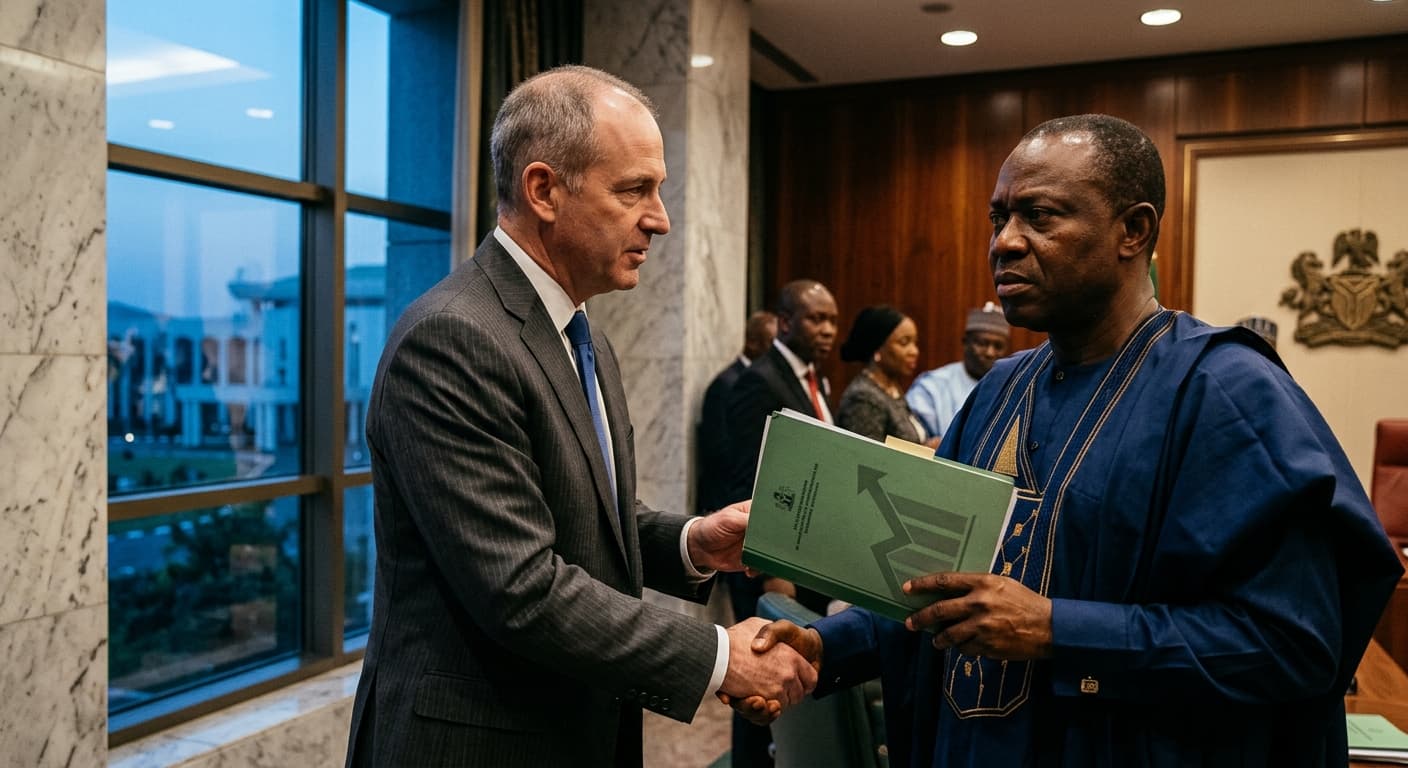
Nigeria's S&P Upgrade to 'B' Validates the Reset — But 2027 Elections Are the Real Test
[S&P Global Ratings upgraded Nigeria from B- to B on May 15, 2026, capping a three-year reform program that slashed fuel subsidies, unified the naira, and overhauled taxes — the rating's survival now hinges on whether the reforms outlast the January 2027 elections.]
S&P Global Ratings lifted Nigeria's long-term sovereign rating from B- to B with a stable outlook on May 15, 2026, aligning all three major agencies at B-equivalent for the first time since 2019 and endorsing President Bola Tinubu's three-year macroeconomic reset. The upgrade matters less as a finish line than as a contract: markets have priced in the reform architecture, but the political system has not yet ratified it, and S&P's own stable outlook explicitly conditions the rating on no reversal of forex liberalization or no return to deficit-funded subsidies. The decisive question is not whether the metrics justify a B — they do — but whether the reforms survive the January 2027 general election, where the cost-of-living crisis and an IMF-flagged N8.8 trillion in off-budget spending have already given opposition figures ammunition to campaign on rollback.
The metrics S&P bought
S&P's decision, reported by Streamline on July 16, 2026, was anchored in verifiable macroeconomic data rather than sentiment. The agency cited stabilization of the balance of payments, rising crude output, expanded domestic refining capacity, and the government's refusal to reintroduce refined-petroleum subsidies as core drivers. On the fiscal side, analysts project Nigeria's debt-to-revenue ratio falling to 338 percent in 2026, down from a suffocating 500 percent in 2023, as subsidy removal plugs the largest single fiscal drain. Streamline
The IMF's 2026 Article IV consultation, concluded June 1, 2026, corroborates the trajectory from the institutional side. Gross international reserves rose to US$46 billion at end-2025 from US$40 billion a year earlier, reaching US$49 billion on a 30-day moving average by end-March 2026, while the naira appreciated 10 percent year-on-year against the dollar in March 2026. Public debt fell to 36.1 percent of GDP in 2025 from 39.3 percent in 2024, on account of a favorable interest-growth differential and naira appreciation. IMF
The upgrade completes an 18-month sequence across all three agencies. Fitch Ratings moved Nigeria from B- to B in April 2025 and reaffirmed it in October 2025; Moody's followed from Caa1 to B3 in May 2025; and S&P revised its outlook from stable to positive in November 2025 before delivering the actual one-notch upgrade this May. The World Bank's Project Appraisal Document records the same chain, noting that all three agencies moved in the same direction within an 18-month window, a convergence that itself signals reduced perceived policy volatility. World Bank
But the headline metrics mask a fragility that S&P itself flagged. Interest payments absorbed an estimated 53 percent of federal government revenue in 2025, up from 41 percent in 2024, as tight monetary policy raised borrowing costs even as the revenue base expanded. IMF The IMF's Executive Board, while commending the reforms, cautioned that "conditions remain difficult for many Nigerians, with poverty and food insecurity likely to worsen in the current external environment," and called for "a neutral fiscal stance in 2026" while flagging "concerns about off-budget spending and complex financing instruments."
IMF
How Tinubu reset the economy
The rating rests on three structural reforms initiated in 2023 that broke with decades of fiscal and monetary orthodoxy — each with distinct winners and losers.
First, fuel subsidy removal. The PMS subsidy, deducted directly from oil revenues, was estimated by the World Bank at N4.5 trillion (2.2 percent of GDP) in 2022 — nearly half the fiscal deficit that year. Effective October 2024, gasoline pricing was tied to the international market and the CBN-set exchange rate, with both NNPC and independent marketers allowed to import. The winner here is the federal treasury, which reclaimed billions in foregone revenue; the loser is the Nigerian consumer, who absorbed a cost-of-living shock that pushed the poverty rate from 47.7 percent in 2024 to an estimated 50.9 percent in 2025, with an additional 10 million Nigerians falling into extreme poverty. World Bank
Second, exchange-rate unification. On June 14, 2023, the CBN collapsed multiple opaque FX windows into a single market-determined rate, destroying multi-billion-dollar arbitrage operations that had enriched a narrow elite while starving the real economy of dollar liquidity. The parallel-market premium fell to roughly 9 percent from a peak exceeding 60 percent. An IMF Selected Issues paper found that the regime shift "strengthened interest rate pass-through and altered the inflation dynamics," with pass-through becoming "positive and economically significant" post-unification — meaning naira movements now transmit to prices far more efficiently than under the managed regime. IMF The winners are foreign portfolio investors, who regained confidence in naira-denominated assets and pushed up to 90 percent of FPI inflows into debt securities, and the CBN under Governor Olayemi Cardoso, which earned policy credibility. The losers are the arbitrage networks — importers, politically connected middlemen, and parallel-market operators — who profited from the spread between official and street rates.
Third, tax reform. Tinubu signed four finance bills into law — the Nigeria Tax Act, Tax Administration Act, Nigeria Revenue Service Act, and Joint Revenue Board Act — merging over 50 overlapping levies into a single code, replacing the Federal Inland Revenue Service with an independent Nigeria Revenue Service, and cutting the corporate tax rate from 30 percent to 25 percent over two years. The government targets a tax-to-GDP ratio of 18 percent by 2026, up from just over 10 percent, which the BBC notes is "far below the African average of 16–18 percent." BBC The immediate losers are state and local governments, which the IMF estimated could lose up to half a percent of GDP in revenue from the decision not to raise the VAT rate — a loss that falls on subnational budgets while the federal government offsets its VAT loss with higher CIT receipts.
IMF
The World Bank's April 2026 Nigeria Development Update records the cumulative fiscal result: FAAC gross revenues rose from 7.9 percent of GDP in 2024 to 9.5 percent in 2025, "driven by improved tax administration" including expanded e-filing, e-payments, and VAT e-invoicing. World Bank
The Dangote effect and second-order dynamics
A factor S&P cited but that receives less attention is the Dangote Refinery, which began producing PMS in September 2024. The refinery's ramp-up has reduced Nigeria's refined fuel import bill — a structural drain that compounded the subsidy burden for decades — and contributed to the current account surplus of 4.8 percent of GDP in 2025. The IMF notes that the surplus was "driven by oil and gas exports and reduced refined fuel imports, with the domestic refinery ramping up production." IMF This is a genuine second-order gain: subsidy removal made market-priced gasoline politically possible; domestic refining made it economically tolerable by substituting local production for imports.
But the Middle East conflict that erupted in February 2026 has introduced a complicating dynamic. Higher oil prices boost Nigeria's export and fiscal revenues — the World Bank notes that FAAC revenues "are expected to benefit from higher oil prices linked to the Middle East conflict" — but they also push up domestic fuel, fertilizer, and food costs, aggravating the inflation and poverty that already threaten reform durability. World Bank Inflation, which had fallen from 33.2 percent in 2024 to 15.1 percent by February 2026, nudged back up to 15.4 percent year-on-year in March 2026 as global energy prices began passing through. This is the classic resource-curse trap: an oil price windfall relieves fiscal pressure precisely when reform discipline is hardest to sustain, and the temptation to restore blanket subsidies grows with every price spike.
The governance gap
The upgrade's most serious vulnerability is not macroeconomic but institutional. The IMF's Article IV report flagged approximately N8.8 trillion (about $6 billion) in spending outside the approved budget — a figure the Finance Minister, Taiwo Oyedele, publicly disputed, arguing that the expenditures were "established by law, disclosed in various fiscal reports, and subject to applicable oversight, audit and accountability mechanisms." BBC The World Bank had separately raised concerns in April about a "hidden spending system," noting that about 41 percent of revenue — roughly N34.5 trillion — did not enter the Federation Account between 2023 and 2025.
The political fallout was immediate. Peter Obi, the opposition presidential candidate for the 2027 election, called the off-budget spending "a pattern of grand corruption," while former Vice President Atiku Abubakar described a government that "governs in secret and spends in secret." BBC Whether or not the IMF's characterization is accurate — and Oyedele's rebuttal is substantive — the episode reveals the gap between macroeconomic metrics that ratings agencies measure and fiscal governance that markets ultimately price.
The cabinet reshuffle that brought Oyedele to the Finance Ministry on April 21, 2026 — replacing Wale Edun — was framed as strengthening "cohesion, synergy in governance." BBC Oyedele, who had chaired the Presidential Fiscal Policy and Tax Reform Committee and architected the four tax bills, now concentrates fiscal authority in the person most identified with the reform program. The bet is clear: the architect becomes the enforcer. But it also makes Oyedele the opposition's primary target.
A historical parallel and its warning
The arc echoes President Olusegun Obasanjo's 2003–2007 reform program, which was also bank-led, also IMF-backed, and also aimed at unlocking Nigeria from fiscal dysfunction. That program earned Nigeria its first investment-grade-adjacent rating — only to be partially reversed by subsequent administrations that could not resist the political temptation to resume deficit monetization and ad hoc subsidies. The difference today is structural: Tinubu's reforms are harder to reverse because exchange-rate unification, once the parallel-market premium closes, is very costly to unwind, and the Dangote Refinery makes a return to import-dependent subsidy logistically and fiscally infeasible. But the political cycle risk is identical: frontloaded pain, delayed benefits, and an election that rewards whoever promises to stop the bleeding.
Diplomat View
The S&P upgrade to B is a genuine achievement — it reflects real, measurable improvement in Nigeria's fiscal and external position, and the convergence of all three agencies removes a layer of ambiguity that previously deterred marginal investors. But the rating is a political contract dressed in macroeconomic clothing. It survives only if three conditions hold through January 2027: no return to fuel subsidies, no reversal of the unified exchange rate, and no explosion of off-budget spending. The Middle East conflict is already testing the first condition by pushing fuel prices into politically explosive territory. The IMF's N8.8 trillion flag is testing the third. The forecast holds if oil prices stay elevated enough to fund the 2026 budget without forcing subsidy reinstatement, and if Oyedele can weather the opposition's corruption narrative long enough to deliver visible cash-transfer relief. It breaks if inflation re-accelerates into double-digit territory by Q4 2026 — the threshold at which the cost-of-living argument becomes electorally decisive and reform rollback becomes the path of least resistance for whichever candidate Tinubu's coalition nominates.
What to watch:
- Q3 2026 inflation data — if headline CPI re-accelerates above 18 percent, the subsidy-restoration pressure becomes politically unstoppable
- 2027 budget presentation, expected October 2026 — whether it maintains the neutral fiscal stance the IMF demands or pre-loads election spending
- January 2027 general election — the ultimate ratification or rejection of the reset
The bottom line: Nigeria's B rating is not a verdict on reform success — it is a bet on reform survival. The metrics justify the upgrade; the politics will determine whether it holds. If Tinubu's successor — or Tinubu himself — reverses any of the three core reforms before 2028, the rating falls back to B- within two quarters, and the cost of the next Eurobond issuance rises by 200–300 basis points. The reform architects know this. So do the markets. The question is whether the Nigerian voter does too.
Discover more
India
Rajnath Singh's Durga Squad for 2026 Polls
Rajnath Singh's Durga Squad promised women's safety in Bengal but has since disappeared from the agenda, revealing BJP's true priorities.
US Politics
SNAP Food Assistance Faces Legal Challenges
In 2026, SNAP faces stricter eligibility rules and mounting legal challenges, threatening food assistance for the millions of Americans who rely on the program.
US Politics
Congress Targets AI Chatbot Access for Terror
The House passed the Generative AI Terrorism Risk Assessment Act, focusing on AI's role in terrorism and potential surveillance implications.

Economics
Fed's Amex AML order puts correspondent banking on notice
Federal Reserve's Amex AML order requires board-level controls and a 90-day plan; OCC fined the bank $350 million over enterprise-wide deficiencies.