Nigeria Senate Ends Operation Safe Corridor
Senate votes to terminate Boko Haram defection program
Model Diplomat8 min readAfrica
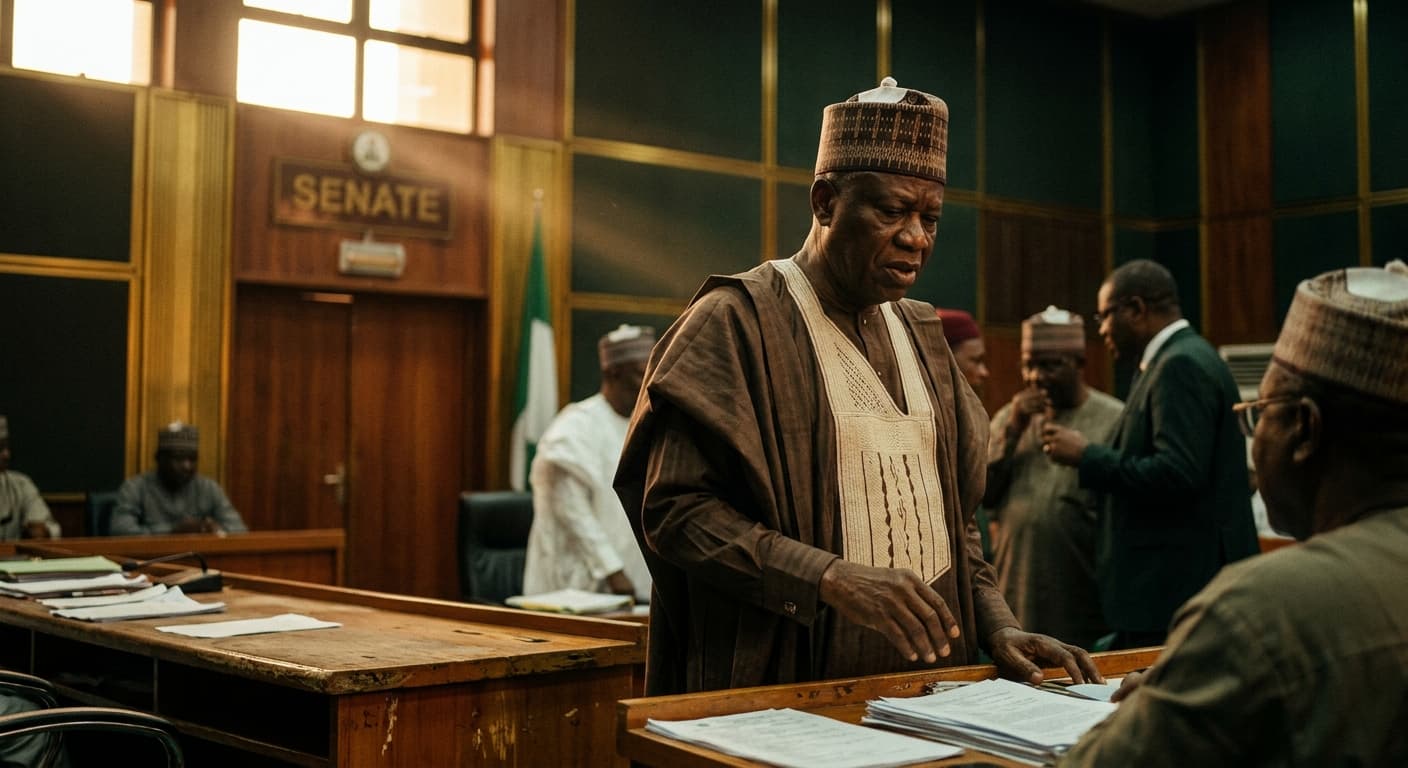
Nigeria's Senate Moves to Shut the Only Exit Door from Boko Haram
On July 7, 2026 Nigeria's Senate ordered an end to Operation Safe Corridor — closing the country's only non-kinetic exit from jihad just as ISWAP hits its deadliest tempo in a decade and the regional Lake Chad coalition falls apart.
Nigeria's Senate on July 7, 2026 formally demanded that President Bola Tinubu terminate Operation Safe Corridor, the ten-year-old programme that has processed more than 900 "repentant" Boko Haram fighters back into civilian life. The motion, moved by Senator Abdulazeez Yar'Adua after the death in bandit captivity of retired Major-General Rabe Abubakar, is being sold at home as accountability for slain officers. The strategic effect is the opposite: Abuja is preparing to shut its last defection pipeline at the exact moment the Sahel's jihadist ecology is merging with the Lake Chad Basin's, and the multinational force built to police that seam is disintegrating. Close the exit, and ISWAP recruits the men who would have walked out — into a war Nigeria's neighbours are already leaving it to fight alone.
What the Senate actually voted
The upper chamber, by voice vote, adopted a prayer directing the Federal Government to "discontinue" the rehabilitation and reintegration of former Boko Haram members and instead prosecute suspected terrorists, according to reporting by Daily Trust and
Vanguard. The senators also directed the security committees to intensify oversight and resolved to meet Tinubu in person over "worsening insecurity," per
Daily Report Nigeria.
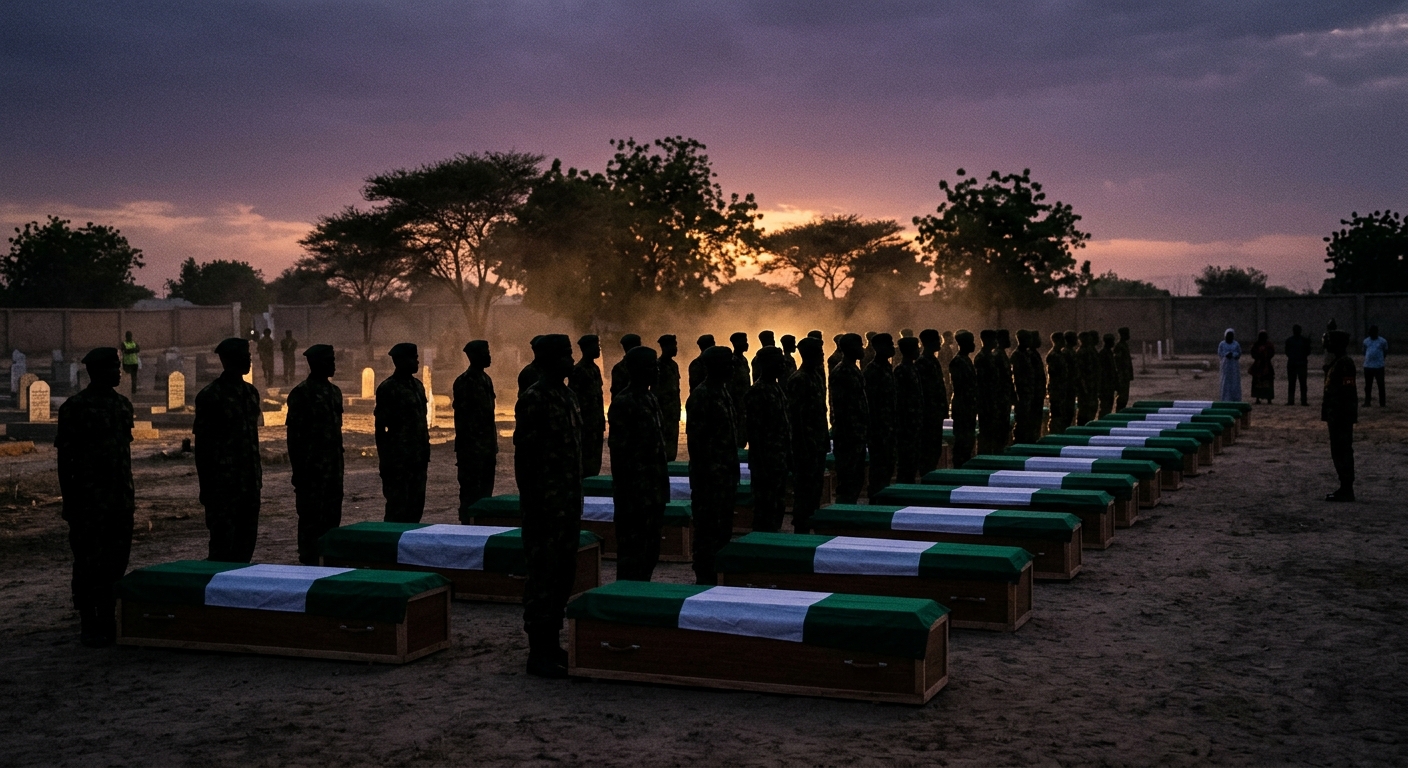
The immediate trigger was personal. Maj-Gen Abubakar — the army's spokesman between 2015 and 2017 — was abducted with his wife in Katsina in August 2025 and died in captivity, the BBC reported. His death sits inside a roll call of senior officers killed since late 2025 that no post-2011 cohort of Nigerian generals has faced: Brig-Gen Musa Uba, executed on video by ISWAP in November 2025; Brig-Gen Oseni Braimah, commander of the 29 Task Force Brigade, killed at Benisheikh on April 9, 2026 in an assault
confirmed by the presidency the same night; and two lieutenant colonels in March 2026. Governor Babagana Zulum of Borno has publicly conceded troops are "losing ground" — a striking
reversal of his years-long insistence that Boko Haram was defeated.
That is the political weather in which the Senate voted. It is not the strategic weather.
What Operation Safe Corridor actually is — and isn't
Operation Safe Corridor was created in 2016 under President Muhammadu Buhari, run from a repurposed youth-service camp at Mallam Sidi in Gombe State, and co-funded by the International Organization for Migration with support from the European Union, the United Kingdom and the United States, according to the International Crisis Group's briefing on the programme. It admits only "low-risk" defectors screened at Giwa Barracks in Maiduguri; senior commanders are diverted to pre-trial detention or, since 2021, to a separate clandestine track called Sulhu run by the domestic intelligence service,
Nigerian Security analyst Obi Anyadike told CSIS.
The numbers matter for the argument the Senate is making. The Presidency itself has conceded, in a State House release rebutting rumours the ex-fighters were being enlisted into the army, that only 601 men graduated from the fourth batch — "none" of whom, it insisted, entered the military. Crisis Group's field research put total intake at 920 with 872 graduates as of 2021. The programme coordinator, Brig-Gen Yusuf Ali, claims a recidivism rate below 2%, according to the
Centre for Democracy and Development. Independent researchers have documented only one confirmed relapse to arms in interviews with graduates, per the
International Crisis Group.
Set that against ISWAP's field strength. The United Nations estimates the group fields 8,000 to 12,000 fighters, Al Jazeera reported in December 2025. Safe Corridor has, in a decade, processed the equivalent of about one week's ISWAP casualty tally from the current campaign. The programme is not why senior officers are dying. What is killing them is a jihadist ecosystem that has scaled up, not defectors that have been paroled.
The Sahel arithmetic the motion ignores
The wider theatre matters more than the debate in Abuja admits. Between July 2024 and July 2025, ISWAP claimed 445 attacks — first among all Islamic State "provinces" worldwide by both operations and fatalities, according to Islamic State's own weekly al-Naba, analysed by the Italian Institute for International Political Studies. Since February 2025, ISWAP has run a doctrinally branded "Burn the Camps" offensive, overrunning at least 26 military bases and, for the first time, weaponising drones in combat, the
South African Institute for International Affairs documented this year.
The multinational architecture that was supposed to contain this — the Multinational Joint Task Force (MNJTF) authorised by the African Union in 2015 and headquartered in N'Djamena — is coming apart. Niger withdrew from the MNJTF in April 2025 after the deterioration of relations with Abuja following its 2023 coup; Chad is publicly threatening to follow. Institute for Security Studies analysts link the coalition's fragmentation directly to the surge in cross-border attacks.
That fragmentation is enabling something new. Islamic State–Sahel Province (IS-SP), based in the Mali–Burkina Faso–Niger triangle, hit Diori Hamani International Airport in Niamey on January 29, 2026 — its first drone-combat operation, SAIIA records — and witnesses said Lakurawa fighters speaking Hausa and Kanuri from northern Nigeria took part, the
Italian Institute for International Political Studies reported. Clingendael's field work in the Kainji Lake corridor traced militants pushed by Nigerian army operations in March–April 2025 into Benin, into areas where JNIM — al-Qaeda's Sahel affiliate — is quietly
establishing presence. What was once a Nigerian problem contained in Borno is now a continuum from Timbuktu to Lake Chad, connected by fighters who move, share weapons, and, increasingly, share command.
Why closing the exit hardens the enemy
This is where the Senate motion cuts against Nigeria's own interest. Deradicalisation programmes are strategically valuable not because they redeem individuals — the moral case is contested and communities in Borno, Adamawa and Yobe openly reject it, CDD West Africa found — but because they change the calculation of the man still holding a rifle. If a low-level fighter believes surrender means Mallam Sidi and vocational training, he may walk. If he believes surrender means Giwa Barracks or a bullet, he fights until he dies or defects to a rival faction offering better protection.
That is not abstract. When ISWAP dismembered its rival JAS/Boko Haram after Abubakar Shekau's death in 2021, the U.S. Institute of Peace and Institute for Security Studies both documented mass defections of Shekau's fighters — many of whom fed Safe Corridor's third and fourth batches. Without that exit, they would have joined ISWAP. The programme, whatever its manifest flaws in screening (Crisis Group's interviews suggest only 20–25% of internees are actual former fighters), has functioned as a wedge inside the enemy camp.
Compare it to what the Presidency is not proposing to fix. The Chief of Defence Staff–controlled programme has no legislative underpinning; SWP Berlin, in a September 2025 policy brief, describes an ongoing turf war between the Defence Intelligence Agency and Defence Headquarters, and a rival Zamfara replica set up bilaterally by DHQ to lock DIA out. Peer-reviewed work by Ogunnubi in
African Identities identifies the "lack of a legal framework" as Safe Corridor's core institutional risk. The Senate could have legislated the programme; instead it moved to abolish it. That is a political choice, not a strategic one.
Who wins the vote — and who wins the war
The domestic winners are visible. Senator Yar'Adua of Katsina, Abubakar's home state, has converted a personal tragedy into a nationally resonant motion. Senate President Godswill Akpabio, boxed in politically by Tinubu's stalled state-police constitutional amendment push in February 2026, gets to look tough on terror without ceding any federal power. Retired military figures — a bloc that has lost three brigadier-generals in eight months — get validation.
The presidency loses room. Tinubu's Information Minister Mohammed Idris used a June 4, 2026 briefing to insist Operation Hadin Kai is winning; the Senate has now told the country it is not. Vice-President Kashim Shettima's proposed
Pulaku solution for the northwest — explicitly a non-kinetic package for Fulbe communities feeding banditry — becomes harder to sell inside a Senate that has just voted against the non-kinetic principle.
The external losers are the ones nobody in the chamber named. The IOM, EU and UN partners funding Safe Corridor lose their signature Sahel-region DDR pilot. Cameroon and Chad, whose forces are being pushed off islands in the Darak district by ISWAP, lose a plank of Nigerian cooperation. Benin, absorbing spillover from the
Kainji corridor, loses an experimental model it has watched. And ISWAP's propaganda desk — which already casts state deradicalisation as apostasy — gets a Nigerian Senate on its side.
The winner of the war, if the motion carries, is the recruitment sergeant on the other side of the front.
What to watch
- Tinubu's response. The Senate has "urged" and demanded a meeting; the executive has, since Buhari, defended Safe Corridor by name. The July 2026 face-to-face will decide whether the programme is quietly shelved, restructured, or defended. The Presidency's July 2020 fact-sheet — "None … is going into the military" — remains the
primary defence.
- The MNJTF review. With Niger out and Chad wavering, the AU Peace and Security Council is expected to revisit the force's mandate in the second half of 2026. Any Nigerian rollback of DDRR will be read by partners as a signal that Abuja is going kinetic-only just as regional cover thins.
- The 2027 campaign. ISWAP is expected by security consultants
interviewed by Al Jazeera to intensify operations into election season. Watch attacks push south of the traditional Borno–Yobe corridor into Niger, Kaduna and Kwara states — the fingerprints of the Sadiku faction and Lakurawa.
- Community-level pushback. Borno's Zulum has previously alleged that a subset of Safe Corridor graduates function as spies for the insurgents. If he backs the Senate motion, the programme is politically dead regardless of what Tinubu decides.
Diplomat View
Nigeria's Senate is making a legible political choice — pardons are unpopular when generals are being buried — and a strategically incoherent one. Operation Safe Corridor is not why 601 fighters exist; it is the reason 601 fighters are not in ISWAP's ranks. Closing it does not restore deterrence; it removes a wedge inside the enemy at the moment the enemy is consolidating, drone-enabled, across three borders that Nigeria can no longer police alone.
The forecast: expect a face-saving pause of new intakes rather than a full termination, coupled with an accelerated pivot to the covert Sulhu track, which faces no comparable public scrutiny. That is the worst of both worlds — the deradicalisation programme with legislative and community accountability shrinks, while the one with none grows.
What would change this call: a Tinubu decision to submit Safe Corridor for the first time to a National Assembly legislative framework — turning the Senate's veto instinct into an oversight role. Absent that, the more probable path is the one the Sahel has already walked: fewer defections, more base overruns, and a deeper southward creep. The next Brigadier General's funeral is the metric.
The Bottom Line
Nigeria's Senate has moved to shut its only working exit from jihad just as ISWAP's operational tempo hit a record 445 attacks a year, the MNJTF regional coalition frayed, and Sahelian fighters began fusing with Lake Chad networks across three borders. Closing Operation Safe Corridor punishes the past decade's paroled foot soldiers and rewards the current decade's recruiters — a domestically popular vote with a strategically inverted payoff. The programme's true failure was never rehabilitation. It was that Abuja never legislated it, and now the National Assembly is choosing to bury it instead of fix it.
Discover more
US Politics
Congress Targets AI Chatbot Access for Terror
The House passed the Generative AI Terrorism Risk Assessment Act, focusing on AI's role in terrorism and potential surveillance implications.
Global Politics
Trump's Conflicting Messages on Iran War
Trump's mixed messages on Iran reflect a strategy of audience management, benefiting Tehran amid a complex geopolitical landscape.
India
Rajnath Singh's Durga Squad for 2026 Polls
Rajnath Singh's Durga Squad promised women's safety in Bengal but has since disappeared from the agenda, revealing BJP's true priorities.

Conflict & Security
Drone Warfare Killing Aid Workers at Unprec
Over 1,000 humanitarian workers killed in three years as cheap armed drones collapse legal protections. Gaza, Sudan, Ukraine, and DRC see deliberate targeting of aid convoys and hospitals with zero prosecutions.