Mali's Anéfis Body Count: A Message to Bamako
Russia's claims in Mali reveal deeper strategic issues.
Model Diplomat8 min readAfrica
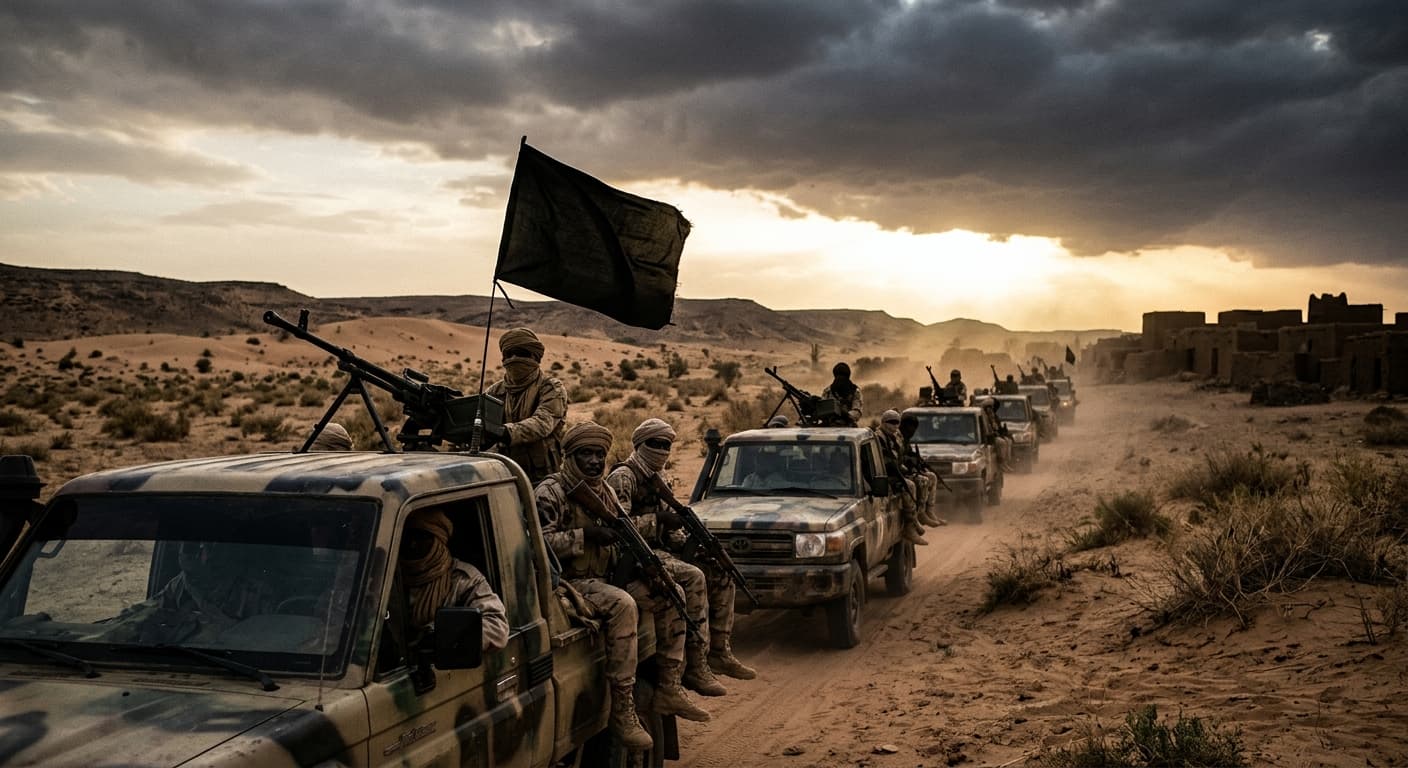
Mali's Anéfis body count is a message to Bamako, not JNIM
Russia's Africa Corps says it killed "several" JNIM–FLA commanders near Anéfis on July 7, 2026. The battlefield map tells a different story about the Sahel's balance of power.
The Africa Corps of the Russian armed forces, fighting alongside Mali's military, said on July 8, 2026 that it had killed "several field commanders" and "the majority" of the militants who launched a coordinated assault on seven northern and central towns four days earlier, according to TASS — even as RFI reported that rebels had seized Anéfis itself by July 7,
per Muted News. Mali's General Staff put the number of attackers killed around Anéfis alone at more than 200, after 35 airstrikes and combined air-ground operations. The claim is designed to travel — and it is aimed less at Jama'at Nusrat al-Islam wal-Muslimin (JNIM) than at a Malian public that has watched the junta lose Kidal, its defence minister, and its northern perimeter in ten weeks. The kill count buys narrative; it does not reverse the strategic map. JNIM and the Tuareg-led Azawad Liberation Front (FLA) now dictate the tempo of the war, Russia's regime-protection model is contracting toward the capital, and the vacuum is drawing in Turkey, the UAE, and — quietly — the United States.
What Bamako says happened at Anéfis
On July 4, JNIM and the FLA hit military positions in Aguelhok, Anéfis, Gao, Kenieroba, Konna, Sévaré and Somadougou. Mali's General Staff said in a communiqué carried by BBC Afrique that all assaults were repelled, that 20 fighters were "neutralised" at Sévaré and six at Gao, and that a ratissage — a mop-up sweep — was under way. Combat continued around Anéfis, a former French forward base 100 km from Kidal that Bamako reinforced in late April precisely because Kidal had fallen. On July 7, the Malian army
reported over 200 militants killed there, a figure the Africa Corps promptly echoed in the TASS dispatch.
Those numbers are unverified — and the battlefield record cuts against them. Two weeks earlier, the FLA said it had "intensified" its assault on the Anéfis base against Malian forces and Russian personnel, according to African Perceptions. Russian Federation Council warships have been shuttling weapons to Mali via the Guinean coast,
Al Jazeera reported, while Tuareg fighters have circulated footage claiming to show a Russian Mi-24 helicopter downed near the fighting. The direction of travel — resupply by sea, air platforms lost, a garrison town under siege — is not that of a force clearing the north.
The Kidal humiliation still sets the frame
Any assessment of "several field commanders eliminated" has to be read against April 25–27, 2026. On that weekend JNIM detonated a suicide truck bomb at the Kati residence of Defence Minister Gen. Sadio Camara, killing the second most powerful figure in the junta and one of the five officers behind Assimi Goïta's 2020 coup, per the BBC. Russian forces claimed up to 12,000 fighters had taken part in the coordinated offensive — a figure that, if accurate, would represent the largest single militant mobilisation in Sahel history and strains credulity on its face. Within 48 hours the Africa Corps
confirmed it had withdrawn from Kidal — the symbolic Tuareg capital retaken from separatists in November 2023 at heavy cost — after cutting a deal with the FLA to secure evacuation. Armoured personnel carriers and a "whole drone station" were left behind, the International Crisis Group's Sahel director Jean-Hervé Jezequel told the BBC.
The International Crisis Group's own reconstruction is blunter still: JNIM briefly took Mopti and most of Sévaré, joined the FLA in seizing Kidal, and forced President Goïta to shelter at a special forces camp 20 km from Bamako for 72 hours before appearing on television. Intelligence chief Gen. Modibo Koné was seriously wounded and his condition remains unknown, Crisis Group reported. "The Malian regime was badly shaken on 25 April, but it did not collapse," the group wrote. "Still, its ability to withstand further attacks in the coming weeks is uncertain."
The July 4 wave was that further attack.
The Africa Corps is smaller, more exposed, and paid in gold
Russia's paramilitary footprint in Mali is thinner than the rhetoric suggests. A senior French military official put Africa Corps strength at roughly 2,500 personnel; Crisis Group says "at least 2,000." Roughly 70–80% are former Wagner fighters transitioned onto Russian defence ministry contracts after Yevgeny Prigozhin's death in August 2023, according to Crisis Group's Franklin Nossiter. RAND's June 2025 assessment concluded the security situation in every country hosting Africa Corps had "deteriorated" and that fatalities linked to militant Islamist groups reached record highs across Mali, Niger and Burkina Faso in the first half of 2024,
per RAND commentary.
The real Russian pivot is analytical, not tactical. ACLED's West Africa lead Héni Nsaibia told the Institute for Security Studies that Africa Corps has shifted "from battlefield engagement towards regime stabilisation, infrastructure protection and strategic influence," as ISS Africa reported. Translation: Moscow will guard the palace and the mines. It will not clear the Adrar des Ifoghas.
That model has a price tag. Bamako paid Wagner an estimated $10 million a month; Africa Corps' contract terms are opaque but non-charitable, and Western budget support is gone. The Malian treasury is now underwritten by gold. Finance Minister Alousséni Sanou told parliament the state expected $1.2 billion in Q1 mining revenue after the 2023 mining code revision, the Financial Times reported. In November 2025 Barrick Mining settled its two-year standoff with Bamako by agreeing to pay roughly $430 million to reclaim the Loulo-Gounkoto complex, which produces 40% of Mali's gold,
according to the German Institute for International and Security Affairs. Gold prices above $5,000 an ounce are, in effect, keeping the junta and its Russian partner solvent while the security perimeter shrinks.
Regional stability: the AES's northern edge is gone
The stated project of the Alliance of Sahel States — the September 2023 mutual-defence pact binding Mali, Burkina Faso and Niger — was sovereignty through arms. At the December 2025 Bamako confederal summit the three juntas inaugurated a Sahel Investment and Development Bank, a joint TV channel and a cross-border battalion, Al Jazeera reported. The AES formally exited ECOWAS on January 28, 2025. Off-camera, Mali's finance minister admitted the IMF would not release loans "until Mali has ironed out its relations with France."
The July 2026 map exposes the gap between rhetoric and control. JNIM's blockade of Bamako, imposed after the April 25 offensive, has choked fuel and food supplies from the north and from the Dakar corridor via Kayes. UN Secretary-General António Guterres told the Security Council on November 18, 2025 that JNIM had been disrupting fuel supplies into Bamako since September 2025 and that Mali's $4.9 billion regional humanitarian appeal was only 16% funded — "among the lowest coverage rates worldwide," according to the UN Secretary-General's remarks. The OHCHR followed on May 5, 2026 warning of "disastrous consequences for civilians," extrajudicial killings and the abduction of prominent lawyer Mountaga Tall,
UN News reported.
For the AES the strategic significance is not that Bamako will fall this month. It is that the junta's writ has retreated from Kidal (population c. 25,000), Tessalit, and — pending the fight at Anéfis — the last significant northern garrison line. Burkina Faso and Niger cannot backfill Mali's north; JNIM already inflicts more fatalities inside Burkina Faso than anywhere else in the Sahel, at roughly 2,370 deaths in the first half of 2025 alone, according to the Centre for Democracy and Development.
International security interests: the quiet re-entry
The most important consequence of Russia's contraction is not who advances militarily — no one is — but who Bamako talks to now. The Stimson Center's Joaquin Matamis argues that Mali is running "a post-alignment strategy grounded in transactional sovereignty," and that as of March 2026 Washington was "reportedly nearing an arrangement with Bamako to resume intelligence-gathering flights over Mali," per Stimson. Turkey supplies Bayraktar drones; the UAE has bought into Mali's mining sector, including Allied Gold's stake. A senior Western diplomat quoted by ISPI put it plainly: "The Malians are quite clearly trying to diversify quietly and respectfully away from Russia towards actors like Turkey, the US and Qatar,"
according to ISPI.
For European capitals the calculus is uncomfortable but concrete. The Real Instituto Elcano argues that Africa Corps is "institutionalising Russia's regime-protection model" while "sidelining European actors" — but the model's evident battlefield failure creates precisely the "quiet off-ramps" that a July 2026 Elcano paper says Europe should offer without demanding public repudiation of Moscow. For Washington the incentive is narrower: JNIM and Islamic State Sahel Province are transnational threats whose reach into littoral West Africa — Benin, Togo, northern Ghana — has already begun, and intelligence flights are cheap relative to the alternative.
For Moscow, Mali is now a reputational liability with a gold-denominated revenue stream. RAND's Ryan Bauer notes that direct Kremlin ownership of Africa Corps means Russia is "now directly and publicly responsible for the Africa Corps' actions, including its human rights abuses, failures, and destabilizing client countries."
What to watch
- The Anéfis perimeter. If the base falls, Bamako loses its last credible forward position between the capital and Kidal, and the FLA's claim to control the north becomes uncontested. The tell: satellite-verified movement of Malian armour south of Gao.
- The blockade math. JNIM's fuel squeeze cut power across Mali in April–May. Diesel imports via Abidjan and Dakar corridors are the pressure gauge; sustained shortages past September 2026 would force either negotiations or a further Russian escalation.
- Washington's ISR arrangement. A formal US–Mali agreement on intelligence flights would confirm the "post-alignment" thesis and mark the most significant Western re-entry into the Sahel since MINUSMA's 2023 exit.
- AES ministerial, second half of 2026. Concrete progress on the Sahel Investment and Development Bank and the joint battalion is the litmus test of whether AES sovereignty is an architecture or a slogan.
Diplomat View
The Africa Corps' Anéfis kill claim is a defensive communiqué dressed as an offensive one. Read against Kidal, Camara's death, the Bamako blockade and the loss of Tessalit, it confirms rather than contradicts the direction of the war: JNIM and the FLA have taken the initiative in the north, and Moscow's role is compressing into palace protection funded by gold. The falsifiable call is this — by year-end 2026, either Bamako will have received the first tranche of a discreet Western or Gulf security package (intelligence-sharing, ISR, targeted training), or JNIM's blockade will have forced a negotiated fuel corridor on terms that treat the group as a de facto authority. Both outcomes shred the AES's sovereigntist narrative. What would revise the forecast: a decisive Malian-Russian retaking of Kidal, or a JNIM leadership decapitation confirmed by name — neither of which the July 7 body count provides. Until then, "several field commanders eliminated" is a claim about morale, not about who holds the ground.
Discover more

US Politics
US Launches $166B Tariff Refund Portal
The US is launching a $166 billion tariff refund portal to aid importers hit by Trump-era tariffs, with major implications for trade and supply costs.
US Politics
Washington's Scrutiny of Iran War Prediction
The Iran war prediction market scandal exposes political ties and regulatory challenges in Washington, as insider trading concerns rise.

India
Women’s Reservation in India
India's 33% women's reservation law is enacted but won't take effect until after 2029 due to political setbacks and census delays.

Conflict & Security
Drone Warfare Killing Aid Workers at Unprec
Over 1,000 humanitarian workers killed in three years as cheap armed drones collapse legal protections. Gaza, Sudan, Ukraine, and DRC see deliberate targeting of aid convoys and hospitals with zero prosecutions.