Kenya's AfDB Loan Buys Ruto Time, Not Solv
AfDB loan masks 15-month IMF gap and 2027 repayment cliff
Model Diplomat9 min readAfrica
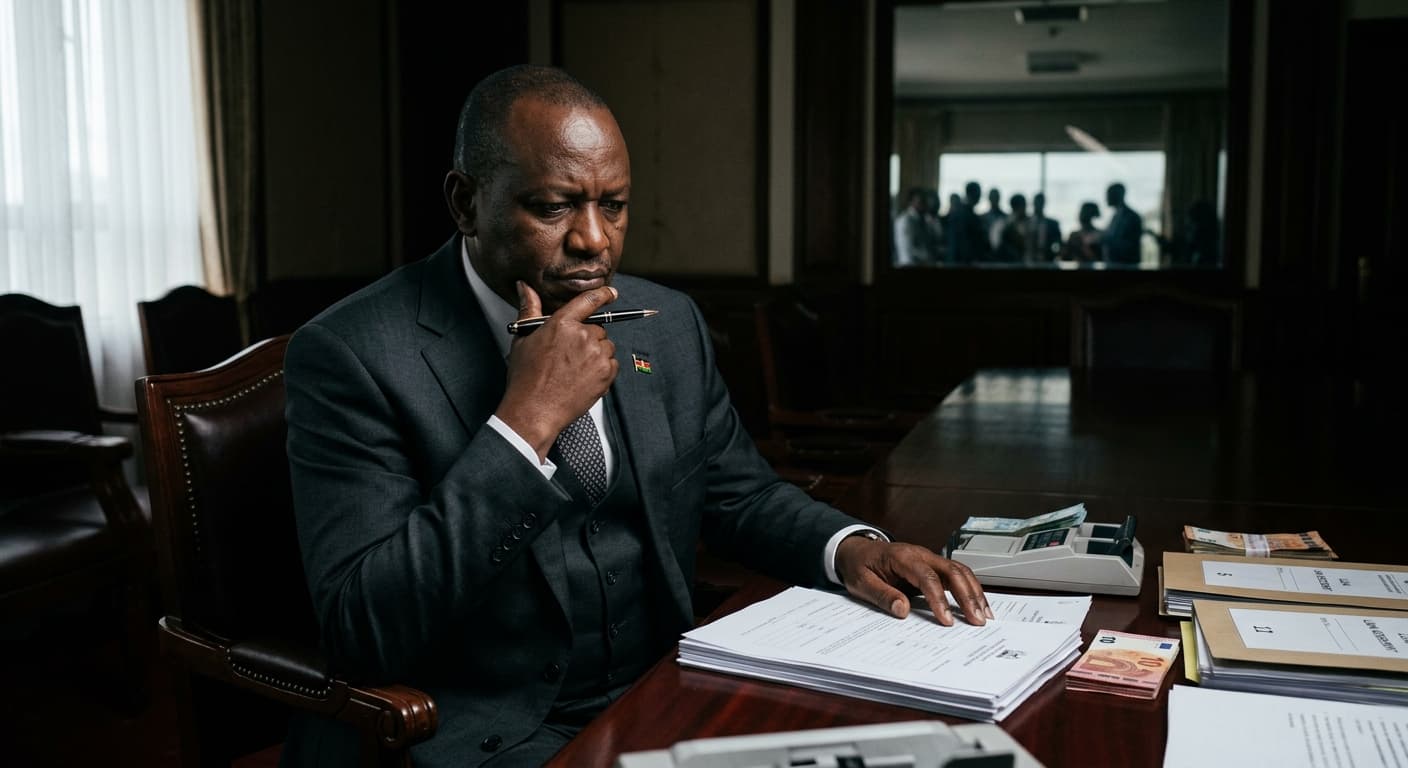
Kenya's AfDB Loan Buys Ruto Time, Not Solvency, as IMF Anchor Slips
Kenya secured a KES 43.3 billion African Development Bank loan in July 2026 after omitting IMF funding from its budget — a bridge that masks a 15-month gap with no IMF program and a 2027 repayment cliff.
Kenya's National Treasury secured a €293.88 million (KES 43.3 billion) stabilization loan from the African Development Bank on July 14, 2026, while deliberately stripping expected IMF disbursements from the budget for the fiscal year that began that month, according to Streamline. The move is being read as a pivot away from Bretton Woods conditionality — but the real story is that Kenya has had no active IMF program since April 1, 2025, and the AfDB facility is a political bridge, not a structural fix. The loan buys President William Ruto fiscal breathing room ahead of 2027 elections; it does not buy the credibility anchor that bondholders and bilateral donors still demand from an IMF seal of approval.
The African Development Bank approved the facility as the second phase of its Economic Inclusion and Green Recovery Support Programme, earmarked for public finance reform, governance, and climate-resilient development, Efficacy News reported on July 14. The funds flow directly into the consolidated fund for budget support, carrying lower conditionality thresholds than a standard IMF structural adjustment program. This is the second major external disbursement the Ruto administration has secured within a compressed three-week window, suggesting a coordinated push to plug the gap before the new fiscal year's financing needs became visible to markets.
How the IMF anchor lapsed
Kenya's IMF engagement did not collapse this month. It expired 15 months ago and was never replaced.
The Extended Fund Facility and Extended Credit Facility arrangements, approved in April 2021 for a combined SDR 2.714 billion (about USD 3.61 billion), were extended once to a 48-month term ending April 1, 2025, the IMF confirmed. The Board completed the seventh and eighth reviews on October 30, 2024, disbursing SDR 365.28 million — but flagged that "performance since the last reviews has weakened" and that fiscal targets had been missed. The Board approved waivers of nonobservance for the end-December 2023 tax revenue target and the end-June 2024 primary budget balance target, based on corrective action through the Supplementary FY2024/25 Budget. But the corrective action itself was a concession that the underlying targets had failed.
The ninth and final review never happened. Reuters reported in March 2025 that Kenya had formally requested a new IMF funding programme after effectively abandoning the last review of the existing arrangement, with IMF staff signaling the ninth review would not proceed.
By the IMF's own lending commitment records as of March 31, 2026, all three Kenya facilities — the EFF, the ECF, and the Resilience and Sustainability Facility — show an expiration date of April 1, 2025, with no successor arrangement listed. An IMF staff team visited Nairobi in late February 2026 and concluded on March 4 with a statement that the mission "will not result in a Board discussion," according to the IMF. Talks were deferred to the April Spring Meetings; no program materialized. The Star reported that Kenya–IMF new facility talks were expected to continue at the April Spring Meetings, but no Board-level decision followed.
The IMF's November 2024 media briefing made the structural constraint explicit: the EFF program "cannot be extended, because when we did the fifth review, we extended the program to the maximum that is feasible," IMF mission chief Haimanot Teferra told journalists, according to the IMF briefing transcript. On the question of a successor arrangement, Teferra added: "Budget need by itself does not translate into a Fund financing." That single sentence is the crux: the IMF does not lend to fill budget deficits; it lends against balance-of-payment needs, and Kenya's BoP pressure has eased since the February 2024 Eurobond issuance calmed markets.
The political economy: why IMF conditionality became toxic
The budget omission is less a repudiation of the IMF than a recognition that IMF conditionality has become politically lethal in Nairobi.
The turning point was June 2024. The IMF-backed 2024 Finance Bill, which would have raised roughly KES 350 billion in new taxes, triggered the most violent protests since Kenya's return to multiparty politics. Protesters stormed parliament and set parts of it on fire; dozens were killed. Ruto withdrew the bill, BBC News reported, and conceded the country would now have to borrow KES 1 trillion "just to be able to run our government" — a 67 percent increase on what had been planned.
The IMF's own staff report acknowledged the rupture in granular detail. The Supplementary FY2024/25 Budget, approved in July 2024, compensated for only about half the 1.8 percent of GDP in foregone revenue from the withdrawn Finance Bill, with more than 90 percent of the spending cuts falling on domestically financed development, the IMF staff country report documented. The primary surplus target slid from 1.7 percent of GDP to 1.4 percent — a full percentage point below what the original budget envisaged. The report warned that the spending cuts were "stop-gap" measures, "top-down and temporary in nature and thus likely to be reversed."
The protests exposed a structural problem for the IMF's leverage: its conditionality requires revenue measures that the Kenyan political system can no longer deliver without violence. The Medium-Term Revenue Strategy, designed to lift collections by 5 percentage points of GDP over FY2024/25–FY2026/27, was built on a Finance Bill that no longer exists. Al Jazeera reported that the IMF had conditioned loans on hiking taxes, reducing subsidies, and cutting government waste — measures that triggered protests first in 2023, when fuel subsidies were reinstated after public backlash, and again in 2024 with the Finance Bill, according to Al Jazeera.
What the AfDB facility actually does — and does not
The €293.88 million AfDB loan is the second tranche of the Economic Inclusion and Green Recovery Support Programme, a programmatic budget-support facility rather than a project loan. Its conditionality centers on public finance management, governance, MSME inclusion, and climate-resilient investment — not the tax-revenue targets and wage-bill ceilings that defined the IMF program.
Business Daily Africa reported that the Treasury had "avoided IMF loans" in the new budget after banking KES 588 billion from state enterprise stake sales, and that the World Bank had "stepped in to heal" the Nairobi–IMF rift, according to Business Daily. The implication is that other multilaterals are filling the financing vacuum — but on their own terms, with their own conditionality frameworks, and without the macro-surveillance function the IMF performs.
The AfDB facility's design reveals what Nairobi wants: reform-oriented conditionality that does not require raising taxes on a population that burned parliament. The loan supports governance, transparency, green growth, and job creation — all politically defensible objectives that do not require a Finance Bill. But none of these conditions address the structural deficit. The IMF's 2024 debt sustainability analysis rated Kenya at "high risk of debt distress" and noted that the cumulative external loan contracting from the start of the program amounted to about USD 7.8 billion in present value terms by end-June 2024, leaving roughly USD 1.2 billion in borrowing space, according to the IMF DSA. That space is now narrower still.
The credibility problem: who needs the IMF seal
The AfDB loan solves a liquidity problem. It does not solve a credibility problem — and in Kenya's debt architecture, credibility is the binding constraint.
Debt servicing consumes more than 60 percent of ordinary revenue collected by the Kenya Revenue Authority. The IMF's function in Kenya's financing strategy was never purely financial. It served as a credibility anchor: a signal to Eurobond holders, bilateral donors, and commercial syndicated lenders that Nairobi was under fiscal discipline. Western donors — the US, UK, and EU — historically condition budget support and grant flows on active IMF program compliance. Without that anchor, Kenya's risk premium widens and donor coordination frays.
The World Bank has tried to bridge the gap. A January 2026 World Bank project appraisal document for a Kenya housing finance operation noted that Kenya has committed, as part of its Medium-Term Debt Strategy and 2025/26 Annual Borrowing Plan, to issuing sustainability-linked instruments and diversifying financing sources, according to the World Bank. A separate World Bank fiscal sustainability development policy operation approved in 2023 provided USD 1 billion in blended IDA and IBRD financing, supporting the same "bottom-up" growth agenda the AfDB loan now extends, according to the
World Bank DPO document. But World Bank and AfDB lending, even combined, cannot replicate the IMF's role as a macroeconomic gatekeeper.
The AfDB cannot fully substitute. Its loan carries conditionality focused on governance, green growth, and MSME inclusion — politically softer targets that do not require the revenue mobilization or wage-bill compression that the IMF demands. But the AfDB does not perform the same macro-surveillance function, and bondholders know it.
Winners and losers, named
Winners: President William Ruto and his Treasury team gain 15 months of fiscal space without accepting the tax hikes or wage-bill freezes that burned the government in 2024. The AfDB gains institutional relevance as a regional alternative to IMF conditionality — a precedent that other African sovereigns navigating between Western financial architecture and domestic political constraints will study closely. Commercial holders of Kenya's 2031 Eurobond benefit from the short-term liquidity injection, which reduces near-term default risk.
Losers: The IMF loses leverage in Nairobi at a moment when its existing program delivered on inflation reduction, exchange-rate stabilization, and reserve accumulation — but failed on the fiscal side because the political system rejected its prescription. Western bilateral donors who gatekeep on IMF compliance — particularly the US Treasury and UK FCDO — face reduced ability to condition their own aid flows. Kenyan taxpayers benefit from the absence of new taxes but face a second-order risk: without the IMF's fiscal guardrails, the Treasury may expand domestic borrowing, crowding out private-sector credit and pushing up Central Bank of Kenya policy rates. The 46,000 junior secondary school teachers whose hiring was deferred after the Finance Bill withdrawal remain un-hired.
The 2027 squeeze: a repayment cliff under a bridge
The AfDB facility's timing exposes its limits. The €294 million loan is roughly the same magnitude as what Kenya will owe the IMF in 2027 — a reverse-flow year in which repayments begin to exceed new disbursements.
According to the IMF's own projected payments schedule as of April 30, 2026, Kenya owes SDR 334,502,671 in 2027 — a mix of EFF repurchases, ECF repayments, RCF principal, and interest charges across both the General Resources Account and the Poverty Reduction and Growth Trust, the IMF projected. The largest single items are two RCF principal repayments of SDR 54.28 million each in May and November 2027, plus quarterly EFF repurchases averaging SDR 11–12 million.
The AfDB loan is not a net inflow against this obligation; it is a parallel liability. Kenya is borrowing from Abidjan to service what it owes Washington — a shell game unless the underlying revenue base expands. And the revenue base is the exact problem the IMF program could not solve because the political system rejected its prescription.
Diplomat View
The AfDB loan is a tactical success and a strategic warning. Ruto has secured roughly 15 months of fiscal breathing room without accepting the tax hikes or wage-bill freezes that burned his government in 2024. That is a real political gain ahead of an August 2027 election. But the pivot exposes the core contradiction: Kenya's debt burden is unsustainable at current revenue levels, and no amount of multilateral shuffling changes that arithmetic. The IMF's credibility function — not its money — is what kept commercial lenders and bilateral donors at the table. Without a replacement anchor, Kenya's risk premium will widen, bilateral budget support will contract, and the 2027 repayment cliff will arrive with no program to refinance it.
The forecast hinges on whether Nairobi can secure a successor IMF arrangement — even a low-access Policy Coordination Instrument — before the October 2026 Annual Meetings. If it does, the AfDB loan becomes a bridge that worked. If it does not, expect a ratings downgrade, a widening of sovereign spreads, and renewed pressure for the exact austerity measures the pivot was designed to avoid. Revision trigger: any formal IMF Board discussion of a Kenya program before end-2026 reverses the bearish case.
What to watch:
- October 2026 IMF–World Bank Annual Meetings, Washington — the next realistic window for a new IMF program or a Policy Coordination Instrument for Kenya.
- Q1 2027: first major IMF repayments fall due — SDR 11.76 million EFF repurchase on January 20, 2027, followed by a SDR 54.28 million RCF principal repayment on May 11, 2027.
- August 2027 general election — the political deadline that makes any pre-election austerity program toxic and shapes IMF negotiating leverage.
The bottom line: Kenya's KES 43.3 billion AfDB loan is not a break from the IMF — it is a 15-month admission that the IMF relationship broke first. The bridge holds through the election; the cliff waits on the other side.
Discover more
India
Rajnath Singh's Durga Squad for 2026 Polls
Rajnath Singh's Durga Squad promised women's safety in Bengal but has since disappeared from the agenda, revealing BJP's true priorities.
US Politics
Congress Targets AI Chatbot Access for Terror
The House passed the Generative AI Terrorism Risk Assessment Act, focusing on AI's role in terrorism and potential surveillance implications.
India
700 Activists Accuse PM Modi of MCC Breach
Over 700 activists allege PM Modi breached election code with a televised address attacking opposition parties just before state elections.

Economics
Fed's Amex AML order puts correspondent banking on notice
Federal Reserve's Amex AML order requires board-level controls and a 90-day plan; OCC fined the bank $350 million over enterprise-wide deficiencies.