Joburg's Treasury Freeze: A Fiscal Shift
South Africa's richest city faces financial scrutiny ahead of elections
Model Diplomat8 min readAfrica
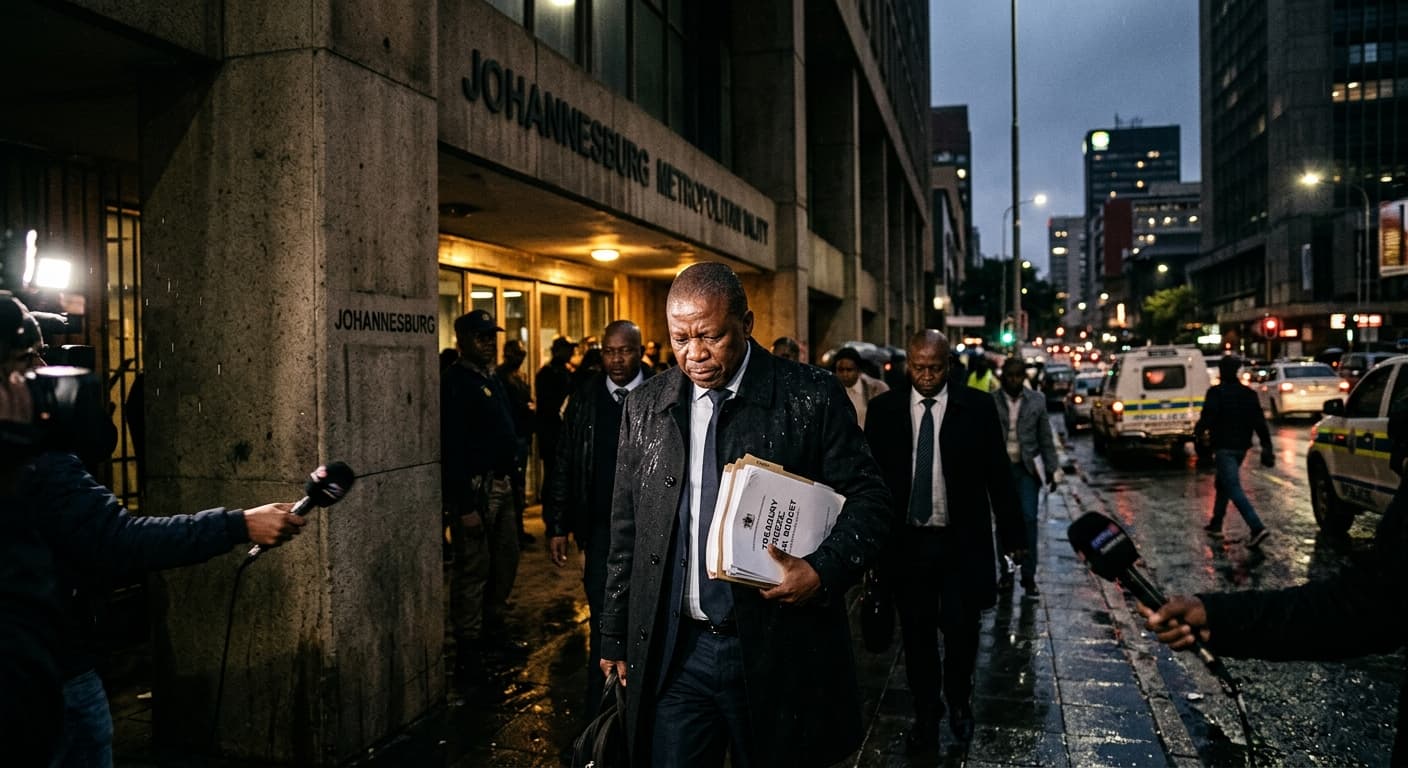
Joburg's Treasury freeze: Africa's richest city meets Section 216
South Africa's National Treasury has withheld the July 2026 equitable share from Johannesburg and 68 other councils, four months before local elections that could redraw Gauteng's political map.
South Africa's National Treasury invoked Section 216 of the Constitution on July 7, 2026, to withhold July equitable share transfers from the City of Johannesburg and 68 other municipalities — the first time Africa's richest city has been placed on the freeze list, and the fourth time in 19 months that the Treasury has used the lever to force councils to pay Eskom, the water boards and SARS. The move is not, on its face, about Joburg. It is about a broader experiment: whether central government can discipline a collapsing local sphere without triggering the service-delivery meltdown it is trying to prevent — and whether it can do so four months before a November 4 election in which the ANC is polling behind the Democratic Alliance in the country's economic capital. The withholding is corrective on paper. In practice, it is the sharpest fiscal instrument Pretoria has used against its own party's flagship metro in the democratic era.
The primary document and what it actually says
The Treasury's media statement frames the action as remedial, not punitive. It cites "persistent and serious non-compliance with the Municipal Finance Management Act (MFMA) and its supporting regulations, despite support provided by the National Treasury through guidance, engagement, and formal or informal communication." The legal anchor is explicit:
The temporary withholding of funds is taken in terms of section 216(2) of the Constitution, read with section 38 of the Local Government: Municipal Finance Management Act 56 of 2003.
The Treasury lists nine provinces of affected municipalities. Gauteng contributes six: the City of Johannesburg, Emfuleni, Lesedi, Sedibeng District, Merafong City and Rand West City. The Free State supplies the largest single provincial cohort — 14 councils, including Mangaung metro. Nelson Mandela Bay in the Eastern Cape is the only other metro on the list. Cape Town, Tshwane, eThekwini and Ekurhuleni are absent.
Parliament's Portfolio Committee on Cooperative Governance and Traditional Affairs, chaired by Zweli Mkhize, said the Treasury action was "a necessary step to enforce accountability" and welcomed the intent but urged rapid compliance so that transfers can resume. The committee's water and sanitation counterpart went further: in a July 2026 briefing, MPs said the earlier rounds of withholding had already produced results, with defaulting municipalities paying
R278 million to bulk suppliers between 7 July and 25 August 2025, including R72 million from Rand West City alone. That is the evidence base Treasury is leaning on. The lever works.
Why Joburg matters differently
Joburg is not the worst offender on the list — Free State's Maluti-a-Phofung and North West's Ditsobotla have deeper structural problems, and the latter is under a formal financial recovery plan supervised by Finance Minister Enoch Godongwana. What makes Joburg different is scale and signalling. The city runs roughly a fifth of South Africa's metro operating budget and hosts the JSE-listed head offices that generate most of Gauteng's corporate tax base. Freezing its July tranche places the ANC-led coalition of Mayor Dada Morero on public notice that Finance Minister Enoch Godongwana's Treasury no longer treats the metro's compliance failures as a family matter.
The underlying numbers explain why Pretoria felt it had no choice. According to the 2026 Budget Review, municipal unauthorised, irregular, fruitless and wasteful expenditure had accumulated to R236.3 billion by 2023/24 — of which R81.6 billion is unauthorised, R137 billion irregular and R17.7 billion fruitless and wasteful. Treasury's document notes plainly that "after years of support measures to strengthen financial governance, the National Treasury has invoked section 216(2) of the Constitution" against persistently non-compliant councils. Local government's 2026/27 allocation is R110.1 billion, per Parliament's
NCOP statement on the Division of Revenue Bill; that is the pot Treasury is now willing to squeeze.
The Institute for Security Studies has documented what the audit numbers imply behind them. In a mapping of graft at three municipalities, the ISS found that at Joburg, corruption "has involved levels of organisation often associated with state capture", including collusion between supply-chain officials, bid-committee members and service providers. The Special Investigating Unit has flagged systemic weaknesses. The Auditor-General has repeatedly cited poor consequence management.
The water crisis is the real detonator
Read the primary text carefully and one clause reveals the operational logic. Treasury's statement says non-compliance "is also threatening the financial sustainability of bulk suppliers (water boards and Eskom)." That is the crisis Section 216 was reactivated to solve.
Johannesburg is the worst-case study. The Institute for Security Studies reports that non-revenue water in the city stands at 44.8% — the city bills and collects on just over half of what it buys — producing an annual deficit of nearly R7 billion. Rand Water, Africa's largest bulk supplier, is now demanding a R2.4 billion deposit against Joburg's bad debt. The Institute of Race Relations puts the figure worse still:
35% of water is lost through leaks, up from 25% at the start of 2024, and 42 Johannesburg Water reservoirs are leaking with budget to fix only 20. Gauteng municipalities collectively owe Rand Water R2 billion.
That is the pipe Treasury is squeezing. Withhold the equitable share; force the CFO to write a cheque to Rand Water and Eskom instead of paying a politically-connected contractor; watch bulk suppliers recapitalise. Crude instrument. It works, for now.
What the opposition sees, and what it doesn't
The Democratic Alliance and ActionSA have seized on the withholding as proof of ANC misgovernance in Joburg, framing it as the fiscal counterpart to the water outages already dominating DA leader Helen Zille's campaign messaging. The Institute of Race Relations argues that survey evidence puts the ANC "uncomfortably behind the Democratic Alliance in Johannesburg and Tshwane" for November. Since 2016, Johannesburg has cycled through nine mayors in eight years — a churn rate ISS Africa flags as making
long-term planning "almost impossible".
But the opposition case has a hole in it, and the Treasury statement quietly points at it. The withholding is a national instrument applied uniformly on MFMA compliance criteria. Nelson Mandela Bay — governed since 2024 by a DA-ActionSA-led coalition — is also on the list. So is Beaufort West, a DA-run Western Cape municipality. So is Buffalo City, run by the ANC. The freeze is not partisan. It exposes a deeper problem: the SAIIA analysis of coalition politics argues that "provincial and municipal coalitions show the highest instability, driven by shifting alliances, leadership turnover and outsized leverage of small kingmaker parties." Coalitions cannot deliver the years of stable, unglamorous financial hygiene that MFMA compliance actually requires. Both Joburg's ANC-led and DA-led coalitions have failed that test since 2016.
The academic literature agrees with the Treasury — reluctantly
A 2025 study in Sustainability found that 64% of South Africa's municipalities are financially distressed — a threshold rarely matched outside conflict states. A
Journal of Southern African Studies paper by Timothy Gibbs argues that South Africa's municipal meltdown is best understood not as a corruption story but as a collapse of the "social contract" underpinning local taxation — mid-sized cities fund most of their redistribution from ratepayers and service charges, and when the middle class opts out (boreholes, solar panels, or emigration), the fiscal base implodes. NPR reported in 2024 that Johannesburg's wealthy are already doing exactly that:
drilling boreholes, installing tanks, semigrating to Cape Town.
The South African Institute of International Affairs frames the paradox: as municipalities become more dependent on Treasury transfers, they lose autonomy under "over-monitoring," which prevents them from developing the very capacity they need. Section 216 withholding is the pointy end of that trend — an admission that the national sphere no longer trusts the local sphere with unconditional grants. The Treasury's own
MFMA Amendment Bill, issued for public comment in 2026, is explicit that the legislative direction is more central control, not less.
Who wins, who loses
Wins: Eskom, Rand Water and the other water boards, which will be paid; Godongwana and the Treasury technocracy, whose instrument has now demonstrably moved money; DA and ActionSA campaigners in Johannesburg, who get a national validator for their governance critique.
Loses: The ANC in Johannesburg, four months before an election it is already forecast to lose; the coalition of Mayor Morero, whose narrative of a "turnaround" now sits uncomfortably next to a national compliance failure; ratepayers in the six Gauteng councils on the list, who face the same water shortages regardless of which sphere is at fault.
The under-appreciated winner is intergovernmental precedent. Section 216(2) had been dormant as an active tool for two decades before December 2024. Treasury has now used it four times. Each round makes the next one more legally defensible and politically routine. That is a permanent shift in South Africa's fiscal federalism, and it will outlast whoever runs Joburg in December.
Diplomat View
Our call: Treasury's July 2026 withholding is not the beginning of Joburg's crisis. It is the moment central government stops absorbing the cost of that crisis and starts pricing it back to the metro. Expect the city to comply within four to eight weeks — the arithmetic of a R110 billion annual local government allocation leaves it no choice — and expect the July transfer to be released before the September mid-quarter. The genuine consequence lands on the November 4 ballot: the ANC will campaign in Johannesburg while the National Treasury, run by its own party, has publicly labelled the city non-compliant. That is a self-inflicted wound the DA and ActionSA will exploit, and internal ANC polling almost certainly already reflects it.
What would change this forecast: (1) a court challenge by an affected municipality against Section 216, which would test whether Treasury's interpretation of "persistent non-compliance" is justiciable; (2) a service-delivery collapse — a Rand Water supply cut to Johannesburg — during the withholding window, which would flip public sympathy toward the city; (3) a Constitutional Court ruling narrowing s.216(2). Absent those, the pattern is now the policy.
Watch next:
- August 15, 2026: Treasury's typical resolution window for prior Section 216 rounds; expect the first municipalities to be released from the freeze list.
- October 2026: Auditor-General's Consolidated Report on Local Government Audit Outcomes for 2024/25 — the primary evidence base for the next round.
- November 4, 2026: Local government elections. Gauteng metro results, particularly Johannesburg and Tshwane, will determine whether Section 216 remains a technocratic tool or becomes a partisan weapon in a DA-led national coalition scenario.
The bottom line: Johannesburg's freeze is less about one metro's failure than about a permanent recalibration of who controls municipal money in South Africa. Section 216 has moved from a dormant constitutional clause to Treasury's most reliable enforcement tool. The next government, whoever leads it, will inherit a fiscal federalism in which the equitable share is no longer unconditional — and that inheritance is not returnable.
Discover more
US Politics
Congress Targets AI Chatbot Access for Terror
The House passed the Generative AI Terrorism Risk Assessment Act, focusing on AI's role in terrorism and potential surveillance implications.
India
Rajnath Singh's Durga Squad for 2026 Polls
Rajnath Singh's Durga Squad promised women's safety in Bengal but has since disappeared from the agenda, revealing BJP's true priorities.
US Politics
SNAP Food Assistance Faces Legal Challenges
In 2026, SNAP faces stricter eligibility rules and mounting legal challenges, threatening food assistance for the millions of Americans who rely on the program.

Conflict & Security
Drone Warfare Killing Aid Workers at Unprec
Over 1,000 humanitarian workers killed in three years as cheap armed drones collapse legal protections. Gaza, Sudan, Ukraine, and DRC see deliberate targeting of aid convoys and hospitals with zero prosecutions.