India's AI Rise
India positions itself as a key player in global AI development.
Model Diplomat7 min readAsia

India's AI Rise: Why the Middle Power Just Set the Global Agenda
India is not building a frontier model — it is building the pipes, the politics and the price point. That combination, not a domestic ChatGPT, is what puts New Delhi at the centre of the 2026 AI order.
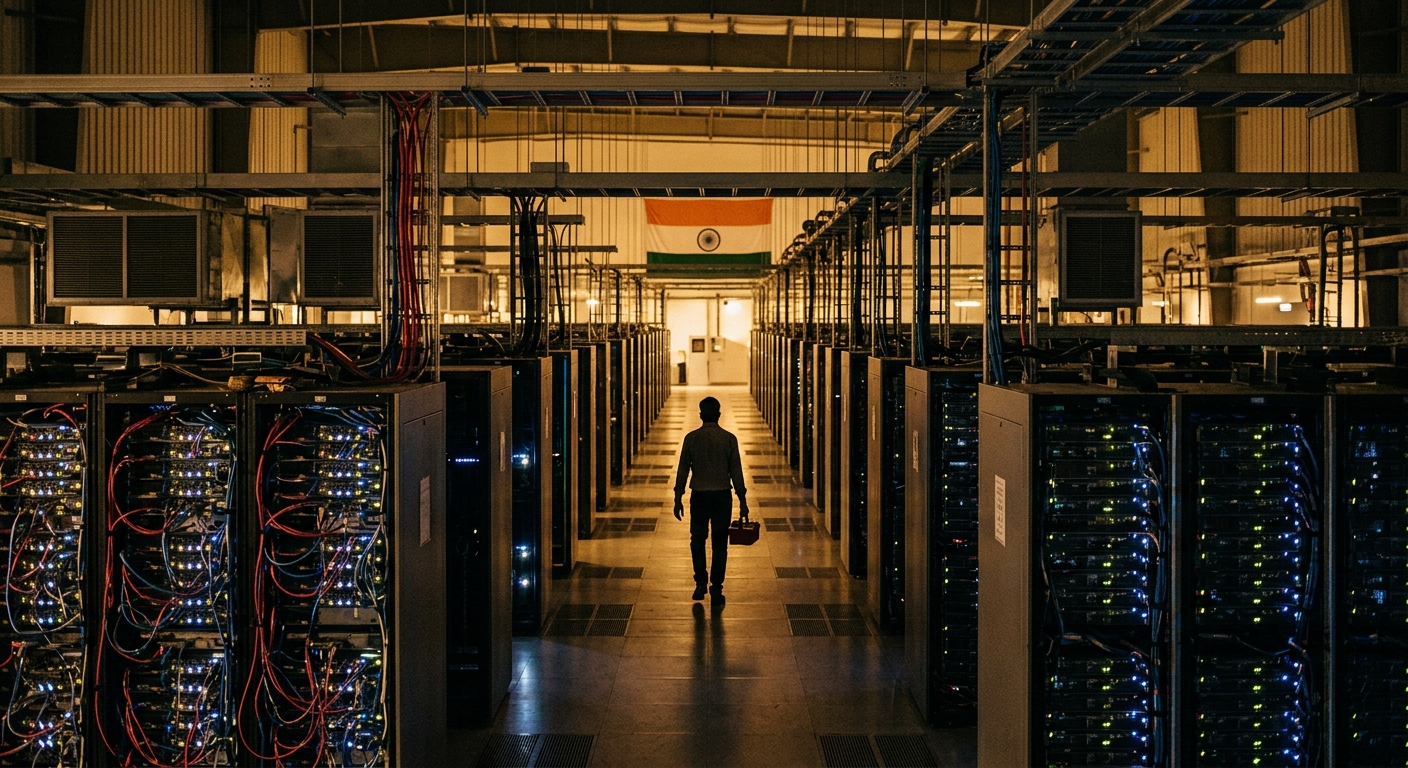
The question that dominated coverage of the India AI Impact Summit in February — where is India's OpenAI? — is the wrong question. India's AI rise is a distribution play, not a frontier-model race: New Delhi is using cheap subsidised compute, digital public infrastructure and Global South convening power to make itself indispensable to whichever model wins, rather than trying to build the winner. Ninety-two countries signing a Delhi-drafted declaration, $200 billion in announced AI investment, and 38,231 GPUs rented out at ₹65 an hour tell the same story — and it is not the one Silicon Valley is telling itself.
The summit that reframed the race
From February 16 to 20, 2026, Prime Minister Narendra Modi's government turned Bharat Mandapam into the largest AI convening the world has hosted. Brookings analysts who attended counted 300,000 visitors across five days — a scale designed to break the private-club feel of Bletchley 2023 and Paris 2025. The Ministry of Electronics and Information Technology (MeitY) confirmed the summit was anchored on three "Sutras" — People, Planet, Progress — in an
official notice framing India as the first Global South host of the series.
Two documents came out of the summit. The Delhi Declaration was endorsed by 92 countries and international organisations, including the United States, China, the EU, the United Kingdom and Russia — the broadest sign-on the summit series has ever achieved, according to a Carnegie Endowment review. The New Delhi Frontier AI Impact Commitments were signed by 13 developers, including OpenAI, Anthropic, Meta, Amazon and Sarvam AI.
The US endorsement matters because Washington refused to sign the Paris declaration a year earlier. As Brookings scholars observed, US envoy Michael Kratsios told the hall the administration "totally rejects global governance of AI" while simultaneously signing a non-binding Indian text — a distinction that only holds because the Delhi document was voluntary by design. That is the trick New Delhi pulled: soft enough for Washington, inclusive enough for Beijing, developmental enough for São Paulo and Nairobi.
The compute economy, priced to move
The load-bearing number is not the $200 billion in pledges but ₹65. That is the hourly price, roughly $0.78, at which the IndiaAI Mission subsidises GPU access for startups, researchers and academics. According to a March 13, 2026 Rajya Sabha reply from Minister of State Jitin Prasada, 38,231 GPUs are now live across 14 empanelled providers, at about one-third the global average cost. India's data-centre capacity, the same document confirms, quadrupled from 375 MW in 2020 to roughly 1,500 MW by 2025, with the Ministry of Power projecting 13.56 GW of data-centre electricity demand by 2031.
The Observer Research Foundation reports another 20,000 GPUs are being added in the immediate term, with a target of 100,000 by end-2026. Brookings analysts studying the global AI divide have called India's model — where the state "funds the access to a public compute pool" and sets subsidised terms — the
clearest working template for a Global South country trying to buy time against hyperscaler concentration.
The private capital chasing that public rail is unusual in scale. Reliance Industries committed $110 billion over seven years to AI data centres. Adani Enterprises pledged $100 billion by 2035 for renewable-powered facilities. Google announced a $15 billion AI hub in Visakhapatnam. Microsoft's Satya Nadella described his $17.5 billion pledge as the company's largest-ever Asian investment, aimed at "sovereign capabilities needed for India's AI-first future," according to the BBC. Amazon committed $35 billion by 2030. Tata Consultancy Services and OpenAI announced a joint 1-gigawatt AI-ready data centre.
The uncomfortable arithmetic
Strip out the pledges and the picture darkens. India's flagship AI mission is budgeted at roughly $1.25 billion over five years. That is next to France's $117 billion sovereign programme, Saudi Arabia's $100-billion-plus AI push and the roughly $500 billion the Trump administration has folded into the Stargate initiative in the United States, as the BBC has documented. In-year execution has slipped further: the Takshashila Institution's
budget analysis shows revised mission expenditure fell to ₹800 crore for FY25-26 against the ₹2,000 crore originally budgeted, with more than 85% of the compute subsidy already flowing to a small set of indigenous generative-model builders — Sarvam, BharatGen, Zenteq, SoketAI, Gnani.ai, Gan.ai and Avataar AI.
Private capital numbers are equally sobering. Indian AI startups raised $1.16 billion in 2024. US AI startups raised more than $100 billion. Chinese startups raised close to $10 billion. On the Stanford AI Index 2025, US firms shipped 40 notable models last year, China 15, and Europe three; India shipped none in that tier, though it accounts for 9.2% of AI research publications — marginally ahead of the US on that specific measure.
Compute infrastructure remains foreign-anchored. Even the ambitious Tata Electronics fab at Dholera, backed by an $11 billion investment and an ASML lithography agreement signed in May 2026, will not deliver leading-edge nodes and is not expected to enter production until 2028. The Union Minister for Electronics, Ashwini Vaishnaw, told Al Jazeera the plant would produce 300mm wafers — necessary, but a generation behind Taiwan and Korea.
The angle Silicon Valley is missing
The interesting move is not that India is trying to beat OpenAI. It isn't. The move is that India is positioning itself as the low-cost deployment layer for everyone else's models — the AWS-equivalent of AI applications for four billion people who don't speak English, don't earn US wages, and won't be a target market for frontier labs optimising for American enterprise revenue.
This is why the Bhashini programme, currently running 350 language models across 22 official Indian languages and processing over a billion tasks, matters more than any headline model launch. It is why the Takshashila Institution argues in a March 2026 essay that the
realistic sovereignty path for India runs through open-source, domain-specific models and diffusion — not through matching Alphabet's $91 billion 2025 capex.
It is also why the Trump administration's shifting export-control regime plays into New Delhi's hand. The Biden administration's AI Diffusion Framework, released in January 2025, placed India in a middle "Tier 2" category — allowed to buy but capped at 50,000 advanced chips without Validated End User status. Trump scrapped the framework in May 2025. Al Jazeera has since reported the Commerce Department
reaffirmed that only China-headquartered firms face blanket restrictions, which effectively upgrades India's access. The Brookings-CEPS report launched at the Delhi summit called this "managed interdependence" — a
pragmatic middle path between autarky and dependence — and singled out India as its cleanest working example.
The geopolitical bill is also arriving. In August 2025, the Trump White House raised tariffs on Indian goods to 50%, citing Delhi's Russian oil purchases, according to the Council on Foreign Relations. That has not derailed the AI investment pipeline — Microsoft, Google, Amazon, Nvidia and OpenAI have all deepened commitments since — because the underlying trade is compute capacity for a market Washington cannot afford to hand to Beijing.
What to watch next
- UN Global Dialogue on AI Governance, Geneva (July 7, 2026): The first UN forum on AI governance opens today. Delhi Declaration language on voluntary frameworks and Global South inclusion will be tested against a UN process the Trump administration distrusts, per
CSIS.
- Sovereign LLM launch: MeitY has told the
BBC the launch of a 22-language government-backed foundation model is "imminent." Slip past Q4 2026 and the political credibility of the IndiaAI Mission takes a hit.
- 100,000-GPU target by end-2026: The Bharat Mandapam pledge. Watch the next Rajya Sabha update, and whether power availability at the announced hubs — Mumbai, Hyderabad, Bengaluru, Noida, Jamnagar — keeps pace.
- Switzerland AI Impact Summit 2027: Whether the Delhi coalition survives a Western host will show if this was an India moment or an India shift.
Diplomat View
India's rise is real, but it is not the rise most Western coverage is looking for. New Delhi will not produce a GPT-5 competitor by 2027, and the $1.25 billion IndiaAI Mission is too small to close the frontier gap. What India is producing is something more useful to its actual constituency: a working template for a middle power that wants sovereign leverage without sovereign delusion. Cheap compute, open-source deployment, digital public infrastructure and Global South convening power together buy Delhi a seat at every table Washington and Beijing set — and a veto over none of them, which is exactly the position India has always played best. The forecast changes only under two conditions: if the sovereign LLM slips past 2026 and undermines the credibility of subsidised compute, or if a second Trump-era tariff shock forces Microsoft, Google or Amazon to scale back their pledged builds. Absent those, expect India, not Europe, to be the third node in the global AI order by 2028. That, more than any Bengaluru unicorn, is the
India story worth pricing in.
The Bottom Line
India's AI rise is not about beating OpenAI — it is about becoming the indispensable middle node between American models, Chinese capital pressure and four billion Global South users. New Delhi's leverage in 2026 rests on ₹65-per-hour GPUs, 92 signatures on the Delhi Declaration and a $200 billion private investment book, not on a domestic frontier model. If that combination holds through the Geneva UN dialogue and the 2027 Swiss summit, the AI order will have three poles, and the third one will be Global South by design.
Discover more

India
India-South Korea $50B Trade Expansion Plan
India and South Korea target $50 billion in bilateral trade by 2030, focusing on industrial cooperation and strategic alignment amid US pressures.
US Politics
Congress Targets AI Chatbot Access for Terror
The House passed the Generative AI Terrorism Risk Assessment Act, focusing on AI's role in terrorism and potential surveillance implications.
India
UN Expert Albanese: India Violates Law
UN Rapporteur Francesca Albanese accuses India of breaching international law, spotlighting human rights concerns in Kashmir and prompting diplomatic pushback.

Conflict & Security
Drone Warfare Killing Aid Workers at Unprec
Over 1,000 humanitarian workers killed in three years as cheap armed drones collapse legal protections. Gaza, Sudan, Ukraine, and DRC see deliberate targeting of aid convoys and hospitals with zero prosecutions.