India-Japan Healthcare Summit
A strategic move to de-risk drug supply chains from China.
Model Diplomat8 min readAsia
India-Japan Healthcare Summit: A Pharma De-Risking Pact in Disguise
Behind the May 5 Joint Committee and the Modi-Takaichi communiqué sits a coordinated bid to prise pharmaceutical supply chains loose from China.
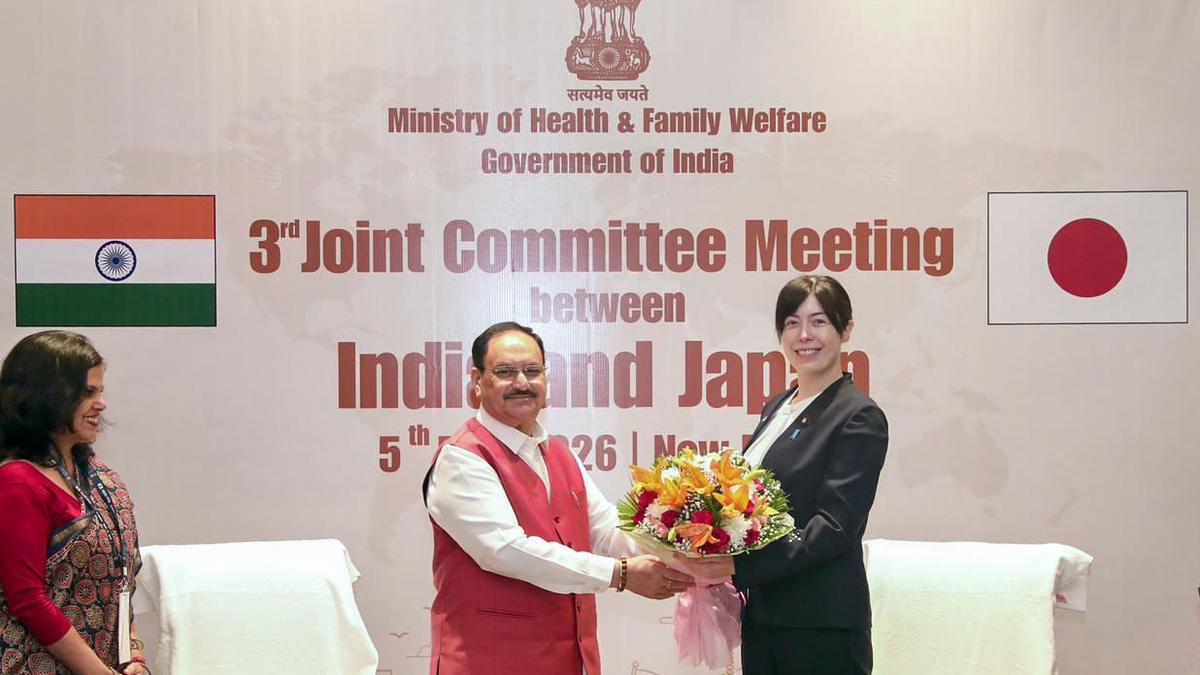
On May 5, 2026, India's Health Minister Jagat Prakash Nadda and Japan's Minister for Healthcare Policy Kimi Onoda co-chaired the third India-Japan Joint Committee Meeting (JCM) on Healthcare at Bharat Mandapam in New Delhi — the first such meeting in three years and the diplomatic set-up for what came eight weeks later. On July 3, 2026, Prime Ministers Narendra Modi and Takaichi Sanae signed a Joint Declaration on Economic Security Cooperation that, for the first time, names pharmaceuticals alongside semiconductors and critical minerals as a "strategic backbone" sector. The healthcare summit is doing quiet work no one is calling by its real name: it is an India-Japan pact to de-risk the drug supply chain from China, dressed as public-health cooperation.
What was actually signed, and what wasn't
The Joint Committee itself produced no treaty. According to the Press Information Bureau, the two sides committed to "deepen cooperation" on health systems, resilient medical supply chains, digital health, medical devices and artificial intelligence in healthcare. The Hindu reported that discussions converged on "innovation, accessibility and resilient health systems," with digital health and AI singled out as priority workstreams (
The Hindu). Nadda framed cooperation as "guided by a shared goal of improving health systems, expanding access," per
ETHealthworld, while Digital Health News noted the initiative "aims to strengthen pharma supply chains, including in APIs and KSMs, through promotion of bilateral investment and business linkages" (
Digital Health News).
The operative deliverable came two months later. The Prime Minister of India's Office published the 16th India-Japan Annual Summit joint statement on July 3, in which Modi and Takaichi "adopted the India-Japan Joint Declaration on Economic Security Cooperation to further promote project-based collaboration in the key sectors of semiconductors, critical minerals, information and communication technology, clean energy and pharmaceuticals" (PMO India). That single clause is the pivot. Healthcare cooperation between the two capitals has been moved out of the soft-power basket and into the economic-security basket.
The document is emphatic about why. The two leaders "reiterated their grave concerns over the use of economic coercion and non-market policies and practices, including arbitrary export restrictions that may lead to supply chain disruptions particularly in critical minerals and critical industrial sectors," and stressed "the need to avoid reliance on any one country" (PMO India). No country is named. Everyone in the room knew which country.
The China problem, in numbers
Both economies enter this partnership with the same wound. Observer Research Foundation calculates that Indian drug makers still source around two-thirds of their active pharmaceutical ingredients from China, and that by 2024 roughly 87% of India's imported antibiotic ingredients by value came from Chinese suppliers — up from about 60% in the mid-2000s (ORF). India's trade deficit with China hit a record $99.2 billion in 2024-25, weighted heavily by APIs, electronics and formulations. When Wuhan locked down in early 2020, New Delhi restricted exports of 26 essential medicines including paracetamol; the pandemic exposed the "pharmacy of the world" as a downstream assembler of Chinese chemistry.
Japan's exposure is quieter but sharper. A CSIS analysis notes Tokyo "faces challenges such as dependence on specific countries, including China, for pharmaceutical ingredients and limited domestic manufacturing capacity," and that the Takaichi administration's first Comprehensive Economic Measures — released in November 2025 — position pharmaceuticals as a "strategic backbone sector," mobilising more than ¥152 billion (about $1 billion) in the FY2025 supplementary budget for onshore manufacturing and R&D (CSIS). Japan's own generic penetration was still only 24% in 2009, against 89% in the United States; the
IMF projected in 2014 that ageing alone would push Japanese health spending from 9.5% of GDP in 2010 to 13% by 2030, with a worst-case of 19%. Cheap, reliable generics are a fiscal instrument, not a preference.
The fit is obvious. Japan has capital, precision-chemistry know-how and regulatory credibility through the Pharmaceuticals and Medical Devices Agency (PMDA), which has streamlined new-substance approval into "among the fastest in advanced economies" (CSIS). India has scale, FDA-inspected plants and the world's lowest-cost API workforce. The Modi-Takaichi declaration formalises what industry has been circling for two years.
The complementarity thesis, in one table
| Capability | India | Japan |
|---|---|---|
| Global generic volume share | ~20% (largest globally) | Historically brand-dominated |
| API sourcing from China | ~67% of formulation raw materials by value | High; ¥152bn allocated to onshore alternatives |
| Regulator | CDSCO; hosted 15-country policymakers' forum (2024) | PMDA — fastest new-substance approval among advanced economies |
| Ageing pressure | ABDM: 104 crore health records, 93 crore ABHA IDs | Health spend: 9.5% GDP (2010) → 13–15.5% GDP (2030) |
| Japanese health-sector ODA to India | Recipient | ¥163.86bn across six loans, cumulative to Nov 2025 |
| Sources: PIB, ORF, IMF, JICA, CSIS. |
The money is already moving
The clearest signal that this is more than communiqué theatre is on JICA's books. On March 24, 2026, Japan signed a ¥62.29 billion ODA loan for the "Project for Strengthening Tertiary Healthcare Delivery, Medical Education System and Nursing Education System in Maharashtra (I)" — funding the construction of four medical colleges, ten nursing schools, and advanced medical equipment procurement, scheduled to complete by September 2032 (JICA). JICA's own ex-ante evaluation confirms that Japan has now approved six yen-loan health-sector projects in India totalling ¥163.856 billion as of end-November 2025 (
JICA ex-ante evaluation), and locates the project inside Japan's "Free and Open Indo-Pacific" architecture rather than pure development assistance.
On the industry side, on April 27, 2026, Dai Nippon Printing opened its first Indian R&D centre at IIT Hyderabad, with initial projects covering "wireless power systems for electric vehicles and the development of synthetic routes of active pharmaceutical ingredients (APIs) for generic drug[s]" (JICA India). That is a Japanese firm setting up API chemistry in an Indian pharmacluster, with a Japanese state-agency ribbon. It is the template.
Winners, losers, and the historical parallel
The immediate winner is the Indian pharma mid-cap. India's Production Linked Incentive (PLI) scheme for APIs — launched in 2020 with ₹6,940 crore — had, by 2024, enabled 32 API/KSM projects adding 56,679 metric tonnes of annual capacity, with 16 more in the pipeline (ORF). But an SSRN study of PLI Phase-I found industry uptake weak because "cheaper import of KSMs and DIs help Indian producers to become competitive in APIs and formulations, they will have no incentive to invest in production in India unless they see the possibility of producing at costs lower than the import price" (
SSRN, ISID working paper). Japanese off-take agreements and JBIC-style financing can close exactly that gap — a guaranteed high-value buyer in Osaka makes an Indian API plant bankable in a way New Delhi's subsidy alone cannot.
The loser is Chinese API dominance in high-regulated markets. The Carnegie Endowment observes that India and its Western partners face a shared "reliance on China for APIs and key starting materials," and that "trade safeguards, minimum price mechanisms, or joint subsidy models" are needed to counter Chinese "artificially low pricing" (Carnegie). If Tokyo commits Japan Bank for International Cooperation capital to Indian API clusters — the CSIS analysis notes JBIC's new Japan Strategic Investment Facility explicitly includes pharmaceuticals (
CSIS) — the effect is a subsidised alternative supply chain that Beijing cannot underprice without bleeding its own producers.
The historical parallel is Japan's post-2011 rare-earth diversification. After China cut rare-earth exports to Japan during the 2010 Senkaku crisis, Tokyo systematically funded alternatives (Australia's Lynas, Vietnamese refining). The pharmaceutical playbook is now visibly similar: ORF's July 2026 analysis frames India-Japan cooperation as one prong of a broader "Pax Silica" and Quad Critical Minerals architecture (ORF supply-chain paper). The G20 health track under India's 2023 presidency already primed this —
CSIS noted the New Delhi Outcome Document laid down "important markers on the importance of international cooperation between governments and the pharmaceutical industry" in medical countermeasures.
The parallel loser Delhi is not naming: American pharma pressure. The BIOSECURE Act provision — enacted December 2025 in the US NDAA — bars federal contracts with "biotechnology companies of concern," accelerating a Chinese exit from the US procurement chain. Japan is hedging by building a redundant, Indian-anchored supply route that does not depend on Washington's tariff calendar.
The digital-health flank
The JCM's second workstream is where the strategic logic gets more interesting. On July 6, 2026, PIB reported the Ayushman Bharat Digital Mission has "built one of the world's largest digital health ecosystems, with over 104 crore health records linked to over 93 crore ABHA accounts" (PIB Backgrounder). Japan, per an ORF analysis, "acknowledged it was lagging in health adoption" but is racing to close it via DASH for Software-as-a-Medical-Device and a dedicated PMDA SaMD office (
ORF). India has the population-scale digital rails; Japan has the AI/medical-device stack. A jointly aligned regulatory pathway — which the JCM explicitly earmarked — creates de facto standards that could travel across the Indo-Pacific ahead of Chinese equivalents.
Diplomat View
The India-Japan Healthcare Summit is not primarily about health. It is the civilian face of an economic-security bet: that Japan can finance and specify, and India can manufacture and scale, an API and medical-devices supply chain that Beijing cannot suffocate. The forecast, specifically: within 24 months, expect at least one JBIC-anchored API investment in an Indian pharma cluster (Hyderabad or Gujarat), and a bilateral off-take framework for a specified list of essential-medicine molecules. What would falsify this call: a US tariff escalation on Indian pharmaceuticals that makes Indian API plants economically unviable for Japanese buyers, or a Takaichi cabinet reshuffle that downgrades the pharma-as-strategic-sector designation set out in the November 2025 Comprehensive Economic Measures. Watch the 2+2 in Tokyo scheduled by year-end 2026, and the FY2027 supplementary budget language on drug-discovery capabilities.
What to watch next:
- End-2026: Fourth India-Japan 2+2 Ministerial Meeting in Tokyo — a test of whether pharma-supply-chain wording migrates into the security column.
- March 2027: JICA's FY2027 loan cycle — first opportunity for a dedicated pharma/API infrastructure loan under the new Economic Security Declaration.
- September 2027: Scheduled fourth JCM on Healthcare (venue TBD) — the meeting where MoUs promised in May 2026 either produce signed off-take frameworks or reveal themselves as diplomatic scaffolding.
The Bottom Line
The India-Japan Healthcare Summit is the polite cover for a hard economic-security manoeuvre: Tokyo's capital and regulatory reach, married to India's manufacturing scale, to build an API and medical-devices supply chain that reduces both countries' dependence on Chinese chemistry. If the JBIC-backed investment flow materialises, this will be the first bilateral pharmaceutical de-risking pact of the Indo-Pacific era — and the template Washington will study before its own next move.
Discover more

India
India-South Korea $50B Trade Expansion Plan
India and South Korea target $50 billion in bilateral trade by 2030, focusing on industrial cooperation and strategic alignment amid US pressures.
India
Modi's Women’s Convention in Varanasi
Modi's Varanasi rally frames women's reservation as a national mission, targeting the 2027 Uttar Pradesh elections with a strategic narrative.
India
Rajnath Singh's Durga Squad for 2026 Polls
Rajnath Singh's Durga Squad promised women's safety in Bengal but has since disappeared from the agenda, revealing BJP's true priorities.

Conflict & Security
Drone Warfare Killing Aid Workers at Unprec
Over 1,000 humanitarian workers killed in three years as cheap armed drones collapse legal protections. Gaza, Sudan, Ukraine, and DRC see deliberate targeting of aid convoys and hospitals with zero prosecutions.